Psychology 101
Question 26: Seven Cues to Depth Perception
1. Linear perspective - the gradual reduction of image size as distance from the object increases
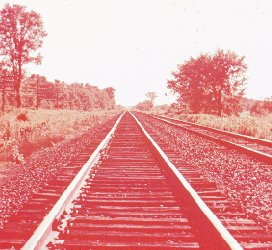


Linear perspective is a depth cue that isrelated to both relative size and the next depth cue, texture gradient. In linear perspective parallel lines that recede into the distance appear to get closer together or converge.
2. Interposition - the partial blocking of a more distant object by a nearer object

Check the small figure with the word interposition on it. There are two rectangles with the farther rectangle, lower and to the right, partially obscured by the nearer one, right? Well, actually both rectangles are at the same distance (the distance of the screen from your eyes). It is the interposition, overlap, that causes the sense of depth to arise. Usually the impression of depth caused by interposition alone is not very strong.
More examples:



Above painting - Madonna of the Magnificant
is by Sandro Botticelli.
Notice the foreground figures, which are all that are important for our present purposes. Here relative size and even relative height play little role in giving the depth order of the various figures (all the figures are roughly the same level and same size). Shadowing plays an important role in giving each of the figures their sense of three-dimensionality, but to tell who is in what position relative to another, the principle cue is interposition.
3. Relative size - object's smaller size on your retina when it is farther away from you

The more distant an object, say a person, is the smaller the image of that object will be on your retina, the back of the eye where we really begin to "see". This effect on object size as distance increases is illustrated in the figure above. The arrows are the same size. The black lines to each arrow indicate the size of the object at the eye. Notice how much larger the angle formed by the black lines to the closer arrow is (there are gray regions on each side of the angle formed by the black lines to the more distant arrow). This reducing in size at the eye is part of the reason that people look like ants as you fly in an airplane and stars appear as dots even though they are enormous.
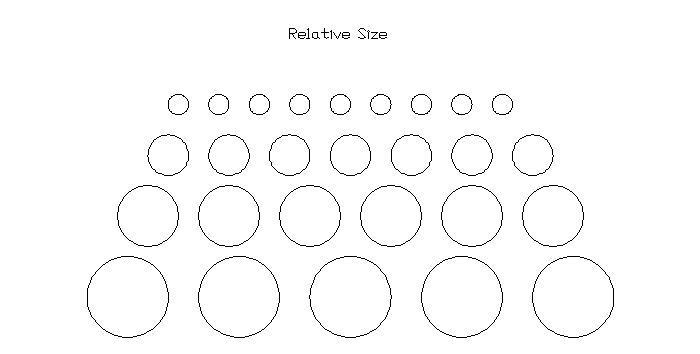
Objects are drawn smaller as they move further away from the viewer.
...& one more...

4. Height in the field - also called relative height - the usual assumption is that where the base of a shape is higher than that of a similar shape, then the one with the higher base is further away. This cue relates objects to the horizon.

Look at the picture above. It starts with six object at the same level of the illustration and they look at the same distance. Then the move; three go above the horizon line and three below the horizon line. At the end the two star-like objects are nearest to the horizon line and look the farthest away. The two circles are farthest from the horizon line and appear nearest.
The relative height of an image is another cue if one object is lower than another it appears to be nearer the observer.
An object close to the viewer will be at the bottom of the drawing, an object off in the distance will be near the middle of the drawing, and objects will be ever higher as they are more distant. This cue can lead to a powerful sense of depth.
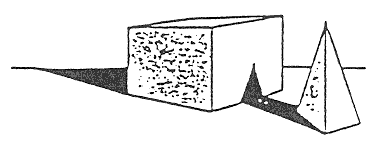
5. Shading and shadow - the impression of convexity or concavity based on the fact that most illumination is from above

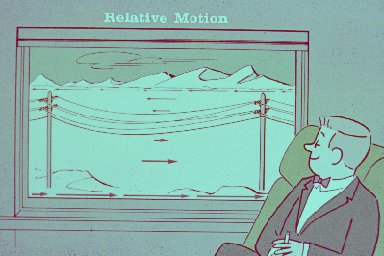
6. Motion parallax - a function of the rate at which the image of an object moves across the retina
Distant objects will appear slow in comparison with close objects even when the two are moving at the same speed. Motion parallax can also be caused by the movement of the viewer's head. Objects closest to the observer will appear to move faster than those further away. This is an important cue to those who only have the use of one eye.

7. Binocular disparity - difference between the images of the same object projected onto each retina
Binocular parallax is the difference between the images of the same object projected onto each retina. The degree of disparity between the two images depends on the parallactic (convergence) angle. This is the angle formed by the optical axes of each eye converging on an object. The parallactic angle is related to the distance of an object from the eyes. At great distances the parallactic angle decreases and depth perception becomes increasingly difficult. The smallest parallactic angle the average person is able to discern, is three arc seconds.

8. Accomodation and Convergence - are associated with the eye muscles, and interact with each other in depth perception. Accommodation is considered a monocular depth cue since it is available even when we see with a single eye. This cue is effective only when combined with other binocular cues, and for a viewing distance of less than two metres (Okoshi, 1976). Accommodation and convergence are considered to be minor cues in depth
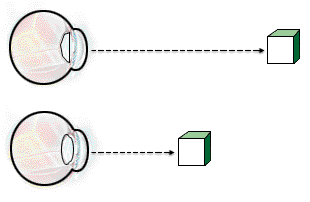


P.S. First picture is that of accomodation and the third one shows convergence.
There are a couple more cues which we did not discuss in class, but maybe if you at least put their names on the test you might get several extra points (maybe).
9. Aerial perspective - the haziness of distant objects

&
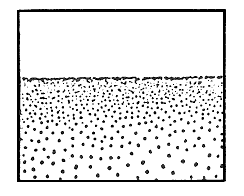
10. Texture gradient - a kind of linear perspective describing levels of roughness of a uniform material as it recedes into the distance

Some more - just for your interests...
VISUAL DEPTH PERCEPTION:
- locating objects in space relative to our bodies
- depth formation = binocular & monocular
Binocular depth cues --- both eyes
- binocular disparity (greater disparity = close)
- convergence (converging eyes = approaching)
Monocular depth cues -- single eye
- kinetic cues
- looming (expanding = approaching)
- motion parallax (fast = close) = opposition direction of movement
- static cues
- linear perspective (wide = close)
- texture gradient (large = close)
- interposition (unblocked object = close)
- shading (light on top = convex shape)
- hight in plane
- no horizon (high = far)
- with horizon (closer to horizon = far)
- aerial perspective (clear = near)
O.K., gOOd luck u guys!!!

