

KURTULUS KARAMUSTAFA's HOME PAGE
Cappadocia
Nevsehir, a provincial capital, is the gateway to Cappadocia. In the town itself the hilltop Seljuk castle, perched on the highest point in the city, and the Kursunlu Mosque, built for the Grand Vizier Damat Ibrahim Pasha, are among the remaining historical buildings. The mosque forms part of a complex of buildings which includes a medrese, a hospice and a library. An ablution fountain in the courtyard still bears its original inscription. The Nevsehir Museum displays local artifacts.Violent eruptions of the volcanoes Mt. Erciyes(3916 meters) and Mt. Hasan (3268 meters) three million years ago, covered the plateau surrounding Nevsehir with tufa, a soft stone comprised of lava, ash and mud. The wind and rain have eroded this brittle rock and created a spectacular surrealist landscape of rock cones, capped pinnacles and fretted ravines, in colors that range from warm reds and golds to cool greens and greys. Goreme, known in Roman times as Cappadocia, is one of those rare regions in the world where the works of man blend unobtrusively into the natural surroundings. Dwellings have been hewn from the rock as far back as 4,000 B.C. During times, chapels and monasteries were hollowed out of the rock, their ochre-toned frescoes reflecting the hues of the surrounding landscape. Even today troglodyte dwellings in rock cones and village houses of volcanic tufa merge harmoniously into the landscape.
Urgup, a lively tourist center
at the foot of a rock riddled with old dwellings, serves as an
excellent base from which to tour the sights of Cappadocia. In
Urgup itself you can still see how people once lived in homes
cut into the rocks. If you wish to buy carpets and kilims, there
is a wide selection available from the town's many carpet dealers.
These characters are as colorful as their carpets, offering tea,
coffee or a glass of wine to their customers and engaging in friendly
conversation. If sightseeing and shopping haven't exhausted you,
 the disco welcomes you to another kind of entertainment. At the
center of a successful wine- producing region, Urgup hosts an
annual International Wine Festival in October.
the disco welcomes you to another kind of entertainment. At the
center of a successful wine- producing region, Urgup hosts an
annual International Wine Festival in October.
Leaving Urgup and heading to the south, you reach the lovely isolated Pancarlik Valley where you can stop to see the 12th-century church with its splendid frescoes, and the Kepez church, which dates from the tenth century. Continuing on to the typical village of Mustafapasa (Sinasos), the traditional stone houses with carved and decorated facades evoke another age. Still travelling in a southerly direction, just past the village of Cemil, a footpath on the west side of the road leads to Keslik Valley where you will find a monastery complex and the Kara Kilise and Meyvali churches, both of which are decorated with frescoes. Back on the main road you come to the village of Taskinpasa where the 14th-century Karamanid Mosque and Mausoleum Complex, and the remains of a medrese portal on the edge of town, make for a pleasant diversion. The next village is Sahinefendi where the 12th-century Kirksehitler church, adorned with beautiful frescoes, stands at the end of a footpath 500 meters east of the village.
Soganli, 50 km south of Urgup, is a picturesque valley of innumerable chapels, churches, halls, houses and tombs. The frescoes, from the 8th to the 13th century, trace the development of Byzantine painting.
Four kilometers north of Urgup is the wonderful Devrent Valley, where the weather has eroded the stone into peaks, cones and obelisks called fairy chimneys.
 Two kilometers to the west, in the Catalkaya Valley, the fairy
chimneys have a peculiar mushroom-like shape, which has been adopted
as a symbol of the town.
Two kilometers to the west, in the Catalkaya Valley, the fairy
chimneys have a peculiar mushroom-like shape, which has been adopted
as a symbol of the town.
The Goreme Open-Air Museum, a monastic complex of rock churches and chapels covered with frescoes, is one of the best-known sites in central Turkey. Most of the chapels date from the 10th to the 13th century, the Byzantine and Seljuk periods, and many of them are built on an inscribed cross plan with a central cupola supported by four columns. In the narthexes of several churches are rock cut tombs. Among the most famous of the Goreme churches are the Elmali Church, the smallest and newest of the group; the Yilanli Church with fascinating frescoes of the damned in serpent coils; the Barbara Churches; and the Carikli Church. A short way from the main group, the Tokali Kilise, or Buckle Church, has beautiful frescoes depicting scenes from the New Testament.
The town of Goreme is set right in the middle of a valley of cones and fairy chimneys. Some of the cafes, restaurants and guest-houses are carved into the rock. For shoppers, rugs and kilims are plentiful.
Continuing on the road out of Goreme, you enter one of the most beautiful valleys in the area. Rock formations seemingly out of a fantasy rise up before you at every turn and entice you to look longer and wonder at their creation. For those who climb the steps to the top of the Uchisar Fortress the whole region unfolds below. Rugs and kilims, and popular souvenirs can easily be purchased from the shops which line Uchisar 's narrow streets.
At Cavusin, on the road leading north out of Goreme, you will find a triple apse church and the monastery of St. John the Baptist. In the town are chapels and churches, and some of the rock houses are still inhabited. From Cavusin to Zelve, fairy chimneys line the road. Unfortunately, it is dangerous to visit the churches in the Zelve valley because erosion has undermined solid footing.
The charming town of Avanos, on the banks of the Kizilirmak River, displays attractive vernacular architecture and is known for its handicrafts. Every August the town hosts an Art and Tourism Festival where a creative and friendly atmosphere pervades. Pottery is the most popular handicraft and it is usually possible to try your hand at making a pot in one of the many studios. Rug weaving and knotting is also making a revival. Leaving Avanos in a southerly direction you come to an interesting Seljuk caravanserai.
On the Nevsehir - Urgup road you can't miss Ortahisar and its
rock-carved fortress. The churches in the Balkan Valley are some
of the oldest in the Goreme region. In the neighboring Hallac
Valley, the Hallac Monastery displays decorations from the 10th
and the 11th centuries. North of Ortahisar, the Kizilcukur Valley
is breathtakingly beautiful, especially at sunset. In the valley
is the 9th-century Uzumlu church.
The underground cities of Kaymakli,Mazi, Derinkuyu and Ozkonak were all used by the Christians of the seventh century, who were fleeing from persecution. They sheltered from the iconoclastic strife of Byzantium as well as other invasions in these safe and well-hidden metropolises. A complete and selfsufficient environment, these cities included rooms for grain storage, stables, sleeping chambers, kitchens and air shafts. Today--they are well-lit, and an essential and fascinating part of a Cappadocian tour.
West of Avanos, Gulsehir has Hittite rock inscriptions, and nearby, at Gokcetepe, there is a basrelief of Zeus. South on the Nevsehir road brings you to the 13th-century church of St. John, and farther along is Aciksaray, where the carved rocks hold churches and chapels.
West of Cappadocia, over the mountains, lies Kayseri, known as Caesarea in Roman times. The city spreads out at the foot of the extinct volcano Mt. Erciyes (3916 meters). In the winter months the ski center has excellent runs for downhill skiiers, and several pleasant hotels cater particularly to the skiers. Close to the Byzantine fortress, the 13th- century Huant Hatun Mosque and Medrese, with the Mahperi Hatun Mausoleum, comprise the first Seljuk complex, the Huant Hatun Complex, in Anatolia. The Medrese is now an Ethnographical Museum. South of the complex, stands the beautifully decorated Doner Kumbet of 1276, a Seljuk mausoleum of classic simplicity. A major Seljuk city, Kayseri was an important center of learning and consequently, there are many medreses among the remaining historical buildings. Those interested in the Seljuk architectural form should see the Cifte (Giyasiye and Sifahiye) Medrese, the first Seljuk school of anatomy, and one of which today is the Gevher Nesibe Medical History Museum. And nearby is the lovely Sahabiye Medrese. Near the city's bedestan is the restored-12th century Ulu Mosque. The Had Kilic Mosque, north of the Cifte Medrese, dates from 1249.
South of Kayseri, in Develi, stand three more important Seljuk buildings: the Ulu Mosque, the Seyid-i Serif Tomb and the Develi Tomb. Nearby, the Sultan Marshes, the habitat of many species of bird, are of interest both to ornithologists and nature lovers.
North of Kayseri, Kultepe, known in ancient times as Kanesh or Karum was one of the earliest Hittite commercial cities. Dating from 2000 B.C., Kultepe was also one of the world's first cities of free trade. Today, however, only the foundations remain. Many of the finds can be examined in the Kayseri Archaeological Museum.
On the same road is Sultanhan, a caravanserai built by the Seljuk Sultan Alaeddin Keykubat in the early 13th century and a favorite stop for tourists.
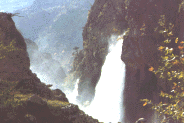 Kapuzbasi Waterfall is 76
km south from Kayseri. In this beautiful natural site, seven different
springs on the mountain-face fall from heights ranging between
30 and 70 metres.
Kapuzbasi Waterfall is 76
km south from Kayseri. In this beautiful natural site, seven different
springs on the mountain-face fall from heights ranging between
30 and 70 metres.
Kayseri is one of the most important carpet and kilim production centres in Anatolia. Bunyan is the most famous carpet-production centre and Yahyali is the most famous kilim-production centre. Rugs woven in finely knotted floral patterns continue a centuries-old tradition. Local production can be purchased in any of the Kayseri carpet shops.
Nigde, the Nahita of Hittite times, lies in a valley flanked by volcanic peaks and commands the ancient trade route from Anatolia to the Mediterranean. Nigde's castle owes its present form to the Seljuks, and the elegant Alaeddin Mosque dates from the same period. From the 14th century era of Mongol rule are the Sungur Bey Mosque and the Hudavend Hatun Mausoleum, an excellent example of the Anatolian tower tomb. The 15th century Ak Medrese now houses the Archaeological Museum.
Ten kilometers out of town is Eskigumus, a Byzantine monastery and church with massive columns and frescoes. These frescoes, which date from the 10th and the 11th centuries, are among the best preserved in the region.
Bor, south of Nigde, was once a Hittite settlement. The town's historical buildings include the Seljuk Alaeddin Mosque and the Ottoman bedestan. Farther on, in the same direction, Kemerhisar is the site of the important Roman city of Tyana. A few more kilometers brings you to some Hittite ruins and a Roman aqueduct.
Most of the historical buildings in Aksaray, west of Nigde and south of Cappadocia, such as the Ulu Mosque, date from the 14th century. The Kizil Minaret is noted for its attractive decorative brickwork. Two of the most famous caravanserais from the Seljuk period remain in the environs. Just 40 km west of the city is the well preserved Sultanhan Caravanserai built by the Seljuk Sultan Alaeddin Keykubat, and 15 km towards Nevsehir is the Agzikarahan Caravansarai.
The Melendiz River, at Ihlara Valley, has eroded the banks into an impressive canyon. Byzantine rock chapels covered with frescoes pierce the canyon walls. Some of the best known are the Agacalti (Daniel ) Church, the Yilanli (Apocalypse) Church and the Sumbullu (Hyacinth) Church.
Guzelyurt is another valley with dwellings dating from prehistoric times. You can see the beautiful silhouette of Mt. Hasan rising like a crown above the town. The valley's underground cities, buildings carved into the rock, interesting vernacular architecture, churches, chapels and mosques embody all of the characteristics of Cappadocia and give visitors a sense of historical continuity. A popular tourist destination, Guzelyurt's hospitable residents, extensive accommodation and restaurants ensure a pleasant stay. The resting-area of Evren by the Hirfanli Lake offers fish restaurants, beach and swimming.
All rights reserved. Kurtulus Karamustafa, June 1998.

