
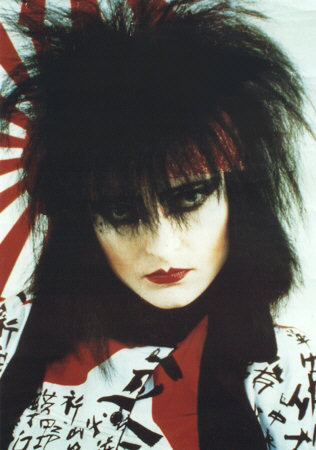
SIOUXSIE & THE BANSHEES
Siouxsie & the Banshees were among the longest-lived and most
successful acts to emerge from the London punk community; over
the course of a career which lasted two decades, they evolved
from an abrasive, primitive art-punk band into a stylish, sophisticated
unit which even notched a left-field Top 40 hit.
Throughout their numerous line-up changes and textural shifts,
the group remained under the leadership of vocalist Siouxsie Sioux,
born Susan Dallion on May 27, 1958. She and the Banshees' initial
line-up emerged from the Bromley Contingent, a notorious group
of rabid Sex Pistols fans; inspired by the growing punk movement,
Dallion adopted the name Siouxsie and formed the Banshees in September,
1976. In addition to bassist Steve Severin and guitarist Marco
Perroni, the band included drummer John Simon Ritchie, who assumed
the name Sid Vicious; they debuted later that year at the legendary
Punk Festival held at London's 100 Club, where their entire set
consisted of a savage, 20-minute rendition of "The Lord's
Prayer."
Soon after, Vicious joined the Sex Pistols, while Perroni went
on to join Adam and the Ants. The core duo of Sioux and Severin,
along with new guitarist John McKay and drummer Kenny Morris,
reached the UK Top Ten with their 1978 debut single, "Hong
Kong Garden; " their grim, dissonant first LP, The Scream,
followed later in the year. Two days into a tour for their 1979
follow-up Join Hands, both McKay and Morris abruptly departed,
and guitarist Robert Smith of the Cure (the tour's opening act)
and ex-Slits and Big in Japan drummer Budgie were enlisted to
fill the void; although Smith returned to the Cure soon after,
Budgie became a permanent member of the group, and remained with
the Banshees' throughout the duration of their career.
With ex-Magazine guitarist John McGeoch on board, the band returned
to the studio for 1980's Kaleidoscope, a more subtle and melodic
effort than their prior records; on the strength of the U.K. Top
20 smash "Happy House," the album reached the Top Five.
A year later, the Banshees released the psychedelic Juju, along
with Once Upon a Time, a collection of singles; at the same time,
Sioux and Budgie formed the Creatures, an ongoing side project.
Following 1982's experimental A Kiss in the Dreamhouse, McGeoch
fell ill, and Smith temporarily rejoined for the group's planned
tour; a pair of 1983 performances at London's Royal Albert Hall
were recorded and later issued as Nocturne. Also in 1983, Severin
and Smith teamed as the one-off project the Glove for the LP Blue
Sunshine.
After his recovery, McGeoch opted not to return, so the Banshees
recruited former Clock DVA guitarist John Carruthers after Smith
exited following the sessions for 1984's dark, atmospheric Hyaena.
With 1986's Tinderbox, Siouxsie and the Banshees finally reached
the U.S. Top 100 album charts, largely on the strength of the
excellent single "Cities in Dust." After 1987's all-covers
collection Through the Looking Glass, Carruthers took his leave,
and was replaced by ex-Specimen guitarist Jon Klein and keyboardist
Martin McCarrick for 1988's Peep Show, a techno-inspired outing
which gave the group their first U.S. chart single with "Peek-a-Boo."
In 1991 -- the year in which Sioux and Budgie married -- the Banshees
performed on the inaugural Lollapalooza tour; their concurrent
LP, Superstition was their most commercially successful, spawning
their lone U.S. Top 40 hit with "Kiss Them for Me."
Another singles collection, Twice Upon a Time, followed in 1992
before the group returned after a long absence with 1995's stylish
The Rapture, produced in part by John Cale. A year later, the
nostalgia surrounding the reunion of their former heroes the Sex
Pistols prompted Siouxsie & the Banshees to finally call it
quits; Siouxsie and Budgie turned to the Creatures as their primary
project, while Severin composed the score for the controversial
film Visions of Ecstasy.
