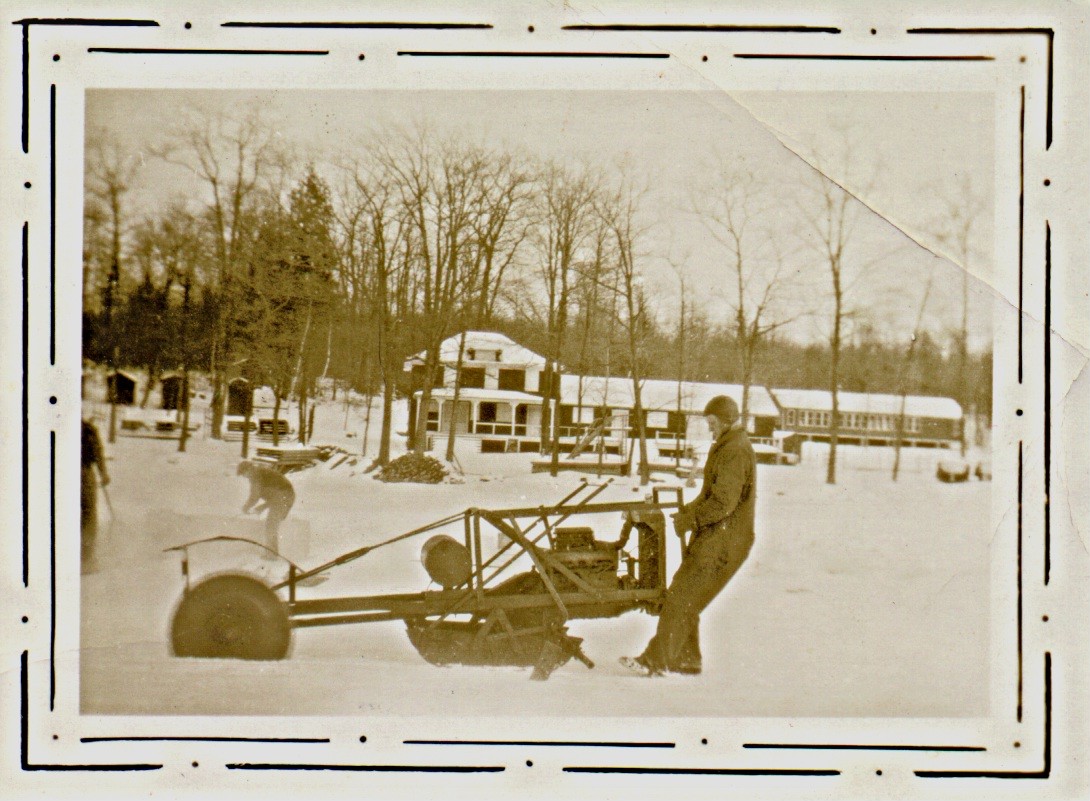
Frank Brundage was in charge of maintenance at Wonposet from 1929 to 1949.
He lived in the log cabin at the entrance to the camp on East Shore Road. As campers and counsellors we frequently took trips to his cabin to hear him tell first hand the early history of the camp. We sat in front of the hearth in which he had embedded a stone he had taken from the Rock of Gibralter. On the mantle was a small sign which read: Friendship like gold requires the acid test of adversity to determine its value. Alongside that sign were Mr. Brundage's two priceless artifacts which he had dug up on the north side of the camp. One was a huge tomahawk. The other was a primitive stone tool, shaped like a dumbell. He said the ancient Indians tied it to a string of deerskin and used it like a boomerang to catch the leg of a deer.
On August 12, 1978, an interview with Mr. Brundage appeared in the Smoke Signal. The credits for the interview go to Edward "Veal" Cutler, Alberto de la Cruz, and Robert Turitz. The text of that interview follows.
I was born in the big stone house on Route 202 between Litchfield and Bantam. My brother lives there now. My father dug the reservoir on the way up to the A-field. He had three or four teams of horses. They'd go down into a big hole in the ground and come up with scoops of dirt. We used to pump lake water up into that building and it would come down by gravity. It took care of the toilets and wash houses. The drinking water was up by the front cottage. The artesian well is still there, and today it supplies the whole camp. One of my engineering feats was a small pump on the porch of the front cottage which would supply water for the fountains and kitchen. A couple men would dig the sand along the lake right over to the dock and up to the kitchen and lay a temporary line of half inch pipe each year.
When I first came home after the first world war, I took over my father's ice and trucking business. We did all the trucking for the camp. There was no road here. Mr. Tindale owned a small piece of property in Keeler's Cove, and everything that came into camp went across the lake by motor boat. They used to have a train coming up from New York to Bantam. Th boys came up in private cars, and we brought them over in big "salt water boats." At most we had seventy-five campers.
In 1929 was my first connection with the camp. My job was general maintenance, but I was also an auctioneer and sales manager at the same time, so I put in sometimes 20 or 24 hours per day and got no sleep. I lived in the front cottage. The boys slept in tents. In 1929 the dining hall was full of lumber. We put in new platforms for the tents where your cabins are. And boy, what a job that was! We put them all up before camp opened, and everything had to be done before the counsellors arrived. And when you'd get a big storm if the flies weren't tied down tight, you could see them rip in half and go up in the woods.
The first cabin built was Mr. Tindale's--second one in from the kitchen in the back row on the noth side. The cabins were well built, as you know. The first one cost $500 to build in 1935. Can you imagine that! You built one this year, and it cost many thousands of dollars. That shows the differences in the times. Five hundred dollars in those days could buy a lot. In 1936 I bought a new Hudson Terraplane four door sedan for $775.
I told you I was in the ice and trucking business. In the winter we cut ice and stored it in the ice house that still stands on the north side. In 1927 I moved your war canoes from Bantam and drove them in a truck straight across the ice. You can't do that now; it's against the law.
In those days we had our own baker, an old German named Busch. He was an artist and got up at four o'clock in the morning to bake the day's bread. The food was the best, and from what I hear, it still is. I used to take the secretary and the steward in charge of the kitchen to the five o'clock market in Waterbury to buy fresh vegetables. And we had raw milk right off the farm.
You still have some old wooden canoes in the ice house that I brought up from New York State the year we lost the recreation hall. The original building was a portable school house moved here from Hartford. When I say portable, I mean you could put your hand on the side and move it. I put in steel rods and so forth, but one day we had a terrific snowstorm, and it was a sticker: the snow didn't flow but stayed and piled up on top of the rec hall. I heard a crash and put on my snow shoes to see what had happened. The rec hall was flat as a pancake, and that is where we stored the canoes. We lost them all. That year we bought twelve Grumann canoes, which were the first made by the Grumann people. They were all made by hand. You have a dozen cedar rowboats, six ten-foot long and six twelve-foot long. I bought them in West Haven in 1940, and when they were new and varnished, they were the most beautiful boats on the lake. The ten footers cost $25 a piece, and the twelve footers $35.
I don't know much about the indians who used to fish and hunt here, but in 1932 I found a tomahawk in front of Cabin One, and one year I found a stone tool and some arrowheads. We used to have campfires in the council ring by the lake, and three or four real Indian Chiefs came over with all their regalia to do Indian war dancing.
I went fishing a lot with Mr. Tindale, the camp's founder. Of course what you have now is the greatest trouble, what I call stunted fish, the white and yellow perch; they never get to any great size.
We used to camp out at Mt. Tom and Copper Mountain, where Washington had his headquarters. We set up a big tent in case it rained, and the boys would sleep out. I slept in the bus. We had a 1928 Reo bus and a couple of Model T's. The boys would always build a fire to see if they could be seen from camp.
Mr. Anderson was in the other day and said, "Why don't you go down and see the camp," and I said, "I do once a year, when you go to Quassapaug there's not much traffic. We park and see the lake front." I think of the camp a lot. In a way I still think I am a camper.