Like Sydney, Adelaide's migrant settlement areas were hotbeds of amateur beat music passions in the early 60's. The areas of Elizabeth and Port Noarlunga, with their heavy British populations, spawned hundreds of ambitious young groups, eager to follow the Mersey lead (which many of the players had witnessed personally).
THE TWILIGHTS were the first Adelaide group to break nationally, late in 1965. THE MASTERS APPRENTICES flew the South Australian flag in 1967 and by late 1968 ZOOT made their presence felt in the eastern states.
As with virtually all successful Australian groups of the 60's, ZOOT was formed, in the main, by British and European settlers. John D'Arcy (English) and Gerard Bertelkamp (Dutch) were school pals, who would get together after school to rehearse harmonies by bands like THE HOLLIES, THE WHO and THE MOVE. John D'Arcy was a recent arrival from Manchester who worshipped hometown heroes, THE HOLLIES.
Together with drummer, Ted Higgins, they formed their first band which they named TIMES UNLIMITED in 1966. The band only played one gig at a scout hall when the bass player decided to leave. John told Gerard (by then nicknamed B.B.) that he would have to learn to play bass guitar and sing at the same time. They hand made B.B.'s bass guitar and proceeded to practise. Around this time they recruited Darryl Cotton as their lead singer and changed their name to DOWN THE LINE after a HOLLIES song. Whenever they could they would catch THE TWILIGHTS every Friday night at the Caledonian Hall on King William Street. Each Sunday morning the group would tape the ABC radio replay of British TV's "Top Of The Pops" and then knock out passable stage versions of unreleased hits by THE MOVE, SMALL FACES and THE HOLLIES. "We were the mod band in Adelaide" recalls Darryl, "we played the mod dance at Scot's Church every Friday night."
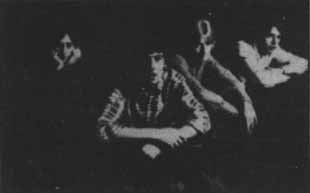
Throughout 1967 TIMES UNLIMITED became a hot live draw in Adelaide, occasionally providing backing for a young English singer who had just split from THE MAVERICKS - Johnny Farnham. When Farnham was discovered by accountant Darryl Sambell and signed to EMI in September '67, the group were called upon to back the singer on In My Room, the flip side of Sadie, The Cleaning Lady.
Before this recording debut, the group had undergone a name change. As Cotton recalls, "a couple of young dance promotors came to see us one day about some bookings and said 'you guys are a great band but you've got a lousy name - why don't you change it to "ZOOT" ? Years later I found out that one of the guys was Doc Neeson." Bass player B.B. had also, by this point, effected a name change - to Beeb Birtles.
In mid '68, hot young EMI producer David McKay was on the road with THE TWILIGHTS. When the tour hit Adelaide, he was highly impressed by one of the support acts and summarily offered them a recording deal. Recalls Cotton, "we only had homemade guitars and amps and hardly any money to go to Melbourne to make our first single. So THE TWILIGHTS loaned us their incredible Marshall amps and paid our train fares across"
In Melbourne they recorded You'd Better Get Going Now / Three Jolly Little Dwarfs, then returned to Adelaide to await release. By this point John D'Arcy had departed. John later to appear in ALISON GROS with Graham Goble. Steve Stone replaced him.
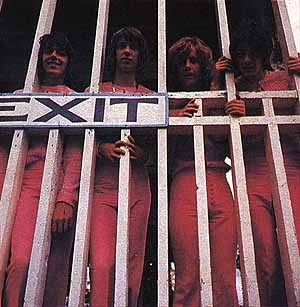
In late August they were instructed to venture forth to Melbourne once more. "McKay was pleased with the record" says Cotton, "but he insisted we needed management. The next day a fellow called Wayne de Gruchy knocked on our door". Wayne was the manager of Berties Disco and, together with creatively-inclined owner, Tony Knight, he came up with a masterstroke of promotion -"Think Pink- Think ZOOT". The concept was launched at a
now-legendary media party at Berties on September 3. Knight decked out the joint in total pink, adding such embellishments as pink champagne, pink carnations and the suchlike. Though it didn't do a great deal for the debut single, the night was a roaring success from a promotional stance.
A second single was knocked out in quick time - this time produced (and written) by the creative hub of the splintering TWILIGHTS, Terry Britten. 1 x 2 x 3 x 4, released in December '68 became a moderate Melbourne hit (32) firmly establishing ZOOT as a light bubble-pop outfit. "We'd never really decided to go in that direction" offers Cotton, "but we played the style of the top 40 and when it changed, we changed. By 1969 the charts were full of Amercian bubblegum".
When it became apparent that global superstardom was not on immediate offer, Higgins and Stone split back to Adelaide. Determined to continue, Cotton and Birtles recruited Roger Hicks - a classically-trained Toorak guitarist, and Rick Brewer - an experienced Adelaide drummer (living in Melbourne) and schoolfriend of the pair, who had already recorded for EMI as a member of THE THIRD PARTY.
A significant national breakthrough came early in 1969 at a giant outdoor concert at Melbourne's Vellodrome track, staged and televised by the 0-10 network's 4 hour pop forum - Uptight. Bottom billed to such acts as THE TWILIGHTS, IGUANA, COMPULSION, WILD CHERRIES and THE CHELSEA SET, ZOOT stole the show
outright - courtesy of a core of hysterical girls, assembled by fan club president Jan Gilbert. The unexpected audience frenzy greatly impressed the TV execs and the group soon became regulars on "Uptight".
With insidious logic, de Gruchy barred his charges from appearing in any public place in the company of a female. Accordingly, Darryl's girlfriend was beset with the ignominous task of climbing over his back fence whenever she wanted to visit.
Though it may not have been apparent at the time, ZOOT kicked off the second 'pop wave' of the sixties (EASYBEATS/TWILIGHTS in '65 being the first) and by the middle of 1969 THE VALENTINES, THE (re- organized) MASTERS APPRENTICES, RUSSELL MORRIS and THE NEW DREAM were scoring hits and causing riots.
Single three, in June '69, backed a leftover Britten production Little Roland Lost (a solitary Birtles/Cotton composition) with an A side produced by Ian Meldrum. Monty & Me - an ode to a pink-dyed Afghan hound (joining car, apparel etc.) - came from the pens of Hans Poulsen and SEEKER, Bruce Woodley (who also wrote with Paul Simon). It fared a little better than its predecessor, peaking at only 33 in Melbourne, but 1 in Brisbane.
A month later they took to the road on their first tour; slogging through the wilds of Queensland alongside RONNIE BURNS, JON BLANCHFIELD and THE SECT, with teenybop frenzy in abundant supply throughout. Two months later, in September, they joined RUSSELL MORRIS, JOHNNY FARNHAM, JOHNNY YOUNG, RONNIE BURNS, THE VALENTINES, MASTERS APPRENTICES and DOUG PARKINSON IN FOCUS on Operation Starlift - a monstrous (and financially disastrous) capital city tour by the absolute upper echelon of Australian rockdom. In December they visited Tasmania with RUSSELL MORRIS and an amazing 1969 (despite the loss of the playoff final of Hoadley's National Battle of The Sounds to THE NOVA EXPRESS in August) came to and end.
Back in Melbourne, the group - now being managed by Darryl Sambell and Jeff Joseph - were without the services of, always out of place, Roger Hicks, who had finally reacted against the escalating "pretty pink pansies" ridicule by defecting to THE BRISBANE AVENGERS. THE AVENGERS took on Hicks after losing their first choice - Ricky Springfield.
Sprngfield was an exceptional-looking guitarist/songwriter of considerable talent. He had toured Vietnam bases with a reformation of MPD LTD. and was playing in Pete Watson's WICKEDY WAK when a JOHNNY YOUNG composed (Meldrum produced) single Billie's Bikey Boys thrust him to general attention. Both THE AVENGERS and THE VALENTINES were vying for his services and they were soon joined by ZOOT, who had spotted him on their northern tour (Beeb sang harmonies on the WW single). In the young, popular and obviously pliable ZOOT, Springfield saw the best potential for his own future, and so joined later in 1969.
At this point, new EMI house producer Howard Gable was assigned to ZOOT - a relationship commenced under a cloud of dispute. For it was in the Go-Set's "new releases" column that the group first became aware of their fourth single - a Brian Cadd/Don Mudie song called It's About Time. It had been recorded as one of a batch of demos for a possible new single and the group were fully expecting to re-record it (or whatever else they may have been finally chosen) for commercial release. They yelled and howled from one end of this vast continent to the other - virtually ensuring the surprise single's chart failure.
This sudden interest in musical values was, of course, a direct result of Springfield's presence. Though he initially clambered into the pink garb, his disdain of the sub-teen image orientation was obvious and in early 1970 the group ceremoniously burned all things pink before the cameras of "Happening 70". And not before time. The snide sniggerings from media and peers was being supplemented by other, more worrying incidents. In December '69 the group had been beaten up in Brisbane by a gang of louts, leaving Darryl with a (well publicized) mild concussion. By 1970, rock in Australia had become drastically polarised. Serious 'heavy' groups such as CHAIN, SPECTRUM and THE AZTECS were beginning to draw huge live followings of older, aggressive fans and any acts unwilling or unable to deliver long (often tedious) instrumental jams were dismissed with ultimate insult of the
era - "commercial".
With Springfield at the creative helm, ZOOT set to work on their first album - "JUST ZOOT", early in 1970. It emerged as a highly admirable efford - with powerful inventive originals (the likes of Mr. Songwriter) and two more superb Britten compositions. (ZOOT OUT in 1971, was just a hits collection).
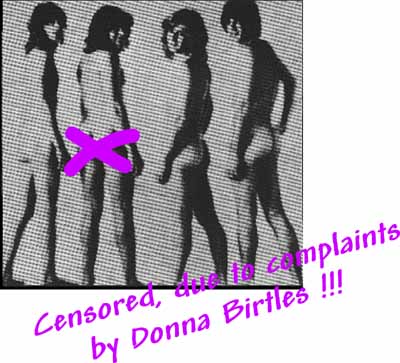
But the most aparent manifestation of the new impetus came in June with the (approved) release of a fifth single - Hey Pinky. This unsubtle lampoon of their just-discarded image was heralded by a Go-Set ad sporting a rather startling beefcake shot of the group. Whether their naked rumps gave them a new credibility in the serious music market or whether it merely gave little girls naughty dreams, remains an inflamed point of contention (though one should not lose a great deal of sleep over it).
In the same month, on the 20th to be precise, the "new" ZOOT turned the nationally televised Go-Set Pop Poll on its ear. With backs to the audience they hurtled into a thunderous, extended workout of THE BEATLES' Eleanor Rigby and quite literally brought the house down. In the poll itself they performed rather dismally, coming in fifth (behind MASTERS, AXIOM, NEW DREAM, TOWN CRIERS) after an outright win in 1969. Two months later they narrowly lost Hoadley's National Battle of the Sounds to THE FLYING CIRCUS.
The maudlin BEATLES song was just one of a series of contemporary classics worked over by
ZOOT - others including Hello, Goodbye, Woodstock and Hurdy Gurdy Man. However the strong reaction from the pop poll performance had Gable insisting on Eleanor Rigby as the next single and in December 1970, it was.
The response was immediate - radio went with it on the day of release and by the first week of the new year it was on its way to the top three and a 21 week chart run. Cruelly, sales stopped just short of gold single status - a feat eventually achieved in 1979 after a re- release urged by Birtles and Cotton.
In the wake on this sudden success the band's pendulum swung a great deal further left of centre than it should have. They became heavier, louder and more complicated - determinded to slap their critics in the face by being adopted by the "head" audience. Brewer was the worst offender, becoming obsessed by experimental British rock and attempting to implement his adventurous tastes into what was, after all, a simple pop-rock band. "We really began to fire as a band then" recalls Cotton, "but it was a bit too late - we just couldn't escape our image. The pink thing haunted us."
A follow-up single, The Freak / Evil Child, fared fairly dismally (27 in Melbourne only) and by early 1971 irrevocable disillusionment had set it. Beeb was being threatened with National Service, Rick Brewer wanted to expand musically and Rick Springfield was under considerable pressure to pursue a solo career.
The camel's back was broken in May when RCA America - furiosly excited with Eleanor Rigby - were thwarted in their attempts to secure ZOOT for a US deal, by idiotic Australian bureaucracy.
Having split almost out of spite, Darryl and Beeb hitched themselves to a suit manufacturer and became a duo called FRIEZE, while Rick Springfield signed to Robbie Porter's Sparmac label and became a prominent teen idol in America. Darryl also found his way to America, where he recorded for MGM as a member of FRIENDS and for 20th Century Fox as one third of the moderately successful COTTON, LLOYD & CHRISTIAN.
Beeb turned up in harmony group MISSISSIPPI in the second half of the 70's participating in the metamorphosis to Little River Band. A short time later Rick Brewer made a long- overdue reappearance in THE FERRETS - playing on their national number 1 hit Don't Fall In Love, in 1977.
As this is being written, Darryl Cotton is back in Australia, scorching up the top five with a massive hit - Same Old Girl, Rick Springfield is popping up as an actor in American TV cop shows and Beeb Birtles has enjoyed his 5th consecutive top 5 US single with Little River Band (and just issued a gospel album with Graham Goble). Rick Brewer is maintaining a low profile.
It is the subsequent activities which testify best to the exceptional level of talent which lurked beneath the surface of a band whose lifespan was marked with sad neglect and ignorant derision. Hear for yourself ...
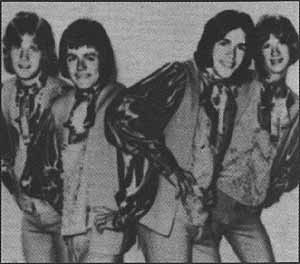
Glenn A. Baker
Aust. editor - Billboard June 1980
revised by Beeb Birtles for this homepage (4/1998)