JG Enterprises, Inc.
Space Exploration
JG's range is not limited to Earth and the Space-Time Continuum. We've taken a giant leap off this small ball of rock and water to the great unknown: OUTER SPACE!
Using secret rocket technologies stolen from the United States government, we've, uh... I mean that we've actually, ahem, borrowed the technology. Yeah. That's exactly what I mean. You never heard anything otherwise, okay?
Please sign the nondisclosure agreement included below.
In the Beginning.
JG's first spacecraft was a surveillance satellite. The Peacemaker 1 was armed with twenty 700-megaton warheads and a complex spy telescope designed to remained focused on Camp MacAfee in Toledo, Ohio. In case of emergencies, the satellite could launch one of the nuclear missiles at the target, or it could launch all 14000-megatons of warheads down to Camp MacAfee and blow 'er off the globe. The system has never been used to date, as the MacAfees are, at last report, behaving themselves properly. Peacemaker 1 is still in geosynchronous orbit of the planet at a height of 22,000 miles above ground level.
To Fly, or Not to Fly?
After Peacemaker 1 was declared a financial success by the JG execs, it was decided to send a human being up into space. And so, on 18 March 1993, a group of JG's elite force forced their way into the Smithsonian Institution's National Air & Space Museum and borrowed (In JG's early days, we borrowed a lot of things) the Gemini IV capsule. It wasn't theft as many people accused JG of, because we did plan on giving it back. So, like McDivitt and White's flight on 3 June 1965, Donnie Guntersen was once again orbiting the Earth. Guntersen had been randomly selected from a crowd on the street. It took 450,000 pounds of thrust and 15 cc's of a common tranquilizer to get Guntersen into space. After a few hours in orbit, the Gemini IV came back down to Earth and back into the Smithsonian with acceptable amount of damage to both the space capsule and the roof of the National Air & Space Museum. But Guntersen was a hero, even if he had gotten sick along the way and the Gemini's interior had to be hosed down afterwards.
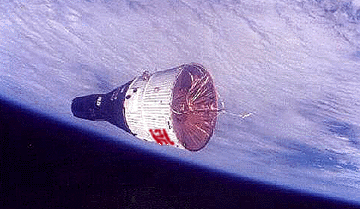
(Above) The flight of Donnie Guntersen.
JG's First Space Station
After much deliberation, JG decided it was time to establish a permenant outpost in space. Soon after, JG scouts began going out and collecting all the needed materials. After about a week and a half, there were cardboard boxes stacked up all over the place inside the hangers. Soon after, work began on building the station, as highly qualified engineers and technicians began duct taping the boxes together. We were making a fort! Yeah! Once completed, the boxes were shipped into orbit around the Earth, from where the station was christened Leiderhosen 7 (The other six were being worn by our executives at that point). The first crew, led by Colonel Leslie Tipping, JGAF, and a crew of hotshot newbies came aboard the station on 18 July 1994. Tragedy struck thereafter, when Colonel Tipping accidentally spilled his fruit punch on the floor, which caused it to become soggy and eventually break, decompressing the entire station and killing everyone except Tipping, who was blown out of the station and was found a week later on a beach in Miami, having survived reentry. Two years later, once the council had come to the conclusion that Leiderhosen 7's electrical systems were at fault in the disaster, the Leiderhosen 8, built entirely out of milk jugs, was put into orbit, where she remains today.
 The Great Experiment—
PROJECT: STARDUST
For as long as man has been venturing into space (Yuri Gagarin, on 12 April 1961, was the first man in space) those sick people out there have been trying to figure out what it would be like to, shall we say, mate, since this is a family page, in space. Well, I can tell you this much: It wouldn't be easy at all. Time for a little physics lesson. In space, with no gravity acting on you, your momentum would carry you across the room and into the wall. The wall or any other object is your only inertia. On Earth, if you threw a baseball, gravity would be the inertia that would act on the ball's momentum and cause the it to arc to the ground. In space, if you threw the same baseball in a zero gravity environment, then the ball would have no gravity to act upon it and it would coast along the same path until it eventually hit something. So, if you were to... mate... with someone in a zero gravity environment, then all you would accomplish is repelling yourself away from the other person and into the first solid object you run into. The greater the force inflicted, then the faster and harder your momentum. Momentum is stopped by inertia. The inertia is the wall. Get the picture? Of course you do. Which leads me to explain what the point of this rambling is.
A group of engineers over in R&D decided that it was about time to try and come up with a way for it to be done. They proposed Project: Stardust, and fed the execs lies in order to achieve funding. To the execs, the idea of a zero gravity jumprope was a worthwhile endeavor. But, alas, that was not to be. A special suit was conceived for the task. It comprised of two jumpsuits, held together by a system of shock absorbers. The suit with the people inside, would then be suspended radially in the room, by cords extending out in all directions to the walls, so that the two people are held firmly in place. In this way, the momentum would be halted by the inertia inflicted by the shock absorbers, and all leftover momentum would be channeled through the radial cords. Neither person was going anywhere.
Two people were selected for the task and thus Project: Stardust became the Black-Schermerhorn Mission. Those two people were Andrew Black, the male, and we are withholding the name of the female simply, as I said before, this is a family page. There could be little kids reading this. But, fortunatelly or unfortunatelly (Pick one) the mission was cut when the executives decided that they were more interested in a zero gravity cappuccino maker. So the great mystery remains unsolved to this day, for better or for worse.
(Notice how this particular topic gets more space than all the others?)
Return to JG Home
This page engaged 8 July 1999.
Last updated 9 October 2001.
©1996-2001, JG Enterprises, Inc. All Rights Reserved.


