Electronic Mail & Messaging
Systems has covered
technology, user, product and market trends in electronic
mail, computer fax, advanced networking (LAN and WAN),
Internet messaging, groupware, wireless email, LAN
interconnection and all facets of electronic messaging and
computer communications since
1977.

"At Lotus, we have a simple definition of
success: doing what we said we were going to
do."
"The good news here is that customers really
do have a choice."
|
|

By Mike
ZismanLotus
Executive Vice President of StrategyThe Electronic Mail & Messaging Systems
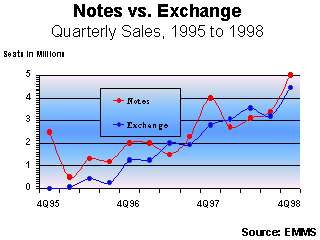
(EMMS) newsletter has just published its third-quarter
statistics on mail shipments. According to this data, Lotus
added 3.4 million new Notes users in the quarter ended
September 30, compared to Microsoft's 3.2 million new Exchange
users. Given the way that the quarter-to-quarter seat race has
been discussed throughout this year, you might have expected
us to put a glowing spin on this new information. Actually,
I'd like to take this opportunity to call into question the
over-interpretation of the kinds of seat differentials that
we've seen each quarter this year, including Q3 in which we
"outshipped" Microsoft. Rather than gloating and telling you
that this information means something it doesn't, I'd like to
ask you to read on and consider the
facts.Fact #1:
Reports of Exchange gaining momentum at the expense of Lotus
Domino and Notes are unfounded. Microsoft has reported sequential shipments of 3.1,
3.6, and now 3.2 million seats for the first three calendar
quarters of this year. From Q1 to Q3 their shipments increased
by 0.1 million, or 3%. Microsoft would have you believe that
this level of growth represents the ascendancy of Exchange in
the marketplace. Fact is, 3% might be great growth in the
steel industry, but not in the software business. Why the big
up-tick in Q2 and fall-off in Q3? Because the second calendar
quarter is the last quarter of Microsoft's fiscal year,
traditionally a company's strongest quarter in our
industry.Fact #2:
Lotus set aggressive growth targets for 1998 and is achieving
them. At Lotusphere in
January of this year, I publicly stated that our 1998 goal was
12 million new Notes users, which would bring the worldwide
Notes user population to 32 million. Throughout 1998, we have
been on track to achieve that goal. Here we are,
three-quarters of the way through the year, with 9.2 million
new users -- three-quarters of this annual goal. At Lotus, we
have a simple definition of success: doing what we said we
were going to do. We set a goal, we made it public, and we're
on our way to achieving it. How is Microsoft doing against its
publicly stated goal? I don't know and you don't know, because
Microsoft never revealed its goal.
Fact #3: Seat counts aren't
hard science. Both
Microsoft's numbers and our own require estimates in addition
to simple license-counting. In Microsoft's case, they must
estimate the number of people who licensed BackOffice, for
example, and are actually using Exchange. Of the 3.6 million
licenses that Microsoft reported in Q2, fully 1.5 million came
from this estimation. Is that a good estimate? Who knows?
So what's the point?
The point is that a competitive "momentum" story built on the
back of these seat counts is pretty lame. Likewise, Lotus also
needs to estimate the number of OEM licenses shipped that are
being used. The point, and it's a pretty obvious point, is
that the inherent error in these estimates is likely to be
greater than the differences in our reported license
shipments. All this makes Microsoft's pronouncements of
comparative momentum ridiculous. Call it spin, or even
aggressive marketing, but obfuscating the facts is ultimately
a disservice to the customer.
Fact #4: Credible research organizations
have questioned Microsoft's representations of its seat
growth. IDC (International
Data Corp.) does independent market research on the deployment
rate for mail clients. According to IDC's recent report
(Network/Web Integrated
Collaborative Environments Software Market Midyear Update,
1998), Microsoft added 5.67
million new users in the first half of 1998 -- 15% less than
Microsoft's own estimate of 6.7 million users -- while Lotus
added 5.31 million new users, just 9% less than our own
estimate of 5.8 million new users. The difference between the
two IDC estimates is minuscule. When you factor in the new Q3
data, the only rational conclusion is that Lotus is shipping
at approximately the same rate. A group product manager for
Microsoft Exchange stated last week that "customers are
overwhelmingly choosing Exchange Server over Lotus Notes."
This is only overwhelming if you live in Redmond and have had
Notes envy for a very long time.
I guess I can accept the "momentum" hype
from product managers -- it's part of the job. But what has
really gotten my attention is that this fast-and-loose
hyperbole flows directly from the executive offices of
Microsoft. Consider the following quote from an article in the
October 21 issue of The Wall
Street Journal regarding
Microsoft's third-quarter results: "In the competition with
Lotus, Mr. Maffei said Microsoft's Exchange product, for
e-mail and messaging, continued to outsell Notes, gaining more
than three million new users for the third consecutive
quarter." Hmmm.... Mr. Maffei is the Chief Financial Officer
of Microsoft. Let's take a closer look at what is troubling
about his statement. First, it's not true, as we now all know.
Second, and far more troubling, Mr. Maffei could not possibly
have known whether his assertion was true
because we had not yet
released our results.
And yes, I must admit my
disappointment that such "Redmondisms" go unchallenged far too
often.
Fact
#5:
Much of the
Exchange growth has resulted from migration from Microsoft
Mail. Microsoft would have
the market forget that much of the growth of Exchange has come
as a result of forced migration from the Microsoft Mail
platform. Meanwhile, the growth of Lotus Notes has almost
entirely been organic, with little effect on a generally
stable installed base of Lotus cc:Mail customers. In recent
years, the Microsoft Mail installed base has fallen more than
40% from its high of 10 million users, while cc:Mail has
increased 40% to 14 million before we finally saw some net
migration earlier this year. Today, according to EMMS, there
are 13.5 million cc:Mail users and only 5.7 million Microsoft
Mail users.
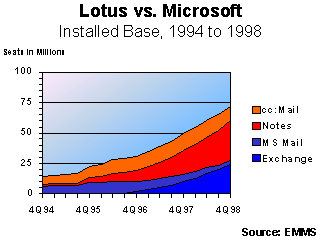
This
translates altogether into about 42 million mail users for
Lotus and 25.2 million mail users for Microsoft. We have 65%
more mail users than Microsoft after almost a decade of
intense competition. That's a fact. Here is my opinion as to
why that's the case:
1. Notes is truly the best platform available for
messaging and collaboration.
2. That's because it's our core business.
3.
We've done a far better job supporting
our customers than Microsoft has done for their
customers.
We led in the
earlier generation of mail systems; we led the evolution to
client/server messaging systems; we're leading in the
deployment of current generation messaging systems; we're
defining the way and leading in the deployment of
collaborative systems; and now we're leading in the definition
and deployment of knowledge management
solutions.
The good news
here is that customers really do have a choice, which is not
the case in other software categories. It's not just a choice
of our messaging vs. their messaging. It's a choice about
visions of how messaging fits into the larger fabric. To
Microsoft, mail is the top layer of the operating system
stack. To us, mail is the bottom layer of a collaborative
applications stack. Microsoft knows that we have the right
vision; they're just not there yet. Part of Microsoft's
"momentum story" is telling press and analysts that "customers
really only want mail and that's why they're choosing
Exchange." I hear this every day when I speak to analysts. My
response is always the same: "www.microsoft.com/exchange." Exchange is described in their own 48-point red
letters as "the fastest growing messaging and collaboration
server in the industry today." It doesn't say "messaging;" it
says "messaging and collaboration." So which is it? Do
customers want "just messaging" or do they want "messaging and
collaboration"?
And by
the way, according to EMMS, Exchange is not the fastest
growing messaging and collaboration server in the industry
today. But I won't hold my breath waiting for Microsoft to
update their Web site. And I won't engage in silly hyperbole
about this quarter or that quarter's numbers. I trust you
agree that it's time to end the focus on which of us reported
300,000 or 400,000 more or fewer seats. The differences are
just not significant, and I mean that from both a statistical
standpoint and a customer standpoint. Microsoft has tried to
assign significance to these differentials, as if they will
determine which of Exchange or Notes will disappear under the
blazing market success of the other
product.
Indeed, much of
the future has already been determined. Two years ago Novell
and Netscape were viewed as formidable players in this market
along with Lotus and Microsoft. Today, Lotus and Microsoft,
with 28.5 million and 19.8 million users respectively, have
achieved the critical mass that puts each in the position of
long-term player. The facts are clear: Lotus Notes is the
market leader, and hence the one to beat.
Further, "momentum" isn't just an installed
base numbers game. It covers a range of areas, including
growth in numbers and quality of developers, applications,
business partners and strategic alliances. It has to do with
innovation and understanding customer problems. It has to do,
most of all, with solutions. The strategic, high-return
solutions that customers are deploying and benefiting from
once they implement our products. On all those fronts, the
market imprint of Lotus Notes and Domino continues to
expand.
We believe that
Lotus Notes and Domino provide superior value. Now, that's a
delta worth contemplating.
More on these topics in my next
column. |

 Support Downloads How to Buy