 |
|



DominoPro Articles
Group Computing Archive
Ask Ben
News & Notes
Tips Corner
Certification Corner
Gary's Page
DominoPro Developer
Forums
Welcome
General
Administration
Adv Programmability
NT/2000 Integration
AS/400 Integration
Career
Job Center
Subscribe
Group Computing
DominoPro Developer
DominoWire
Site Info
About Us
Contact Us
Masthead
Media Kit
Editorial Calendar
Write for Us

What About Next Year?
| by Eric Arnum | Group
Computing Magazine, July
1998 Article ID: 418 See more articles by Eric Arnum |
 Printer-Friendly
Version Printer-Friendly
Version |
|
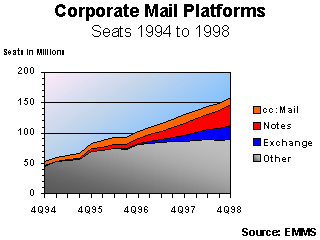
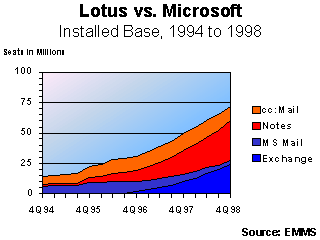
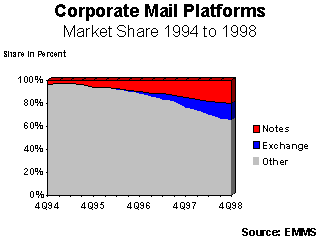
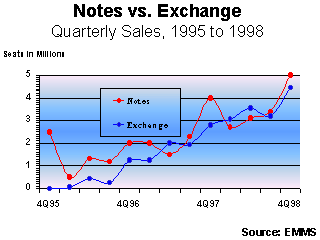
Lotus Notes has the biggest share of the groupware market, but it's facing a serious challenger. When Lotus announced at January's Lotusphere 98 that Notes had more than 20 million users, making Notes the world's largest groupware/messaging platform, the Lotus camp was thrilled. They had sided with the winner; Netscape, Novell, Oracle, and Hewlett-Packard had been vanquished. But when they looked over their shoulders, they saw big, bad Microsoft Exchange Server coming on strong. By the end of March, it was clear that Lotus and Microsoft were locked in a two-way battle, with the other companies fighting for the leftovers. And it looked like momentum was beginning to shift in Microsoft's favor. According to figures compiled by me and my colleagues at Electronic Mail & Messaging Systems, a newsletter that I edit, Exchange outsold Notes for the first time during the first quarter of 1998. Microsoft sold just over 3 million Exchange seats, while Lotus sold about 2.7 million Notes seats. (We define a seat as a person with a mailbox on a host or server.) With Notes 5 slated for rollout this fall, and with sales of Exchange 5.5 peaking now, it's possible that Exchange will overtake Notes again in the second quarter and perhaps also in the third. By the end of the year, though, market momentum will probably shift back to Lotus, not only because the company's messaging products always have a great fourth quarter, but also because Notes 5 will give the channel something new to sell. What a turn of events! Two years ago, the pundits said Notes was dead and Exchange didn't have a chance. Notes and Exchange were dinosaurs, they said, and the Internet was going to make them extinct. But Notes and Exchange have thrived, and Netscape is hanging on for dear life. Internetted vs. Proprietary GroupwareThe Internet was expected to decimate all the so-called proprietary groupware/messaging platforms, with Netscape and other companies providing the next generation of products based on open Internet standards. In 1996 and 1997, most people in the computer industry spent a lot of time learning an alphabet soup of new acronyms, such as LDAP, MIME, IMAP, and HTML. And many of us believed that Lotus, Novell, and Microsoft didn't have a chance, because the Internet would free everyone from such old-fashioned products as Notes, NetWare, and Windows. Back in early 1996, when Netscape Vice President Marc Andreessen boldly called the then two-week-old Exchange a "legacy system," Notes had only 5 million users — half as many as Lotus cc:Mail and a million less than Novell GroupWise. At that time, it wasn't at all clear whether Notes had a future. But nobody seemed to notice that Netscape, for all its bravado, didn't have a credible messaging/groupware product. Back then, a platform that combined the functions of Notes and the openness of the Internet was nothing more than a dream. Lotus, Novell, and Microsoft were angered by the sheer arrogance of Andreessen's implication that Netscape could do in six months what they had spent years working on. Standards alone do not define a product, they said. A groupware/messaging platform wasn't a Bundt cake, where you could mix IMAP, LDAP, MIME and HTML, add water and stir; such platforms took years to develop. Engineers at Lotus, Novell, and Microsoft said it would take Netscape at least six years to develop products that could rival theirs. But, they said, we'll need only only six months to catch up to Netscape. It took a bit longer than six months, but Lotus, Novell, and Microsoft have learned all the new tricks. For example, Novell's GroupWise Java client is arguably the best remote messaging solution on the market. And Microsoft's new Outlook 98 (reviewed on page 50 of this issue) and Lotus's upcoming Notes 5 clients implement a new multimedia messaging standard that enables users to create messages that look like web pages. Now it's Netscape's turn to catch up, not only in standards and features, but also in market share. With its browser/client market share hovering at about 50 percent, the number of messaging server mailboxes that Netscape can claim is startlingly low, behind even that of such minor players as Sun Microsystems and Software.com, let alone that of Lotus, Novell, and Microsoft. Notes and Exchange on TopInstead of making the endangered species list, Notes and Exchange are sitting on top of the corporate messaging world. Instead of leading the revolution to victory, Netscape is fighting for its life. Novell, always the underachiever in messaging, may finally have hit its stride and may deliver on the promise of Internet centricity with its new 5.2 release of GroupWise. Oracle simply gave up on groupware, and HP seems to have decided it's better to resell Exchange rather than to compete with it. So by the end of 1997, Notes was in the lead, cc:Mail had peaked, and GroupWise was still in contention. But Exchange, not Netscape Messaging Server, was coming on strong. Notes had 19.3 million seats — and was headed toward 20 million by late January 1998. Exchange was at 10 million, up 8 million for 1997, while GroupWise was at 8.5 million seats and HP OpenMail at 5.4 million. Where was Netscape? According to my newsletter's survey, Netscape's Messaging Server product line had only 2.4 million seats, a mere fraction of the number of people using its Navigator browser.
By the way, Notes 4.6 and Exchange 5.5 currently outsell GroupWise 5.1 and Netscape Messaging Server 3.5 by almost ten to one. Notes and Exchange acquired 5.7 million new seats in the first quarter of 1998; Netscape and GroupWise, about 600,000. While this imbalance between Notes/Exchange and Netscape/GroupWise might narrow, nobody seriously believes it will disappear. Netscape might outsell Novell in the corporate market, but it will never outsell Lotus or Microsoft. Netscape found out the hard way that clients don't sell servers, especially in an open standards world. Whether Netscape Navigator/Communicator has 50 or 60 million users doesn't matter, because all those users don't help sell Netscape Messaging Server to any great degree. Microsoft's giveaways of Outlook/Internet Explorer clients also don't help sell Exchange. And Qualcomm, maker of the popular Eudora line of messaging clients, learned that their giveaways of client software didn't help much either when it came time to sell the Eudora Worldmail Server. In the groupware/messaging market, giving away razor blades and charging for the razors doesn't work. That's because the clients are really like shaving cream, not blades, and all the free shaving cream in the world won't lead shavers to buy a particular brand of blade. Beating Netscape at Its Own GameIn another ironic turn of events, it turns out that a vendor's adoption of swiftly developed open standards brings only short-term proprietary advantage. But Netscape hoped that this wouldn't be the case, as it submitted one Internet-draft standard after another to the Internet Engineering Task Force (IETF) and then quickly proclaimed itself to be the first vendor to implement them. Two years ago, Netscape set the pace in email and web standards. In 1996, for example, Netscape pioneered a multimedia messaging breakthrough called Rich HTML, applying it to the Navigator client to launch an email broadcasting service called InBox Direct. Rich HTML specified how a page of text can be organized to include graphics and logos that were posted elsewhere in Usenet News Groups and on web pages. The message contained pointers to these graphic elements but did not contain the elements themselves. As long as the user was online while he read his messages, it didn't matter where the graphics were stored: the whole message was drawn within seconds, as though it were a web page. Netscape's breakthrough allowed publishers to leave plain text behind. With Rich HTML and InBox Direct, they could push out the kinds of multimedia correspondence they previously had to post on a web page. According to Netscape, InBox Direct now has 11 million subscribers, and email is the best push technology on the market. Even Microsoft copied Rich HTML, adding it to Outlook 97. There's just one problem with Rich HTML: if the user isn't online, only the text of the messages will appear. There's only one attached file: the text. The logos and photos, since they're on other servers, appear as broken links. This happens because, when Rich HTML was invented, a standard that organized graphic elements (that is, multiple related MIME attachments) did not exist. Lotus and Microsoft studied the rules of the IETF game and found out that anyone can play. All that's required is a willingness to fund the salary of a few brilliant developers and send them to standards-making meetings. And so Lotus and Microsoft told their best and brightest software engineers that their only job from now on is to monitor and develop Internet standards. Being their best and brightest, the engineers didn't merely sit in the back of the room and take notes. Instead, they stepped forward and got heavily involved in the process. Case in point is the new MIME HTML standard, which Microsoft and Lotus coauthored along with a Swedish IETF veteran. The result is a true breakthrough in messaging standards: MIME HTML is much more than a marriage of email's Multipurpose Internet Mail Extensions and the web's HyperText Markup Language. MIME HTML allows a message to contain multimedia picture elements and enables those elements to be assembled into what looks like a web page. The breakthrough is the way that the resulting message can organize and reassemble the elements into a single HTML page. This is how the breakthrough came about: In March 1997, Alexander Hopmann of Microsoft and Jacob Palme of Stockholm University coauthored RFC 2110, "MIME E-mail Encapsulation of Aggregate Documents such as HTML (MHTML)." This standard is to multiple MIME attachments what a collator is to a copy machine. It organizes all the graphic elements of a web page, enabling multiple related attachments to travel alongside the text. Unlike Rich HTML, RFC 2110 doesn't require you to be online to read multipart hypertext messages. There was just one problem with RFC 2110: it was defined only for email that traveled using Simple Mail Transfer Protocol (SMTP). In an era where an increasing number of people were using web-based email, this could be a drawback. In February 1998, Nick Shelness of Lotus joined with Hopmann and Palme to create an Internet-draft standard to replace RFC 2110, primarily to broaden its usefulness to other protocols. The new standard, which has the same title as the original, works just as well with the web's HyperText Transfer Protocol as RFC 2110 did with SMTP. Given its parentage, it's no surprise that MIME HTML is supported by Outlook 98 and Notes 5. It will also be supported by Netscape clients, and eventually by all other clients on the market. The point is, Microsoft and Lotus are leading, and Netscape is following. It didn't used to be that way. Proprietary AdvantageThe market might demand Internet-standards products, but nobody will buy Notes or Exchange because of MIME HTML. And nobody will buy Netscape Messaging Server because of IMAP4, nor will they buy GroupWise because of Java. In and of themselves, open standards do not make a product a success. Any company can go to a certain web page (http://search.ietf.org/internet-drafts/draft-ietf-mhtml-rev-06.txt) and get a free copy of the new MIME HTML standard. For a few months, though, until everyone else catches up, Lotus and Microsoft have a proprietary advantage over their competition. Proprietary, for some strange reason, has become a dirty word in the computer industry. The dictionary defines the word as something that is held under patent, trademark, or copyright by a company or an individual. The onset of the Internet redefined proprietary to mean any standard that doesn't have an Internet standard (aka RFC) number. The meaning of the term "proprietary advantage" has never changed. It refers to something that one company has that others don't. For a brief period, RFCs also can become proprietary advantages. Those who author an RFC unquestionably understand it best and can implement it faster. Those who implement it faster can gain a proprietary advantage over those who don't. But eventually, everybody has it. There's no question that in 1996 Netscape understood the Internet better than Lotus, Novell, or Microsoft. But Lotus and the other companies were fast learners. By now everybody has the same standards and features, and other considerations, such as manageability, are what sell products. If groupware were a card game, standards would be like jacks or better to open in poker — necessary but insufficient to win. Features win, and features are proprietary advantages. For this reason, Notes and Exchange have come to dominate the corporate messaging world. The Notes-Exchange HorseraceNow the ultimate question: when will Exchange's installed base catch up with Notes? Exchange outsold Notes in the first quarter of 1998, 3.05 million to 2.7 million. But Notes has a 9-million-seat lead. So, according to my calculations, it will take at least another 18 months — until the middle of 1999 — for Exchange to catch up to Notes. And that assumes that Notes 5 is so underwhelming that Lotus doesn't get its traditional fourth quarter kick. It also assumes that the early interest in the AS/400 and mainframe versions of Notes won't last. The first quarter is always a bit slow for Lotus, which does better business as the year progresses. In the third quarter of 1997, Lotus sold 2.3 million Notes seats, while Microsoft sold 1.95 million Exchange seats; in the fourth quarter, Lotus sold 4 million seats to Microsoft's 2.8 million. But the first quarter of 1998, Exchange advanced while Notes fell back slightly. So there's a distinct seasonal pattern to the sales. But Notes has a big lead, and both Lotus and Microsoft are way ahead of everyone else.
Will Exchange outsell Notes again? Undoubtedly. Will the Exchange installed base ever surpass Notes? Well, it's more reasonable to predict that Notes will break the 30-million-seat threshold a few quarters ahead of Exchange, and that while the distance between them will narrow, the gap between them and everyone else will widen. IBM has always been a leader in the messaging market, and its acquisition of Lotus has perpetuated that lead. IBM/Lotus has always had about a two-to-one lead over Microsoft in messaging seats. Thanks to Microsoft's recent acquisitions of Hotmail and WebTV, however, Redmond is catching up. Therein lies the challenge for IBM/Lotus. Notes may remain a few paces ahead of Exchange, but can IBM/Lotus stay ahead of Microsoft/Hotmail? When Microsoft acquired Hotmail, its share of the world's mailboxes jumped 6 points to 17 percent. IBM/Lotus's share, meanwhile, remained at its usual 21 percent. It's highly likely that before Exchange catches Notes, if it ever does, Microsoft/Hotmail/WebTV will catch IBM/ Lotus/cc:Mail. Webmail is growing faster in the consumer sector than groupware is in the corporate sector. IBM/Lotus has yet to offer a freemail platform to answer Hotmail, and its cc:Mail and PROFS users are migrating to Notes or Exchange. Two years ago, nobody would have predicted that Notes and Exchange would lead the corporate market; few investors were willing to bet against Netscape. But time has shown that it's much easier to build Internet-standard products than sophisticated groupware. Vendors can't ignore standards, but they no longer have to behave as if proprietary were a dirty word. ERIC ARNUM is the editor of Electronic Mail & Messaging Systems, a newsletter about the worldwide market for email, fax, and telex. Electronic Mail & Messaging Systems publishes a census of the world's electronic mail products by vendor every quarter. Email: earnum@rcn.com. |

You are at
groupcomputing.com.
Report Bugs | Submit Comments | Read Site Use
Agreement | Read Privacy Policy | Contact Us
Copyright © 1998 Duke
Communications International.
| Duke Communications Group Computing | AS400 Network | Selling eServer Solutions | Business Finance | SQL Server Magazine | Windows 2000 Magazine |