 |
|



DominoPro Articles
Group Computing Archive
Ask Ben
News & Notes
Tips Corner
Certification Corner
Gary's Page
DominoPro Developer
Forums
Welcome
General
Administration
Adv Programmability
NT/2000 Integration
AS/400 Integration
Career
Job Center
Subscribe
Group Computing
DominoPro Developer
DominoWire
Site Info
About Us
Contact Us
Masthead
Media Kit
Editorial Calendar
Write for Us

The Past, Present, and Future of E-Mail
| by Eric Arnum | Group
Computing Magazine, September
1999 Article ID: 142 Related Topics: Internet, Messaging, e-mail See more articles by Eric Arnum |
 Printer-Friendly
Version Printer-Friendly
Version |
|
A veteran high-tech journalist recounts e-mail's history and speculates about its future. I’ve covered the e-mail business for almost 15 years, and it’s never been boring. I watched as electronic messaging shifted from timeshared computers to value-added networks to minicomputers to LANs, and more recently to Internet mail and "Webmail," such as Hotmail and Yahoo! Mail. Like the weather in New England, things changed so fast you could see several seasons in a day, and there’s every reason to expect that pace to continue. Before I started covering the messaging industry, I helped launch the data networking news section of Communications-Week, a then-new magazine published by CMP Media of Manhasset, N.Y., and I wrote for a publication that covered the early market for modems and online services. I started using e-mail in 1984, and the following year became the editor of the biweekly newsletter Electronic Mail & Messaging Systems (EMMS). EMMS was published—in print—by a company in Connecticut at the time, then later by Telecommunications Reports International in Washington D.C. Working out of New York as the editor of EMMS, I’ve also written about the e-mail industry for other publications, including Group Computing, Business Communications Review, and PC Week. When I first took the job with EMMS, virtually no one I knew used electronic messaging, and the standard question at parties was "What’s e-mail?" I would answer that it replaced telephone tag or, alluding to an ad slogan of MCI’s back then, that it was the nation’s new post office. I must say, having watched the videotext and teletext businesses soar and then crash like a kid’s model rocket in the early 1980s, I wondered how much longer e-mail would be around. (Videotext was the attempt by Prodigy and others to brighten up the online experience with graphics and sound, and teletext was an information service aimed at TV viewers with remotes.) But every year e-mail gained users at a healthy rate.
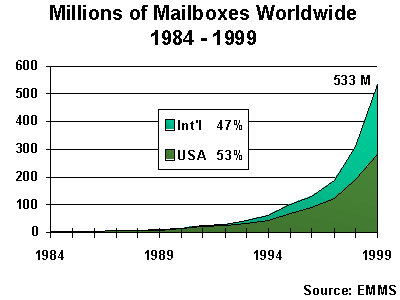
Explosive GrowthEMMS documented the number of electronic mailboxes throughout the world from 1980 to early 1999. In 1980, there were fewer than 500,000 electronic mailboxes, and more than 85 percent of them were in the United States. When I wrote my first report on the size of the e-mail market in 1985, there was a population of nearly 2,000,000 mailboxes, growing at a 70 percent annual rate. E-mail was becoming increasingly visible in the mid-1980s. In 1986, the big news was the electronic trail left behind during the Iran-Contra scandal (a trail that the Clinton administration is still fighting to keep away from historians). In 1987, the mass commercialization of e-mail began, as products like cc:Mail version 2.0 entered the corporate market, and services such as the Internet’s NSFnet backbone brought e-mail to more university students and researchers than ever before. By the end of the 1980s, corporations, government departments, and universities were interconnecting their e-mail systems, and there were 10,000,000 e-mail addresses in the world. The first hundred million mark didn’t come until 1995, but the second hundred million took only two more years to achieve. Today the world is closing in on its four hundred millionth mailbox. The question at parties is no longer "What’s e-mail?" but "What’s your e-mail address?" Nowadays everyone seems to know what it means when you say you’re somebody at somewhere dot com. In the next few years, e-mail will make even wider inroads into the mass market, to the point where anyone with a phone, computer, TV set-top box, or even a video game console will have an e-mail address. The Monkey TailPeople forget that back in the 1970s and 1980s, debates raged over what format to use for e-mail addresses. One community, led by companies that included CompuServe, Western Union, and MCI Mail, preferred numeric mailbox addresses such as those that telex and fax machines used. Another group, led by GTE Telenet, backed the X.400 style of long character strings with slashes, semicolons, and equal signs. ITT Dialcom assigned their hosts numbers from 1 to 100, gave each user an ID, and separated the two with a colon, as in 93:DTE541. And a whole chunk of the world was limited to eight-character user names, because that’s what IBM PROFS, Novell NetWare, and MS-DOS supported. Along came this thing called the Internet, already 18 years old in 1987 and never taken very seriously by anyone outside academia until then. Around that time, with Internet and e-mail usage bursting out all over, the @ symbol as the separator for Internet mail addresses became part of the common vernacular, and not just in the United States. In France they call the @ symbol a monkey tail, because they say it looks like a sitting monkey as seen from the air. In Italy it’s called the chiocciola, a snail; there’s even a new @-shaped pasta on view at the Museo delle Paste Alimentari di Roma. Think about it: Of all the one-symbol abbreviations for words, including the monetary ($ £ ¥) and the legal (© ® TM), only @ is absolutely indispensable to electronic commerce. The man who chose this symbol — who originally thought of using it in the middle of an e-mail address — was Raymond S. Tomlinson, and he did so precisely because that character was getting so little use elsewhere in the computer world back in 1971. The Roots of E-mailAt Bolt, Beranek, and Newman, then an independent company based in Cambridge, Mass., but now part of GTE, Tomlinson was an engineer working on the ARPAnet, the precursor of the Internet; the ARPAnet was developed by the Advanced Research Projects Agency, part of the Defense Department. In particular, Tomlinson, whom I interviewed for EMMS in 1997, was working on enhancing a program called SNDMSG, which at the time was simply a file-sharing program that switched ownership of a file from one local user to another; the file itself never moved. SNDMSG was incorporated into the Unix operating system, so all Unix users could receive messages from other local users. But what the user actually received was a pointer to a message file, which signified to the system that this user had permission to access that file. When the user deleted the message, it deleted this pointer, and the storage occupied by the file became available for reuse by the operating system. Tomlinson enhanced SNDMSG so that messages themselves were copied from one system to another across a network. In other words, the messages moved electronically along a wire from a point of origination to a destination, more like a letter or a phone call. This was the dawn of what we now call e-mail; indeed, Tomlinson is commonly credited with being the inventor of network e-mail (for example, see "On the Origins of Internet Mail Species," a 1994 article by Dave Crocker that’s available at http://www.brandenburg.com/). Tomlinson told me he couldn’t remember exactly when he enhanced SNDMSG, but he thinks it was in mid to late 1971: "I cobbled together a simple program, to run one copy on one machine and then run another copy on another machine, which specified files to be transferred over the network. I took the code from that program and incorporated it into the mailing program, and I had a program—still called SNDMSG—that worked over a network." He realized that if multiple computer systems were going to be involved in this process, each user would need a two-part address: someone at somewhere. So he looked down at the keyboard for a suitable separator. "There weren’t a whole bunch of choices," he said. "Nothing really stood out except the @ sign." Incidentally, Tomlinson doesn’t recall what he wrote in the first message he sent to test the new program, so there’s no e-mail equivalent to Alexander Graham Bell’s "Watson, come here, I want you," or Samuel Morse’s "What hath God wrought?" Too bad. Mixed MediaThe original messages received electronically were printed out on paper at local terminals. By 1985, plain, boring text on a monochrome monitor was mostly all there was, with multicolored text and variable-width fonts being used only in experimental labs. The Macintosh and then Windows enabled people to make their text pretty, but it was still just text. We’ve come a long way since then. E-mail containing nothing but text will soon be as quaint as the rotary phone. It will become common practice to pump virtually everything through a network as an e-mail attachment, including music, photos, videos, software, voice mail, and faxes. This is not some Jules Verne-like fantasy for the twenty-first century; already even the crudest e-mail systems are delivering multimedia content to the home and HTML-formatted news to the office. Many e-mail products have built in the ability to carry photos and sound, although (except for AOL) few are in mass deployment yet. Kodak’s new "You’ve Got Pictures" service will e-mail JPEG versions of snapshots to customers, who can forward them to friends and relatives. Microsoft’s WebTV set-top box has a digital video input jack, enabling subscribers to create their own video e-mail. Greeting cards and dancing babies overwhelm the e-mail networks on holidays, and e-mail already carries more MP3 recordings than the Web. There are literally hundreds of different formats that can be attached to e-mail. There’s not just one format for sound, but dozens. There’s not just one format for images; there are several choices for black-and-white faxes alone. Unified messaging—the ability to attach any media type to an e-mail message—is just the beginning of the migration to e-mail as a general-purpose parcel post for everything from pager messages to hour-long symphonies. Delivery and Much MoreE-mail, then, is the nation’s new post office for delivery of more than just written communications. And in the future, e-mail will save even more trees than it has already, since anything that begins its life as a digital file will remain in that form as it passes from the author to the distributor to the retailer to the purchaser. (Any physical goods that can’t be turned into digital files will help keep Federal Express and UPS in business.) Why kill a tree to print a book that was written on a word processor? Or make a CD at a factory when customers can do a better job of deciding which tracks they want to hear and in what order? There’s no technical reason why books and CDs can’t be shipped as e-mail file attachments. Most of the objections are legal and are raised by the seller. People could print their own books and create their own CDs, if only Amazon.com and CDNOW would sell them the files. But e-mail is more than just a delivery vehicle: it’s poised to become the end-to-end solution for electronic commerce. It will be used to advertise the goods, buy them, ship them, and pay for them. A digital transaction will be a series of e-mail messages between buyer and seller. Whereas the telephone sped up order-taking and trucks sped up deliveries, e-mail will speed up order-taking and deliveries, not to mention payments, customer service, and new-customer solicitations. E-mail represents a pervasive change in the whole cycle of a transaction, from conception to consummation. It’s eventually going to deliver your monthly bills and send your payment advice to the bank. People will use digital signatures more often than paper checks. When they use credit cards on the Web, they’ll receive confirmation as an e-mail message. If they have questions, comments, or complaints, an e-mail workflow system will shepherd their messages through customer service. In short, electronic messaging will replace not only telephone calls and postal mail, but also trucks, cashiers, and even checks. However, critical to making all this work is protection from something very dangerous that e-mail can carry: virus infections. This is a huge problem that needs to be tackled with not only on-network virus scanning and content-filtering software but also encryption keys and digital signatures. Moving OnIt’s a great time for e-mail and, I believe, a good time to leave the print publishing industry. In particular, working on a print publication that attempts to keep pace with an industry as fast-moving as e-mail has become a bit of a joke. Like blacksmiths and vaudeville and vinyl record albums, printing news on paper for sale is becoming a thing of the past. Especially for the delivery of business news, a biweekly printed newsletter like EMMS is hard to sustain when e-mail and the Web can deliver a far more current and visually pleasing product. You might say EMMS isn’t Y2K-compatible. In fact, unfortunately for my employers at EMMS, e-mail had such a negative impact on their business that they were no longer able to charge a premium price for printed-and-mailed news that was always at least a week old. The obvious move for them was to embrace e-mail and the Web for distribution, but instead they decided to sell the company (to CCH Inc., a subsidiary of Wolters Kluwer NV in Amsterdam). I decided it was also time for me to move on, to ensure that I’m Y2K-compatible: I’ve taken a position as an editor with Messaging Online in New York, working on a project very relevant to the Notes community in the area of portals and communities. If I could twist the words of Marshall McLuhan for a moment, I believe that e-mail can not only be the message, but also the medium of the message. And I believe that since e-mail, the Web, and the Internet are becoming such worldwide phenomena, the advantages of e-mail distribution over print-and-mail will only increase. E-mail has changed the print-and-publish pattern to publish-and-print, where end users decide which content they want to read on a screen and which they would rather see on paper. There will always be news, and there will always be people who report it, but killing trees for paper and applying postage to deliver it is something that e-mail has made unnecessary. ERIC ARNUM recently cleaned out a closet and found a boxload of punch cards that he used to make Snoopy calendars on his high school’s PDP-11, an early DEC minicomputer. E-mail: earnum@rcn.com. |

You are at
groupcomputing.com.
Report Bugs | Submit Comments | Read Site Use
Agreement | Read Privacy Policy | Contact Us
Copyright © 1999 Duke
Communications International.
| Duke Communications Group Computing | AS400 Network | Selling eServer Solutions | Business Finance | SQL Server Magazine | Windows 2000 Magazine |