Internet Cross-Subsidisation:
Traffic, Commercial Spending, and Government Funding of the Internet. A close-up study of the commercialisation of the Internet and the growth of the NSFnet backbone service from January 1993 to January 1995.
By Eric Arnum
earnum@rcn.com
fax +1 (718) 896-0874
Report to the Commission of the European Communities
Directorate General XIII.A3
Telecommunications, Information Market and Exploitation of Research,
Information Society, Trans-european Telecommunications Networks
Contract no. 45358
Completed Jan. 1995
TABLE OF CONTENTS
| Page | Section | Description |
|---|---|---|
| 2 | 1.0 | Table of Contents |
| 3 | 1.1 | Description of this report |
| 6 | 2.1 | What is the Internet? |
| 8 | 2.2 | Internet applications |
| 13 | 3.1 | The Information Superhighway |
| 14 | 4.1 | Internet size and growth estimates |
| 19 | 4.2 | Explanation of the IP address |
| 21 | 4.3 | Internet quarterly host census reports |
| 33 | 5.1 | Internet traffic patterns in 1993 and 1994 |
| 34 | 5.2 | NSFnet traffic by application |
| 39 | 5.3 | The rise of the World Wide Web |
| 43 | 5.4 | NSFnet traffic patterns by country |
| 45 | 5.5 | Data import/export ratios from the NSFnet as a function of national economic conditions, GDP & previous technology diffusion rates |
| 53 | 6.1 | Components of Internet funding in North America |
| 56 | 6.2 | The hidden university subsidy |
| 58 | 6.3 | Internet cost per Megabyte |
| 60 | 6.4 | The NSFnet backbone service |
| 62 | 6.5 | Successor to the NSFnet backbone |
| 63 | 6.6 | NSFnet regional networks and the Commercial Internet Exchange |
| 66 | 6.7 | Other American Internet access services |
| 69 | 6.8 | Other regional Internets |
| 70 | 6.9 | The future for Internet funding |
| 71 | List | List of all tables and figures |
| 73 | App | Appendix |
1.0 CHAPTER ONE
1.1 DESCRIPTION OF THIS REPORT
The European Commission has asked the following questions related to the Internet:
- Where does the money come from?
- Is the Internet able to survive without the subsidisation of the US government?
- What are the usage costs?
- How big is the penetration of Internet in the commercial sector?
- How is the addressing done?
- What about the standardisation?
- Who is doing what?
The short answers to these questions are as follows:
The operators of each host connected to the Internet must maintain that host locally. They are responsible for the actual end users, and the cost of the computing resources they consume. A network administrator must add and delete users, maintain the disk drives, routers, gateways, and processors, and most important of all, protect the system with security measures. The equipment and personnel needed to complete this task is a major component of total Internet spending. The average corporation or university can expect their annual costs to approximate $53,000 to $63,000 per year for an Internet access link, equipment, and labour.
Just the wages and salary benefits paid to local Internet administrators is a phenomenally large amount of money. Assuming that the Internet consumes ¼th the time of a $100,000-per-year skilled network administrator, then the cost of maintaining an Internet connection is $25,000 per year per company. There are currently 34,500 companies and 3,500 universities in the USA connected to the Internet, so just the salary component of Internet costs is over $950 million a year.
The number of hosts connected to the Internet is expanding at a rate of about 5% a month. It was last reported to be 4.85 million hosts worldwide in January 1995.
The number of bytes of data transmitted across the Internet's primary backbone network is growing at a rate of about 7% a month. It is presently transmitting about 22 trillion bytes a month, or approximately 22,000 Megabytes per month.
The number of people connected to the Internet is unknown, but is believed to be growing at a rate similar to the data reported above. The worldwide total user base is believed to be just over 36 million people, based on data reported in January 1995.
The Internet address is composed of four numbers, separated by dots, in a form similar to 131.107.1.13, where each number is assigned to a network, a sub-network, or a specific host. This numeric form is used primarily by the machines, since most human operators work with the easier-to-work-with alphabetical name. Each numeric address, however, is unique, and can be used in conjunction with the alphabetical host name to provide access security.
The standards process is informal. Technical committees and individuals make written proposals, called Requests for Comments (RFCs), which are distributed, discussed, and then informally accepted and approved. Many RFCs are issued as updates of earlier standards. Compliance with any Internet standard is voluntary. Those that serve a need will be used heavily, and those for which there is no clear need will be used only occasionally. The best recent example of a protocol gaining widespread backing through this grassroots type of approach is the World Wide Web, which soared in popularity, growing from 0.002% of Internet traffic in January 1993 to 16% of traffic in December 1994.
2.0 CHAPTER TWO
2.1 WHAT IS THE INTERNET?
The Internet is a worldwide tangle of interconnected computer data networks. Though definitions differ, most would say that the dividing line between those networks that are "on" the Internet and those that are not, is marked by their use of the TCP/IP protocols.
The TCP/IP protocols, shorthand for the Transmission Control Protocol/Internet Protocol, were invented by researchers working for the US Department of Defense on an experimental military computer network called the ARPANET. That name, in turn, is derived from the acronym of the Dept. of Defense's Advanced Research Projects Agency, which sponsors many leading-edge research efforts. The ARPANET was eventually joined by other TCP/IP-based networks, which together became known as the Internet. At present, the ARPANET has been decommissioned, and there are thousands of interconnected networks that collectively form the Internet.
There are other protocols used to run data communications networks, but none has garnered such worldwide backing as the Internet and its TCP/IP protocols. For instance, both IBM and Digital Equipment Corp. invented proprietary networking architecures for use with their computer systems. Designers of Unix workstations and MS-DOS-based personal computers created data communications protocols that work over phone lines. In recent years, the International Organisation for Standardisation and others have worked to create the Open Systems Interconnect (OSI) model, which contains its own suite of data communications protocols. None of these networking architectures is as popular as the Internet.
The ARPANET was created in September 1969 as an experiment, to see if reliable computer communications networks were possible. It was used to send what is believed to be the first electronic message between computers on November 21, 1969. Twenty-five years later, the pioneers of the ARPANET were honoured during a gala dinner thrown in Boston, Massachusetts, by Bolt Beranek & Newman Inc., one of the early commercial contractors hired by the US Dept. of Defense. Among those honoured as Internet pioneers were Benjamin Barker, Roland Bryan, Vinton Cerf, Steven Crocker, Douglas Engelbart, Frank Heart, Robert Kahn, Leonard Kleinrock, Severo Ornstein, Jon Postel, Lawrence Roberts, Robert Taylor, David Walden, and Barry Wessler.
The technique the ARPANET followed was based on a 1964 proposal by Paul Baran of the Rand Corp. He designed a network architecture for military applications that stressed three features: no central hub, an assumption that links between any two points would sometimes be cut, and a method to chop long files into smaller units, called packets. Such a system, which came to be known as packet switching, could route data around points of failure.
The ARPANET was built to survive a devastating enemy attack, which theoretically would be launched against a military intelligence, command, control, and communications network in time of war. The network architecture was designed to keep running even after large portions of the infrastructure were knocked out. Because there was no central hub, and built-in redundancy, data could be routed around points of failure. In fact, the resilience of the underlying TCP/IP protocols was proven during the Persian Gulf War, when TCP/IP-based routers and switches used by both sides. Ironically, the TCP/IP-based network userd by the Iraqi military in their intelligence, command and control network withstood much of the U.S. military's bombardment. It did not, however, help change the outcome of the war. The Americans and allies, who had installed their own TCP/IP-based network in Saudi Arabia, used their installation to great effect for such applications as logistics, supplies, as well as command and control.
In more peaceful times, the Internet protocols have proven to be relatively resilient for university-based networking. There are some security concerns, however, including the possibility that expert users can "wiretap" the data stream, prevent or redirect data, masquerade as another user, and so on. Some of the teenage boys that typically populate the universities take great pride in their ability to "hack," or cause mischief on the network. This perceived lack of security is a major disadvantage of the Internet -- one which will slow down its use for commercial endeavours. However, these concerns have more impact on the end user's ability to trust their data than they do on the ability of the network to operate. Complete network failures are uncommon.
2.2 INTERNET APPLICATIONS
The primary applications of the Internet are electronic mail, file transfers, news distribution, and remote terminal logins. Each has its own protocol defined within the TCP/IP suite. E-mail is delivered using the protocol SMTP (short for Simple Mail Transfer Protocol). An enhancement of SMTP that allows multimedia messages to be sent is called the Multipurpose Internet Mail Extensions, or MIME.
File transfers use the File Transfer Protocol, or FTP. Distribution of the Usenet News Groups, which are a hybrid of electronic bulletin boards, news wires and discussion groups, is accomplished on the Internet using the Network News Transfer Protocol (NNTP). Usenet News Groups, however, also are widely distributed outside the Internet community using other protocols.
Remote terminal logins use a protocol called telnet, which is usually written in lower case and which is completely distinct from the brand name Telenet. The latter name was once used by Sprint Corp. as the name of its packet-switching network service, which in fact was also based on technology derived from government research performed by Bolt Beranek & Newman and the Rand Corp.
The primary backbone network for the Internet community is the NSFnet, operated for the National Science Foundation by a consortium of companies that include MCI Communications Corp., IBM Corp., and Merit Network Inc. These three companies formed a joint venture called Advanced Network Services Inc., or ANS, which was recently sold to America Online Inc. Merit, it should be noted, is itself a joint venture of several universities in the American state of Michigan.
The NSFnet has been the "backbone" service of the Internet for six years. It assumed that role from the ARPANET, which was phased out as the NSFnet was phased in. The NSFnet is a network's network, in the sense that it interconnects regional, local, and international networks. It is like a main artery that collects traffic from dozens of regional networks, which themselves collect traffic from a few hundred smaller networks. And so on.
The NSFnet was supposed to be used for non-commercial traffic only. However, some amount of commercial traffic still traverses it. In order to facilitate commercial Internet traffic, several of the pioneering commercial Internet carriers formed the Commercial Internet Exchange (CIX) to create a commercial-friendly Internet backbone in competition with the NSFnet. Their traffic volumes, however, are still dwarfed by those seen on the NSFnet.
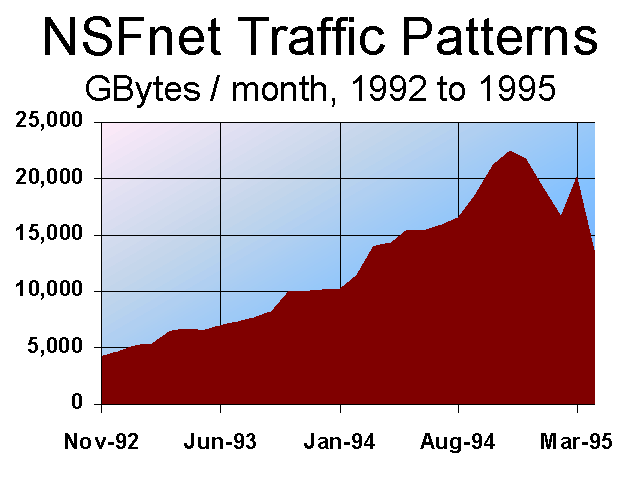
In January 1993, the NSFnet carried 5.16 trillion bytes of information, bundled into 27.5 billion packets of information. That in itself is a huge volume of data. But by January of 1994, the NSFnet was carrying 10.3 trillion bytes and 55.3 billion packets of data per month. And by November 1994, the NSFnet was up to 22.5 trillion bytes of data and 106.6 billion packets. Growth has averaged 5.5% to 6% a month over the period.
Beginning in December 1994, the amount of traffic on the NSFnet began to fall, as more and more regional networks began a slow migration to a new system of four Network Access Points (NAPs). All Internet carriers are supposed to interconnect with an NAP, and therefore with each other. This will eventually replace the NSFnet Backbone Service, which is gradually being phased out.
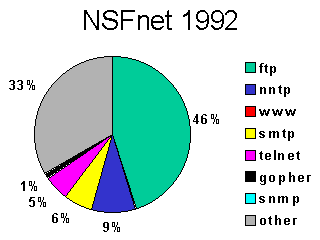
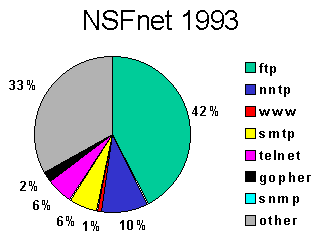
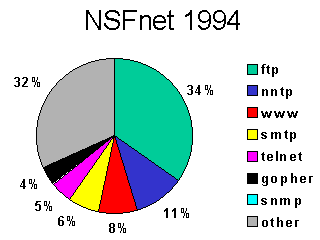
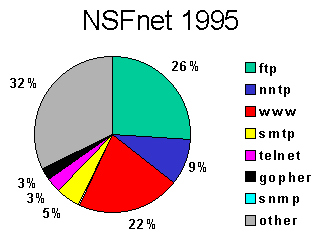
Historically, the NSFnet's share of traffic has divided up as follows: FTP file transfers: 35% to 40%; NNTP Network News Groups: 9.5% to 10.5%; SMTP e-mail: 6.2% to 6.3%; and Telnet remote terminal logins: 4.9% to 5.7%. These ranges are observed directly from monthly traffic reports computed in terms of bytes, and published by Merit Network Inc., the backbone network operators.
Figure 2-1
NSFnet Traffic by Major Applications
1992 to 1995
| 
|
| 
|
Source: Merit Network Inc.
In recent years, the number of Internet standards and protocols has grown to include dozens of new applications. The most important have turned out to be those that provide searching, navigation, and retrieval tools to end users. These include Gopher, Archie, the World Wide Web, Mosaic, and others. In 1993, usage of Gopher grew quickly. In 1994, it was the World Wide Web that grew fastest.
The World Wide Web, created in 1989 at CERN, the European Laboratory for Particle Physics in Geneva, Switzerland, provides a means for Internet information services to organise their data. Users can type the name of a Web server, and then reach through the Internet to link to that server on an interactive basis. When they type the address of the Web server's system, they are greeted by a "home page," which contains a brief summary of the contents of the service, and perhaps a table of contents. Users can select a topic by number, or if they use a graphical interface such as Mosaic, can click on an icon. The Web server then presents the user with more data and more choices. As users delve deeper into the Web, the amount of detail increases.
The service is aptly named. Frequently, the hypertext-enabled pages also include pointers to the home pages of other services. For instance, the name of a company might be listed in a news story. Clicking on that name might result in a connection to that company's home page. Clicking on a copyright notice might result in a connection to the author's home page, and so on. Users can weave a tangled web of links between Web servers.
The World Wide Web has sprung up -- almost out of nowhere -- to become one of the most favoured protocols on the Internet, especially for Electronic Commerce applications. The same protocols that can guide users through a search can also guide them through an online catalog. The World Wide Web uses a page presentation format called the Hypertext Markup Language (HTML), and a communications language called Hypertext Transport Protocol (HTTP). In recent months, companies such as Terisa Systems have come forth advocating Secure HTTP, a security-conscious version of the language built to include end-to-end encryption.
Back at the beginning of 1993, the World Wide Web accounted for only 0.002% of the NSFnet's total traffic. By the end of 1993, it accounted for 2.2%, almost a thousand-fold gain. By July 1994 it had passed SMTP e-mail in total volume and by November 1994, it accounted for 13.9% of the NSFnet's total byte volume. It ended 1994 at 16% for the month of December, and an average of 7.4% for the whole year.
There are only a few thousand active World Wide Web servers in existence, but already they generate upwards of 3.48 trillion bytes per month of Internet traffic. Commercial carriers and software developers have quickly embraced the protocol, as have end users and database providers. Carriers and software developers have moved swiftly to open consulting services that will help merchants create World Wide Web home pages. Some carriers go one step further and offer to host these applications on their own systems, on behalf of these merchants.
There are daunting hurdles to overcome before a secure World Wide Web can be trusted with money transactions. Not even the transmission of a credit card number across the network is presently adviseable. However, the ability to buy and sell with a reasonable amount of security is clearly the goal of a good portion of the Internet community. Right now, though, most commercial activity is in its initial stages, collecting sales leads, providing samples, and maintaining contact with customers.
Many companies that might someday want to sell on the Internet are opening home pages simply to gain experience -- the proverbial foot in the door. Some have gone as far as to hire people whose sole responsibility is to give a company an active profile on the Internet. For instance, they might operate a Web server, an informational electronic mailbox, and a news group, just to provide visibility for their employer.
The services and protocols that will be most useful to the commercial world will be the World Wide Web (and HTTP), Network News Groups (and NNTP), and e-mail (using SMTP and MIME).
However, before any commercialisation of the Internet can occur, some very thorny issues in security must be solved. The Internet was designed to keep running even when under attack. Some of the features that were built to keep it running in wartime can also be exploited in peacetime by "hackers" who can gain illegal access to computer systems. Their exploits are becoming the raw materials for legends and folklore. Much of their activity is benign, done more for amusement than malicious intent. However, their exploits receive so much publicity that corporations are beginning to see their Internet links as potential liabilities.
Even the world's largest companies are not immune. In November 1994, the General Electric Company of the United States was forced to very publicly disconnect itself from the Internet after it found that someone had gained illegal entry. Early in 1995, news reports said hackers had found new ways to infiltrate computer systems connected to the Internet.
Various means, such as the use of encryption and "firewalls," can defend against hackers, but nothing is certain. GE had a firewall in place, designed to prevent users in one section of the network from moving to another section. But it didn't prevent the break-in, for which the perpetrator remains at large.
The very next week, GE joined a consortium called CommerceNet, which is composed of commercial companies and researchers interested in providing Electronic Commerce services over the Internet. Many other companies, including Meckler Corp. with its MecklerWeb, and First Virtual Holdings Inc. with its Internet Payment System, are looking to solve a basic dilemma: how to conduct business and provide for the secure exchange of on the frontiers of the Information Superhighway?
The workings of the Internet depend on the presence of a host computer system, connected full-time to a high-speed dedicated link to a regional or local Internet access provider. Some users also are able to use dial-up modems and personal computers to connect occasionally to the network, but they must first go through a host that is connected full-time.
Most corporations that expect to make any extensive use of the Internet should arrange for dedicated access, either through a leased line or through an ISDN connection. Dial-up modems are not sufficient to handle the traffic volumes a corporation can expect.
However, having a computer connected full-time to the network is a potential point of vulnerability. This is a dilemma every company connecting to the network needs to consider: how to balance the need for full-time access with the requirement for round-the-clock security.
3.0 CHAPTER THREE
3.1 THE INFORMATION SUPERHIGHWAY
The American debate on the future of the Internet has centered on the provision of an "Information Superhighway." The idea arose from comparisons made between the national data networking infrastructure and the 1950s-era introduction of limited-access superhighways across America. Another term invented to describe the Internet is the "Infobahn," which though it sounds German, actually was originated by an American author.
The metaphor has been taken to extreme in American media reports. They talk of "toll roads" to refer to commercial services, "onramps" to mean access services, and so on. The term appeared in 57 articles during the month of January 1993. By January 1994, the Nexis database of newspaper and magazine articles contained 1,480 references to the term "Information Superhighway," or a synonym.
Use of the term possibly peaked during an "Information Superhighway Summit" planned for late September 1994 in California. Nowadays it is a term used sarcastically, and apologised for, in most environments.
Also coming into popular usage are such contracted terms as the "I-Way" and simply, "the 'net." Use of many of these terms before an audience is now likely to cause as many groans and rolling eyes as it does nods of agreement.
In 1993, U.S. President Bill Clinton announced plans to create a "National Information Infrastructure," the NII. The U.S. Department of Commerce has begun to take a leading role in the debate through its creation of several committees. One such committee is the Advisory Council on the NII, which was formed in January 1994. Its membership includes chairmen and presidents from many of the nation's leading telecom companies and research consortia. To date, the committees have produced primarily position papers and informational publications.
There also now is a European Information Infrastructure (EII) as well as a Global Information Infrastructure (GII). Again, most of the production to date has been of papers and publications.
4.0 CHAPTER FOUR
4.1 INTERNET SIZE AND GROWTH ESTIMATES
As of January 1995, it was still both fair and accurate to say that the Internet is an American phenomenon. Though the base of the Internet is growing very rapidly internationally, still over six out of ten computers connected to the Internet are located within the USA. Within the USA, most of the Internet is concentrated in the ten largest states, but especially California.
The Internet now reaches at least 85 countries. However, a relative handful of countries account for the great majority of Internet activity worldwide. Over 90% of all Internet-linked computers are currently located in a short list of ten countries. Large Internet countries such as Britain, Germany, and Canada have thousands as many computers connected to the Internet as places such as China, India, and Egypt.
In addition, though the Internet is growing at a rapid pace, it is not growing as fast as is sometimes reported in the press. The often-cited rate of growth of "ten percent a month" is significantly inflated. The number of computers connected to the Internet has been growing at a rate of about 5% a month since the beginning of 1993. The number of bytes transmitted over the Internet has increased at a rate of about 7% a month since the beginning of 1993.
The number of Internet users is a metric for which there are only educated guesses. Everybody has their own method for making this calculation. None are as accurate as the counts of hosts, networks, bytes, or packets. However, the industry has come to support a belief that the number of users per host currently averages 7.5 people. Estimates in the past have ranged all the way from five to ten users per host, though, so the actual user count could be much larger (or smaller) than believed.
Using 7.5 users-per-host as an average, there were 36.38 million people sharing 4.85 million host computers attached to the Internet as of January 1995. In January 1994, there were 2.23 million hosts on the Internet, and therefore probably 16.7 million users worldwide. Growth in the year to January 1995 was therefore a booming 118%. The annual growth rate for hosts connected to the Internet has ranged between 58% and 92% since 1991.
Figure 4-1
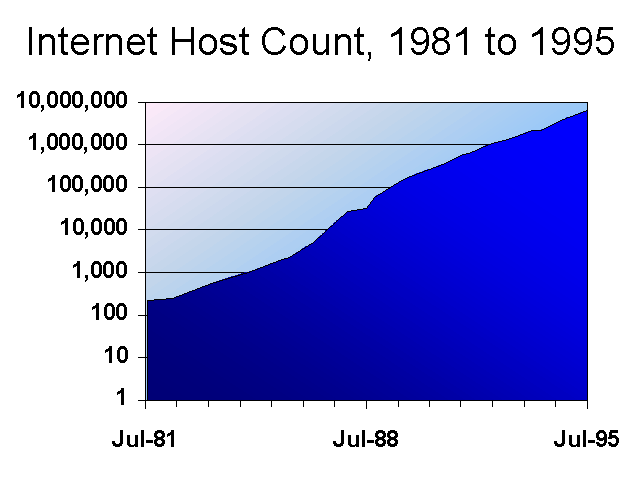
Source: SRI International & Network Wizards
According to statistics published by the companies SRI International and Network Wizards, both from Menlo Park, California, about 65.5% of all the Internet hosts counted in January 1995 were located in the USA. Furthermore, there is a decided concentration of the Internet within the USA to relatively few of its 50 states. According to a group called Internet Info, located in Falls Church, Virginia, about 60% of the new registrants to Internet in the month of August were located within one of ten American states, with an astonishing 23.4% located within just the state of California.
The National Science Foundation published a list on December 1, 1994 that gave the home state of all 24,780 American networks that were connected to the NSFnet through one means or another. More than half the hosts were located in one of seven states. The NSF also placed California in the lead, albeit with a smaller share of 18.5%.
Table 4-2
NSFnet Networks by State in Dec. 1994
| State | Networks | Share |
|---|---|---|
| California | 4,586 | 18.5% |
| New York | 1,696 | 6.8% |
| Virginia | 1,539 | 6.2% |
| Massachusetts | 1,490 | 6.0% |
| Ohio | 1,195 | 4.8% |
| Texas | 1,151 | 4.6% |
| Maryland | 1,034 | 4.2% |
| Washington | 901 | 3.6% |
| Pennsylvania | 880 | 3.6% |
| Colorado | 875 | 3.5% |
| Minnesota | 802 | 3.2% |
| New Jersey | 780 | 3.1% |
| Michigan | 645 | 2.6% |
| North Carolina | 633 | 2.6% |
| Florida | 630 | 2.5% |
| Oregon | 578 | 2.3% |
| Washington DC | 543 | 2.2% |
| Illinois | 499 | 2.0% |
| Georgia | 399 | 1.6% |
| Indiana | 287 | 1.2% |
| Connecticut | 284 | 1.1% |
| Tennessee | 283 | 1.1% |
| Missouri | 257 | 1.0% |
| Wisconsin | 228 | 0.9% |
| Alabama | 228 | 0.9% |
| South Carolina | 213 | 0.9% |
| Nebraska | 203 | 0.8% |
| Arizona | 163 | 0.7% |
| Iowa | 144 | 0.6% |
| New Mexico | 137 | 0.6% |
| New Hampshire | 135 | 0.5% |
| Louisiana | 134 | 0.5% |
| Oklahoma | 112 | 0.5% |
| Utah | 107 | 0.4% |
| Rhode Island | 104 | 0.4% |
| Hawaii | 97 | 0.4% |
| Mississippi | 88 | 0.4% |
| Maine | 79 | 0.3% |
| Kansas | 72 | 0.3% |
| Kentucky | 64 | 0.3% |
| Idaho | 55 | 0.2% |
| South Dakota | 46 | 0.2% |
| Vermont | 45 | 0.2% |
| Arkansas | 40 | 0.2% |
| West Virginia | 35 | 0.1% |
| Nevada | 30 | 0.1% |
| Wyoming | 30 | 0.1% |
| Montana | 22 | 0.1% |
| North Dakota | 18 | 0.1% |
| Alaska | 18 | 0.1% |
| Delaware | 17 | 0.1% |
| Total | 24,780 | 100% |
| Source: NSFnet |
The networks connected to the NSFnet tend to be more non-commercial in nature than commercial. That is due to the simple fact that the Internet remains dominated by non-commercial entitied such as government, military, and universities. However, a good portion of them connect to companies in the private sector.
As of January 1995, the split was about 52.7% non-commercial and 47.3% commercial, as close to balanced as it has ever been. In October 1994, the split was 55%/45%, and in October 1992 it was 63%/37%, both heavily weighted towards non-commercial hosts (in the .gov, .mil, and .edu domains). In July 1991, the earliest for which reliable host statistics are available, the split was 66%/34% in favour of non-commercial hosts.
Figure 4-3
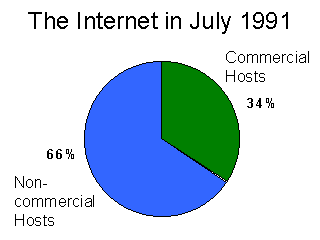
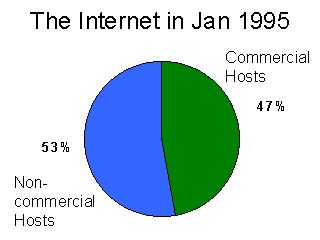
Source: SRI International & Network Wizards
There are other statistics that track commercial hosts by city and by telephone area codes. These statistics show that the San Francisco Bay Area is particularly thick with Internet-connected companies, as are the cities of New York, Boulder CO (near Denver), Boston, Houston, Chicago, Seattle, and Washington, DC. The company called Internet Info, from Virginia, compiled the NSFnet statistics into regional breakdowns by city and area code. The Top ten in each category are presented in Tables 4-4 and 4-5, respectively:
Table 4-4
Biggest Commercial Internet Cities
April 1994
| City, State | Companies |
|---|---|
| New York NY | 291 |
| San Jose CA | 260 |
| San Francisco CA | 218 |
| Boulder CO | 194 |
| Santa Clara CA | 175 |
| Cambridge MA | 159 |
| Sunnyvale CA | 157 |
| Palo Alto CA | 155 |
| San Diego CA | 154 |
| Mountain View CA | 143 |
| Source: Internet Info, Falls Church, VA |
Table 4-5
Commercial Internet Domain Distribution in North America
Top Ten By Telephone City Code
| Phone Code | .com Domains | City & State |
|---|---|---|
| +1 415 | 1460 | San Francisco, California |
| +1 408 | 1158 | San Jose and Sunnyvale, California |
| +1 303 | 942 | Boulder and Denver, Colorado |
| +1 617 | 739 | Boston, Massachusetts |
| +1 212 | 532 | New York City, New York |
| +1 703 | 527 | Arlington, Fairfax and Roanoke, Virginia |
| +1 510 | 497 | Oakland, California |
| +1 206 | 429 | Seattle, Tacoma and Vancouver, Washington |
| +1 619 | 375 | San Diego, California |
| +1 508 | 330 | Worcester and Framingham, Massachusetts |
| Source: Internet Info, Falls Church, VA |
There are approximately 38,000 companies and 4,000 schools within the USA connected to the Internet. According to the Internet Info statistics, the American companies with the largest Internet presence as of May 15, 1994 were Exxon Corp., Transamerica Corp., GTE Corp., Unisys Corp., Texas Instruments inc., Boeing Co., Motorola Inc., Hewlett-Packard Co., Commonwealth Edison Co., Sprint Corp., Johnson Controls Inc., Loral Corp., Pacific Telesis Group, Martin Marietta Corp., Smithkline Beecham plc, Lockheed Corp., Ford Motor Co., Bell Atlantic Corp., General Electric Co., and Intel Corp.
The worldwide Internet census conducted by Network WIzards in January 1995 found approximately 4.85 million hosts, an increase of about 25% over October 1994 and a 118% gain over January 1994 figures. Within that total, several geographic and economic regions were defined for the purposes of this report. Each region is growing at a different rate -- some above the worldwide average and some below. In general, year-over-year growth rates for hosts on the Internet were lower in 1994 than in 1993 or 1992, though several began 1995 at very high growth rates.
However, the variable growth rate is more a function of the nature of statistics than it is any evidence of a real slowdown. As the bases upon which the growth rates are computed become large, passing the 100,000 mark and then the one-million-host mark, percentage growth may decline even as unit growth increases..
For instance, in the calendar year 1992, the number of hosts on the worldwide Internet grew by 90 percent, from 741,783 to 1,410,243. That means the number of hosts added to the Internet during 1992 was 668,460. The number of hosts added in 1993 was 817,487. However, in the year between January 1993 and 1994, the Internet grew at a rate of only 58 percent, to 2,227,730 hosts. So while the raw number of hosts added in 1993 was larger than the number added in 1992, the percentage growth rate was smaller in 1993 than in 1992.
There is no slowdown of the spread of the Internet. There have been month-to-month declines and there have been quarters in which growth was slow. But there is no evidence that the size of the Internet has peaked. However, growth rates are leveling off as the size of the base grows. As was mentioned previosly, the average monthly growth rate for Internet host attachment has been 5% since the beginning of 1993.
All of the raw numbers for Internet hosts included in this report were gathered by Mark Lottor of SRI International, a Menlo Park, California-based organisation that has tracked the operations of the Internet since its earliest days. He has traditionally published Internet host reports during the months of January, April, July, and October since 1991. From 1993 until January 1994, SRI International made the quarterly reports available through the is.internic.net section of the the InterNIC Information Service.
There was no quarterly report published in April 1994, after Lottor left his job at SRI and joined a small company called Network Wizards. However, once he was settled in at Network Wizards, he began publishing his quarterly Internet Census reports again. The July 1994 and October 1994 reports, as well as the January 1995 report, were published under the name Network Wizards.
The quarterly reports are resolved down to the top-level domain name, which can normally be found as the right-most element of an Internet name. For instance, the top-level domain used by the IBM Corporation is part of its Internet name, IBM.COM. The top-level domain used by it and many other corporations is COM. The top-level domain of RADIOMAIL.NET is NET.
Each top-level domain is assigned to either a country code, or in the case of hosts within the USA, to a functional code that describes what type of Internet user they are. The country-specific codes follow the International Standards Orgainisation's ISO 3166 recommendations for two-letter country codes. For instance, the country code for Ireland is IE, so the top-level domain for the University of Limerick, which uses the host name UL.IE, also is IE. Germany uses DE, Switzerland uses CH, and so on. As of October 1994, there were 81 country codes in use on the Internet, though several countries with recently-changed borders (e.g. Soviet Union, Yugoslavia, and Czechoslovakia) were using multiple country codes during their transition. Since October, several more countries have been rumoured to have signed on, though no hard data has yet been published.
The American Internet codes come in two forms. There is a top-level domain of US, but it is only lightly used. The most heavily used codes are three letters long, and are assigned based on the activity of their bearer. Those issued to companies in the private sector are given the code COM. Those issued to schools and universities use the code EDU. The US government uses GOV. The US military uses MIL. Internet network services use NET. Non-commercial organisations use ORG. In other words, the host name EFF.ORG is assigned to the Electronic Frontier Foundation, a non-profit organisation. President Bill Clinton uses the address president@whitehouse.GOV.
4.2 EXPLANATION OF THE IP ADDRESS
The IP name is usually written in the style of microsoft.com or some other similar structure. But associated with that nameis a unique IP address, which is written as four numbers separated by periods, as in 131.107.1.13 or some similar form. The IP Name is usually a combination of words and codes. The IP Address is usually numeric.
Each of the four numbers in the IP Address points to either an Internet network or an Internet host. The first number always specifies the number of the network and the last always specifies the number of the host. The middle two, depending on the size of the network, can be part of either the network or the host address.
In a Class A network, the first number is the network and the second, third, and fourth are the host. Class A networks are the elite on the Internet. Many of the pioneering Internet organisations operate these type of networks. Only a select few companies, Digital Equipment Corp. among them, operate a Class A network.
Most large companies operate Class B networks. In a Class B network, the first and second numbers are the network and the last two are the host. There are many more of these available, and they have sufficient capacity for a single large company.
In a Class C network, the first three numbers are the network and the last is the host. There are very many Class C networks, but each has proportionally less capacity than either a Class A or B network.
Class A XXX.OOO.OOO.OOO Few networks, many hosts on each
Class B XXX.XXX.OOO.OOO
Class C XXX.XXX.XXX.OOO Many networks, few hosts on each
Where:
XXX Number is part of the network address
OOO This is part of the host address
Example:
131.107.1.13 a Class B network (microsoft.com)
Each of the numbers is always between 0 and 255. This is because each of the four bytes is only eight bits long, and the number 256 is a nine-bit number. Furthermore, if the first number is between 0 and 127, it is a Class A network. If it is between 128 and 191, it is a Class B network. So the example above belongs to a Class B network, since its first number is 131.
There are only 128 possible Class A networks, but each can connect well over two million hosts. Conversely, there are over two million possible Class C networks, but each can contain only 256 hosts.
4.3 INTERNET QUARTERLY HOST CENSUS REPORTS
The quarterly Internet host census reports for July 1991 through January 1995 were compared on the basis of the top-level domains or country codes under which all Internet hosts were registered. The domains were grouped into regions for the purposes of comparison in this report. Economic regions defined and analysed included the 12 existing members of the European Union, those 12 plus the three countries that are candidates for EU membership (Austria, Finland and Sweden), and the North American Free Trade Area (NAFTA, which includes the USA, Canada, and Mexico). All of the three-letter top-level domains, plus the codes US and PR (for Puerto Rico), were assigned to the USA for the purpose of comparison.
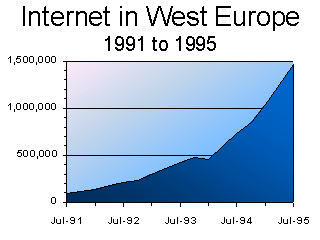
Also computed were statistics for the regions of Western and Eastern Europe, which were arrived at using the 1945-90 "Iron Curtain" border as their delimiter. In addition, several additional continental and regional areas were defined: Africa, Asia/Pacific (Asia, Australia, plus Pacific Islands), Europe, and Latin America (South and Central America plus Mexico).
On this basis, the USA in January 1995 had about 3.18 million Internet hosts, about 65.5% of the worldwide total. The American share of the Internet has generally declined, from 75.1% in July 1991, to 68.7% in July 1992, and 65.4% in July 1993. The European share of the Internet has generally increased, from 15.9% in July 1991 to 22.3% in January 1995. The rest of the world contained about 9% of the Internet in July 1991, and 12.2% in January 1995. Figure 4-6 details these percentages for the months of July 1991 through 1994.
Figure 4-6
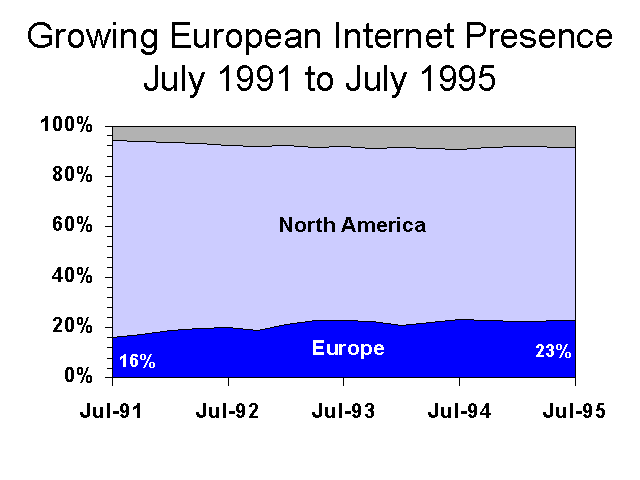
Table 4-6
American and European Internet
Percent Share
July 1991 to July 1994
| Region | July 1991 | July 1992 | July 1993 | July 1994 | July 1995 |
|---|---|---|---|---|---|
| USA | 75.1% | 68.7% | 65.4% | 63.4% | 64.3% |
| Europe | 15.9% | 20.1% | 22.7% | 23.4% | 23.0% |
| R.O.W. | 9.0% | 11.3% | 11.9% | 13.1% | 12.7% |
| Source: raw data from SRI International, percentages by the author |
The 12 members of the European Union as of January 1995 had about 15.5% of the total Internet hosts worldwide. Including the three new applicants (Austria, Finland, Sweden), the enlarged EU15 had 19.2% of the Internet hosts in January 1995. Other important Internet centers within Europe include Norway and Switzerland. Outside of the USA and Europe, the most significant Internet countries include Canada, Australia, Japan, New Zealand, South Korea, Taiwan, Hong Kong, and South Africa.
Figure 4-7
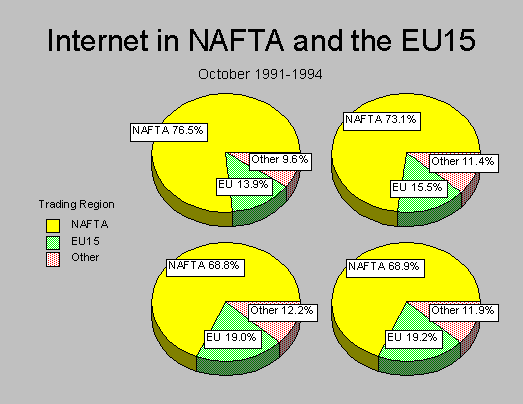
Table 4-7
Internet in NAFTA and the EU15
| Trade Region | Oct. 1991 | Oct. 1992 | Oct. 1993 | Oct. 1994 |
|---|---|---|---|---|
| EU15 | 13.9% | 15.5% | 19.0% | 19.2% |
| NAFTA | 76.5% | 73.1% | 68.7% | 68.9% |
| Other | 9.6% | 11.4% | 12.2% | 11.9% |
| Sources: SRI International, Network Wizards |
Figure 4-7 and Table 4-7 examines the regional distribution of Internet hosts by trading regions, specifically, the two great economic treaty zones, the EU and NAFTA. These statistics illustrate a trend where growth rates are shifting away from the USA and towards other regions such as the EU. In every case, the growth rates observed within the USA and NAFTA during the years 1991 to 1994 were below the average growth rate of the entire Internet. For instance, in the year between July 1992 and July 1993, the growth rate for the entire Internet host base was 80.1%. Growth for the USA was 71.5%, and growth for NAFTA was 72.2%.
In every case, growth rates observed for the EU (with or without its three proposed new members) were higher than the average for the Internet as a whole. In the year to July 1993, the 12-member EU's host count grew 115.4%, and the 15-member EU's host count grew 102.8%. Figure 4-7 contains the observed size of each of these regions, and Table 4-8 contains the observed growth rates in the years 1991 to 1994. Additional details of all 14 quarterly reports collected from July 1991 to January 1995 are compiled in a spreadsheet attached in Appendix A.
In the year between January 1994 and 1995, Internet hosts growth within the 12-member EU was 126%, as the count jumped from 332,506 to 751,785 hosts. This is considerably higher than has been the case in the past. In the year between July 1993 to July 1994, for instance, the growth rate for the 12-member EU was 74.3%.
Growth was slightly higher for a 15-member EU: 141% in the year to January 1995. Growth rates in nine of the 12 existing EU members were above average while growth in Germany, Italy, and the Netherlands was below average. The growth rate in the Netherlands, however, was just fractionally under the overall worldwide average of 67.6%. Growth in all three of the new EU applicants was above average. Norway, which voted against joining the EU during 1994, was reported to be growing at a below average rate during that year.
The year-to-year growth rates for the USA, NAFTA, the EU, and the expanded EU15 in the past four months of July are summarised below in Table 4-8. The overall Internet total is included for comparison's sake. Not included to avoid overlap or repetition is the July 1993-94 growth rates for Europe as a whole (73.5 percent), or for Western Europe (72.0 percent). Those statistics and others can be found on separate spreadsheets attached in the appendix.
Table 4-8
Internet Host Growth Rates in NAFTA & EU15 July 1991 to July 1994
| Internet | Host Growth | Rates | |
|---|---|---|---|
| Trade Region | 1991 to 1992 | 1992 to 1993 | 1993 to 1994 |
| NAFTA | 73.0% | 72.2% | 63.7% |
| EU15 | 150.4% | 102.8% | 74.4% |
| Entire Internet | 87.5% | 80.1% | 67.7% |
| Sources: raw data SRI International & Network Wizards, calculations by the author |
As the chart shows, the Internet has been growing at a below-average rate within the NAFTA zone, primarily because the USA is approaching the saturation point. Growth in Canada and Mexico has been above average, but not by enough to offset the slower growth within the various American top-level domains taken as a whole. Growth rates within the USA will continue to slow as the market approaches saturation. However, saturation in no way implies deterioration or shrinkage. Other "saturated" markets include automobiles, homes, and telephone lines, where new placements roughly approximate the number of retirements. It implies not a drop in size but a drop in annual growth rates.
The growth in Internet hosts within the European Union (for both 12 and 15 members) has always been above average during the period July 1991 to 1994. However, the rates of growth have declined as the years passed. This is entirely due to the nature of statistics. There is no sign that the Internet in Europe is at or near a saturation point, except perhaps in Iceland, Norway, and Sweden, which have some of the world's highest rates of diffusion for Internet usage (based on a comparison of GDP and Internet hosts counts). Regardless of the individual country situations, the installed base has in every case grown by a greater number of units, year to year.
In October 1994, the number of hosts in the 15-member EU region had jumped to 748,261, led by Britain, Germany, the Netherlands, and France. New applicants Sweden and Finland were next, followed by Italy, Spain, then Austria. By January 1995, the EU15 total had grown a further 24% to 930,456 hosts.
Europe as a whole had 881,924 hosts in October 1994, of which 848,972, or 96.3%, were in the traditional "west." The situation by January 1995 was little changed, with 95.7% of some 1.08 million hosts located in the "west."
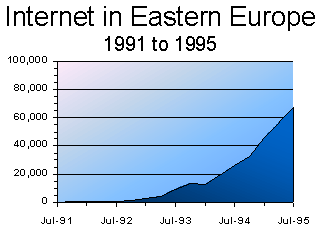
The eastern countries collectively had 32,952 hosts on the Internet in October 1994, and 46,101 hosts in January 1995, representing above-average growth of 40% for the quarter. The host base in Eastern Europe, which had been growing at rates well into the triple digits, was reported to have grown 194% in the year to January 1995.
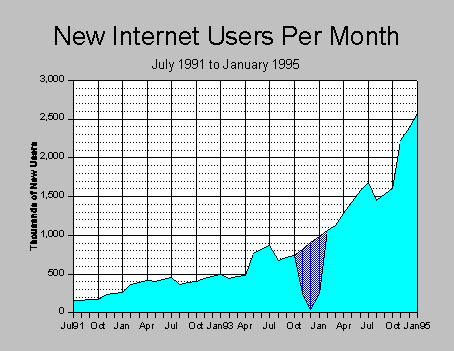
Various studies have estimated that the average number of Internet users per host is in the range of five to ten users per host. For these calculations, the midpoint figure of 7.5 users per host will be used. This results in a January 1995 estimate of about 36.4 million Internet users worldwide, growing at a rate of 2.6 million new users per month since October. The worldwide Internet user base therefore probably crossed the 30 million mark in late 1994, and the 36 million mark in early 1995.
Figure 4-9
Source: SRI International, Network Wizards
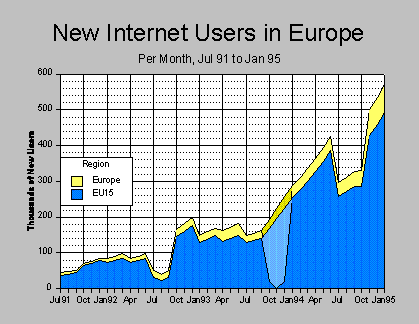
SRI International, the operators of the quarterly survey until January 1994, reported network problems during the final Internet census-taking it was responsible for. For instance, the country of Finland was reported to have dropped from 29,000 hosts in October 1993 to only 3 hosts in January 1994 -- an obvious mistake. For that reason, in the graphs of Figure 4-9 and Figure 4-10, the resulting radical dip in the growth rate has been smoothed to a rate more in keeping with data collected before and after the problem-plagued January 1994 census.
At the beginning of 1993, there were an estimated 10.6 million Internet users worldwide, growing at a rate of 165,000 new users per month. At the beginning of 1994, there were an estimated 16.7 million Internet users worldwide. The user base is now 36.4 million people, increasing at a rate of 2.6 million people per month, based on monthly gains in the host count of better than 340,000 new hosts per month.
Theoretically, the user base would follow about the same regional and economic division as the host count. In other words, the 12-member EU contains about 5.6 million Internet users as of January 1995. The 15-member EU contained just under 7 million Internet users as 1995 began. The Internet user base within the EU-15 is currently expanding at a rate of about 490,000 new users per month, up significantly from the 350,000-a-month pace seen in the first half of 1994, and much higher than the 130,000-a-month pace seen in 1993.
Figure 4-10
Source: SRI International & Network Wizards
Besides the USA (#1), the countries with the largest number of Internet hosts as of October 1994 were Great Britain (#2); Germany (#3); Canada (#4); Australia (#5); Japan (#6); Netherlands (#7); France (#8); Sweden (#9); and Finland (#10). Six of the Top Ten are, or have applied to become, EU members. Germany and Britain have in the past year traded places several times, with Germany briefly holding the #2 spot.
Back in October 1991, Australia was #2, Germany was #3, Canada was #4, and Sweden was #5. There were only 33 countries reported to have hosts registered under their own country codes in October 1991. By October 1994, there were 81 countries with at least one host on the Internet.
The enormous concentration of the Internet within a relative handful of countries continues. In October 1991, the Top Ten Internet countries contained 95.3% of all the hosts. In October 1994, the Top Ten still contained 90.5%. In October 1991, the USA plus the next 25 largest Internet countries contained fully 99.9% of all the hosts. By October 1994, their share had fallen only slightly, to 98.5%. Even as late as January 1995, only ten countries held more than 90% of the Internet. So while the reach of the Internet is growing, the great bulk of it remains concentrated in a relative handful of countries. For the past 3.5 years, well over 90% of the Internet has remained within a handful of countries. As detailed in Figure 4-11, as few as 7, 8 or 9 countries have in the past contained over 90% of all Internet hosts.
At present, it takes only 23 countries to account for over 98% of all Internet hosts, and only 16 countries to account for 95% of all hosts. The remaining 62 to 69 countries hold less than 2% to 5% of the Internet's hosts, and by extrapolation, less than 2% to 5% of its users.
Figure 4-11

Source: SRI International & Network Wizards
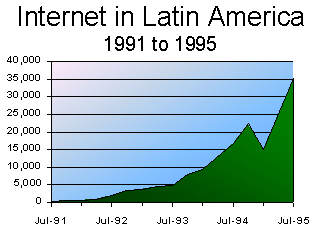
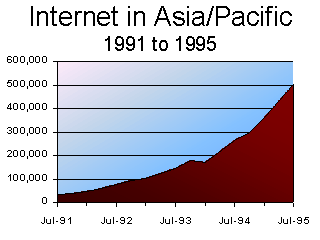
According to the data in Tables 4-12 and Figure 4-13, growth in Eastern Europe, Africa, and Latin America has in every case occurred at triple-digit rates or better (Latin America includes Mexico and Central America, as well as South America).
In the period July 1991-92, in fact, growth rates within Eastern Europe and Africa were measured above 1,000%. Growth in the year to October 1992 in Africa exceeded 11,000%, as the installed based jumped from 25 to 2,837 hosts. In all cases, growth rates have moderated in 1993 and 1994.
In the Asia/Pacific region, which includes large Internet countries such as Australia, Japan, and New Zealand, has the growth rates ever fallen below 100 percent, year over year. The growth rates and raw numbers for these regions are summarised below in Table 4-12.
Table 4-12
Internet Host Growth Rates in Other Regions
July 1991 to July 1994
| Internet | Host Growth | Rates | |
|---|---|---|---|
| Region | 1991 to 1992 | 1992 to 1993 | 1993 to 1994 |
| Eastern Europe | 1,088% | 811.3% | 121.4% |
| Asia & Pacific | 141.7% | 89.2% | 80.1% |
| Africa | 8,224% | 253.2% | 112.9% |
| Latin America | 475.2% | 148.1% | 250.2% |
| Internet Total | 87.5% | 80.1% | 67.7% |
| Sources: raw data SRI International & Network Wizards, calculations by the author |
Figure 4-13
| 
|
| 
|
Sources: raw data SRI International & Network Wizards, calculations by the author
Table 4-13
Internet Hosts in Other Regions
| Total | Internet | Hosts | Found | |
|---|---|---|---|---|
| Region | July 1991 | July 1992 | July 1993 | July 1994 |
| Africa | 25 | 2,081 | 7,350 | 15,700 |
| Latin America | 331 | 1,904 | 4,724 | 16,619 |
| Eastern Europe | 116 | 1,378 | 12,558 | 27,802 |
| Asia & Pacific | 32,034 | 77,416 | 146,447 | 263,635 |
| Internet Total | 569,514 | 1,067,633 | 1,923,304 | 3,225,177 |
| Sources: raw data SRI International & Network Wizards, calculations by the author |
It bears mentioning, though it tends towards repitition, that the four regions identified in the chart above contain only 9.25% of the Internet as of January 1995. In July 1991, however, these regions contained only 5.7% of the Internet. Still, it remains largely accurate to say that the Internet is primarily a phenomenon of the Western industrialised countries.
Turning back to the USA for a moment, the much-heralded shift to a commercial Internet is beginning to show up in the statistics. In the year to January 1995, the number of hosts in top-level domains counted as "commercial" (primarily .COM, .NET, and .US) showed a growth rate of 156%, much faster than the USA as a whole, which grew 115%. The hosts in the "non-commercial" domains (primarily .EDU, .GOV, .MIL, and .ORG) showed an 88% growth rate, well below the USA average.
The commercial sector is growing faster, and will therefore overtake the non-commercial sector in terms of installed base sometime in late 1995 or early 1996. Of the ten annual growth rates computed from the host census reports, the rate for commercial hosts in the USA was above the American average eight times and below twice. The non-commercial average was abover average twice and below average eight times. And the commercial average was ahead of the non-commercial average seven times. So the commercial Internet is growing faster than the non-commercial Internet, at least in the 1991-94 period.
However, in the year between July 1992 and 1993, the number of hosts in the non-commercial Internet grew slightly faster than the American average while the commercial Internet grew slightly slower. The year before, 1991-92, was more in keeping with conventional wisdom, when the commercial Internet grew at a 94.6% rate while the "non-commercial" Internet grew at a 59.3% rate. These trends are detailed in the percentages of Table 4-14.
Table 4-14
Growth of Internet Hosts in the USA
Commercial vs. Non-commercial Sectors
July 1991 to July 1994
| Host | Growth | Rates | |
|---|---|---|---|
| USA by type of host | 1991 to 1992 | 1992 to 1993 | 1993 to 1994 |
| Commercial | 94.6% | 68.7% | 71.1% |
| Non-commercial | 59.3% | 73.3% | 57.3% |
| Total USA | 71.4% | 71.5% | 62.6% |
| Sources: raw data SRI International & Network Wizards, calculations by the author |
In the latest quarter for which statistics are available, October 1994 to January 1995, the surge in corporate (.COM) signups continued. In the July-October 1994 quarter, the (.com) sector became the first in history to pass the million mark, jumping from 774,735 hosts in July 1994 to 1,054,422 hosts in October 1994. By January, it had hit 1,316,966 hosts, a jump of 26%. But the educational, governmental, and other domains also surged, and the .EDU domain became the second to pass the million mark.
At last count, about 47.3% of the hosts on the Internet were registered in the commercial domains (primarily .com and .net), while about 52.7% were in the non-commercial domains (mostly educational, government, and military). It will take several more quarters of strong commercial growth before more than half the hosts are in the commercial sectors, though that day is steadily approaching.
It is important to remember that these measures are being made by top-level domain. It is entirely possible that an Internet host, being used entirely for research, is registered to a commercial company such as IBM. Conversely, it is possible that a host with a top-level domain of ORG is engaged in producing commercial traffic on the Internet. These measures are being made not on the basis of applications, traffic, or users, but solely on the registered name of the host. In addition, in countries besides the USA, the top-level domain codes used by both commercial and non-commercial hosts is the same, so computations are not so forthcoming.
There is the conventional wisdom that the size of the commercial Internet is larger than the non-commercial segment. In fact, authoritative statistics show the opposite: that the commercial share of the Internet has consistently been below 50 percent since at least 1991. The Internet hosts statistics released by SRI International and Network Wizards, as compiled in Figure 4-15 and Table 4-16, show that while the commercial segment is growing, it only recently passed the 40% mark. It is likely to pass the 50% mark in late 1995 or early 1996.
Figure 4-15
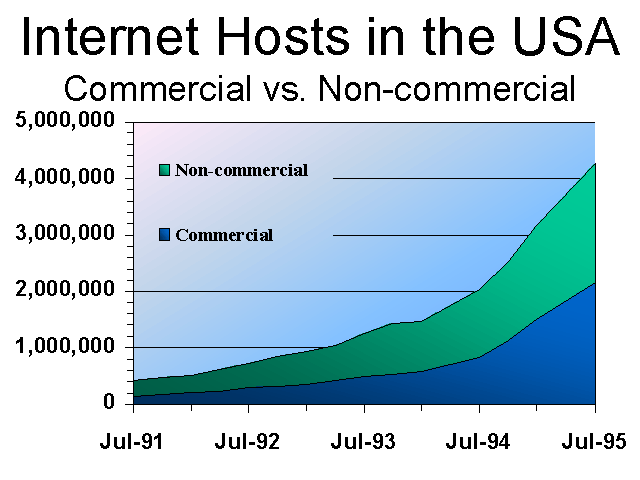
Table 4-15
Internet Hosts in the USA
Commercial vs. Non-commercial Split
July 1991 to Jan. 1995
| Commercial Split | July 1991 | Oct. 1991 | Jan. 1992 | Apr. 1992 | July 1992 | Oct. 1992 | Jan. 1993 |
|---|---|---|---|---|---|---|---|
| Percent Commercial | 34.2% | 36.5% | 41.0% | 35.8% | 38.8% | 37.4% | 38.0% |
| Percent Non-commercial | 65.8% | 63.5% | 59.0% | 64.2% | 61.2% | 62.6% | 62.0% |
| Commercial Split | April 1993 | July 1993 | Oct. 1993 | Jan. 1994 | July 1994 | Oct. 1994 | Jan. 1995 |
| Percent Commercial | 40.5% | 38.2% | 37.6% | 39.8% | 40.2% | 44.8% | 47.3% |
| Percent Non-commercial | 59.5% | 61.8% | 62.4% | 60.2% | 59.8% | 55.2% | 52.7% |
| Sources: raw data SRI International & Network Wizards, calculations by the author |
Outside of the USA, there may very well be more commercial Internet hosts than non-commercial. However, there are no statistics to support that claim, and most of the anecdotal evidence supports the opposite. In many other top Internet countries, the bulk of Internet users are in the academic and research communities, precisely where the bulk of the American user base was three to five years ago. As additional evidence, the rate of new host signup seems to dip every summer in Europe, a period during which most students are on recess and academic activity slows in general.
In fact, some say that the percentage of the Internet outside of the USA that is in schools and research organisations may be even higher than it is in the USA. Since many of the 85 countries presently on the Internet are in the first stages of Internet adoption, it is more likely that the vast majority of the hosts on the Internet in those countries are used by schools, universities, and governments, as they were within the USA in the early 1980s.
Furthermore, the long-heard claim that more than half the growth of the Internet is in the commercial domain only recently became accurate, at least within the USA. Thanks to the strong growth seen since July 1994, the commercial sector has accounted for well over half of the new hosts that registered since October 1993. In 1993, commercial domains represented only 43.4% of all new hosts added in the USA. In 1992, commercial hosts accounted for only 37.2% of the total growth.
5.0 CHAPTER FIVE
5.1 INTERNET TRAFFIC PATTERNS IN 1993 AND 1994
Internet traffic volumes are somewhat harder to pin down. The problem is the very nature of the Internet. It is not one network at all. Rather, it is composed of thousands of networks -- some 25,000 as of July 1994 -- that are interconnected using the TCP/IP protocols. Still, there are only a few backbone networks that take on the role of providing a central point for interconnection. One of these is the NSFnet, run since 1987 on behalf of the National Science Foundation in Washington, DC.
The NSFnet is a network of networks. Its primary role is to interconnect other networks such as the regional Internets. Not every Internet connection must go through the NSFnet. Only those that are connecting users or hosts on different regional networks, or those in different countries, will use the NSFnet.
In addition, many commercial Internet access providers have purposefully routed their interconnections around the NSFnet, to avoid running afoul of its non-commercial usage rules. There are many Commercial Internet Exchange (CIX) carriers whose traffic seldom traverses the NSFnet Backbone Service.
Having said all that, the NSFnet is enormous. It is by far the largest network counted as part of the Internet community. Its traffic volume represents at least 75% and perhaps 90% of all Internet traffic. Another large chunk of traffic is routed through the Internet hub service operated by CERN, the European Laboratory for Particle Physics located in Geneva.
Monthly traffic volumes on the NSFnet averaged 16.4 trillion bytes in 1994, up from 7.6 trillion bytes in 1993. The NSFnet operators provide monthly statistics in terms of both bytes and packets. Measured in packets, the average monthly volume in 1994 was 79.8 billion packets, up from an average of 39.8 billion bytes in 1993.
The traffic volume for all of 1994 topped 197 trillion bytes and 958 billion packets, with the biggest month coming in November, at 22.5 trillion bytes and 106.6 billion packets. December was close behind, at 21.75 trillion bytes (21,750,000 Megabytes) and 99.7 billion packets.
The difference between measuring Internet traffic in bytes and packets is slight. Some types of traffic create packets with more data in them than others. The network average is about 205 bytes per packet, but it varies tremendously from an average of 70 packets per byte for telnet users to 170 bytes/packet for e-mail, and 360 bytes/packet for file transfers.
To neutralize this variance among applications and to maintain consistency, only measurements in bytes per month will be considered in the comparisons of section 5.2, though results would be similar if packets were considered. In section 5.3, which discusses country-by-country statistics, the NSFnet packet count will be used.
5.2 NSFNET TRAFFIC PATTERNS BY APPLICATION
The composition of the NSFnet traffic varies month to month, but some clear trends can be identified. In the current year, about 68% of the traffic is accounted for by six applications. File transfers, using the FTP protocol, average 35.3% of the monthly byte volume. Transfers of the Usenet News Groups, using the NNTP protocol, account for about 10.5% of the NSFnet bytes per month. Electronic mail, using the SMTP protocol, account for a further 6.3% of byte volume. Remote terminal logins, using the telnet protocol, account for an additional 4.9% of volume.
Use of the World Wide Web is surging, however. It began 1994 accounting for 2.6% of the traffic in January. By December its share had soared to 16% of bytes. For the entire year, the World Wide Web accounted for 7.4% of bytes, up from 0.7% in 1993.
Use of "Gopher" for network navigation also is growing, taking an additional 3.7% of traffic in 1994, up from 1.9% in 1993. Gopher derives its name from the mascot of the school at which it was invented: the University of Minnesota. It is, however, a very appropriate name for an Internet navigation utility that helps people burrow through file libraries and directories.
Remaining protocols and applications -- and there are dozens -- account for about 32% of traffic. Only a handful are used to generate more than 1% of traffic. However, literally dozens of specialist protocols and applications each generate a few tenths of a percent of the Internet's traffic.
What follows in Table 5-1 is a partial listing of protocols from the December 1994 NSFnet traffic report, which includes all protocols and applications that were used to generate at least 0.001% of the network's traffic (measured in packets). Several dozen protocols which the network operators could not identify (and therefore listed as unknown) are omitted, as are the many protocols that accounted for less than 0.001% of traffic.
Table 5-1
NSFnet Backbone Service
Traffic Distribution for December 1994
Packet Total:  99,696,592,300 packets

Byte Total:  21,750,840,932,250 bytes

Bytes per Packet:  218 bytes/packet average


Service Name     Packet Count    % Pkts          Byte Count   % Bytes

============   ==============   =======   =================   =======

ftp-data       19,572,625,600   19.632%   6,886,925,643,300   31.663%

other_tcp/udp  16,843,870,200   16.895%   3,017,129,951,350   13.871%

www            11,672,375,900   11.708%   3,475,374,706,500   15.978%

telnet         10,810,344,400   10.843%     850,344,092,550    3.909%

nntp            9,830,212,750    9.860%   2,378,838,642,400   10.937%

smtp            7,276,030,300    7.298%   1,220,168,622,000    5.610%

domain          5,878,731,450    5.897%     593,712,989,150    2.730%

ip              2,990,981,850    3.000%     794,852,485,650    3.654%

gopher          2,776,513,700    2.785%     778,290,801,250    3.578%

irc             2,699,381,950    2.708%     299,214,178,450    1.376%

ftp             1,891,428,550    1.897%     150,352,737,300    0.691%

icmp            1,771,951,150    1.777%     182,765,774,350    0.840%

X0                620,054,900    0.622%     128,029,549,500    0.589%

unidata-ldm       591,553,800    0.593%     178,123,820,650    0.819%

login/who         343,580,150    0.345%      45,941,679,000    0.211%

talk              301,480,200    0.302%      31,214,482,700    0.144%

efs/router        273,153,350    0.274%      35,211,493,200    0.162%

vmnet             255,443,050    0.256%      96,718,102,800    0.445%

snmp              235,974,100    0.237%      28,408,489,550    0.131%

ntp               198,840,700    0.199%      14,934,867,100    0.069%

finger            185,041,700    0.186%      20,567,980,500    0.095%

auth              180,847,550    0.181%       7,816,512,750    0.036%

cmd/syslog        134,013,350    0.134%      42,842,232,000    0.197%

igmp              123,535,350    0.124%      40,888,126,400    0.188%

bgp                97,966,400    0.098%       6,228,787,050    0.029%

uucp               93,358,100    0.094%      25,392,912,600    0.117%

ipx                79,066,750    0.079%      25,081,966,500    0.115%

netbios-ssn        54,397,900    0.055%      18,291,121,900    0.084%

ntalk              40,146,800    0.040%       4,213,881,850    0.019%

chargen            37,955,450    0.038%       3,351,153,500    0.015%

z39.50             34,467,700    0.035%      10,335,865,150    0.048%

csnet-ns           30,688,350    0.031%       3,245,217,150    0.015%

netbios-ns         26,980,300    0.027%       2,207,440,350    0.010%

pop3               26,912,450    0.027%       3,424,894,700    0.016%

snmptrap           26,103,400    0.026%       2,247,891,750    0.010%

locus-con          23,681,100    0.024%       2,451,861,100    0.011%

time               22,772,650    0.023%         710,772,400    0.003%

sunrpc             20,936,900    0.021%       1,645,111,350    0.008%

netbios-dgm        17,732,900    0.018%       4,454,356,250    0.020%

metagram           17,009,500    0.017%       4,437,440,300    0.020%

ipip               16,378,700    0.016%       2,047,847,100    0.009%

netrjs-1           15,871,100    0.016%       3,818,261,150    0.018%

nicname            15,087,950    0.015%       1,682,336,900    0.008%

igp                14,208,200    0.014%      17,116,138,700    0.079%

any-prjes*         13,712,600    0.014%       5,279,811,000    0.024%

imap2              11,924,500    0.012%       3,808,651,400    0.018%

ax.25               9,034,950    0.009%         958,389,400    0.004%

aurp                8,894,750    0.009%         726,224,700    0.003%

exec/biff           7,286,500    0.007%       2,693,323,900    0.012%

pup                 5,906,700    0.006%         124,042,650    0.0006%

kshell              5,798,500    0.006%         901,699,850    0.004%

timed               4,537,700    0.005%         442,416,750    0.002%

X1                  4,457,150    0.004%         774,765,600    0.004%

ipcserver           4,020,800    0.004%       1,041,788,850    0.005%

ris                 3,623,900    0.004%         949,113,850    0.004%

cadlock             3,615,150    0.004%         563,023,000    0.003%

discard             3,575,300    0.004%       1,278,557,950    0.006%

netrjs-2            3,534,050    0.004%         954,590,250    0.004%

any-pdos*           3,429,400    0.003%       1,439,770,750    0.007%

klogin              3,341,250    0.003%         209,242,250    0.001%

tftp                3,114,300    0.003%         174,673,050    0.0008%

src                 2,981,400    0.003%         906,952,600    0.004%

merit-inp           2,939,550    0.003%         139,663,050    0.0006%

arns                2,859,900    0.003%         302,934,400    0.001%

tcpmux              2,711,750    0.003%         339,432,200    0.002%

X3                  2,647,950    0.003%         239,413,800    0.001%

bootpc              2,537,150    0.003%         835,141,700    0.004%

any-pps*            2,536,150    0.003%         557,873,900    0.003%

sql-net             2,515,900    0.003%         596,437,600    0.003%

printer             2,264,650    0.002%         102,794,800    0.0005%

iso-tp4             2,252,900    0.002%         104,091,550    0.0005%

egp                 2,064,000    0.002%         328,440,200    0.002%

gppitnp             2,049,350    0.002%         313,694,850    0.001%

device              1,946,900    0.002%         673,411,700    0.003%

hosts2-ns           1,939,250    0.002%         548,540,150    0.003%

mcidas              1,830,050    0.002%         609,655,300    0.003%

iso-tsap            1,716,500    0.002%         410,977,100    0.002%

X2                  1,711,050    0.002%         207,914,950    0.001%

remote-kis          1,634,000    0.002%         145,163,600    0.0007%

netrjs-4            1,602,850    0.002%         428,040,600    0.002%

netrjs-3            1,446,200    0.001%         431,966,950    0.002%

daytime             1,384,050    0.001%          67,682,050    0.0003%

cfdptkt             1,336,500    0.001%         413,678,050    0.002%

hostname            1,287,000    0.001%         338,746,600    0.002%

echo                1,257,850    0.001%         437,586,650    0.002%

newacct             1,163,200    0.001%         291,660,800    0.001%

aes-sp3-d           1,126,850    0.001%         280,408,900    0.001%

xdmcp               1,115,850    0.001%          74,744,850    0.0003%

acr-nema            1,039,950    0.001%         249,962,600    0.001%

at-rtmp             1,036,900    0.001%          85,251,850    0.0004%

loc-srv             1,022,350    0.001%         109,829,050    0.0005%

vines                 984,400    0.001%         113,490,800    0.0005%


Source: Merit Network Inc.
It is easy to lose sight of what these figures mean, especially when data is counted in the billions and trillions of units. Suffice it to say that while the vast majority of Internet traffic follows one of six standard protocols, the remaining portion is spread among more than a hundred protocols, each of which has its pockets of adherents. Some of the additional protocols come from other standards bodies, such as the ISO, while others come from major datacomm vendors, such as Microsoft Corp.(NetBIOS) or Banyan Systems Inc.(VINES).
Still, it remains true that the Internet is concentrated around a relative handful of application services and their respective protocols. These core applications services include file transfer, news distribution, and electronic messaging.
The amount of traffic on just the NSFnet for these applications dwarfs its counterparts outside of the Internet community. In other words, value-added networks such as SprintNet/Telenet or the IBM Information Network carry but a fraction of the traffic that traverses the NSFnet. Those services report the occasional month where traffic passes 5,000 Gigabytes, which is less than 1/4 the NSFnet's total.
Put another way, the NSFnet carried about 2.25 billion e-mail messages in 1993, about four times as many messages as the entire commercial X.400-based e-mail community carried that year. This figure is estimated based on the SMTP byte count, and an assumption that each message averaged 2,500 characters.
In 1994, the NSFnet carried close to 5 billion messages. If the NSFnet were charging the prevailing commercial rate per message, its e-mail turnover alone would have surpassed $1.8 billion in 1993, and would have more than doubled to $4 billion in 1994. In contrast, commercial e-mail carriers in the USA such as AT&T EasyLink, MCI Mail, and CompuServe Inc., together had 1993 turnover of about $440 million, and 1994 turnover of about $600 million.
The question remains whether their combined turnover would have been even larger, had it not been for the Internet. Students and researchers are highly unlikely to spend 80 cents per message. Much of the Internet's NNTP news and SMTP e-mail traffic flows only because it is "free". Many users do not pay extra if they subscribe to a dozen news groups or a hundred mailing lists, and receive a million bytes of traffic a day. Those that do pay -- the ones accessing their mailboxes through dial-up long distance links -- are much more frugal about where and what they subscribe to.
It is entirely possible that if Internet users were billed on a usage-sensitive basis, they would not be such prolific authors and consumers. The price-sensitive portion of the Internet's traffic would evaporate if per-message fees were imposed. There is no way to measure this until flat-rate pricing schemes are discontinued, which is highly unlikely.
As high as the traffic volumes are, they are not incredibly high. Let's assume that the NSFnet was used to deliver 5 billion e-mail messages in 1994. Divided among the estimated 30 million subscribers, that equals about 167 messages per user per year, or less than one message per weekday. Similarly, that figure of 197 trillion bytes in 1994 equals only 6.58 Megabytes per user per year, or only 26 Kbytes per weekday per user. These NSFnet traffic totals are well within the range of beleivability.
It warrants repeating that e-mail comprises only 6.3% of the NSFnet's traffic. Yet it is four times as large as its counterpart in the commercial realm, in terms of bytes. The percentages of NSFnet bytes apportioned to mature and established services such as remote terminal logins, e-mail, and Usenet News Groups have more or less held steady in 1993 and 1994. The amount of file transfers using FTP has trailed off somewhat, from a high of 46.8% at the beginning of 1993 to a low of 31.7% at the end of 1994. It appears that Internet users have begun to migrate from FTP to more user-friendly file retrieval tools such as the World Wide Web.
5.3 THE RISE OF THE WORLD WIDE WEB
The protocols that drive the World Wide Web service were created in 1989 by researchers at CERN, the Geneva-based Organisation Européenne pour la Recherche Nucléaire (European Organization for Nuclear Research). According to CERN's director-general, the Web "was invented at CERN to improve communication between our many international collaborators." As its name implies, CERN is otherwise primarily concerned with nuclear particle physics. However, in the past six years its little experiment in communications protocols has grown from obscurity to near the top of the protocol pack.
Back in January 1993, there were dozens of protocols and applications with a larger share of monthly traffic than the World Wide Web. However, the World Wide Web service gradually passed most of them in popularity. It passed the Gopher service, measured in terms of NSFnet bytes per month, in March 1994. It passed telnet in May 1994. World Wide Web passed SMTP, the e-mail protocol, in July 1994, and passed NNTP, the Usenet News Group protocol, in November 1994. It is now second, behind file transfer in terms of bytes, and third behind file transfers and telnet in terms of packets. It seems likely that soon the Web protocols will be the leading traffic generator on the Internet.
The World Wide Web is now poised to become the foundation of Electronic Commerce on the Internet. It is extremely useful for electronic catalogs and online shopping services. However, the Internet is not yet secure enough to allow users to trust their credit card or bank account information to the wires. So while people can browse and gather information, they cannot as of yet pay for their goods using the Internet.
The source and destination of the traffic is not normally analysed by the type of organisation. However, in April 1994, in response to Congressional questioning, the NSF said less than six percent of traffic either begins or ends with a government organisation. Only about two percent of NSFnet traffic begins and ends wholly within a government organisation, NSF said.
The monthly totals for both packets and bytes sent over the NSFnet backbone for the months December 1992 to July 1994 are detailed in Table 5-3. Figure 5-2 graphically illustrates growth in bytes, and Figure 5-4 contains a plot of NSFnet monthly packets.
Figure 5-2
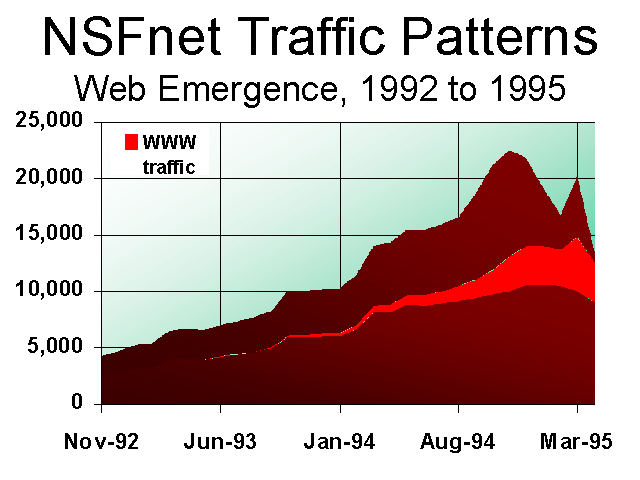
Table 5-3
NSFnet Packet and Byte Detail
1993 to 1994
| Month | Packets | Bytes |
|---|---|---|
| Jan 1993 | 27,459,168,150 | 5,159,543,112,250 |
| Feb 1993 | 30,006,999,150 | 5,437,317,967,750 |
| Mar 1993 | 34,874,064,400 | 6,502,203,065,800 |
| Apr 1993 | 36,242,500,150 | 6,708,134,170,200 |
| May 1993 | 34,509,184,650 | 6,522,423,697,350 |
| Jun 1993 | 36,373,705,600 | 6,932,825,104,700 |
| Jul 1993 | 38,490,966,200 | 7,367,382,469,700 |
| Aug 1993 | 39,013,861,400 | 7,704,071,912,250 |
| Sep 1993 | 43,278,074,950 | 8,268,586,809,600 |
| Oct 1993 | 51,114,053,550 | 10,079,562,831,500 |
| Nov 1993 | 53,297,042,200 | 10,032,250,470,650 |
| Dec 1993 | 52,417,597,400 | 10,185,121,052,450 |
| Jan 1994 | 55,305,691,300 | 10,294,076,393,700 |
| Feb 1994 | 59,978,894,650 | 11,415,444,417,600 |
| Mar 1994 | 69,552,904,950 | 14,024,028,116,050 |
| Apr 1994 | 71,504,084,850 | 14,312,300,661,250 |
| May 1994 | 76,099,207,500 | 15,457,170,813,800 |
| Jun 1994 | 75,280,338,950 | 15,350,480,259,500 |
| Jul 1994 | 74,941,251,400 | 15,947,658,867,700 |
| Aug 1994 | 79,781,018,700 | 16,541,742,151,700 |
| Sep 1994 | 89,144,453,350 | 18,622,407,085,450 |
| Oct 1994 | 100,133,948,600 | 21,197,056,320,800 |
| Nov 1994 | 106,638,100,250 | 22,462,439,417,900 |
| Dec 1994 | 99,696,592,300 | 21,750,840,932,250 |
Figure 5-4
Source: Merit Network Inc.
Merit Network Inc. is the organisation that, along with MCI Communications Corp. and IBM Corp., runs the NSFnet backbone on behalf of the National Science Foundation. The companies formed a joint venture called Advanced Network & Services Inc., of Elmsford, New York, to focus on the task of NSFnet network management. America Online Inc. recently agreed to acquire that company, primarily so it can use the company's high-speed T3 network for its own purposes.
Among Merit's responsibilities is the task of gathering traffic data, which its Network Information Centre (NIC) publishes monthly in a variety of online forms. The statistics included here are gathered via file transfer from the nic.merit.edu server operated by Merit NIC.
The biggest monthly jump in traffic volumes seems to come in February-March, when both packet and byte volumes jump at double-digit rates. In February-March 1993, bytes were up 19.6% while packets were up 16.2%. In February-March 1994, bytes were up 22.9% and packets were up 16.0%.
Another spike is apparent when classes resume at the universities that are the NSFnet's heaviest users. In September-October 1993, byte volume jumped 21.9% and packet volume jumped 18.1%. In September-October 1994, byte volume grew 13.8% while packet volume jumped 12.3%. In October-November 1994, growth returned to normal, at 6% in bytes and 6.5% in packets.
The average monthly gain in byte volume during 1993 was 6.2 percent. This picked up somewhat in 1994, to an average of 7.3% a month growth. The average monthly gain for packet volume in 1993 was 6.2 percent. Surprisingly, the average growth rate for packets per month was down slightly, to 5.7% per month in 1994.
Since January 1993, the average monthly gain has been in the range of 6.9% for bytes and 6.1% for packets. However, not every month has shown positive growth. In the two-year period, the monthly byte volume dropped four times and the monthly packet volume dropped five times.
As Figures 5-2 and 5-4 illustrate, the general trend has been upwards, despite the occasional declines. Volume for the entire year 1994 was up 117% in byte terms and 101% in packet terms, to a total of 197,375 Gigabytes and 958 billion packets. Volume in 1993 was 90,899 Gigabytes and 477 billion packets.
The monthly slowdowns seem to occur at around the same time as schools let out for the summer recess and Thanksgiving/Christmas holiday breaks. The NSFnet's byte volume dropped 2.8 percent in April-May 1993, -0.5 percent in October-November 1993, and -0.7 percent in May-June 1994. Growth rates were very low during the late fall and early winter of 1993-94. The NSFnet's packet volume dropped 4.8 percent in April-May 1993, -1.7 percent in November-December 1993, -1.1 percent in May-June 1994, and -0.5 percent in June-July 1994.
During the spring of 1994, before the school year ended, the NSFnet was carrying about 987 billion bytes of e-mail per month. Using the industry average of 2,500 bytes per message, this represents some 395 million messages per month. Volume has since then peaked at 1,410 Gigabytes of e-mail, or about 565 million messages a month, during the month of October 1994. This is perhaps eight times larger than any traffic volume ever experienced by a commercial e-mail network such as AT&T Mail or CompuServe.
CompuServe, in fact, reports a monthly exchange between its network and the Internet of about 3 million messages. America Online trades 16 million messages a month with the Internet. Prodigy Services Co. said its subscribership went up 10% in a matter of months when it added easy access to the World Wide Web.
Clearly, the Internet is an enormous phenomenon. Its usage outstrips anything experienced in the commercial sectors of the European and the American data communications markets. In byte terms, it is larger than any managed data network or value-added network. The surprise is how little money changes hands, relative to the amount of users or the amount of traffic.
End users mistakenly believe that while little money changes hands, the Internet is somehow "free." It is not. End users do not count the amounts of money spent buying routers and host computers, or the salaries of the people who run them. These are the major costs of the Internet.
5.4 NSFNET TRAFFIC PATTERNS BY COUNTRY
Every month, the NSF measures the amount of NSFnet traffic originating from, or terminating in, each of the countries that are part of the Internet community. In 1994, host computers in all of the 15 EU member countries accounted for about 4.8% of the inbound traffic to the NSFnet, and about 5.8% of the outbound traffic from the NSFnet, in terms of packets. Traffic into the NSFnet from the EU15 region topped 41.9 billion packets, and traffic out accounted for 50.95 billion packets. The surplus for the EU15 stood at 9.05 billion packets for the year.
The largest surplus was found in Britain, which imported 2.64 billion more packets than it exported to the NSFnet in 1994. But in percentage terms, Italy and Greece imported a much higher amount than Britain. The figures for Greece are 246.6 million packets in, 377.2 million out, for a national surplus of 130.6 million packets. This is a difference of 34.6% between input and output. Italy exported 1.18 billion packets and imported 2.29 billion packets, meaning it got back about twice as much as it gave.
Figure 5-5
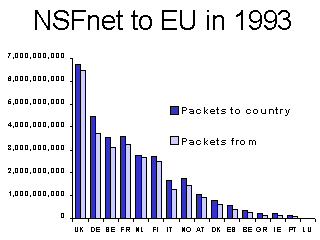
| 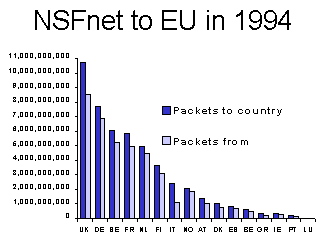
|
Source: Merit Network Inc.
The NSFnet itself is always in balance, that is, as many packets enter the network as exit. However, most countries receive more data from the network than they send to it. In a study of NSFnet traffic patterns in the 24 months of 1993 and 1994, only 12 out of the top 26 Internet countries turned in any deficits (output-input=negative). Only seven did so more than twice in the 24-month period.
The 26 countries were selected from a list of 81 using two criteria. All 15 EU members and applicants were automatically included, as were all countries with 10,000 or more hosts connected to the Internet in October 1994. This resulted in a list of 26 countries, which together account for 97.9% of the hosts and 98.7% of the traffic on the Internet. By way of comparison, these 26 countries account for about 84% of the world's GDP and about 17% of the world's population.
The only countries to experience a net deficit for the entire 24 months were the USA and Switzerland. All 24 others had a net surplus (output-input=positive) for the period. The USA was the only country to have a deficit in all 24 months. Next was Switzerland (17), followed by Australia (6), the Netherlands (6), and New Zealand (4). Spain and Taiwan both experienced three deficits, Finland and France registered two, and Canada, Luxembourg, and Sweden each experienced one.
Figure 5-6
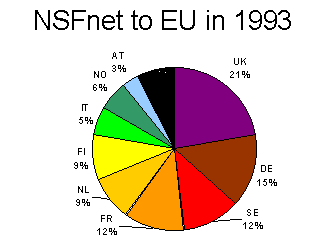
| 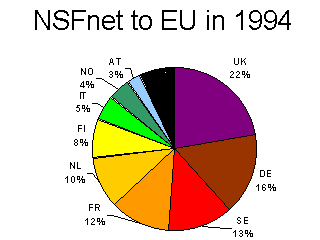
|
Source: Merit Network Inc.
In sum, in the 24 monthly reports for 26 countries, there were 70 deficits and 554 surpluses. In the EU15, there were 15 deficits and 345 surpluses. The EU15 taken as a whole experienced 24 surpluses and no deficits. In an aggregate figure for all the other Internet countries outside of the 26, there were 23 surpluses and one deficit over the two-year period.
Hosts located in the USA accounted for 87% of the traffic into the NSFnet and 85% of the traffic out from the network, a deficit of some 18.9 billion packets. The EU15 accounted for 4.8% of the traffic in and 5.8% of the traffic out, a surplus of 9.05 billion packets. Still, the American deficit was equal to only 2.5% of its outbound total. So while the raw number is large, the deficit in percentage terms was small. The surplus for the EU15, on the other hand, was equal to 17.8% of its outbound total.
The surpluses and deficits have no economic consequence. That is, there is no money being paid by one country to another, as there would be if the commodity were minutes of telephone traffic or more generalised merchandise trade. The commodity in this case is information, which is neither bought nor sold. It is simply transferred. The deficits in the USa and the surpluses elsewhere are happening because many European, Australian, and Japanese Internet users are downloading information from American databases, and few Americans are downloading data from Japan or Europe. The reason that Switzerland is so frequently in deficit is perhaps two-fold. First, its datbases are sought after. Second, the CERN lab within its borders functions as something of a European switching hub for the Internet.
Looking just at the 15-member EU, the leading Internet country is clearly Britain. As Figure 5-5 illustrates, the country accounted for about 22.7% of all of the EU's traffic with the NSFnet in 1994. Its share in 1993 was 24.5%. Next was Germany, with 17.4% in 1994 and 15% in 1993. Then comes Sweden, accounting for 13.7% in 1994 and 12.1% in 1993. Fourth is France, at 13.1% in 1994 and 12.1% in 1993.
Figure 5.7
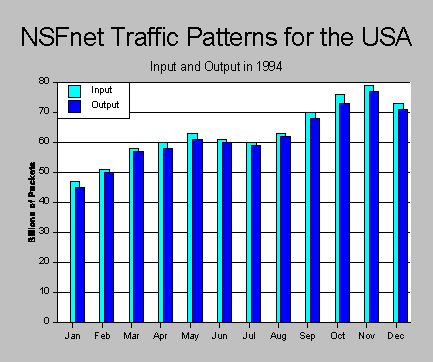
Source: Merit Network Inc.
Outside of the EU15, the most important Internet countries are Australia, Canada, Hong Kong, Japan, New Zealand, Norway, South Africa, South Korea, Switzerland, Taiwan, and the USA. Data for these countries is presented in two charts:
Figure 5-7 for the USA and Figure 5-8 for the other ten countries.
Figure 5-8
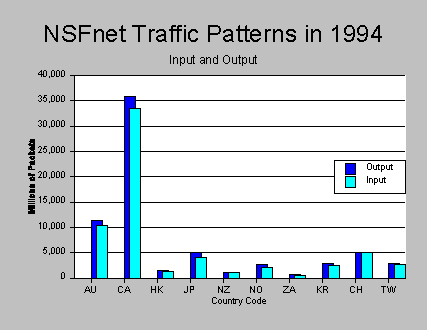
Source: Merit Network Inc.
These 26 countries essentially are the Internet. They contain nearly all of the Internet's hosts and generate nearly all of the traffic that flows into and out of the NSFnet.
Quite a bit is known about these countries, both in socio-economic terms and in terms of telecommunications usage. These statistics, combined with the rich amount of Internet data known for 1993 and 1994, allow some in-depth analysis of traffic patterns.
5.5 DATA IMPORT AS A FUNCTION OF ECONOMIC CONDITIONS
Data was collected for the 26 countries, for Gross Domestic Product, population, postal mail volumes, and such telecommunications-related measures as the installed bases for fax machines, cellular phones, regular phones, office equipment, computers, and pagers. This data was combined with existing statistics for Internet host populations and traffic patterns using the following formula:
                    OE + PM + CP + PC + TP + FM + PG
IT Quotient   =    __________________________________

                         GDP  x  Host  x  NSF

Key:


OE = Total spending on office equipment in 1990, in US$
PM = Pieces of mail delivered in 1990
CP = Number of cellular phone subscribers in 1994
PC = Number of computers in use in 1993
TP = Number of telephones in use in 1990
FM = Number of fax machines in use in 1992
PG = Number of pagers in use in 1992
GDP = Per capita Gross Domestic Product in 1995 (US$ Estimates)
Host = Number of host computers on the Internet in October 1994
NSF = Sum of NSFnet inputs + outputs in 1994, in billions of packets
The statistics were assembled into a spreadsheet, and the calcutaions performed. As an example, the following statistics were used to compute an IT Quotient for Australia:
OE = US$13,364,000,000
PM = 3,493,185,000
CP = 760,000
PC = 3,400,000
TP = 8,727,000
FM = 600,000
PG = 330,000
GDP = US$18,100
Host = 133,886
NSF = 21.74396245
This results in a calculation of:
     16,871,014,000
_________________________

  52,692,940,034.11067
which, when rounded off to four decimal places equals 0.3202 for the IT Quotient of Australia. Similar calculations were performed for the other 25 countries under study.
The 26 IT Quotients were sorted from smallest to largest, resulting in the following list of IT quotients, from smallest to largest:
Table 5-9
IT Quotients for 26 Countries
| Country | IT Quotient |
|---|---|
| USA | 0.0069 |
| Canada | 0.2005 |
| Australia | 0.3202 |
| Sweden | 1.4045 |
| Netherlands | 1.6692 |
| Switzerland | 1.7157 |
| Finland | 1.7207 |
| UK | 1.8568 |
| Norway | 2.5361 |
| Germany | 3.1518 |
| New Zealand | 3.1681 |
| France | 6.1020 |
| Hong Kong | 6.8576 |
| Taiwan | 10.4708 |
| Austria | 11.0651 |
| Japan | 15.6954 |
| Denmark | 19.4710 |
| South Korea | 28.4587 |
| Belgium | 37.0870 |
| Spain | 39.1307 |
| South Africa | 40.6125 |
| Italy | 75.1116 |
| Greece | 86.8670 |
| Ireland | 139.7509 |
| Portugal | 154.7880 |
| Luxembourg | 1411.6897 |
Next, the 26 countries were broken into four groups. The USA was kept by itself in a special Group U. The countries with the next eight lowest IT Quotients were combined into a Group A, whose members would theoretically have the highest rates of diffusion for computers and telecommunications, as well as the highest levels of economic activity. Their IT Quotients ranged from 0.2005 to 2.5361.
The middle-most nine countries on the list were placed into Group B, whose members would have near-average rates of IT diffusion. Their IT Quotients ranged from 3.1518 to 28.4587. The lowest eight countries were placed into a Group C, which had the lowest rates of IT diffusion among the 26 countries. Their IT Quotients were 37.0870 and above. The four groupings are detailed in Table 5-10.
Table 5-10
The Four Country Groupings
Formed Using IT Quotient
| Group A | Group B | Group C |
|---|---|---|
| Canada | Germany | Belgium |
| Australia | New Zealand | Spain |
| Sweden | France | South Africa |
| Netherlands | Hong Kong | Italy |
| Switzerland | Taiwan | Greece |
| Finland | Austria | Ireland |
| United Kingdom | Japan | Portugal |
| Norway | Denmark | Luxembourg |
| South Korea | ||
| Group U | ||
| USA |
Thus the four groups were formed, containing countries that were above (A), below (C), and very near (B) the worldwide IT average, plus the USA treated separately (U). Because the vast majority of worldwide Internet activity takes place within its borders, the USA's share of the NSFnet traffic is very high. Therefore, its inclusion in Group A would skew the results.
Next, calculations were made using the traffic patterns each of the 26 countries experienced with the NSFnet from January 1993 through December 1994. For each of those 24 months, the number of packets of data sent from each of the 26 countries to the NSFnet was counted, as were the number of packets of data sent from the NSFnet to each of the countries. Also calculated was the sum of input plus output, as well as the difference.
Theoretically, the number of packets sent into the NSFnet would always equal the number of packets sent out from the network. However, this is not the case for any single country. Most countries send slightly more than they receive, or receive slightly more than they send.
During the 24 months examined, in fact, most countries repeatedly registered surpluses with the NSFnet. Among the 26 countries, and among 24 monthly reports for each (24 x 26 = 624), there were a total of 554 surpluses and 70 deficits (554 + 70 = 624). Of the 70 deficits, 24 were recorded by the USA, 17 by Switzerland, six each by Austria and Netherlands, and 17 by the other 22 countries. In other words, the other 22 continuously received more data from the NSFnet than they sent to it.
Only the USA and Switzerland had annual deficits (input to NSFnet exceeds output from NSFnet for the year as a whole). A major contributor to the Swiss tendency towards deficits, besides its sophisticated IT infrastructure, may be the Internet's architecture, under which a major switching centre is located at the CERN laboratory in Geneva. However, just as with the NSFnet, exactly as many bits must enter the CERN switching hub as will leave it.
The other 24 countries had annual surpluses. In fact, 14 of these 24 countries registered a surplus every month, and did not once record a deficit. Three recorded only a single deficit apiece over the 24 months, and two more recorded 2 deficits and 22 surpluses each over the two-year period.
Among the three multi-country groups, the correlation between a low IT Quotient and a high rate of monthly NSFnet deficits was extremely high. Group A had 33 deficits, Group B had 9, and Group C had only 4. Group U, the USA, had 24 monthly deficits -- every month in the survey.
This suggests that coutries with low IT Quotients, and therefore high rates of computer and communications usage, tend to be net exporters of data on the Internet. Countries with low rates of computer and communications usage tend to be net importers of data. This is further confirmed by graphs of the actual rate of data import and export.
Next, the magnitude of the monthly surpluses and deficits was compared over time, using the formula:
                         Packets Into NSFnet
Internet Ratio =    ______________________________

                        Sum of Input + Output
The 624 ratios thus computed ranged in magnitude from .3097 (a very large surplus) to .6550 (a very large deficit). Accuracy was maintained at four decimal places throughout this process. Of the 624 ratios for the 26 countries over 24 months, 554 were above .5000 and 70 were below .5000, corresponding to the number of surpluses and deficits. The NSFnet as a whole always had a ratio of .5, meaning that as many packets arrived as departed, and that input always equaled output for the network itself.
For each of the 26 countries, the series of 24 ratios were plotted on a graph. Those graphs are summarised in the following three charts, Figures 5-11 through 5-13, containing the members of Groups A, B, and C, respectively.
Figure 5-11
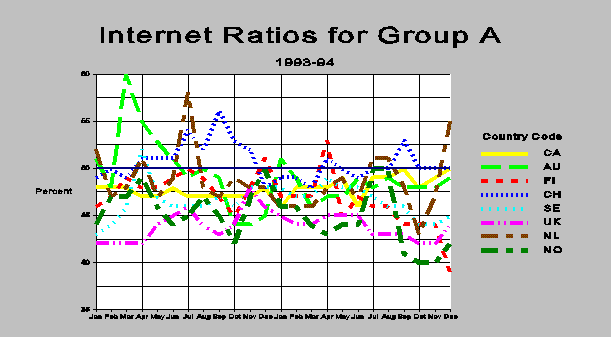
Figure 5-12
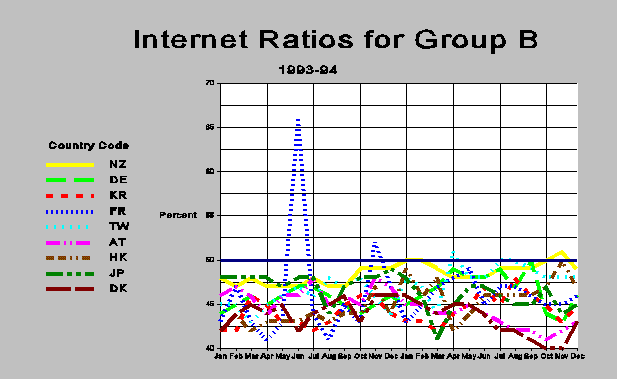
Figure 5-13
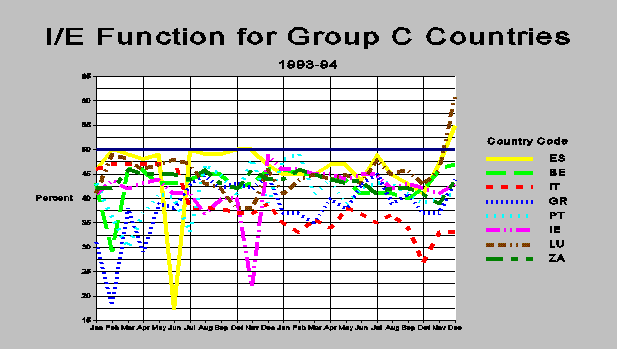
Source: author's calculations
The individual lines on the three graphs of Groups A, B, and C show no clear trends on their own. However, many of the lines in Group A are very close to the 50% line, which corresponds to the equilibrium ratio of .5000, and many of the lines in Group C are very far away from the 50% axis. The USA is always slightly above the 50% line, and the Group B lines are scattered between Groups A and C.
A simple average was taken for each group. The 624 monthly reports were thereby condensed and simplified into four series of 24 reports. These results were then plotted on a fourth graph. As expected, the averages for Groups A, B, and C tended to be further away from the .5000 axis, representing consecutively larger data surpluses with the NSFnet. The results were plotted with four decimal places of accuracy, in order to better show the trend lines. The lines for the four groups seldom intersected. In fact, the only intersection between the Group A and Group B lines occurred in October 1994. The only intersection between the lines for Group B and Group C took place in December 1994. There was never any intersection between Group A and Group C, or between the USA's Group U and any other group.
This suggests that there is a very high correlation between the IT Quotient and the Internet Ratio. Group A tended to have higher Internet Ratios than Group B, and Group B tended to have higher ratios than Group C. However, in the final months of 1994, as illustrated in Figure 5-14, the three groups tended to intersect at approximately 46% ratios.
Figure 5-14
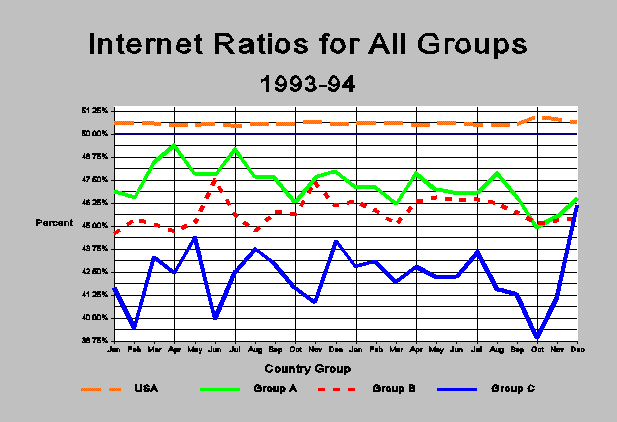
Source: author's calculations with NSFnet data
As on the other three charts, the 50% line represents a balance between input and output. Deficits are above the 50% line and surpluses are below the line. Though the members of Group A registered 33 monthly deficits, as an average the group was always in surplus. The closest they came to equilibrium was in April 1993 and again in July 1993. At no other time was any multi-country group above a 49% ratio.
6.0 CHAPTER SIX
6.1 COMPONENTS OF INTERNET FUNDING IN NORTH AMERICA
There are four components of the Internet's cost structure. First, there is the subscriber equipment. Second, there are the end user subscriptions to an Internet access provider. Third, there are the regional and commercial Internet service providers. And fourth, there is the Internet backbone, currently the NSFnet Backbone Service operated by the National Science Foundation.
The NSFnet currently functions as the primary means of interconnection between the various regional, local, and international networks, though this role is expected to decrease over time. The regional, local, and international networks tend to be structured as not-for-profit ventures serving customers in the academic and research communities, though their structure is increasingly becoming commercial and for-profit.
The typical connection to the Internet is accomplished via an ISDN leased line or another type of dedicated telecom service. However, many small companies and Internet newcomers typically start with low-speed dial-up subscriptions. Unfortunately, the typical 9600 or 14,400 bps modem is simply not up to the task, resulting in long delays per file transfer or per screen download.
The typical university or large corporation with a connection to the Internet will need a dedicated link to the Internet, plus one to three Unix workstations and at least one router. This equipment inventory would suffice for a university or corporation with 4,000 to 8,000 Internet users. Approximate cost would be $10,000 per workstation and $10,000 per router, for a total cost of $40,000 in equipment purchases. Using a three-year depreciation schedule results in a per-year equipment cost of $13,333.33 per organisation.
In 1993, there were approximately 16,000 corporations and 3,000 colleges and universities connected to the Internet within the USA. If each spent $13,333.33 per year connecting their computer systems, to the Internet, then total spending on equipment in 1993 was in the range of $250 million for the 19,000 American organisations with an Internet link.
By 1994, there were 38,000 companies on the Internet, representing a doubling of the size of the Internet. The number of corporations grew to 34,500, representing more than 1,500 new signups per month. The number of colleges and universities on the Internet grew to about 3,500, representing virtually universal coverage of the two-year and four-year college and university market segment.
Among the 38,000 organisations on the Internet, total spending in 1994 on equipment was around $500 million, assuming per capita spending of $13,333.33 on equipment per year.
In addition, a corporation or university will need a person to monitor the equipment and oversee the Internet link. For the typical university or corporation, this will occupy about one-quarter of one computer professional's time, or about one-fourth of a single salary (1/4th of $100,000). Annual cost for an Internet administrator's salary and benefits is therefore in the range of $25,000 per year, or a total of $475 million in 1993 and $975 million in 1994
Subscriptions to Internet access services range in grade from the simplest dial-up link running at 2400 to 14,400 bits per second, to the most complex T3 link running at 45 Megabits per second. Most universities and corporations, however, choose either a 56 Kbps leased line or a 1.544 Mbps T1 connection to the Internet. In fact, a 56 Kbps link should be viewed as a minimum. The much slower dial-up links are sufficient for individual PC users, but are totally inadequate for universities or corporations. The much faster T3 links (running at 45 Megabits per second) are for only a handful of the largest Internet users in the world.
The typical corporation or university will spend about $15,000 to $25,000 per annum on an Internet access subscription via a 56 Kbps or T1 line. This is sufficient for the needs of 4,000 to 8,000 Internet users. Startup costs will be in the range of $2,000 to $5,000, depending on the Internet service provider selected.
Table 6-1
University and Corporation Spending on Internet Links
| Item | Cost | Total Per Year |
|---|---|---|
| Unix workstation | $10,000 x 3 units / 3 yr. life = | $10,000 |
| Internet router | $10,000 x 1 unit / 3 yr life = | $3,333.33 |
| Salary | $100,000 person x 1/4 time = | $25,000 |
| Internet access | $15,000 to $25,000 / year = | $15,000 - $25,000 |
| Cost per year per site | = | $53,333.33 - $63,333.33 |
Source: EMMS estimates
The total turnover for American commercial Internet service providers has grown appreciably in the recent past. In 1993, their combined turnover was in the range of $50 million in 1993 and in 1994 was probably in the range of $200 million. It is expected to grow by about 50 percent in 1995 to about $300 million. These carriers are collectively known as the Commercial Internet Exchange (CIX) providers.
Non-commercial Internet access providers, primarily the regional Internets that interconnect with the NSFnet backbone, typically have an annual turnover in the $5 million to $7 million range. There are several dozen of these carriers, each typically specialising in a single state or in serving a group of states. Taken together, these non-commercial Internet access providers had annual turnovers in the range of $150 million in 1993, and about $300 million in 1994..
Commercial and non-commercial Internet access providers as a group therefore had total annual turnover in the range of $200 million in 1993 and $500 million in 1994. These turnover levels reflect average annual revenue collections from each Internet subscriber site of about $10,500 in 1993 and $13,200 in 1994, which reflects the rapid pace at which new subscribers are appearing in the latter parts of each year.
Furthermore, the difference between the CIX carriers and the non-commercial Internet access providers is quickly disappearing. In future years, it will make less and less sense to differentiate Internet carriers into commercial and non-commercial. They will all be commercial, though some may continue to specialise in serving the academic and research communities.
Finally, there is the NSFnet backbone and other administrative spending. Through various contracts, but primarily those let by the National Science Foundation (NSF), the U.S. government spends approximately $10 million a year running the Internet backbone, the NSFnet. It spends approximately $5 million more on administrative organisations, such as the Internet Assigned Numbers Authority, the InterNIC, and the Secretariats of the Internet Activities Board (IAB) and the Internet Engineering Task Force (IETF). Beginning in 1995, the U.S. government is shifting much of the burden of these tasks to end users and commercial Internet access providers. For instance, in October 1994, the phasing-out of the NSFnet was begun. Gradually over time, it will be replaced by a series of four NSF-sponsored interconnection hubs. The existing regional Internets and the CIX carriers can make use of these hubs to interconnect with the rest of the Internet. But they will slowly have to migrate away from sending their traffic over the NSFnet backbone.
Sometime in 1995, the NSFnet plans to scale back its services so that it will serve only half a dozen supercomputer centres with a network called the very-high-speed Backbone Network Service (vBNS). However, the planned phase-out of the NSFnet will probably take much longer than projected, and last into 1996. For instance, it was scheduled to begin on October 31, 1994, but November's traffic volume nevertheless grew 6%.
The importance of the interconnection role played by the NSFnet cannot be underestimated. It is simply the network of networks. Once it is phased out, the task of interconnecting all of the regional and commercial Internet access providers will fall to the carriers themselves. Many of the standards-making tasks now performed by the IETF and IAB will be taken over by the Internet Society, a nonprofit Virginia-based organisation financed by member dues.
However, the NSF will continue to provide about $5 million a year for Internet administrative activities. The money it saves shifting IETF and IAB expenses to others will more than be made up by a continued role in internetwork routing and management. These will include the operation of the four hubs, formally called Network Access Points (NAPs), at which carriers can interconnect, as well as a registration database and routing assistance. The NSF also will continue to fund the InterNIC Information Service, which provides Internet statistics, information, directory, and registration services, among other activities.
Table 6-2
US Government Spending Through 1994
Internet admin tasks $5 million / year
NSFnet network operation $10 million / year
Table 6-3
US Government Spending After 1995
Internet admin tasks $5 million / year
vBNS network operation $10 million / year
The total spending by end users in 1993 was therfore in the range of $250 million on Internet equipment, $475 million on salary and benefits, and $200 million on Internet access services. Figure 6-4 summarises these totals.
State governments spend an additional $10 million per year directly on Internet activities, primarily on the operation of state and regional Internet access providers. Most of the customers of these networks are the state and local universities. However, an additional amount of money is spent by state-owned universities on Internet equipment, access, and salaries.
6.2 THE HIDDEN UNIVERSITY SUBSIDY
There is a hidden pool of government subsidy on the Internet, however. In the United States, there are approximately 14 million students attending 3,500 colleges and universities. However, about 80% of the student body attended state-owned colleges and universities. In some measure, then, a percentage of the costs associated with running the Internet at perhaps 2,800 colleges and universities came from tax revenue and other government sources. In other words, about 80% of the hosts in the .edu domain are ultimately state owned.
Such an assumption does not change the nature of the calculations very much. Assuming that each of the 2,800 universities spent $53,000 to $63,000 on their Internet link each year, then total Internet spending by publicly-owned colleges and universities was in the range of $150 to $175 million per year in both 1993 and 1994.
A portion of this money was derived from tuition payments and a portion of this money was derived from government subsidies. However, even if 56% to 66% of the public university's budget for computing operations were derived from public tax sources, the total amount of hidden subsidy would represent only 11% of all Internet spending by corporations and universities in 1993 and 5% in 1994.
The federal government provides only about $15 million in additional spending per year. Its Internet administration budget has not changed much in the 1993-94 period. However, it spent an incalculable amount of money more than a decade ago funding the development of the TCP/IP protocols. This amount may never be known. The Department of Defense Advanced Projects Agency (ARPA) is not the most forthcoming with spending figures for its activities. The Internet Protocols were designed in the 1970s so they could run the ARPANET for the U.S. military.
The Pentagon has almost no funding role in the modern Internet. However, without its participation (and extensive equipment purchases), Internet vendors would have had to bear the cost of protocol development. Furthermore, its lead role assured equipment vendors they would have a ready and waiting market for their wares (unlike the Open Systems Interconnect market). Given the high costs associated with the OSI developmental efforts over the years, one can only guess what the free-market costs of developing TCP/IP might have been.
Table 6-4
American Spending on the Internet in 1993
1993 Spending Components
Equipment $250 million
Salary $475 million
Access $200 million
Fed Gov't $15 million
State Gov $10 million
Total $950 million
Source: EMMS estimates
Figure 6-4
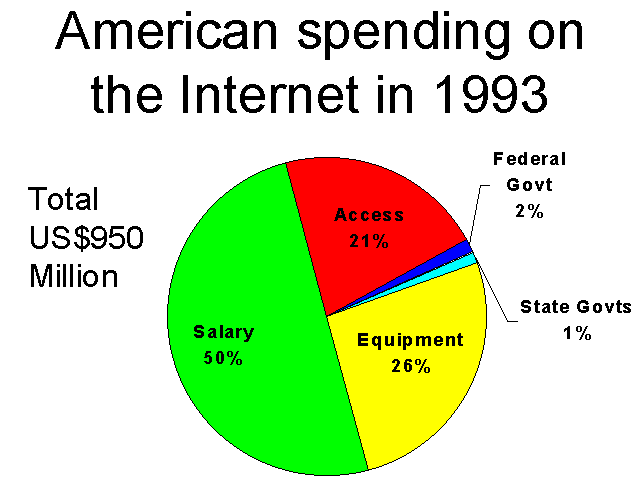
Source: EMMS estimates
As the above chart illustrates, the federal government contributes little in the way of direct subsudies of Internet costs. In 1993, universities and corporations paid about 97.4% of their total costs themselves, while governments contribute an additional 2.6% of funding.
In addition, state government provide invisible subsidies in the form of sponsorship of Internet activity at state universities. The magnitude of this subsidy is probably in the range of $100 million a year, assuming that students pay 33% to 43% of the operating costs of a public university, and taxpayers pay the rest.
6.3 INTERNET COST PER MEGABYTE
Given the amount of traffic traversing the Internet, the calculation of cost per unit of data is infinitesimal. About 90.9 trillion bytes, or 90,900,000 Megabytes, traversed the NSFnet in 1993. Cost was therefore about $950,000,000 / 90,900,000,000,000 bytes, or just about $10.45 per Megabyte.
Such a cost per Megabyte is extremely low. Commercial e-mail service providers, for instance, charge approximately $70 per Megabyte. There were 5.62 million Megabytes of e-mail on the NSFnet in 1993. The difference between what Internet users paid and what commercial e-mail providers would have charged was therefore about $334.5 million in 1993.
The story in 1994 is similar. Total spending was in the range of $2 billion, consisting of 25% in equipment, 48.8% in salary, and 25% in access services. Direct government spending was an additional 1.2% of the total.
There were approximately 197.4 million Megabytes transmitted across the NSFnet in 1994. Assuming $2 billion in spending, this results in a calculated cost of $10.15 per Megabyte ($2 billion / 197.4 million). Again, most of these costs were assumed by end users, and very little was supplied in the form of direct government subsidies.
Table 6-5
American Spending on the Internet in 1994
1994 Spending Components
Equipment $500 million
Salary $975 million
Access $500 million
Fed Gov't $15 million
State Gov $10 million
Total $2,000 million
Source: EMMS estimates
The "hidden" subsidy contributed by state-owned universities, net of their tuition receipts, amounted to 11% of the 1993 Internet spending and 5% of the 1994 spending. This is a somewhat larger magnitude than the amounts contributed directly by government agencies such as the NSF. However, it remains a small fraction of the overall total.
There were about 12.43 million Megabytes of e-mail sent across the NSFnet in 1994. If each Megabyte in 1994 cost $10.15 instead of $70, commercial e-mail service providers could theoretically claim to have experienced a lost opportunity of $743 million for e-mail alone in 1994. The e-mail would generate costs of $127 million on the Internet, but would have generated $870 million for the existing commercial non-Internet carriers if they had instead carried it. In other words, when all costs are considered, Internet e-mail costs roughly 1/7th as much as commercial e-mail at today's prevailing rates.
Figure 6-5
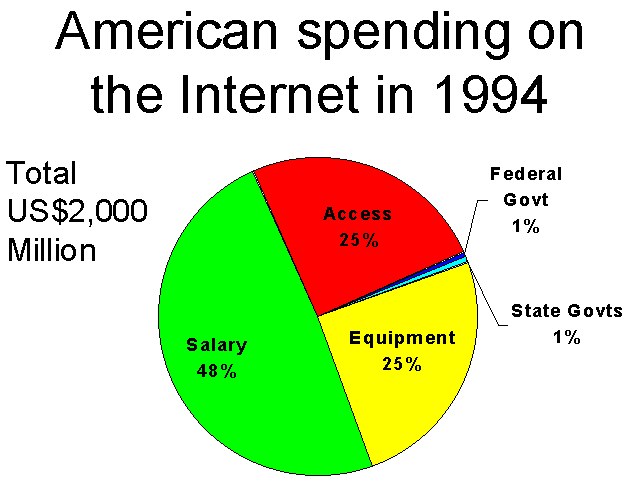
Source: EMMS estimates
Their opportunity to carry Usenet News traffic and World Wide Web sessions is similarly lost. If commercial non-Internet carriers were transmitting the traffic for those applications -- even if they were charging only $10.15 per Megabyte -- their revenue would be $211 million and $165 million, respectively.
The inescapable conclusion is that end users mistakenly believe that the Internet is free because they have not realised the amount of money they themselves spend to maintain their links. They fail to properly account for the cost of the equipment or the cost of personnel skilled enough to operate it. The Internet isn't free, but it is largely self-funded. It isn't heavily subsidised by government money, though the government plays a crucial role as the central manager of the backbone network.
Host computer operators will increasingly attempt to recover their costs by charging individual end users some set fee for their usage. Most will choose a flat-rate billing method, because the cost of administering such a system is lowest among the alternatives. Few will charge per Megabyte or per hour, because such a billing system is more expensive to administer. It also runs counter to the popular theories of the Internet community, which vaunt flat-rate billing as an advantage of the network.
Most Internet access arrangements are billed by the month or by the year, not by the minute, packet, or byte. Therefore, users may be encouraged to send and receive as much traffic as they wish on the Internet, hence the heavy usage. For instance, the only apparent penalty for subscribing to multiple news groups or special-interest mailing lists is a full inbox. Users do not see the cost in terms of money; they see it in terms of time wasted while wading through hundreds of Megabytes of data.
It is as if the cost of a newspaper were measured not in its subscription price, but the amount of time it took to read. If the free newspaper contains valuable information, people will spend the time. If they do not perceive the value, they will not subscribe, or if they do, they will discard without reading the issues.
6.4 THE NSFNET BACKBONE SERVICE
The first place to look for Internet spending is within the national backbone that interconnects all of the American regional Internets. Called the NSFnet, it carried in excess 22 million Megabytes of data a month. However, is composed of only a few dozen 45 Megabit-per-second and 1.5 Megabit-per-second data lines leased from MCI Communications Corp. and other common carriers.
The National Science Foundation (NSF) has spent approximately $54 million on the NSFnet backbone network and related programs since 1988. The NSF is an agency of the U.S. government with a $3 billion-plus annual budget. Its primary mission is to disburse funds to a wide variety of advanced science and engineering research. The NSF is authorised to spend up to $3.2 billion in the fiscal year beginning in October 1994, and $3.4 billion in the year beginning in October 1995. So Internet funding is a very small component of its budget.
The massive success of the National Science Foundation's Internet backbone, the NSFnet, has brought the agency into conflict with its stated goal of funding education, science, and research. When the NSFnet opened for business in July 1988, it was truly experimental in nature. It used high-speed T1 data lines to interconnect a nationwide collection of regional networks. However, when the network carries over 22 trillion bytes a month for over 36 million people, it can no longer be called an experiment.
Stephen Wolff, director of the NSF's networking division, told the magazine PC Week in June 1993: "When the current Internet was built, there was no one who could supply it, so we commissioned that backbone. Since then, providers have sprung up who can supply it on demand."
Therefore, in the fiscal year that begins October 1, 1995, the NSF is seeking ways to remove itself from its present role of fully funding the Internet backbone. Instead, it will ask all of the regional networks to turn to commercial service providers to provide them with interconnection services among themselves.
The NSFnet as it is now configured is just one piece of a three-level hierarchical structure. It functions as the backbone to which all other networks interconnect. Within each region or state in America, there is a regional network that flows into the NSFnet like a tributary river. Then, within each university or corporation, there is an internal network interconnected to one of the regionals. The NSF provided total funding for the backbone, startup funding for the regional networks, and nothing at all for the internal networks of the universities and corporations.
NSF signed a five-year, $28 million Internet backbone network management contract with a company called Merit Network Inc. in 1987. Merit is a consortium that was formed expressedly to run the NSFnet for the NSF. Its members include eight Michigan universities, MCI, and IBM.
In 1990, the NSF gave an additional $7.9 million to Merit to upgrade an initial round of eight nodes to the T3 speed of 45 Mbps. The High Performance Computing and Communications Act, Public Law 102-194, authorized the NSFnet upgrade. This touched off a round of speculation over how the government would manage the "Information Superhighway." As a result, the members of Merit began to plan for a vastly larger role in the provision of Internet services. So in September 1990, after several years of managing the NSFnet, the members of Merit agreed to form yet another joint venture, called Advanced Network & Services Inc., based in Elmsford, NY. Northern Telecom Ltd. later joined ANS as a third corporate partner.
In early 1991, the NSF awarded an additional $6 million to ANS/Merit to upgrade eight more nodes of the NSFnet to T3 speeds. Among the nodes with T3 capabilities were the NSF supercomputer centers in San Diego, CA and Champaign IL, as well as sites in Palo Alto, CA and Ann Arbor, MI. ANS uses T3 switches made by IBM; T-3 Plus Networking of Santa Clara, CA; Cisco Systems of Mountain View, CA; and Larscom of Santa Clara, CA.
At the beginning of 1993, the National Science Foundation awarded $12 million in contracts to run an Internet Network Information Centre (InterNIC). AT&T Corp. was contracted to provide directory and database services. Network Solutions Inc. of Herndon, Virginia, was asked to provide Internet registration services. General Atomics, of San Diego, was contracted to establish an Internet information service available through both online access and e-mail exchange.
6.5 SUCCESSOR TO THE NSFNET BACKBONE
The NSF for some time has been looking for an exit strategy for its Internet involvement. That exit strategy has now taken shape. The NSF, chartered with a mission to fund experimental projects, has decided to interconnect a select number of the nation's supercomputer centres with very-high-speed lines, and leave the rest of the Internet's hosts and networks to fend for themselves.
In February 1994, the 24-member National Science Board, which oversees the NSF, approved solicitation number 93-52, which outlined the NSF's plans for a very-high-speed Backbone Network Service, the vBNS. This new backbone, running at a speed of 155 Megabits per second over fibre-optic lines, will connect only five supercomputer centres: in San Diego, California; Boulder, Colorado; Champaign, Illinois; Ithaca, New York; and Pittsburgh, Pennsylvania. It will be open for use exclusively by NSF-sponsored supercomputer centres, and will not be open to the general public.
The vBNS therefore is not a replacement or an upgrade to the current NSFnet. Rather, it is a restricted-use network, open only to an elite customer base. Such restrictions mean the NSF is returning to its traditional role as a funding source for advanced research and educational programs.
However, the NSF has played too large a role in the growth of the Internet for it to just simply walk away from it, as the Pentagon largely did eight years ago. The Pentagon, which funded the birth and development of the ARPANET and related networks from 1969 to roughly 1987, handed over the civilian Internet operations responsibility to the NSF, and then created its own restricted military-use Internet.
Some say the NSF is pursuing a similar strategy by creating the restricted-use vBNS and spinning off the general-purpose Internet operations role to commercial enterprises. However, the NSF will continue to fund several projects related to central network operations. In addition to the vBNS, the NSF will fund the creation of four locations nationwide that will function as sites for all of the regional, local, and commercial Internets to interconnect. These four Network Access Points (NAPs) will be located in Chicago; New York City; Washington, DC; and a site to be determined in the state of California. The New York site will be managed by Sprint, the Washington site by MFS Datanet Inc., the California site by Bell Communications Research and Pacific Bell, and the Chicago site by Ameritech.
NSF plans to split the award into three parts. The largest single vBNS award will go to MCI: a five-year, $50 million contract to run the network backbone. The NAP contract is in two much smaller parcels. Merit received a contract for $11,099,743 over five years for routing arbiter management, a registry database, an operations center, and ongoing software development. The University of Southern California's Information Sciences Institute, in cooperation with IBM, will receive up to $9,235,847 over five years to develop route servers, advanced routing techniques, a test-bed, and routing engineering.
Sprint complained to General Accounting Office that the vBNS award to MCI was unfair. Sprint said that MCI's tie-in with ANS produced a conflict of interest, since an ANS member was on the National Science Board. However, he turned out to be from the Michigan university system, and had nevertheless recused himself from the vBNS award process.
Sprint further claimed that the $50 million will function as "seed money" that will help MCI fund the development of very-high-speed networking services that it presently does not have. Sprint also complained to the GAO that MCI and the NSF avoided the competitive bidding process for vBNS, by terming it a cooperative project. The GAO, however, said it had no jurisdiction, and turned down Sprint's protest.
On 12 April, 1994, House Government Operations Committee chairman Rep. John Conyers Jr. (D-Michigan) wrote to National Science Foundation Director Neal F. Lane, questioning whether NSF circumvented procurement rules when it entered into the $50 million cooperative agreement with MCI for vBNS. He asked whether the NSF "awarded its cooperative agreement to the incumbent vendor after a sham 'competition.'" Lane responded that he found nothing wrong in the manner in which the contract was awarded. The contract awards at this point appear likely.
6.6 NSFNET REGIONAL NETWORKS AND THE COMMERCIAL INTERNET EXCHANGE
At some point, there will be no meaningful division between the commercial and the non-commercial Internet marketplace. There will be educational, corporate, governmental, and international market segments, but all will be considered commercial. This is how the router market is seen now. There are no non-commercial routers sold by Cisco Systems. They are all commercial routers, or more accurately, their ability to route data is independent of their owner's tax status.
There already is a long list of carriers that formally call themselves commercial Internet carrier services in the U.S. Sprint Corp. is the first "big name" telecoms carrier to open a commercial Internet service to date. However, AT&T, MCI, CompuServe Inc., Prodigy Services Co., America Online Inc., and IBM all took an opportunity in 1994 to announce their own commercial Internet access strategies. In addition, another company called ANS, which was a partnership of IBM, MCI, and Merit Network, Inc., had a major role in the operations of the NSFnet.
ANS is now scheduled to be acquired by America Online for $35 million. IBM and MCI are opening their own independent Internet access services through the IBM Global Network and internetMCI, respectively.
The label "commercial Internet" was at first applied to the services of the five companies listed in Table 6-6. They were the pioneers that began operating networks in parallel with the NSFnet. Their ranks have now swelled, as additional carriers who were serving the academic and research communities have begun to also serve corporate customers, and as additional commercial Internet access providers appear in markets such as Sweden, Britain, and elsewhere.
Table 6-6
Pioneering Commercial Internet Access Providers
| Company Name | Location | Service Name |
|---|---|---|
| Performance Systems Int'l (PSI) | Reston, VA | PSInet |
| Sprint International | Reston, VA | SprintLink |
| Advanced Network and Services (ANS) | Elmsford, NY | CO+RE |
| General Atomics | San Diego, CA | CERFnet |
| UUNet Technologies Inc. | Falls Church, VA | Alternet |
These five companies sell commercial Internet services that provide all the same services as the non-commercial Internet. The major difference they have with the non-commercial Internet community is the type of customer they serve and the purpose of their usage. The non-commercial Internet is theoretically used for research and education purposes only. The commercial Internet is theoretically used for routine business operations.
PSI was started in 1989 by Martin Schoffstall and William Schrader to make the research and communication capabilities of the Internet available to the corporate and PC user. The two opened the company for business in January 1990 and had a prototype Internet access service operating that summer. In October 1991, the service formally went commercial.
Sprint Corp. commercially launched SprintLink in July 1992. At that time, it was interconnected with NSFnet in the United States, as well as to research Internets in France and Sweden. Subscribers may reach the SprintLink service via a leased line to the nearest of any of 270 points of presence Sprint maintains in the United States.
ANS is the company that runs the NSFnet Backbone Service for the NSF. It was formed in 1990 by IBM, MCI, and Merit Network, Inc., which in turn is funded by several Michigan universities. IBM and MCI contributed about $10 million in startup capital to ANS. ANS was a non-profit company and therefore tax-exempt. However, ANS also operated a commercial Internet service called CO+RE through a wholly-owned subsidiary called ANS CO+RE Systems, Inc., which it founded in June 1991. Revenue in 1994 was $22 million, of which about $12 million was related to its NSFnet operation and $10 million was derived from commercial Internet access services. In 1995, after its acquisition with America Online is completed, the firm and its network will become part of the AOL service orffering.
General Atomics provides a commercial Internet service called CERFnet. CERFnet is short for the California Education and Research Federation Network. But Cerf is also the surname of Vinton Cerf, one of the principal architects of the TCP/IP protocols over the past two decades. CERFnet is headquartered at the San Diego Supercomputer Center, which is also managed by General Atomics. Both are located at the University of California in San Diego. The company was launched in the spring of 1989 with a $2.8 million grant from the National Science Foundation.
UUnet Technologies, founded in 1987, is best known as a provider of Unix Mail connectivity. It sells commercial subscriptions to the community of cooperative networks, variously called Usenet, UUCP, Unix Mail, EUnet, and UUnet, that interconnect using the Unix-to-Unix Copy Program (UUCP). The UUCP networks are comprised of thousands of sites that use modems to periodically dial each other and exchange mailbags. Uunet Technologies recently received a minority investment from Microsoft Corp., which evidently is interested in combining the small company's Internet expertise with its forthcoming Microsoft Network online service.
In fact, something of a merger boom is now occurring within the Internet access services community. Besides the aforementioned acquisitions of ANS by America Online and the UUnet investment by Microsoft, there also is the acquisition of the small Pipeline Network Inc. by PSI. Pipeline, with 10,000 subscribers, has turnover in the range of $4 million a year.
Another likely future acquisition candidate is the company Netcom Online Communications Services Inc. It grew 600% in 1994, to more than 70,000 subscribers, each of whom pay a flat monthly fee for dial-up Internet access through Netcom's host.
The Commercial Internet Exchange (CIX) was formed in March 1991 by three of the five pioneering providers of commercial Internet services: PSI, UUnet Technologies, and General Atomics. They formed the consortium to interconnect their respective commercial Internet services, so that customers could send their commercial traffic from one site to another without having to traverse the non-commercial NSFnet backbone.
After CIX was formed, Sprint joined, as did the European Unix Network (EUnet). As of April 1994, the CIX had 45 members, representing carriers in the U.S., Mexico, Canada, Taiwan, Britain, Costa Rica, South Africa, Scandinavia, Japan, Russia, and Hongkong.
6.7 OTHER AMERICAN INTERNET ACCESS SERVICES
In the US, there are numerous e-mail and bulletin board services that offer gateway access to the Internet. Commercial e-mail carriers such as CompuServe, AT&T Mail, MCI Mail, Dialcom and SprintMail maintain gateway interconnections with the Internet. Online services such as America Online Inc. and Prodigy Services Co. also now provide e-mail-only links to the Internet. Their subscribers can therefore send and receive messages from the Internet.
There are many companies that sell dial-up links to the Internet, or that provide Internet gateways from their existing online services. Many are small operations with annual turnover in the several-million-dollar range.
Included in this group are: a2i Communications (San Jose, CA); Bunyip Information Systems Inc. (Montreal); the Cooperative Library Agency (San Jose, CA); Delphi Internet Services Inc. (Cambridge, MA), formerly General Videotex Corp.; Demon Internet Services (London); Msen Inc (Ann Arbor, MI); RadioMail (San Mateo, CA); Portal Communications (Cupertino, CA); Software Tool and Die (Brookline, MA); and The Well (Sausalito, CA).
Furthermore, the list of full-service Internet access providers will in time become the roster of commercial Internet providers. The list of regional, international, non-commercial and commercial providers includes the carriers named in Table 6-7.
Bolt Beranek & Newman Inc., one of the original vendors working on the ARPANET and other government Internets in the 1970s, is now in a position to becme a major commercial Internet access provider. For five years, it has operated the NEARnet regional Internet access service in the New England area.
In June, BBN made two strategic moves that will broaden its Internet market. First, it began selling NEARnet access to companies and schools in the New York and New Jersey areas. Second, it bought BARRNet, the regional Internet in California, from its operators at Stanford University. Price was not disclosed.
By making these purchases, BBN is now in a position to offer Internet access services in four of the top ten states: California, Massachusetts, New York, and New Jersey. According to InterNet Info of Falls Church, Virginia, these four states are home to about 42 percent of all of the corporate Internet connections in the U.S.
Table 6-7
Internet Access Providers Worldwide
| Network Name | Geographic Coverage |
|---|---|
| AARNet | Australia |
| ARnet | Alberta |
| BARRNet | Northern/Central California |
| BCnet | British Columbia |
| CICnet | Midwestern USA |
| CO Supernet | Colorado |
| CONCERT | North Carolina |
| CSUnet | California |
| Datalink | Finland |
| EUnet | Europe and Tunisia |
| HoloNet | North America |
| Infolan | Worldwide (Infonet) |
| Interaccess | Chicago |
| INet | Indiana |
| Interspan | Worldwide (AT&T) |
| IP sur 802.3 | France |
| JvNCnet | US and International |
| Los Nettos | Los Angeles Area (CA) |
| MBnet | Manitoba |
| MichNet/Merit | Michigan |
| MIDnet | Midwestern USA |
| MRnet | Minnesota |
| MSEN | Michigan |
| NB*net | New Brunswick |
| NEARnet | Northeastern USA |
| NETCOM | California |
| netILLINOIS | Illinois |
| NevadaNet | Nevada |
| NLnet | Newfoundland and Labrador |
| NorthwestNet | Northwestern USA |
| NSTN | Nova Scotia |
| NYSERnet | New York |
| OARnet | Ohio |
| ONet | Ontario |
| PACCOM | Hawaii (HI) and Pacific Rim |
| PEINet | Prince Edward Island |
| PIPEX | Britain |
| PREPnet | Pennsylvania |
| PSCNET | Eastern US (PA, OH, WV) |
| RISQ | Quebec |
| SASK#net | Saskatchewan |
| SDSCnet | San Diego Area (CA) |
| Sesquinet | Texas |
| SURAnet | Southeastern US and Caribbean |
| SwIPnet | Sweden |
| THEnet | Texas & northern Mexico |
| UKnet | Great Britain |
| VERnet | Virginia |
| Westnet | Western US (AZ, CO, ID, NM, UT, WY) |
| WiscNet | Wisconsin |
| World dot Net | Pacific NW (OR, WA, ID) |
| WVNET | West Virginia |
| Source: InterNIC Information Service |
The North Carolina Information Highway is a new regional Internet that will serve people in the state of North Carolina. It will use fibre-optical data networking technology that allows it to run at speeds up to 155.52 Megabits per second on its backbone links. Connections to schools, government agencies, hospitals, and businesses will use T1 lines, which run at 1.544 Megabits per second. The network also will interconnect with the local telephone company's Asynchronous Transfer Mode (ATM) network.
The backbone, running at the 155 Mbps speed, will use OC3 fibre-optic lines provided by Southern Bell Telephone and Telegraph Co., the local phone company in the state. Southern Bell has filed a tariff with the state public utilities commission that anticipates first-year revenue of $1,891,451 for provision of OC3 lines to the network. In the second year of operation, the telco anticipates revenue of $6,171,313 from the backbone. Third-year revenue is projected to be $12,860,704. It added that these projections anticipate a positive cash flow in year three, and a profit in year four.
The initial phase of the network rollout to subscribers will involve the acquisition of about 1,235 T1 lines from providers such as AT&T. Plans call for the network to grow to about 3,700 T1 lines over the next several years.
AT&T charges about $2,600 per month for a T1 line, plus $3.65 per mile (about $2.20 per kilometre). Though the state is more than 650 kilometres from west to east, its major cities of Charlotte, Winston-Salem, Greensboro, Durham, and Raleigh are in a 200-kilometre arc in the central area of the state. Therefore, most of the network's T1 lines will have a realtively short length between the AT&T backbone and their termination point.
On this basis, then, the North Carolina Information Highway is likely to have a total monthly recurring line cost for end users of about $3.5 million in its initial stages, and about $10.4 million a month when fully deployed. Revenue for T1-based end user connections is likely to be about $45 million the first year, $60 million the second year, and $90 million the third year. Each site will pay approximately $2,800 per month to AT&T for its T1 line.
The state legislature approved a funding bill in July 1994 that creates a $7 million grant program to aid qualified sites with connections to the network. The state anticipates that locations will have to spend about $4,000 per month on line charges and upwards of $70,000 on equipment to connect to the network.
Total revenue for backbone and end user connections to the state network will therefore be in the range of $47 million in year one, $66 million in year two, and $103 million in year three. The proposed $7 million subsidy will supply only a small fraction of this money.
6.8 OTHER REGIONAL INTERNETS
The U.S. Department of Energy (DoE) and NASA selected Sprint Corp. to provide the Internet backbone for DoE's Energy Sciences Network as well as NASA's AEROnet and Science Internet systems. The contract to run these services was announced to be worth $50 million over five years. At first, Sprint's winning bid was overturned by a protest from AT&T. However, after re-evaluation, the University of California's Lawrence Livermore National Laboratory, on behalf of the DoE, once again awarded the ESnet contract to Sprint. The Lab had itself managed the ESnet service for DoE since 1990.
The Japanese Ministry of Posts and Telecommunications sponsored the creation of an Internet Service Contact Committee, which met for the first time in June 1994. It was formed to facilitate discussions about the commercialisation of the Internet, and the interconnection of commercial Internet services in Japan to each other and to the American Internet. Members include Nippon Telegraph & Telephone Corp., Kokusai Denshin Denwa Co., AT&T Japan Enhanced Network Services, Fujitsu, and NEC Corp.
In Canada, the Canadian Network for the Advancement of Research, Industry and Education (CANARIE Inc.) is a consortium with about one hundred members spread among businesses, universities, research institutions and government organisations. It was established in March 1993 in order to facilitate the establishment of an advanced high-speed broadband network, called the National Test Network (NTN). CANARIE plans to spend Can$22.5 on the establishment of the NTN. It also will spend Can$6.2 million on upgrades to its CA*net Internet backbone service.
The consortium has an ambitious plan to combine private-sector and government funds to create a high-speed nationwide Internet backbone in Canada. During the period from 1995 to 1997, they anticipate a need for Can$470 million. In 1998 to 1999, CANARIE projects spending levels of Can$600 million. The great majority of these funds are to come from the private sector.
The NTN will connect seven regional test networks with high-speed 45 Mbps circuits leased from Stentor and Unitel, Canada's two major competitive carriers, as well as from local phone and cable companies such as Bell Canada, BC Tel, Rogers Network Services, AGT, EDTEL, SaskTel, and Manitoba Tel. In early 1995, it linked 14 universities, 30 companies, and 6 research and teaching hospitals.
Only five of the seven planned regional networks were operational in early 1995. They are Rnet in British Columbia, Wnet in the three prairie provinces, LARGnet in London, Ontario, OCRInet in Ottawa and RISQ in Quebec. Two additional networks will appear later in 1995: Intercom in the Toronto area and ACORN in the Maritime Provinces.
6.9 THE FUTURE FOR INTERNET FUNDING
The starting point of the 1995 Internet funding debate was the February 1994 budget proposal of President Bill Clinton, which asked for $134 million for the National Telecommunications and Information Administration (NTIA), part of the Department of Commerce. Since that proposal was made, the budget makers have tossed back and forth vastly different numbers for NII funding.
Originally, Clinton had asked for $99.9 million to be spent on NII demonstration grants. Congress later reduced this amount to $64 million. The House of Representatives agreed to $70 million, but the Senate approved only $52 million. In June, an amendment in the House to reduce NII demonstration grants to $48 million was soundly defeated. Finally, the $64 million figure arose from a House-Senate budget conference in August.
The original Clinton budget proposal requested $166.83 million for the Federal Communications Commission, essentially the same amount as in 1994. However, the President's proposal anticipated that this entire amount would be raised from auctions and user fees. Almost none of the 1993-94 budget was funded in this manner.
The President's budget requested $273.5 million for the NSF's spending on all types of computer and information science research, an increase of 13.7 percent over 1994 levels. Congress, still working on the final figures, has bantered with numbers in the range of $262.2 million for these programs.
In the fiscal 1995 budget that is took effect on Oct. 1, 1994, the FCC's budget is set at $185.23 million, of which $116.4 million, or nearly 63 percent, is to come from licensing fees and other revenue-generating programs. President Clinton original request of $166.83 million was to be raised entirely from licensing fees. The higher total budget, and lower figure for licensing revenue, arose from House-Senate conferences, which approved a final measure in August that awaits the President's signature.
The FCC amply demonstrated its ability to cover its expenses through bandwidth auctions. In July 1994, the FCC held an auction for ten nationwide licenses for narrowband Personal Communications Services. It expected to raise perhaps $80 million in total from the auction, which was to proceed in rounds until the highest bidder stood alone. Instead, it raised $617 million, in 47 rounds of some of the most frenzied action seen in Washington. Five licenses, each for a pair of 50 KHz channels, fetched $80 million each.
7.0 A LIST OF ALL TABLES AND FIGURES IN THIS REPORT
| Page | Section | Number | Title |
|---|---|---|---|
| 9 | 2.2 | Figure 2-1 | The NSFnet by major application, 1993 & 1994 |
| 14 | 4.1 | Figure 4-1 | Internet Host Count, 1981 to 1995 (Logarithmic scale) |
| 15 | 4.1 | Table 4-2 | NSFnet networks by state in Dec. 1994 |
| 16 | 4.1 | Figure 4-3 | Commercial vs. Non-commercial, Internet host comparison, July 1991 & Jan. 1995 |
| 17 | 4.1 | Table 4-4 | Biggest commercial Internet cities, April 1994 |
| 17 | 4.1 | Table 4-5 | Commercial Internet domain distribution in North America, top ten by telephone city code |
| 21 | 4.3 | Figure 4-6 | American and European Internet, percent share, July 1991 to July 1994 (graph) |
| 21 | 4.3 | Table 4-6 | American and European Internet, percent share, July 1991 to July 1994 (table) |
| 22 | 4.3 | Figure 4-7 | NAFTA and EU Internet graph, Oct. 1991 to Oct. 1994 (graph) |
| 23 | 4.3 | Table 4-7 | NAFTA and EU Internet table, Oct. 1991 to Oct. 1995 (table) |
| 24 | 4.3 | Table 4-8 | Internet host growth rates in NAFTA & EU15, July 1991 to July 1994 |
| 25 | 4.3 | Figure 4-9 | New Internet users per month, July 1991 to Jan. 1995 |
| 26 | 4.3 | Figure 4-10 | New Internet users in Europe, per month, July 1991 to Jan. 1995 |
| 27 | 4.3 | Figure 4-11 | Number of countries with Internet hosts, July 1991 to Jan. 1995 |
| 28 | 4.3 | Table 4-12 | Internet host growth rates in other regions, July 1991 to July 1994 |
| 28 | 4.3 | Figure 4-13 | Internet hosts in other regions, July 1991 to July 1994 (graph) |
| 29 | 4.3 | Table 4-13 | Internet hosts in other regions, July 1991 to July 1994 (table) |
| 30 | 4.3 | Table 4-14 | Growth of Internet hosts in the USA, commercial vs. non-commercial sectors |
| 31 | 4.3 | Figure 4-15 | Internet hosts in the USA, commercial vs. non-commercial split, 1991 to 1995 (graph) |
| 31 | 4.3 | Table 4-15 | Internet hosts in the USA, commercial vs. non-commercial split, 1991 to 1995 (table) |
| 35-36 | 5.1 | Table 5-1 | NSFnet traffic distribution for December 1994 |
| 39 | 5.3 | Figure 5-2 | NSFnet traffic pattern in bytes, 1993-1994 |
| 40 | 5.3 | Table 5-3 | NSFnet packet and byte detail |
| 40 | 5.3 | Figure 5-4 | NSFnet trafic patterns in packets, 1993-1994 |
| 43 | 5.4 | Figure 5-5 | NSFnet traffic patters in the EU15, input and output in 1994 |
| 44 | 5.4 | Figure 5-6 | NSFnet traffic patterns in the EU15, percent in 1994 |
| 45 | 5.4 | Figure 5-7 | NSFnet traffic patterns for the USA in 1994 |
| 45 | 5.4 | Figure 5-8 | NSFnet traffic patterns for others in 1994 |
| 47 | 5.5 | Table 5-9 | IT Quotients for 26 countries |
| 48 | 5.5 | Table 5-10 | The four country groupings for IT Quotients |
| 50 | 5.5 | Figure 5-11 | Internet Ratios for Group A, 1993-1994 |
| 50 | 5.5 | Figure 5-12 | Internet Ratios for Group B, 1993-1994 |
| 50 | 5.5 | Figure 5-13 | Internet Ratios for Group C, 1993-1994 |
| 51 | 5.5 | Figure 5-14 | Internet Ratios for all groups, 1993-1994 |
| 54 | 6.1 | Table 6-1 | University and corporate spending on Internet links |
| 56 | 6.1 | Table 6-2 | US Government spending through 1994 |
| 56 | 6.1 | Table 6-3 | US government spending after 1995 |
| 57 | 6.2 | Figure 6-4 | American spending on the Internet in 1993 |
| 58 | 6.3 | Figure 6-5 | American spending on the Internet in 1994 |
| 64 | 6.6 | Table 6-6 | Pioneering commercial Internet access providers |
| 67 | 6.7 | Table 6-7 | Internet access providers worldwide |
8.0 APPENDIX
CONTENTS
| Page | Section | Description | Spreadsheet Name |
|---|---|---|---|
| 73 | 8.1 | Internet host surveys, 1991-1995 | Hosts95.123 |
| 75 | 8.2 | NSFnet traffic by application, 1993-1994 | NSFapps.123 |
| 76 | 8.3 | NSFnet input by country, 1993-1994 | Country.123 |
| 77 | 8.4 | NSFnet output by country, 1993-94 | Country.123 |
| 79 | 8.5 | IT Quotient and national statistics | ITQuot.123 |