










 Winner of PANPA Award for
Excellence Winner of PANPA Award for
Excellence |




| Comments and suggestions to Maureen at maureen @bangkokpost. co.th |


|
Wednesday, July 24, 2000
.............................................................. What's happening to English?
INTRODUCTION | |||||
Every so often, a headline about the English language appears in the Bangkok Post. That always catches my attention. Today, I’ve put together excerpts from three articles so we can look at some of what is happening to English, the language that has become a lingua franca -- a language that is used between people whose main languages are different. It has become the language in common use in modern business, among international friends and travellers, in international relations and on the Internet. The English language used in those places, however, often looks and sounds very different. Different speakers with different purposes and attitudes produce English with a variety of characteristics. The articles today look at sloppy English, hybrid English and loanword English. Articles like these frequently raise a long-standing controversy about changes in language. One group of people, the language traditionalists or purists, do not want to see changes in the language, especially if they introduce words and phrases that are thought to be not standard English. The other group argues that communication is the most important criteria for language. In other words, correctness is not nearly as important as people understanding each other. You will find both attitudes reflected in different ways in today’s articles. Sloppy English
The first story concerns email communications. The names of the people quoted and the attitudes they express are listed below. First, match the people with their opinions, then decide whether they are purists (P) or those who tolerate change and inaccuracy (C).
Can you identify the six errors in the email message that begins this first article? What do you think the 'A' in the title refers to? Hybrid English
The hybrid lingo in the title of the second article is the result of Koreans coining (forming) new words by combining English and Korean, or two different English words. The results, as you’ll find out as you read, are not good Korean, and not good English. One of the concerns of the writer is the way English is being learned in Korea. Much of the emphasis in schools has been on "reading and rote memorisation of English grammar and vocabulary at the expense of conversation." Rote memorisation means repeating something without necessarily understanding its meaning. It has been proven that being able to repeat in class does not mean something is learned. However, the school system is not the only place that Koreans are learning English. You will read in the article that words are being brought into the language to explain modern concepts. In this very short article the writer talks about two related problems.
Rote memorisation is no longer the preferred way of teaching and learning a foreign language. This is clear in the new Education Act of the Thai government. It emphasises the need for students to actively think for themselves and use what they learn in real life situations. As a student of English you probably have had some good and some bad experiences. Think about two examples, one good learning experience, one unsuccessful one. Think about what you were trying to or expected to learn – vocabulary, grammar, reading skills, conversation. What did you and your classmates do in order to accomplish the task? How successful were you – completely successful, moderately so, not at all? If you are working in a class or study group share your experiences with your friends. Loanword English
The third article, about the revisions in the Oxford dictionary, emphasises the fact that English, like all languages, is constantly changing. Adding new words is an ongoing process. While some of the hybrid Korean-English words were mangled, it is clear that there is a process for adding words to English and they do become accepted into standard usage. Language purists will continue to resist sloppy usage and reject newly-coined words that mangle the original meaning. On the other hand, the dictionary attempts to reflect how the language is actually used. Here’s an interesting exercise if you have time and a dictionary that gives word origins. Find out the source language for these common English words. What was the original meaning? Is the meaning different in its present English usage? Do you think the purists of the time objected as these new words came into the language? typhoon, tsunami, café, boutique, kindergarten, mafia, cafeteria, pundit, hors d’oeuvres |
INTRODUCTION sloppy hybrid loanword controversy tolerate judgements lingo at the expense of mangled | ||||
OUR STORIES FROM THE BANGKOK POSTType A or typo ;-)COMMUNICATIONS: Email may be quick and easy, but sloppy writers delete the rules of spelling and punctuation MARTHA IRVINEChicago, AP
Experts say people who communicate via computer are becoming increasingly informal — and sloppy. Email is routinely strewn with typos, grammatical errors and various shortcuts, such as no capital letters. The trend — as relaxed as the Silicon Valley dress code — really bugs some grammar purists. "A student wouldn't walk into a professor's office asking a question using bad English. Why would they send me that kind of mistake in an email?" gripes Kenneth Brown, an assistant professor at the University of Iowa business school. An avid tracker of email etiquette, Mr Brown says he regularly chides students for sending sloppy emails to him and even to prospective employers. Some faculty members have also got a talking to. Shonquis Moreno, a 28-year-old writer from New York with a penchant for the lower-case, says she likes the "more intimate, casual, off-the-cuff tenor" her emails have. In many cases, she has even stopped fixing jumbled letters. "Maybe it's because I know that typos are recognisable as typos and not spelling errors," says Ms Moreno, who works for an Internet start-up and finds herself scurrying to answer more than 30 emails a day. Internet experts say the advent of instant messages — real-time conversations — has only heightened the casual, abbreviated nature of online chatting. But even they warn against misspellings and grammatical goofs. On the Web, "you won't be judged by the colour of your skin, eyes, or hair, your weight, your age, or your clothing," author Virginia Shea says in her rules of Netiquette, which are posted online. "You will, however, be judged by the quality of your writing." The solution? Reread your email, not just for mistakes but for impetuous words, says Eric Arnum, Messaging Online's editor. "If you type faster than you think, there's a danger that your words will do more than offend schoolmarms," he says, pointing to the recent use of emails as evidence in the antitrust case against Microsoft. Jeff Rubin, a newsletter publisher in Pinole, California, said computer communication has become a "forum for people who cannot spell or string 10 words together". "I have a friend who has a daily, paid-subscriber email message with circulation exceeding 500. He misspells words in each transmission," Mr Rubin wrote. "It's embarrassing." Still others raved about the ease email has brought to communication. Now a student getting her master's degree in Internet strategy, Cincinnati resident Carol Boyd was relieved to escape the "legendary one-page memo" she spent years perfecting during her nearly 30 years at Procter and Gamble. "Communication is less disciplined but Oh — what a timesaver!" Ms Boyd wrote. "It's amazing what my teacher can convey in a one-word email that simply says: Cool." Even Mr Brown — who uses ellipses in some communication — says some shortcuts can give an air of informality that is perfectly acceptable "provided that the person I'm writing to understands it". But he still tells students to err on the side of good grammar and spelling. "It's their calling card," Mr Brown says. "It's how people judge them." |
strewn with typos Silicon Valley dress code bug (v) avid etiquette chide penchant off-the-cuff tenor scurry advent impetuous schoolmarm antitrust circulation rave ellipses err on the side of | ||||
Koreans make do with hybrid lingoLANGUAGES: Mangled English dismays purists SANG-HUN CHOESeoul, AP
For a laugh, South Koreans watch a "gagman," or comedian. To see what's on sale, they go "eye-shopping". Those in the fast lane ride "autobis," or motorbikes. The English language is not widespread in South Korea, but it is creeping, often quirkily, into everyday talk. "It's neither Korean nor English. As it proliferates, youngsters grow up without learning either language properly," says Ahn Jong-hyo, a novelist and translator whose latest book, Dictionary of Phony English, includes 1,000 mangled English phrases commonly used by South Koreans. Schools have stressed reading and rote memorisation of English grammar and vocabulary at the expense of conversation. Today, many college graduates can read complex textbooks in English, but falter in chats with native speakers. President Kim Dae-jung addressed the weakness in English during his New Year's speech, warning that "we will not win in world competition" unless South Korea masters the lingua franca of the Internet age. When South Korea industrialised and English words flooded in, South Koreans could not find — or bother to find — proper translations. They chopped, patched or twisted English words to create a slew of wacky terms. Sometimes they came up with entirely different meanings. So "villa" means a low-rise apartment building in a congested Seoul street. A TV actor, talented or not, is a "talent". "Leports," which does not exist in English, combines leisure and sports. "Many Koreans now believe they can boost their social status by speaking English," Mr Ahn says. "But the reality is that they don't know English and use poorly coined words." Konglish does have defenders. "Koreans are adopting foreign words to fit their needs and to express new phenomena in their culture," read a recent letter to The Korea Herald, an English language newspaper. The worst linguistic butchers may be the country's young pop singers, who sprinkle lyrics with baffling English phrases. Duo JinuSean bops to the chorus: "You say you feel me. You say uh had the key all it's time for all to see." In another song, they get really cryptic: "Got to be real. Feel my power like Omega." These lyrics appear as subtitles on TV screens, and youngsters memorise them without knowing their meaning. "I think it's neat," says Kim Sung-ae, a 16-year-old student. "You don't consult your grammar book when you sing along." |
make do
gag quirky proliferate falter flood in slew congested phenomena linguistic butchers baffling cryptic | ||||
Oxford English Dictionary goes onlineNew additions better reflect cultural diversity, international scopeBILL
ROSATO
If you are in KwaZulu-Natal you should be careful of mafufunyana — a form of hysteria often believed to be the result of evil spirits, while in Canada a macoun is an apple. John Simpson, chief editor of the OED, said: "Delivering the OED online will represent the achievement of a major goal, but this is only part of the story." More than 300 staff and advisers are completely revising the OED — the first revision since it was originally completed in 1928. "We will get to the end and have to start revising again. It is an ongoing process," OED spokeswoman Kate Farquhar-Thomson said. Every word in the OED has examples of its use through the ages from contemporary writings and while Shakespeare is the most quoted now he is joined by film-maker Quentin Tarantino, singer Lou Reed and a cast of thousands. The Bible will remain the most quoted text but scripts from the British comedy series Monty Python and soap opera lines will also be studied for quotations that illustrate how words are used.
•This lesson was prepared by Maureen Paetkau, a professional teacher of English as a second and foreign language and Assistant Manager and Webmaster for Educational Services at the Bangkok Post.
|
venerable flurry hysteria | ||||
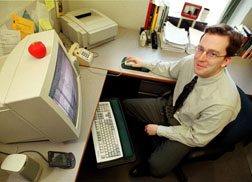 Kenneth Brown, PhD, an assistant professor
of management and organisations at the University of Iowa says
he regularly chides students for sending sloppy emails to him
and to others. People are becoming increasingly informal and
send email strewn with typos and grammatical errors. — AP
Kenneth Brown, PhD, an assistant professor
of management and organisations at the University of Iowa says
he regularly chides students for sending sloppy emails to him
and to others. People are becoming increasingly informal and
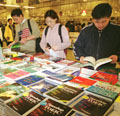
send email strewn with typos and grammatical errors. — AP South Korean college students browse
through books designed to help prepare for English language
skills tests at a major bookstore in Seoul. Many college
students read complex textbooks in English, but falter in
chats with native speakers. — AP
South Korean college students browse
through books designed to help prepare for English language
skills tests at a major bookstore in Seoul. Many college
students read complex textbooks in English, but falter in
chats with native speakers. — AP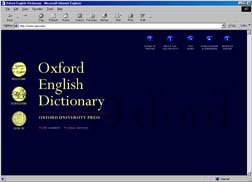 The
venerable Oxford English Dictionary (OED) went online this
past week with a flurry of new words.The international
flavour of today's English is illustrated as words like
macoute (a Haitian term for a bad man), maginnis (an
Australian wrestling hold), and mack (meaning a smooth,
seductive talker in the United States) join other new words from
around the world.
The
venerable Oxford English Dictionary (OED) went online this
past week with a flurry of new words.The international
flavour of today's English is illustrated as words like
macoute (a Haitian term for a bad man), maginnis (an
Australian wrestling hold), and mack (meaning a smooth,
seductive talker in the United States) join other new words from
around the world.