|
|
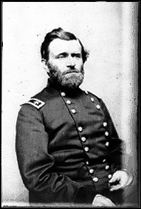
Ulysses S. Grant (1822-1885), led the Union armies to victory in the Civil War and later became the 18th President of the United States. His military career began with an appointment to West Point in 1839 and graduation in 1843 -- 21st in a class of 39. He served with distinction in the Mexican War (1846-48), though personally opposed to American objectives, believing it to be a war of conquest.
|
Within two weeks of the fall of Ft. Sumter in April, 1861, Grant volunteered his services to the Union cause. By June, Grant was appointed Colonel of the 21st Illinois Volunteers. Showing an aptitude for command, he was soon appointed a brigadier general of volunteers. Grant's first major campaign began in 1862, capturing Ft. Henry and attacking Ft. Donelson. Grant told Confederate commander Simon B. Buckner, a former West Point classmate, that only "an unconditional and immediate surrender" could be accepted. It was the first important victory of the war for the North. "Unconditional Surrender" made Grant popular. He was promoted to major general of volunteers.
Following the fall of Ft. Donelson in 1862, Grant went on to lead the victory Battle of Shiloh, one of the bloodiest of the war. Though severely criticized and called upon to be removed from his post, President Lincoln remarked, "I can't spare this man -- he fights."
In 1863, Grant demonstrated his genius at strategy, taking the Confederate stronghold of Vicksburg, Mississippi and Port Hudson. These victories cut the confederacy in two. By October 1863, Grant, now a major general in the regular army was made commander of the Military Division of the Mississippi. He promptly went to the aid of Union forces at Chattanooga and drove Confederate troops out of Tennessee, opening the way to Georgia.
|
In 1864, Grant was placed in command of all Union armies. Within 13 months, his strategy of advancing toward the heart of the Confederacy and applying pressure at all times to wear them down had succeeded. General Robert E. Lee and the Army of Virginia surrendered on April 9, 1865. END
|
 |
| HOME | THE MEN | CIVIL WAR MUSIC | CIVIL WAR QUILTS | GEN. BARLOW SITE |
"The Battle Cry of Freedom" midi sequenced by
Barry Taylor