Chapter One

The Basics
Lines:
Slope: m = rise/run = @y/@x = (Y2-Y1)/(X2-X1)
Explanation: The general equation for finding the slope of a line.
Point-slope: y-y1 = m(x-x1)
Explanation: Used to find the slope of a line when only a point it goes
through is given.
Slope-intercept: y = mx + b
Explanation: Gives you the slope of a line with y-intercept at b.
Functions:
Function: a rule which assigns to each element x in the domain, a single element
y in the range.
Domain: the domain of a function f is the set of all real numbers for which f is
defined.
Range: the range of a function is all of the y values that result from the input
of the domain.
Even functions:
An even function is a function which has symmetry about the y-axis.
f(-x) = f(x)
Odd Functions:
An odd function is a function which has symmetry about the origin.
f(-x) = -f(x)
Exponential functions:
An exponential function is f(x) = ax, where a = a positive real number
other than 1.
Rules for Exponents:
1. ax • ay = ax+y
2. ax / ay = ax-y
3. (ax)y = (ay)x = axy
4. ax • bx = (ab)x
5. (a/b)x = ax/bx
Exponential Growth / Decay:
Exponential growth can be described with the equation y = k • ax, when k > 1 and a >1.
Exponential Decay uses the same equation, but 0 < a < 1.
Functions and Logarithms:
One-to-One function: A type of function that assigns a different element in the
range to each element in the domain so that no two domain elements map to the
same range element. Tested with horizontal line test.
Logarithms:
Base a logarithms are represented by the equation y = logax, which is the inverse
of the base a exponential function y = ax (a>0, a --? 1).
Other logarithms:
logxx = ln x
log10x = log x
Properties of Logarithms:
Inverse Properties:
Base a: alogax = x, logaax = x, a > 1, x > 0
Base e: elnx = x, ln ex = x, x > 0
Other Properties:
Product rule: logaxy = logax + logxy
Quotient Rule: logax/y = logax – logay
Power Rule: logaxy = y logax
Change of Base Formula:
logxx = ln x / ln a
***NOTE: This can be used to evaluate a base a logarithm function on your calculator.
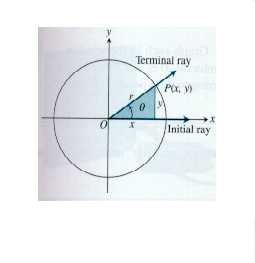
Trigonometric Functions:
Sine: sin q = y/r
Cosine: cos q = x/r
Tangent: tan q = y/x
Cosecant: csc q = r/y
Secant: sec q = r/x
Cotangent: cot q = x/y

Periodic / Period:
A function is periodic if there is a positive number h so that there is a point
or points where f(x+h) = f(x). The smallest of these is the function’s period.
Transformations of Trigonometric Graphs:
Like all other functions, trigonometric functions can also be even or odd.
This is a model to explain all of the transformations possible for a trigonometric
function:
y = a f(b(x+c)) + d
a = vertical stretch or shrink; reflection about the x-axis.
b = Horizontal stretch or shrink; reflection about y-axis.
c = horizontal shift
d = vertical shift
Inverse Trigonometric Functions:
Function Domain Range .
y = sin-1x -1 ≤ x ≤ 1 0 ≤ y ≤ π
y = cos-1x -1 ≤ x ≤ 1 - π /2 ≤ y ≤ π /2
y = tan-1x - ∞ < x < ∞ - π /2 < y < π /2
y = sec-1x |x| ≥ 1 0 ≤ y ≤ π , y ¹ π /2
y = csc-1x |x| ≥ 1 - π /2 ≤ y ≤ π /2, y ¹ 0
y = cot-1x - ∞ < x< ∞ 0 < y < π

***NOTE: Pictures taken from Calculus: Graphical, Numerical, Algebraic pgs 41, 41, and 47.
Back Home | Next Chapter | Reference Page

