
Newton's Third Law of Motion
Imagine yourself
floating about
a hundred feet above a mile wide river of asphalt. You are facing the
sun,
minding your own business as you watch the unending river flow into the
horizon. Suddenly you feel a slight gust of wind and then...SPLAT!!!!
The
expansive windshield of a gigantic semi has just hit you from the back.
Question: who exerted more force? You as your body hit the semi or the
semi as
it hit you? The perhaps surprising answer is that you both applied the
SAME amount
of force! Granted, the truck is still moving while your body parts have
been
scattered in several directions, but the amount of force each of you
exerted on
the other was the exact same. Welcome to the exciting realm of Newton's
Third
Law!
Isaac Newton, being the cool guy that he was (not), figured out that
when one
object applies a force to a second object, the second object will apply
an
equal amount of force to the first object, just in the opposite
direction.
You've probably heard this stated less accurately before as "For every
action, there is an equal and opposite reaction." This statement is too
ambiguous. What action are we talking about and what is it acting on?
What is
the reaction and what is it acting on? So most physicists would rather
have it
said like this (stated again for your reading pleasure):
Whenever one object exerts a force on
a second
object, the second object will exert an equal and opposite force on the
first
object.
"For every action or force there is an equal and opposite reaction or
force."
F1,2 = -F2,1
Any time you touch an object, it is
touching you
with the same amount of force. Forces always come in equal and opposite
pairs.
This means that the forces are equal even when a big object crashes
into a
small object.
If object A exerts a force F on object B,
then object B exerts a force F' on
object A,
where F' is equal in magnitude to F
but directed in the opposite direction
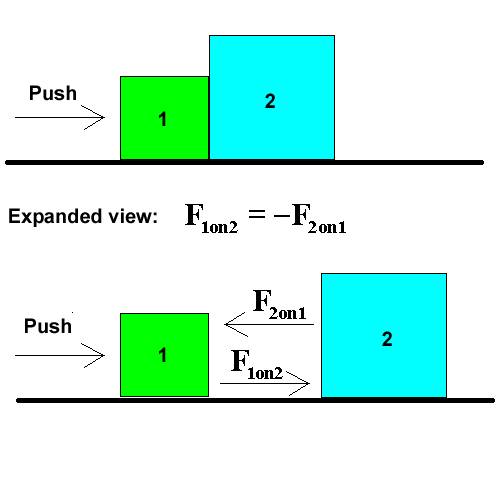
The diagram above brings us to an interesting and critical point. This is the concept of defining your system. If we consider the two blocks to be THE system we notice that the net force between them is zero. There is the force of box1 on box 2 and the force of box 2 on box 1. The forces add up to zero. BUT NOTICE that if we consider the push to be delivered by an EXTERNAL force then the 2 boxes DO accelerate with respect to, say, the table top. Newton’s 3rd law applies to systems where we do not consider any EXTERNAL forces. This is a good place for an Interactive Physics demonstration of center of mass. Let’s consider two blocks connected by a spring.
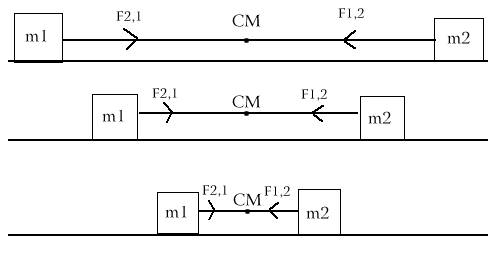
Notice in this diagram that the Center of Mass does not move! SO, the SYSTEM has a net force of zero. This makes sense inasmuch the two forces, F1,2 and –F2,1 add to zero.
Many people at first make the mistake
that since the initial force and the reaction force are equal in
magnitude but
opposite, they will cancel each other out. This is 100% untrue!
Newton's third
law involves TWO separate forces and TWO different objects. The forces
do not
cancel each other out because each force acts on a different object.
Let’s now consider another example of
Newton’s 3rd Law that involves a rifle. There are two masses
involves: the bullet, and the rifle. Expanding gas exerts a force on
the rifle
and bullet. Let’s look at a diagram.
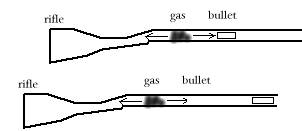
Here we have two masses: rifle mass mr and bullet mass mb. We also have two accelerations: ar and ab. There is a force acting on the bullet and a force acting on the rifle. As Newton tells us: the sum of the forces must equal zero. That is, the force on the bullet is equal to the force on the rifle, just in the opposite direction. So,
mbab =
-mrar
As you can see, since the mass of the bullet is small, the acceleration must be large. By the same token, since the mass of the rifle is large, the acceleration of the rifle is small. Well, that really depends on the size of the charge.
