
Physics 100
In order to conduct the simulation you
must have the simulation running. This is just the worksheet for the
simulation.
This lab can be accessed at http://webphysics.ph.msstate.edu/jc/library/4-7a/index.html
Purpose
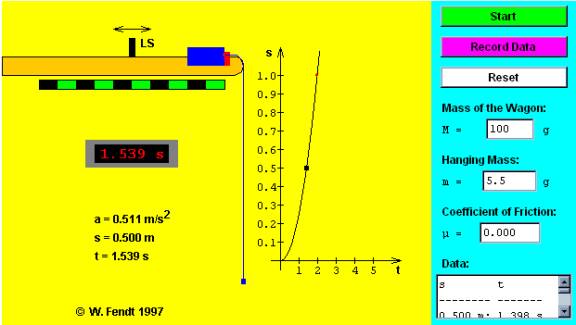
The purpose of this lab simulation is to explore the relationships among the mass, force, and acceleration of a system in motion. In other words, to examine Newton’s 2nd Law of Motion.
In this simulation we have a hanging mass, which provides the force, and a mass on a frictionless table, which will allow us to examine how acceleration is affected by the mass that must be accelerated. For the first half of the experiment we will be changing the force by changing the hanging mass, while keeping the mass being pulled constant. . In the second half we will keep the force constant and change the mass that is being moved.
Adjust the masses to correspond with the masses in the table below. Fill in the blank columns. SET THE COEFFICIENT OF FRICTION TO 0.00.
|
Table mass |
Convert to |
Hanging mass |
Convert to |
Total mass |
Acceleration |
Hang Force |
|
M(g) |
kg |
m(g) |
kg |
(M+m)kg |
m/s2 |
F=mg (N) |
|
100 |
|
0.5 |
|
|
|
|
|
100 |
|
1.0 |
|
|
|
|
|
100 |
|
1.5 |
|
|
|
|
|
100 |
|
2.0 |
|
|
|
|
|
100 |
|
2.5 |
|
|
|
|
|
100 |
|
3.0 |
|
|
|
|
|
100 |
|
1.0 |
|
|
|
|
|
150 |
|
1.0 |
|
|
|
|
|
200 |
|
1.0 |
|
|
|
|
|
250 |
|
1.0 |
|
|
|
|
|
300 |
|
1.0 |
|
|
|
|
|
350 |
|
1.0 |
|
|
|
|
1) What do you observe as the mass of the hanging object increases?
2) What do you observe as the mass of the table object increases?
3) Convert the masses to kilograms and enter into the table.
4) Calculate the force of the hanging mass (F = mg) and enter into the table.
5) Why is it necessary to convert the masses into kilograms?
6) Make a graph of the hanging force (last column) vs the acceleration of the system.
7) Make a graph of the acceleration of the system vs the total mass (M + m).
8) What conclusion can you draw from the graph in question 6?
9) What conclusion can you draw from the graph in question 7?
10) Why was it necessary, for question 7, to use the total mass (M+m)?
