
 |
Contact  Quality Management System |
 |

Contents
Contest Winner!
Aligning Metrics With Goals
The OS Quality Journey
Steering Committee Update
The Cost Of Quality
VISION Issue 1 |
Quality Management Organization
Doug Flanigin
Doug Flanigin
Doug Flanigin
Doug Flanigin
Doug Flanigin
|
|
The OS QMS select panel of judges has made its
decision: In case you haven’t
read the heading, the title of our newsletter is: “VISION”
and the envelope please… The winner is Doug Flanigin, who will receive a
check for $25.00US. Thank you, everyone who entered, and the entries
were:
|
The Contibutors |
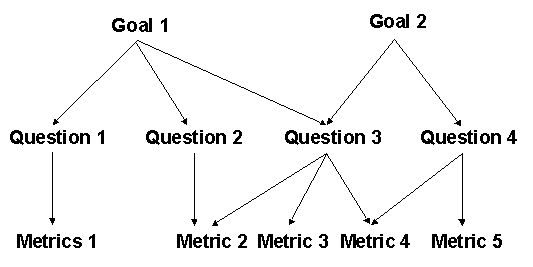
| Software metrics programs must be designed to provide the specific information necessary to manage software projects and improve software engineering processes and services. The foundation of this approach is aimed at making practitioners ask not so much, "What should I measure?" but, "Why am I measuring?" or, "What business needs does the organization wish its measurement initiative to address?" In order to accomplish this, software metrics must be selected that align with our organizational, project and process goals. The Goal/Question/Metric paradigm defined by Basili and Rombach provides an excellent mechanism for defining a goal-based measurement program.
|
The first step in using the Goal/Question/Metric paradigm is to focus on one or more measurable goals. The goals we select to use will vary depending on the level we are considering for our metrics:
|
|
In the first issue of Vision, the following questions were asked: · Are you onboard for the OS Quality Journey? · Who is responsible for quality? · Is it the responsibility of Quality Assurance (QA)? · Is it the responsibility of Quality Control (QC)? · The Quality Management Organization (QMO)? The truth is that all of the above are responsible. The support and implementation is an internal undertaking by all OS resources including consultants, suppliers and our customers through feedback and other tracking media. There are many measurements for quality and each vary in importance to each quality effort. Therefore, we searched for a tool to provide quality and the implementation of measurements of success. In response to Customers and Suppliers, Management has selected the ISO 9001 Model for quality assurance in design/development, production, installation and servicing. The QMO under the guidance of the Vice President of Quality Management, Mike Smith, is taking the lead in Process Improvement and System Level Procedure (SLP) Documentation development and the institutionalization of the OS Quality Management System (QMS). The utilizes the 20 elements of ISO 9001 as a balance sheet and a measuring device for documented procedures and the quality artifacts that support the QMS effort. ISO is not a product quality label. When an organization has a management system certified to ISO 9001, this means that an independent auditor has checked that the processes that influence quality and the impact of the organization’s activities conform to the standard’s requirements. The ISO logo is a registered trademark. ISO does not authorize its logo to be used by a quality system or by system certification bodies. The certification body for OS is the British Standards Institute (BSI).
|
The following is a discussion of the six (6) elements that have been addressed first by the QMO team: The first element of ISO 9001 addresses the Quality Manual. OS management is required not only to define its policy and objectives for and commitment to quality, but shall also take steps to ensure that this policy is understood, implemented and maintained at all levels. The Quality Manual is responsible for defining responsibility, authority and interrelationships of personnel who manage and verify work that affects quality. Through scheduled Management Reviews the total QMS is reviewed and evaluated. The fourth element of ISO-9001is Design Control. Design control relates to all OS products by utilizing the verification and reviews phases as well as the software development and support life cycle. This element looks at the resource support and the business strategic planning. The fifth element is titled Document and Data Control. This is a comprehensive requirement whose scope covers ALL documents and data related to the requirements of the OS QMS. This element requires that all such documents are reviewed and approved by authorized personnel prior to issue, thus crossreferencing the requirement of Responsibility and Authority. Changes to documents must be reviewed by the same functions/organizations that performed the original review and approval prior to initial issue, unless specifically designated otherwise. OS must establish and maintain a Master List identifying the current revision status. That is why we state in the footer of each document, "Check the Master List...." Corrective and Preventive Action is the 14th element and documents and tracks internal problems as well as those of the customer. The preventive action is needed to prevent the recurrence of problems in OS products. Quality Records, element 16, identifies the requirement for Quality Artifacts, the Responsibility for, and the retention period. In addition, the requirement for actual storage of such records should be addressed. Element 17 is titled Internal Quality Audits. We refer to these activities as evaluations. A planned and scheduled program will be carried out in accordance with documented procedures and is one of major element for OS Management Reviews. Next Month: Design Control and S/W Dev |
|
The Quality Management System (QMS) Steering Committee provides the management level sponsorship for the QMS project. They oversee the implementation and on-going operations of the QMS. Members of the QMS Steering Committee include: |
The
Cost Of Quality Series: Part 1, The 1~10~100 Rule
|
If asked
about the cost of quality, most of us could spin off a list including the
Quality Guru's salary plus the cost of those expensive quality conventions
that he or she attends and maybe the cost of his or her use of the Xerox machine
and the telephone. What about
the hidden costs of quality? How
many of us recognize our own contribution (good and bad) to the Cost of
Quality? We are each internal customers
and internal suppliers to each other.
There is a continuous exchange among us of ideas, data, experience,
paper, charts, partially completed projects, and reports along the
"Customer - Supplier Chain" that leads to our Ultimate Customers.
|
If I catch
and correct one of my errors before passing the work on to my colleague, then
the Cost of Quality may be relatively small. Perhaps ten minutes of rework is the only cost. However, the cost increases if the
work is used by several in my department before the error is detected. Now several people must correct their
work product. The Cost of
Quality really escalates when the error is not detected until it reaches the
final customer. We can all
imagine the cost to OS of approaching the customer with the proud news that
we have successfully achieved acceptance testing the ASR Gateway only to learn from the
customer that he had purchased the LSR.
The cost is now huge in terms of rework, dissatisfaction, overtime,
loss of respect, loss of a good business reference, loss of future business,
and possibly exposure to a lawsuit.
The ultimate (and hidden) cost of quality occurs when we have a
dissatisfied customer. The 1 ~
10 ~ 100 Rule should remind us of our responsibility for quality output. We all should feel empowered to pull
the cord that stops the assembly line.
Correct the error right here, right now. Every OS worker has a responsibility to ensure that a
truckload of errors does not back up to the customer's receiving dock. Next Month: Part 2, The Supplier-Chain |
|
Comments, Corrections, and Suggestions? Please use the E-mail icon at the bottom of the page to submit your ideas. |

|
? |
