
6.1 Fishing Darwin Harbour Recreationally: Amateur or non-commercial fishing in Darwin Harbour is one of the dominant recreational aquaculture pastimes for locals and visitors alike. 45% of the hours fished annually in the Northern Territory by
|
Genus/species |
Common Name |
Genus/species |
Common Name |
|||||||
|
Acanthopagrus berda |
Pikey Bream. |
Lutjanus sebae |
Red Emperior. |
|||||||
|
Caranax Sp. |
Trevelley |
Lutjanus russeli |
Russell's Snapper. |
|||||||
|
Choerodon Sp. |
Parrot Fish. |
Lutjanus vitta |
Yellow Finned Sanpper. |
|||||||
|
Epinephalus malabaricus |
Estuarine Rock-Cod. |
Lethrinis nebulosua |
Spangled Emperor. |
|||||||
|
Epinephalus lanceolatus |
Queensland Groper. |
Oxyekeotris lineolatus |
Sleepy Cod. |
|||||||
|
Hephaestus fuliginosus |
Black Bream. |
Platax batavianus |
Moonfish. |
|||||||
|
Johnius didcanthus |
Spotted Jewfish. |
Plectropompus maculatus |
Coral Trout. |
|||||||
|
Lates calcarifer |
Barramundi. |
Plectrohynchus pictus |
Painted Sweetlip. |
|||||||
|
Lutjanus argentimaclatus |
Mangrove Jack. |
Polynemus sheridani |
Threadfin Salmon |
|||||||
|
Lutjanus carponatus |
Spanish Flag Stripey. |
Polynaemus sheridani |
Threadfin Salmon. |
|||||||
|
Lutjanus chysoctomus |
Red-Throat Emperor. |
Pomadasys nageb |
Trumpeter. |
|||||||
|
Lutjanus fletus |
Red-Finned Emperor. |
Scylla serrata |
Mud Crab. |
|||||||
|
Lutjanus johni |
Golden Snapper. |
Somberoides Sp. |
Skinny Queenfish. |
|||||||
|
Lutjanus malabaricus |
Saddle-Tailed Snapper. |
Thunnus tonggol |
Northern Bluefin Tuna. |
|||||||
|
Some Of The Targeted Marine Life From Darwin Harbour |
Table 2: |
|||||||||

resident and visitor anglers were spent in Darwin Harbour (Coleman, 1998). This indicates an acceptance by all non-professional anglers that Darwin Harbour is where ample fishstocks are present and/or that it is close to a major urban centre. However, the same study determined that only 1% of all Territorians were the member of a fishing club. It is certain that anglers can be successful with a ready catch of fish in the many mangrove-ringed inlets, bays and rivers that make up the littoral of the Darwin Harbour. Mud crabs are also an important, sought after marine creature and Darwin Harbour is a reserve for recreational crabbing only (NT Government, 1995). In fact a total ban on commercial fishing of any nature is in force for the area considered as Darwin Harbour.
Groups and individual fishers who use the harbour are as diverse as the species of fishstock, which are being exploited for sport and consumption. Table 2 has some of the fish species found in the harbour. The fisherpersons’ range of activity cover such as guided tours for tourists and those of the local fisherpersons who mostly have their own boats. A wide variety of perceptions by these anglers vary as to the relevance of harbour mangals to the marine ecosystems and marine life, which they exploit. Most of the locals interviewed or questioned regarded the mangals as a separate issue to their chosen recreational activity. That is, Mangroves may be important to the overall values of Darwin Harbour, but the government should be looking after them. They were passive in their outlook toward the relationships between the marine ecosystems and their recreational activities. "I’m a baker, not a politician" claimed one respondent, "Let the government manage the mangroves if they want to".
However, the intra-territory and the interstate visitors to the Top End who were questioned had a different story to relate. Most thought that the general public should take a more active role in the forming of government policy and legislation for the management of mangals and recreational fishing. Peter Holden, a fishing visitor from Adelaide said that: "Well I suppose I don’t know too much about what mangroves actually do for the environment. I’ll leave that to the government. I'm only a truck driver. I do know that it is the mangroves though where the fish breed and grow up. Governments should at least try to keep them and so should the fishermen who use them".
I also asked Cymon Brooks, an ex fishing tour guide in Darwin Harbour the question: "The government has mentioned a figure of 80% of the mangroves to be saved whilst the remaining 20% is to be developed. Do you have any views on this?". His verbatim reply was: "Well that sort of thing I feel it is most important that if they take 20% out they have to take 20% out of an area that is not actually used by the fishing itself because they cannot damage the fishing's ecology. The impact of 20% in the wrong area would outweigh leaving 80% behind because of my understanding of what mangroves actually do, it is simple things in the food chain that a decomposing mangrove tree is eaten up by mangrove worms and therefore the trees actually act as a fertiliser just like a normal tree would on land. If the government were to do this 20% bit it would really have to be places where the function of the mangrove themselves are not really that important to fishing. I couldn't give specific areas because to me they are very important in many areas. Because not only that you will find out at the time that if you go to the very back end of the fringe of the mangroves you still see bait fish on the spring tides right up to there so it has to have some sort of impact".
These two individuals’ reactions to my questions cannot of course be taken as a cross- representational response by all of Darwin Harbour tour guides and recreational fishers. Although, they are views and concepts held by two people, in different walks of life, these observations could very well be held by many. Another issue, which should be raised here, is that of security parking at Darwin Harbour boat ramps. Thieves frequently break into unattended vehicles whilst the owner is on the water fishing. Fenced off and manned enclosures at Leaders Creek on Gunn Point Road is a successful venture (Whitfield, 1999, p. 6). However, this is the only security carpark for angler’s vehicles.
To have security at every boat ramp in Darwin Harbour, there is eleven in total, would not only be uneconomical, but unpractical. This is a no win situation for Darwin’s anglers because the Territory Governments and the Local Councils won’t supply funds for this purpose. Most anglers are divided with no supporting lobbying association. The Amateur Fishing Association cannot afford to pay for these services but are presently lobbying community service groups to get some work done in this area, (Whitfield, 1999, p. 6).
It is difficult to decide just where mangroves in Darwin Harbour should be preserver and which ones should be earmarked for development. When asked most of the persons questioned answered that they should all be saved. However a realistic approach is required. To answer the question of which mangroves should be preserved in relation to fishing activities I have consulted the NT Fish Finder 2 and have noted on the enclosed map of the area which positions in the harbour should have at least consideration for preservation.
6.2 Sailing: Sailboat owners and those who hire yachts from the various outlets on the Fanny Bay foreshore hold this activity on Darwin Harbour. Often these craft are reliant on winds and tides for forward momentum and at first glance mangrove management and conservation seem irrelevant to sail activities. However, the values associated with sailing are the relaxing nature in boating on an unpolluted waterway, the aesthetic qualities of fresh air, scenic views and a clean environment. Moreover, the depletion of mangrove forests diminish the sailing enthusiast’ aesthetic conception of the naturalness of the harbour foreshores. Documentation has also shown that mangals act as a filtering system for toxicants and pollutants thereby acting as a cleansing agent for polluted waters. Consequently, they contribute to the clean qualities of the actual water. Mary Watson from Sydney claims:
"If I want to see houses and buildings and high-rises from the water I can go to Sydney Harbour or to Surfer’s Paradise. I don’t come to Darwin just to go sailing but when I am here it is good to see natural trees and foreshores and not dirty, noisy, Sydney or Surfers".
Although the impact with mangrove removal on sailing Darwin Harbour is not readily noticeable, the above response is indictable of a conception of why some people may sail for recreation. Again, as with recreational fishing responses, one person’s views cannot be classed as representational across the board for the territory’s sailing community. It merely gives an indication of how individuals may perceive the values of sailing on this water playground.
6.3 Swimming/SCUBA Diving: Darwin Harbour is a graveyard for many marine wrecks. Some of these were sunk for a specific purpose whilst others were due to acts of war or to misadventure. Artificial reefs have been positioned off the Nightcliff Jetty, Lee Point, Stokes Hill Wharf and at Fenton Patches, all within this study’s boundaries of Darwin Harbour. These are some of the better artificial reefs in Australia if one wants to contrast them to those in other states. Inclusive is sunken barges, trawlers, Asian refugee boats, and other out of date and outmoded large objects
discarded by Darwin industry. They provide good fishing, excellent SCUBA diving locations and marine habitats.
Additionally, World War Two naval and air wrecks occupy various sites in the harbour as well as motor vessel and trawlers which were sunk by Cyclone Tracey in 1974. Whilst line fisherpersons do use these artificial reefs for their own particular purpose, they are used extensively for diving excursions by local dive shops and groups such as Coral Divers and the NT SCUBA Divers Club.
The wrecks provide many marine species with shelter and also accommodate some spectacular sights for divers when the water conditions permit. Sash Muller of Coral Divers claims that: "Offshore at the Fenton Patches divers are treated to seeing huge
Name Dive Depth Bennets Bottom. 35 Meters. The Backbone. 35 Meters. No. 6 Buoy Coral Slopes. 18 Meters. Platters Rock. 12 Meters. East Point Coral Gardens. 10 Meters. Old Man Rock. 10 Meters. Dudley Bommies. 07 Meters. Darwin's Natural Coral Reefs And Their Accessible Depths. Table 3:
However, the wrecks, whether they are planned or accidental, aircraft
or sea-going vessel have very little relevance to the existence of mangals. Except where the wreck is
within the boundaries of intertidal sand and mud flats, as are a few of the aircraft, which accommodate the mangroves. The wreck then becomes an integral habitat for mangal flora and fauna. With the exception of the aforementioned filtering qualities of the mangals to provide clear water for diving and swimming, no direct correlation is apparent or immediately recognisable. This does not mean diving on wrecks, as a pastime should be ignored for this proposal. Further dialogue could be employed to gain further information, as this is a popular pastime for visitors and locals.
jewfish and trevally, cobia, rays, huge cod and even
sharks"
(Muller, p. 113).
Darwin Harbour has to rate a world-renowned dive spot if Mullers’ observations are indeed correct. Some
divers have been know to travel to places such as the Carribean, Hawaii, the Philippines and other Pacific
islands in search of what can be found in Darwin Harbour by Muller’s description. Furthermore, large
areas of corals and other marine life abound in this Indo-Pacific marine environment
(Allen, 1994),
at natural reefs such as those in Table 3. Many blue water dives exist on a system of artificial reefs just outside of the Darwin Harbour but which are reliant on the harbour for sufficient tidal flow to assist in clearing visibility. Whilst a further 14 World War 2 and Cyclone Tracey ships and aircraft wrecks are also scattered throughout the area
(Coral Divers, No Date).
6.4 Motor Boating, Water and Jet Skiing. These three activities have an obvious impact on mangrove communities. The momentum of each vessel through the water causes a bow-wave. Consequently, this bow-wave could cause some damage by crashing into the exposed root systems and eroding the soil bed in which the trees stand. I have found little research into this occurrence and I am therefore assuming that the increased water movements caused by the passage of motor vessels can affect the growth of mangroves individually and collectively. If this is indeed the case then the whole of Darwin harbour could be at risk because power vessels and boats can cover the entire harbour’s waterways.
The NT Water Ski Association has no identifiable policy concerning conservation and preservation of mangroves in regard to their members skiing activities. They merely refrain from going near mangrove strands as this could have dangerous overtones for those being towed as a skier. If the extra water movement around and within the mangrove root systems do have erosive qualities, I feel it would prove minimal as bow-wave movements could only effect mangrove systems on the out-going tide. If these movements were indeed erosive, then incoming tides would redistribute displaced soils further into the mangrove wetlands. There would be no disturbance on both low and hide tides. On the former, tidal bow-wave movements do not contact the exposed root systems and during high tides the systems are covered. However, out going tidal movements could have root systems partially covered and susceptible to the extra water movement caused by the bow-wash.
Whilst water movements do have considerable affect on the growth and development of mangals, this influence could prove considerable if impacts resulted from decisive currents and strong tidal run-off. Bow-wash from powerboats and vessels should have minimal affect because these movements are not as determined as are tidal flows. The re-routing of tidal channels and normal flow paths cause more problems with water movement than do boats and their bow-waves. As one skier questioned claimed: "More damage to mangroves are caused by changing current flows by building jetties and rock-walls than my boat would cause in ten thousand hours of skiing". Power boating, jet and water skiing may affect mangroves marginally. Although, it is not immediately apparent if this is indeed the case or if there are any long term affects caused by power boating in and around mangrove communities. This therefore is a matter for further consultancy and research.
6.5 Mangrove Boardwalks:
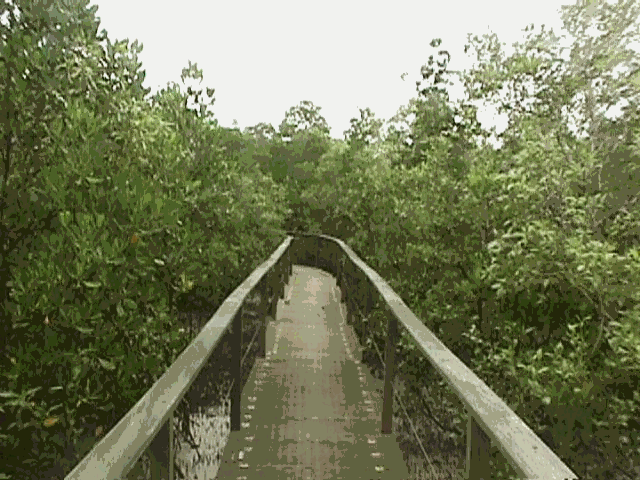
Presently there is only one mangrove boardwalk in the Darwin Harbour study area. This is situated at East Point and is maintained by the Darwin City Council. Users of this structure are inevitably the first time user who ventures out onto the platform for a novelty value. There are also those who watch the marine fauna and those interested in and wish to observe the mangrove species and vegetation itself. It is however, covered on high tides and is closed at this time. It is a popular first time experience but this novelty soon wears off. As one tourist from the US said: "It's nice to see these things because we don’t have them in New York. But once you have been there, what’s on next?"
This boardwalk is rather educational and it extends for about 1.5 km through the coastal integrated and educational kits are available for these excursions. This boardwalk was made possible by Greening Australia NT; The Commonwealth Ecotourism Program,
the Darwin City Council on whose reserve it is situated and the Australian Trust for Conservation Volunteers
(Hudson, No Date).
6.6 Picnics/Public Access/Outdoor Entertainment/Festivals. There are literally hundreds of parks and reserves scattered around and throughout the greater Darwin and Palmerston metropolitan areas. The Darwin City Council presently has control of parklands and foreshore areas in excess of 600 hectares
(Darwin City Council, No Date{d}).
One such recreation reserve, the East Point Reserve, comprising the aforementioned mangrove boardwalk, is only a few minutes by public transport from the CBD. The largest and most popular are listed on the Internet
(Darwin City Council, No Date{e})
and are also accessible by the present public bus system.
The two main seasons in Darwin are the Wet and the Dry and it is during the Dry that the outdoors social calender is most active. The three permanent and one Dry season outdoor markets are available for bric-a-brac, hand crafts, Asian traditional crafts, fresh vegetables and fruit and also the traditional dishes of the many Darwin ethnic communities and groups. These are public access markets, which ingress a diverse cross-section of cultural groups for the benefit of tourists and the general local public alike. Additionally picnic faculties are provided in many of the parks on the harbour foreshore. The extensive beaches provide a marine scenario and Lake Alexander, an artificial waterway built in 1991, provides relatively safe swimming all year long. Stingers, crocodiles and other marine life are excluded here to control this safety. Three chlorinated swimming pools also complement the safe swimming practices of Darwin populations. Additionally, further activities are organised during school holidays, with the emphasis on entertainment for school children. This initiative operates weekly and is a free service offered to encourage an increased use and awareness of the parks and gardens infrastructure around the harbour
(Darwin City Council, No Date{c}).
Free Recreation and Entertainment for everyone in the Parks (FREEPS) festivals are also venues and social events designed to also encourage social integration and to promote these opportunities. These are Dry season events and are usually are scheduled for twice a month. These festivals are directed towards all age groups, ethnic groups and people from all walks of life
(Darwin City Council, No Date{b}).


These Pages are supported by Angelfire
This site is best displayed by Netscape.
