

Before the invention of the match lock firearm, musketeers had relied on an even simpler device, the hand cannon. It originated around the 1290s This firearm was extremely crude by anyone's standards and tended to harm the musketeer almost as often as the intended target! Early hand cannons were made of a bamboo tube, that was plugged on one end. A measure of low grade powder was poured into this tube, followed by a hard baked clay bullet. These items were then packed to the breech of the tube. The musketeer would then light the powder with a burning stick. If all went well, a large clay bullet would exit the tube in the intended direction. Later models of the hand cannon included a cast barrel and wooden stock. In battle, these early firearms did not have a major influence. This was because the hand cannon's bullets did not exit the barrel with enough force to penetrate most armor and had a range of only 30 yards.
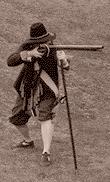
The Match Lock Firearm
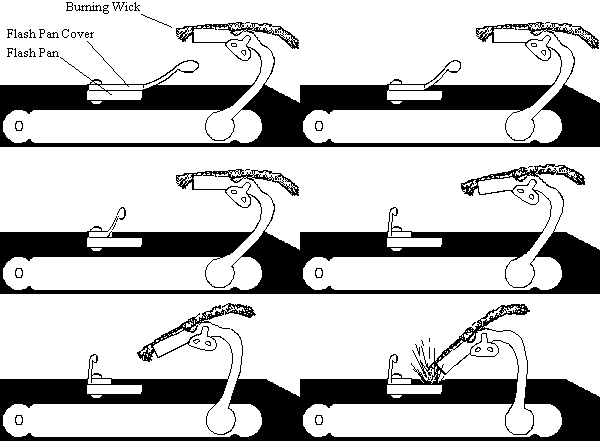
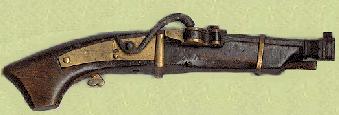
The match lock originated around the 1450’s. This firearm was inexpensive to make and was in wide use until the early 1700’s. The match lock was a very easy gun to use, but the barrel construction was very heavy, so a balancing stand was need on most matchlocks. Another disadvantage was that the wick was very vulnerable to moisture, any water on this part of the gun would make it next to impossible to light up. Also, the match lock was slow and cumbersome. It took a well trained musketeer at least 30 seconds to reload it. The advantages of this firearm were that this gun could be held by both hands, increasing accuracy and control.
|
|
Updated on June 18th, 1998
Daniel Berry
