
Breech loading and cartridge Firearms
The percussion cap system was king for many years,
but this action still needed to be muzzle loaded with a measure of powder
followed by the bullet. After the battle of Gettysburg in 1863 it is recorded
that some rifles picked up from the battlefields were found to be carrying
as many as fifteen charges, one on top of the other. It appears that
the soldiers did not notice the misfires in the heat of the battle and
continued loading from the muzzle until the barrels were full. Much
effort was put into simplifying the muzzle loading procedure, but the task
was still time consuming. What was needed was a breech
loading firearm that took a cartridge that already had the powder and bullet.
Captain Patrick Ferguson developed a breech loading rifle during the late
1700's, but his design failed to attract attention after his death in a
battlefield. A Swiss inventor Johannes Pauly patented another very
effective breech loading firearm in 1812. These designs were very
well thought out, but one reason or another, gun makers of the time did
not use these ideas.
With respect to the cartridge, Lefaucheux had developed
a system whereby the fulminate was placed on a separate cap which was incorporated
within a metal case, near the tail, was a small metal rod which touched
the fulminate cap. When placed in the breech of the special Lefaucheux
firearm a small slot was left for the rod to pass through the breech.
When the hammer fell it drove this rod down to the fulminate and detonated
it, sending the bullet out. This system is known as the pinfire.
Although this system was effective, it was still limited.
In 1855, Rollin White took out a patent for a breech
loading revolver. basically, he drilled out the cylinders all
the way and inserted .22 inch cartridges in the breech end of each cylinder.
The cartridge were known as rimfire because the detonating fulminate was
deposited on the inside rim of the cartridge. The firm of Smith and Wesson
used this idea to make a .22 calibre firearm, but the public wanted a larger
calibre. So after much work, they came out with firearm that held
a .32 calibre bullet. Other gun makers wanted to begin production
of a rimfire weapon too, but Smith and Wesson held the master patent until
1869. After the patent expired almost all of the gun makers ganged
over to the new design. After much work and experimentation the centrefire
was introduced.
The centrefire cartridge opened the way to a whole
new breed of weapons including bolt action rifles, repeating rifles, and
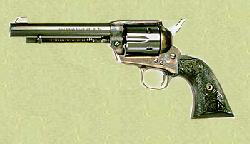
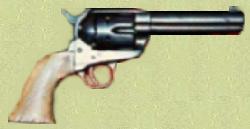
machine guns. In 1873 Colt produced the Colt Army Single Action revolver
which used this centrefire cartridge. These weapons now can sale for more
than $1,500.

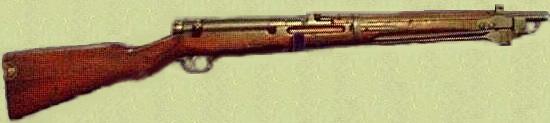
1890 Swiss Sniper with Mauser action

Mauser Model 1895 made for Chile






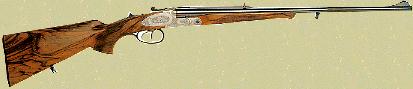
Of course, the truly interesting thing about double
rifles is that they are not shotguns. double rifles
were created during the colonial period of the 1800's when the British
and other colonial powers
came face to face with big game in the colonies of Africa. That
is, the big five: elephant, rhino, cape
buffalo, lion and leopard. finding that their guns were not powerful
enough to bring down these huge
and or ferocious creatures, they developed double rifles. a gun
with two barrels side by side (SXS)
which fired not shot but a heavy caliber bullet. bullets with
diameters big enough to penetrate thick
hides and stop the charges of dangerous game. .375, .416, .500,
.505, and even .600 diameter
bullets were fired from these guns. why two barrels you ask?
the double rifle was designed to fire a
second shot almost instantly when needed if the first shot did not
succeed in subduing the dangerous
game. a bolt action rifle is too slow in this respect in that
you have to pause to work the bolt of the
gun in order to be ready to fire the next round. if you were
charged by an angry elephant, you would
be dead by the time you worked that bolt. a double rifle solved
this problem because you had two
triggers to pull on the gun, one trigger firing one barrel, the second
trigger firing the second barrel .
both barrels could actually be fired at the same time by using two
fingers, one on each trigger, but
the guns were so powerful that the force of both barrels going off
at the same time could either
knock the shooter to the ground from the impact or dislocate the shooters
shoulder.
these guns were (and still are) incredibly expensive
to manufacture because you have to design
them so that both barrels are so aligned that the bullet will land
in the same spot when each is fired.
this is called regulating the barrels. think about it, if you
have to parallel lines running off into infinity,
the lines will probably cross at some point, the secret to designing
a double rifle is to make that point
be at about 100 yards, the usual distance that game is shot at (the
human eye begins to lose it's
accuracy beyond that). average price for a double rifle is $30,000.
so yes, i am interested in double barrel shotguns, but i am in love
with double barreled rifles or
double rifles as they are commonly known. By Donald James
Cleave 6/17/98
|
|
Updated June 21st, 1998
Daniel Berry
