 The Fashion Plate for dolls, Vol. 1, No. 3

October-November-December 2000
Pattern Layout
(third in a series)
When starting
a project, wouldn't it be nice to sit right down and start sewing? Unfortunately, it doesn't work that way—sigh. In fact, actual sewing takes only a small part of our time when compared to preparations and finishing touches. Short-cutting these steps often leads to results that are less than our highly desirable expectations. My motto: You can't rush perfection!Grain
Pattern pieces are laid out relative to the grain of the fabric. (Be sure that the grain lines noted on the original pattern are transferred to all working pattern pieces or templates.) If you are starting with a piece of yard goods that has a selvedge, then the grain is easy to see. The selvedge is the finished woven edge that runs lengthwise. This is the grain-line direction, i.e. "straight of grain" or "on grain."
Some pieces are cut "on bias." Find the bias grain by folding the selvedge at a right angle to the crosswise threads. That folded edge on the diagonal is the bias grain. This edge stretches easily which is why bias trim is cut in this direction and hence, it's name. The bias grain allows give while the straight grain does not. Bias-cut skirts drape beautifully, but use care not to stretch sewing a bias seam.
Sometimes a piece of fabric appears to be "off grain," that is, with woven threads tilted or skewed from straight. How does this happen? While weaving is always straight, it is sometimes pressed or rolled crooked on the bolt before it leaves the mill. If something is cut off grain—caused by either
off-grain fabric or crooked pattern placement—the garment will never hang right or the fabric design will look wrong. This is especially true with directional prints, stripes or plaids. Off grain can be straightened by pulling or stretching diagonally across the bias (both ways until squared up) and steam pressing. If you wash the fabric first, then stretch to straighten and press.Knowing how to find the straight of grain becomes even more useful when you consider that many of us who sew doll fashions like to use up small pieces of leftover fabric. Simply put, to determine what is on grain, if you try stretching the (woven) fabric piece, here's what you will see: If it stretches, you are on the bias; if it does not stretch, this is the straight (or crosswise) of grain. Directional prints and stripes are, of course, easy to see. And don't forget to consider nap, whether it's velvet, corduroy, or knits, etc. (Refer to "Fabrics 101" in the last issue.)
Cutting Layout
Commercial patterns include diagrams that show the position of pattern pieces on a prescribed piece of fabric. Generally, I have found they are not always very useful and do my own thing. Many times I use leftover pieces of fabric that won't fit the diagram "ideal." And there can be other ways of laying out the pieces to save on fabric, especially if doing multiples. Also, fabric amount requirements are usually generous and the pattern layout does not always conserve fabric. My objective is not wasting fabric if I can help it.
To figure your own placement layout and how much fabric will be needed for a particular pattern, lay all the pieces out. Eliminating "on fold" pieces (making a new complete piece that can be cut out flat, unless large) makes it easy to accurately position all pieces without cutting on the fold. If doing multiples, some pieces are easily "nested." For instance, the outer curve of a collar closely matches the inner curve and permits several collars without loosing virtually any excess fabric. Look for those pieces that complement each other for maximum economy. We'll cover multiples in more depth in a later installment.
To estimate fabric requirements, I usually place all the pieces side-by-side. Look at the tallest pattern piece. A pencil skirt may require 5"-6".
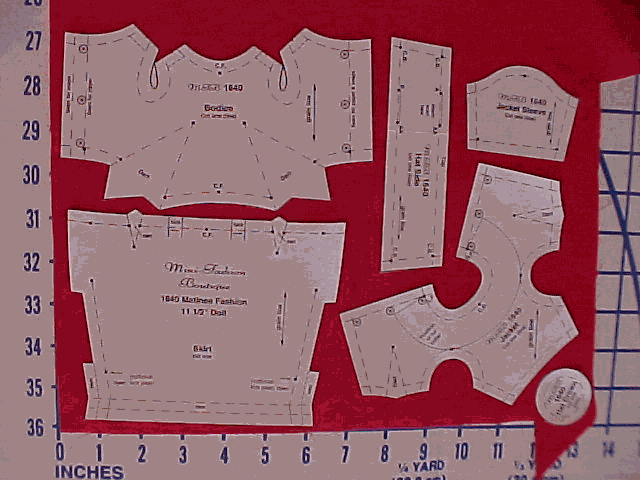
Below: Matinee Fashion pattern pieces laid out on leftover fabric. Note that the pencil skirt is about 5" while the bodice on bias needs about 6"
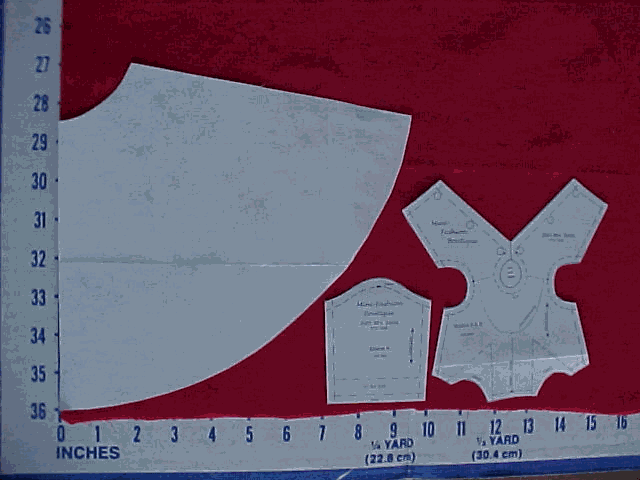
A full skirt (remember the grain line) may be 9"-12" as shown in the picture of Mrs. Santa layout.
Pattern pieces from Mrs. Santa Clause for Barbie are laid out according to grain, with circular skirt on the fold. Note that 9" length is needed.
Position all the other pieces out to the left or right of this tallest piece, keeping the pieces on grain and in a straight line along the lower edge. Move the pieces to various places to conserve fabric waste. There will probably be some unused area(s) which would be available for multiples. If all the pieces to complete one garment can be positioned within this limit, add about 1/2" to 1" for the length you would need to purchase. Keep in mind that most fabrics come in either 44/45" or 58"/60" and are folded on grain with the selvedges touching.
If you have leftover fabric, select fabric scraps according to size and place various pattern pieces on grain. Do this for all pieces for an outfit before cutting out in case you run short. I have some favorites that I squeeze every bit out that I can. If you are short, there may be pieces that you can select from a contrasting or complementary fabric—a collar, cuffs, some special trim, etc. In fact, this can lead to a totally new look!
Next time: Pattern Layout continues with matching plaids and stripes
Future topics: Cutting multiples
When is basting necessary?
Machine sewing techniques
Lining a bodice/jacket
Closures
And many others!
I invite your comments, questions, topic suggestions and tips. You may email me at srheater@earthlink.net
Return to Table of Contents

© 2000 Mini-Fashion Boutique