
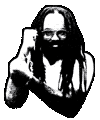
Mumia's supporters believe that the real killer of police officer, David Faulkner, escaped the night of the shooting, and Mumia was set up because of his past involvement with the Black Panther Party in the 60's.
Trial Errors
I. The Commonwealth withheld materially favorable evidence from the defense, and knowingly used false evidence. Evidence withheld and false evidence include the following:
(1) statements by an eyewitness, indicating that another individual, not Mumia, was the shooter, that the actual shooter fled the scene, and that a critical prosecution witness was actually not present at the scene
(2) evidence of the failure of a prosecution eyewitness to identify Mumia in a photo array
(3) the favorable results of a polygraph examination administered to an eyewitness called by the defense which corroborated the claim that the actual shooter fled the scene
(4) extensive police files concerning Mumia's political activities and affiliations which expose law enforcement's deep-seated bias against him and show that Mumia engaged in no criminal conduct during the years he was closely surveilled
(5) evidence of intimidation, special deals and favors, and coercion which was applied to numerous witnesses, causing one eyewitness to flee the jurisdiction, causing Cynthia White to give false testimony, causing two eyewitnesses to retract their claim that they saw the shooter flee, and causing a police officer witness to take an unauthorized vacation in order to prevent his availability at the trial; and...
(6) evidence of incompetency in the Medical Examiner's autopsy report.
II. The court deprived Mumia of his fundamental right to present a defense in the following ways:
(1) Mumia was effectively barred from presenting crucial evidence that he had not made any incriminatory statements. Consequently, the prosecution's claim that Mumia had confessed to the shooting of Officer Faulkner remained unrebutted.
(2) Mumia was barred from examining Veronica Jones and showing that prosecution witness Cynthia White--perhaps the most critical eyewitness for the prosecution--was coaxed and coerced to testify.
(3) Mumia was prevented from showing that another prosecution witness was susceptible to police pressure to change his account of events because he was on probation and because of prior drunk driving convictions.
(4) Because of his indigence (poverty) and the court's unwillingness to authorize funding for investigation and expert witnesses, Mumia was unable to present expert testimony which would have established that the prosecution's theories were false.
III. The court impermissibly held two in camera (in judge's chambers; in private) conferences outside Mumia's presence, at a time when Mumia's pro se (representing oneself in a case rather than being represented by an attorney) status was still intact, wherein Mumia's pro se status was discussed, an African-American juror selected by Mumia was removed, a question of juror taint was explored, and the admissibility of certain police officer testimony was considered.
IV. The conflicts between Mumia and his court-appointed attorney were so pervasive, divisive, and intense that his right to effective assistance of counsel must be presumed to have been violated; and, further, that these conflicts in fact led to a constituionally inadequate defense.
V. The court prematurely and unjustifiably stripped Mumia of his right to proceed as his own attorney, and instead imposed upon him a constituionally ineffective attorney.
VI. The court unjustifiably banished Mumia on numerous occasions from the trial proceedings, thereby violating his right to self-representation, his right to assist in his own defense, and his right to confront the prosecution's witnesses.
VII. The prosecutor's guilt-phase closing argument exceeded the bounds of propriety and violated Mumia's right to due process.
VIII. The court impermissibly responded to a juror's inquiry, which ultimately led to that juror's removal, without notifying the defense of that inquiry.
IX. New evidence establishes that intentional racial discrimination infected the selection of the jury.
MORE DETAILS
X. The jury pool from which the jury was selected was not a product of a random cross-section of the community.
Sentencing Errors
XII. The Pennsylvania death penalty is unconstitutional because it is applied disparately, unequally, arbitrarily, and freakishly. (See The Philadelphia Story)
XIII. The sentencing verdict form created a substantial probability that jurors believed that unanimity was required to find a mitigating circumstance.
XIV. The prosecution's summation in the penalty phase diminished the jury's responsibilty in determining whether death was an appropriate sentence, burdened the defendant's right to silence, and exploited the defendant's difficulties with the court and his own attorney over his pro se status.
XVI. The prosecution's use of and argument from evidence of Mumia's irrelevant political past and abstract ideas violated Mumia's constitutional rights.
XVII. The jury was not advised that a sentence of life carried with it no possibility of parole, violating Mumia's Eighth and Fourteenth Amendment rights.
XVIII. The ineffective assistance of Mumia's appellate counsel prevented appellate review of meritorious issues based on the record.
XIX. The cumulative impact of the above errors deprived Mumia of due process.
* In an unrelated proceeding, six former Philadelphia District Attorneys swore under oath that no accused could receive a fair trial in Sabo's court. *
* A medical examiner's report states that Faulkner's wounds were made by a .44-cal gun, but Mumia had a .38. This key evidence was withheld from Mumia and his defense in his 1982 trial. Moreover, a weapons expert found it incredible that the police at the scene of the shooting failed to test Jamal's gun to see if it had been recently fired or to test his hands to see if he had fired a weapon. *
Freedom Socialist Party spokesperson Yolanda Alaniz called on California state voters to write-in death row prisoner Mumia Abu-Jamal's name in the presidential primary on Tuesday, March 7. Alaniz called the vote "a rallying cry for a new trial and a protest against death penalty laws and the incarceration of two million people in this country "
The board-blinded windows knew what happened;
the pavement sleepers of Philadelphia, groaning
in their ghost-infested sleep, knew what happened;
every black man blessed
with the gashed eyebrow of nightsticks
knew what happened;
even Walt Whitman knew what happened,
poet a century dead, keeping vigil
from the tomb on the other side of the bridge.
More than fifteen years ago,
The nameless prostitutes know,
Mumia: the Panther beret, the thinking dreadlocks,
The veiled prostitues aregone,
Mumia, if the last nameless prostitute
the cataract stare of the cruiser's headlights
Officer Faulkner dead, suspect Mumia shot in the chest,
the nameless witnesses who saw a gunman
running away, his heart and feet thudding.
hunched at the curb, their bare legs chilled.
Their faces squinted to see that night,
rouged with fading bruises. Now the faces fade.
Perhaps an eyewitness putrifies eyes open in a bed of soil,
or floats in the warm gulf stream of her addiction,
or hides from the fanged whispers of the police
in the tomb of Walt Whitman,
where the granite door is open
and fugitive slaves may rest.
dissident words that swarmed the microphone like a hive,
sharing meals with people named Africa,
singing out their names even after the police bombardment
that charred their black bodies.
So the governor has signed the death warrant.
The executioner's needle would flush the poison
down into Mumia's writing hand
so the fingers curl like a burned spider;
his calm questioning mouth would grow numb,
and everywhere radios sputter to silence, in his memory.
gone to the segregated balcony of whores.
But the newspaper reports that another nameless prostitute
says the man is innocent, that she will testify at the next hearing.
Beyond the courthouse, a multitude of witnesses chants, prays,
shouts for his prison to collapse, a shack in a hurricane.
becomes an unraveling turban of steam,
if the judges' robes become clouds of ink
swirling like octopus deception,
if the shroud becomes your Amish quilt,
if your dreadlocks are snipped during autopsy,
then drift above the ruined RCA factory
that once birthed radios
to the tomb of Walt Whitman,
where the granite door is open
and fugitive slaves may rest.
Have a comment about Mumia's case?
Post on our message board.
