
Vertebrate Fossils
Vertebrate fossils generally are not common in NJ, with
the exception of shark teeth. These are
most often found by sifting sediment through a wire mesh
screen. Most of the teeth are Cretaceous
or Paleocene in age, however, Eocene and Miocene teeth
have been found at a few localities.
Sharks have a skeleton which is composed entirely of cartillage. Cartillage is rarely preserved unless it has been petrified. Usually only the vertebra centra, dermal denticals, and fin spines are preserved.
Sometimes bony fish are found alone with shark teeth,
though are usually less common or very small. Sometimes jaws with the teeth
still are found. Common Cretaceous bony fish include Enchodus and Anomeoudus.
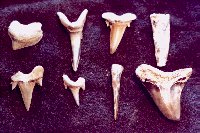 |
From upper left to lower right:
Squalicorax kaupi, Scapanorhyncus texanus
|
Besides the remains of fish teeth, other vertebrate fossils
are sometimes found, mostly reptile.
Shell fragments are not uncommon, especially at the K/T
bone bed between the Navesink and Hornerstown formations. This bed has
produced most of the complete turtle and crocodile
skeletons found in NJ. Crocodile and mosasaur bones
and teeth, highly prized among
collectors, are scarce. Dinosaur fossils from the
Cretaceous are extremely rare, since NJ
was under water during most of this period. Footprints
from the Triassic period have been
in large numbers in northern NJ, however almost no
bone material has been found.
Three partial skeletons have been found during over 150
years of collecting. Since the
decaying corpses had to be transported for miles from
rivers or estuaries, they normally
would have been torn apart by scavengers, such as sharks.
Thus, only exceptional
circumstances would allow a relatively complete dinosaur
such as Hadrosaurus foulkii to
be buried quickly enough in marine sediments to be preserved.
 |
Several crocodile scutes, which served as armor on the back and head of the animal |
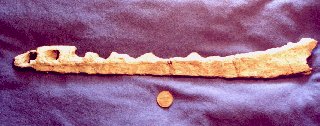 |
A partial crocodile jaw |
The rarest fossils found in the Cretaceous of NJ are those
of birds and mammals.
The bones of both were very small and delicate, hindering
preservation. The teeth
of mammals are especially difficult, since most are so
small they require a powerfull
hand lens or microscope to be identified.
 |
A mosasaur tooth |
| Go to Dinos of New Jersey Page |
