
Most of the universe is invisible to us because we only see the visible
light portion of the
electromagnetic spectrum. When most people think of telescopes they think
of visible light,
or optical, telescopes.
|
When the first optical telescope appeared in the
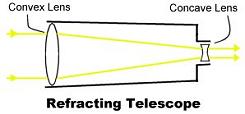
1570s, the design was simple - one concave and one convex lens fitted inside a tube. The tube acted as a receiver, or 'light bucket'. The lenses bent, or refracted, the light as it passed through the glass and thus made the scene appear 3 to 4 times larger. |
 |
 |
Left: Galileo Galilei (1564-1642), Italian astronomer,
mathematician and
physicist.The glass lenses in the Galileo telescope weren't very clear, however - they were full of little bubbles and had a greenish tinge due to the iron content of the glass. Also, the shape of the glass lenses gave the field of view very fuzzy edges. |
|
reached 140 feet in length they became almost
useless for observation. It was impossible to keep the lenses properly aligned at such long lengths. Longer telescopes also required larger lenses, and after a lens reached 1 meter (3.28 ft.) in diameter it would deform, sagging under its own weight.
Right: Johannes Hevelius' 150-ft. telescope (Machina
Isaac Newton invented the first reflecting telescope
|
 |
In 1672, Newton described how white light is actually a mixture of colored
light. Each color
 |
has its own degree of refraction, so curved lenses split
white light into
the colors of the spectrum. This chromatic aberration caused central images in refracting telescopes to be surrounded by rings of different colors. Planets seen through a refracting telescope would appear to be encircled by a rainbow. Left: Sir Isaac Newton (1642-1727), English mathematician and physicist. By 1730, Newton's reflecting telescope had caught on with the scientific |
|
another bonus of Newton's reflecting
telescope is that it can also be used to study ultraviolet and infrared light. The Hubble Space Telescope, famous for its stunning optical images of the universe, also works in the ultraviolet and infrared parts of the spectrum. |
 |
But it wasn't until the 1930s that astronomers even began looking for other
parts of the
electromagnetic spectrum. Karl Jansky inadvertently discovered galactic
emissions of radio
waves in 1933. Working at Bell Telephone Laboratories, Jansky was trying
to find what
caused short-wave radio interference in Trans-Atlantic communications.
By building a
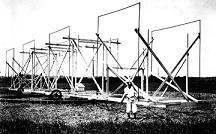
rotating radio telescope to look at the horizon, he eventually discovered
that most of the
static resulted from engine ignition noise and distant lightning storms.
But Jansky
 |
also discovered that some radio noise was coming from
thecenter
of the Milky Way Galaxy. Left: The "Jansky Antenna" doesn't look much like modern
|
|
smaller telescopes. Radio telescopes also need to
be large in order to overcome the radio noise, or "snow," that naturally occurs in radio receivers. We generate a large amount of noise on Earth as well, so smaller telescopes would lose some astronomical radio signals amid our daily production of rock music, television broadcasts and cellular phone calls. An example of a modern radio telescope is The Very Large Array in New Mexico (right), composed of 27 antennas electronically combined to give the resolution of an antenna 36 kilometers (22 miles) across. |
 |
Infrared and ultraviolet light are affected more dramatically by the Earth's
atmosphere. Their
telescopes must therefore always be positioned high above the ground or
in space. Infrared
 |
telescopes are placed on mountaintops, far above
the low-lying water vapor that interferes with infrared light. Left: The NASA Infrared Telescope Facility 3.0 meter
|
