
Everything You Wanted to Know about Puberty . . .
But Felt Weird Asking
 |
Ok, so it's a funny word. . . but what is puberty, anyway?
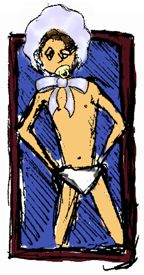
Puberty (say: pyoo-ber-tee) is the name for when your body begins to develop and change. During puberty, your body will grow faster than any other time in your life, except for your very first year. Back then, your body was growing rapidly and you were learning new things. . .you'll be doing these things and much more during puberty. Except this time, you won't have diapers or a rattle and you'll have to dress yourself! It's good to anticipate the changes that come along with
puberty,
|
Time to change
When your body reaches a certain age, your brain releases
a special hormone that starts the changes. It's called gonadotropin-releasing
hormone, or GnRH for short. When GnRH reaches the pituitary gland, this
gland releases two more puberty hormones: luteinizing hormone (LH for short),
and follicle-stimulating hormone (FSH for short). Boys and girls have both
of these hormones in their bodies, but in different amounts. And depending
on whether you're a boy or a girl, these hormones go to different places!
For boys, these hormones go to the testes and give the signal to begin
the production of testosterone and sperm. These puberty hormones are the
ones that allow men to reproduce. In girls, the hormones go to the ovaries,
which contain eggs that have been in the ovaries since birth. The hormones
stimulate the ovaries to begin producing another hormone called estrogen.
Estrogen, along with the puberty hormones LSH and FSH, prepare a girl's
body for pregnancy. So that's what puberty really means - it's all these
new chemicals moving around inside of your body, turning you from a kid
into an adult with adult hormones.
Usually, puberty can start from age 8 to 13 in girls,
and age 10 to 15 in boys, although some kids start puberty later. Each
person is a little different, so everyone enters puberty on his or her
body's own schedule. This is one of the reasons why some of your friends
might still be short, while others are very tall.
| It doesn't hurt. . .it's just a growth spurt.
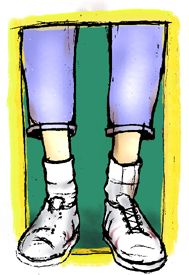
A "spurt" is the word used to describe a short burst of activity, something that happens in a hurry. And a growth spurt is just that: your body is growing, and it's happening really fast! When you enter puberty, it might seem like your sleeves are always getting shorter and your pants always look like you're ready for a flood - that's because you're experiencing a major growth spurt. It lasts for about two to three years. When that growth spurt is at its peak, some kids grow four or more inches in one year! This growth during puberty will be the last time your body will grow taller. When you finish your growth spurt, you will be at your adult height. But your height isn't the only thing that will be changing. . . |
 |
Taking shape
As your body grows taller, it will be changing in other
ways, too. You will gain weight, and as your body becomes heavier, you'll
start to notice changes in its overall shape. Boys' shoulders will grow
wider, and their bodies will become more muscular. Their breasts may grow
a tiny bit, but this goes away for almost all boys by the end of puberty.
Their voices will become deeper. They will notice other changes, too, like
the lengthening and widening of the penis and the enlargement of the testes.
All of these changes mean that their bodies are developing properly during
puberty.
Girls' bodies usually become curvier. They gain weight on their hips, and their breasts develop, starting with just a little swelling under the nipple. Sometimes one breast might develop more quickly than the other, but most of the time they soon even out. With all this growing and developing going on, girls will notice an increase in body fat - and that's normal. Gaining some weight is part of developing into a woman, and there is no need to go on a diet. If you ever have questions or concerns about your weight, talk it over with your doctor.
About one and a half to two years after girls' breasts start to develop, they experience their first menstrual period - one more thing that lets them know puberty is progressing. It means that the puberty hormones have been doing their job. Girls have two ovaries, and each ovary holds thousands of eggs. During the menstrual cycle, one of the eggs comes out of an ovary and begins a trip through the fallopian tube, ending up in the uterus (the uterus is also called the womb). While the egg is traveling, the uterus is building up its lining with extra blood and tissue. If the egg gets to the uterus and is fertilized, it will stay there and grow into a baby, using that extra blood and tissue to keep it healthy and protected as it's developing. Most of the time, though, the egg is only passing through. When the egg doesn't stay in the uterus, the uterus no longer needs the extra blood and tissue, so it leaves the body through the vagina as a menstrual period. A period usually lasts from five to seven days, and about two weeks later a new egg is released and the whole cycle begins again.
Hair, hair, everywhere
Well, maybe not everywhere. But one of the first signs
of puberty is hair growing where it didn't grow before. Boys and girls
both begin to grow hair under their arms and in their pubic areas. It starts
out looking light and sparse. Then as you go through puberty, it becomes
thicker, heavier, and darker. Eventually, boys also start to grow hair
on their faces. And speaking of face. . .
About face
Another thing that comes with puberty is acne , or pimples.
It's caused by hormones that are present during puberty. Pimples usually
start around the beginning of puberty and can stick around during adolescence
(the teenage years). You may notice pimples on your face, your upper back,
or your upper chest. It's a good idea to keep your skin clean, and your
doctor may be able to offer some suggestions for clearing up acne. The
good news about acne is that it usually disappears by the end of adolescence.
Putting the P.U. in puberty
P.U.! A lot of kids notice that they have a new smell
under their arms when they enter puberty, and it's not a pretty one. That
smell is body odor, and everyone gets it. As you enter puberty, the puberty
hormones affect the glands under your arms, and the glands make chemicals
that smell bad. These chemicals put the scent in adolescent! So what can
you do to feel less stinky? Well, keeping clean is a good way to stay smelling
clean. You might want to take a shower every day, either in the morning
before school, or the night before. And it's a good idea to use deodorant
(or deodorant with antiperspirant) every day, too.
There's more?
Boys and girls will also notice other body changes as
they enter puberty, and they're all normal changes. Girls might see and
feel a white, mucousy discharge from the vagina. This doesn't mean anything
is wrong, it is just another sign of your changing body. Boys will begin
to get erections (this is when the penis fills with blood and becomes hard),
sometimes as they fantasize and think about sexual things, or sometimes
for no reason at all. They may experience something called nocturnal emissions
(or wet dreams). This is when the penis becomes erect when a boy is sleeping,
and he ejaculates. When a boy ejaculates, semen comes out of the penis
- semen is a fluid that contains sperm. That's why they're called wet dreams
- they happen when you're sleeping and the bed might be a little wet when
you wake up. Wet dreams become less frequent as boys progress through puberty,
and they eventually stop.
Change can feel kind of strange
Just as those hormones create changes on the outside,
they also create changes on the inside. During puberty, you might feel
confused or have strong emotions that you've never experienced before.
You might feel overly sensitive, or become easily upset. Some kids lose
their tempers more than usual and get angry at their friends or families.
You may feel anxious about how your changing body looks.
You might have new, confusing feelings about sex. You
may have sexual feelings that you've
never felt before. And you probably have lots of questions.
When you have new adult hormones like estrogen and testosterone, it means
that you need to be responsible for what you do with your body. That's
why it's important to get all those questions answered. It's easy to feel
embarrassed or anxious when talking about sex, but you need to be sure
you have all the right information. Some kids can talk to their parents
about sex and ask all the questions they need answered. But if you feel
funny talking to your parents about sex, there are many other people to
talk to, like your doctor, a school nurse, a teacher, or a school counselor.
Sometimes it can be difficult to deal with all these new
emotions. It's important to know that while your body is adjusting to all
these new hormones, so is your mind. Try to remember that people aren't
trying to hurt your feelings or upset you on purpose. It might not be your
family or friends - it might be your new "puberty brain" trying to adjust.
And while the adjustment can feel difficult in the beginning, it will gradually
become easier.
| Developing differently
People are all a little different from one another, so it makes sense that they wouldn't all develop in the same way. No two people are ever at exactly the same stage as they go through puberty, and everyone changes at his or her own pace. Some of your friends may be getting curves, while you don't have any yet. Maybe your best friend's voice has changed, and you think you still sound like a kid with a high, squeaky voice. Or maybe you're sick of being the tallest girl in your class, or the only boy who has to shave. But eventually everyone catches up, and the differences between you andyour friends will even out. It's also good to keep in mind that there is |
 |
material courtesy of http://www.kidshealth.org/kid/index.html
