
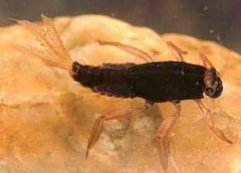
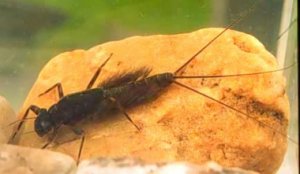
Mayflies (Ephemeroptera)
 |
 |
Mayflies are common insects found in almost all freshwater habitats, as
well
as some brackish ones.
There are over 2 000 named species in 200 genera and
19 families. The adults
are soft bodied insects with very short antennae, vestigial mouthparts,
two long cerci and usually a long caudal filament at the end of the abdomen.
Most adult Mayflies have two pairs of wings however the second pair
are considerably smaller
than the first and in some species are absent altogether.
Nymphs have much longer
antennae, functioning mouthparts and are aquatic.
Mayflies date from the Carboniferous and Permian times and are the oldest
of the extant (still
living) winged insects, they are unique in being the only insect
order to have a subimago
(last non-adult life stage) with wings. Adult Mayflies do
not feed and live very
short lives, many species live only for one or two days but
in others the adult life
span may be as short as 2 hours or as long as 14 days.
Nymphal life cycles can
range between 3-4 week to 2.5 years depending on the species. Mayflies
can be easily recognized because they are the only order of
insects to hold their
wings pointing straight up, they can not fold them down,
they generally hold their
abdomen curved upwards away from the substrate
(what ever they are standing
on.)
Mayflies have attracted man's attention for a long time and one of the
oldest accounts of Mayfly biology was published bySwammerdam in 1675, it
is an
unfortunate fact that
the genus of Mayflies studied by Swammerdam Palingenia sp.
is now extinct in the
Netherlands and the rest of Western Europe, a consequence
of the Mayflies general
low tolerance for pollution.
|
Classpage |
Go to African elephants |
Information courtesy of Insect World http://www.insect-world.com/main/six.html
