
|
|
 |
 |
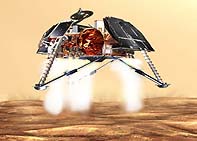
The Mars Polar Lander was successfully
launched from Launch Complex 17B at Cape Canaveral Air Station in Florida on January 3, 1999. It is due to become the first spacecraft to set down near the edge of Mars' southern polar cap on DECEMBER 3, 1999 at about 2:00 P.M. |
| The spacecraft
is equipped with a robotic arm to dig beneath the
layered terrain of the Martian polar region and will conduct two days of soil and water experiments up to 1 meter (3 feet) below the Martian surface. |
 |
 |
The Mars Polar Lander is the second of two spacecraft launched to the red
planet during the December 1998-January 1999 Mars launch opportunity. Mars
Climate Orbiter was
launched December 11, and was scheduled to reach Mars September 23. (It disappeared and was lost forever.) Onboard Mars Polar Lander are two microprobes. The Deep Space 2 probes will smash into the Martian surface as a test of new technologies for future planetary descent probes. |
Why Explore Mars?
After
Earth, Mars is the planet with the most hospitable climate in the solar
system -
so hospitable that it may
once have harbored primitive, bacteria-like life. Outflow
channels and other geologic
features provide ample evidence that billions of years
ago liquid water flowed
on the surface of Mars. Although liquid water may still exist
deep below the surface of
Mars, currently the temperature is too low and the atmosphere
too thin for liquid water
to exist at the surface.
What Are We Looking For?
The
planet Mars landed in the middle of immense public attention on July 4,
1997,
when Mars Pathfinder touched
down on a windswept, rock-laden ancient flood plain.
Two months later, Mars Global
Surveyor went into orbit, sending back pictures of
towering volcanoes and gaping
chasms at resolutions never before seen.
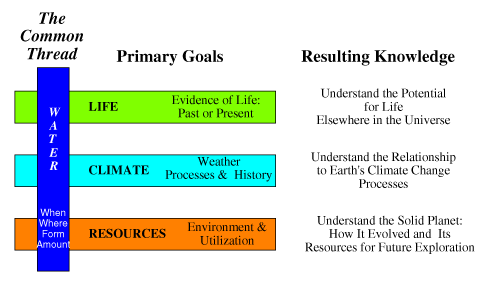
All of these spacecraft have the goal of understanding
Mars better, primarily by delving
into its geology,
climate
and history.
 |
Mars Exploration: Fundamental Questions
What is the meteorology and climate history of Mars?
What are, and where are, the reserviors of water and carbon dioxide on
Mars?
What is the process of climate change including behavior of the polar caps?
What does the history of climate change on Mars tell us about Earth?
Has there ever been life on Mars?
What
is the evidence for, and timing of, warmer, wetter past conditions?
Where is the evidence for past life likely to be found on Mars?
How do we recognize evidence of past life and sample Mars properly?
What is the geology and inventory of resources on Mars?
What is the interior structure of Mars and is the planet active today?
What do the global topography and geologic structure tell about the planet's
evolution?
What are the global inventory and distribution of near surface materials
and volatiles?
Should Mars be the next destination for human exploration?
Mars And Life
Mars and Water Mars today is too cold, with an atmosphere that is too thin,
to support
liquid water on its surface.
Yet scientists who studied images from the Viking orbiters kept encountering
features that appeared to be formed by flowing water - among them deep
channels and canyons, and even features that appeared to be ancient lake
shorelines.
Added to this were more
recent observations by Mars Pathfinder and Mars Global Surveyor
which suggested widespread
flowing water in the planet's past. Some scientists identified features
which they believe appear to be carved by torrents of water with the force
of 10,000 Mississippi Rivers.
The question of what happened to the water remains a mystery. Most scentists
do not
feel that Mars' climate
change was necessarily caused by a cataclysmic event such as an asteroid
impact that, perhaps, disturbed the planet's polar orientation or orbit.
Many believe
that the demise of flowing
water on the surface could have resulted from gradual climate
change over many millennia
as the planet lost its atmosphere.
Scientists do not understand
what happened to Mars' water. Some undoubtedly must
have been lost to space.
Water ice has been detected in the permanent cap at Mars' north
pole, and may exist in the
cap at the south pole. But much water is probably trapped under
the surface - either as
ice or, if near a heat source, possibly in liquid form well
below the surface.
