
| On Thursday, June 8 we are going to visit The American Museum of Natural History. While we are there, one of the exhibits we will see is a fabulous fossil find: the two fighting dinosaurs of the Gobi Desert in Mongolia. It has never been seen before in North America, and it will only be at the Museum until October 29. The two Fighting Dinosaurs are a fierce Velociraptor that was apparently buried alive while attacking a plant-eating,shield-headed Protoceratops. |
 |
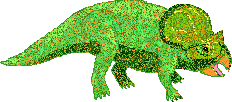 |
Living 90 million years ago, Protoceratops was the distant ancestor of the larger and more familiar Triceratops. They shared many of the same features. Measuring six feet long and weighing close to 400 pounds, Protoceratops had a large, heavy skull framed by a bony neck frill which was made lighter by two window-like openings in the skull. It also had a narrow, parrot-like beak with powerful, toothed jaws. |
By far the most famous discovery made in the Gobi Desert was a whole nest of very well-preserved Protoceratops eggs along with skeletons of hatchlings and juveniles. The eggs had been carefully laid out in a circular fashion in shallow depressions made in the sand of an earlier desert at this same site, but the swirling sands had probably covered the nest so deeply that the babies never had a chance to hatch.
Protoceratops lived in the late-Cretaceous period, about 72 to 65 million years ago, toward the end of the Mesozoic, the Age of Reptiles.
BEHAVIOR
Protoceratops was probably
a herding animal, like the other Ceratopsians. This hypothesis is supported
by the finding of bone beds, large deposits of bones of the same species
in an area, and large groups of nests. Each nest had 12 or more eggs, laid
in a spiral fashion.
Click
here to "interview a protoceratops."
 |
Velociraptor
was a speedy, bipedal carnivore. It had about 80 very sharp, curved teeth
in a long, flat snout; some of the teeth were over an inch (2.5 cm) long.
This predator had an s-shaped neck, long thin legs, arms with three-fingered
clawed hands and four-toed clawed feet. Its head was about 7 inches (18
cm) long.
Velociraptor may have been able to run up to roughly 40 mph (60 km/hr) for short bursts. |
A 3.5 inch (9 cm) long, sickle-like, retractible claw was on the middle toe of each foot. This claw was its main weapon, and could probably kill most of its prey (defenseless plant-eaters like hadrosaurs) easily.
Velociraptor's brain was relatively large in comparison to its body size (this is true for all the Dromaeosaurid dinosaurs, who were the most intelligent dinosaurs).
ENVIRONMENT
Velociraptor lived in
a hot, dry environment, a desert-like environment with some
streams.
BEHAVIOR
Velociraptor
may have hunted in packs, attacking even very large animals.
In 1971,
fossils
of a Velociraptor and a Protoceratops were found together.
They died together; the Velociraptor was attacking the Protoceratops with
its claws and the armored head of the Protoceratops had apparently pierced
the chest of the Velociraptor.
Velociraptor, along with
the other Dromaeosaurids, were the smartest dinosaurs, as
calculated from their
brain:body weight ratio. This made them very deadly predators.
DIET
Velociraptor was a carnivore,
a meat eater. It probably ate just about anything it could
slash and tear apart.
It may have hunted in packs. It ate Protoceratops (one was found
fossilized with Velociraptor
in a battle to the death) and probably ate many other
plant-eaters, like hadrosaurs
(duck-billed dinosaurs).
LOCOMOTION
Velociraptor walked on
two slender legs; it was certainly among the fastest of the
dinosaurs, considering
its long legs and light weight. Velociraptor may have been able to run
up to roughly 40 mph (60 km/hr) for short bursts. Velociraptor could probably
jump also.
Now click
here to see where Mongolia and the Gobi Desert are located.
