Chapter 7.1
(Earthquakes)
| Chapter 7
Earthquakes - movements
of the earth's crust when plates shift and release stored energy
Stress builds along each side of a fault until it reaches its elastic limit. Then the rocks break, releasing their energy. (EARTHQUAKE!!!!!!!!!) See an animation of a fault reaching its elastic limit. (Click here) Focus of an earthquake - where an earthquake actually begins. This may be below the earth's surface. Epicenter of an earthquake - the point on the earth's surface directly above the focus.
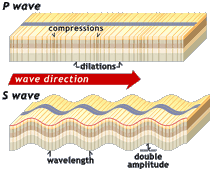
Types of seismic waves: Primary (P) waves are longitudinal, arrive first Secondary (S) waves transverse, arrive next L waves
(surface) when P and S waves get to the surface - they cause the most damage
Seismographs detect seismic
waves
Richter and Mercalli Scales describe the strength of an earthquake. The Richter magnitude is based on the amount of shaking caused by an earthquake. Each increase of 1 on the Richter scale equals an increase of 10 in the amount of shaking. The Mercalli scale is
based on the amount of damage done.
Earthquake zones- - near the edges of plate boundaries
|