
Chapter 5.2 Notes
The key to understanding continental drift lays on the ocean floor.
Sonar provided scientists
with topography of ocean floor. They mapped it and discovered underwater
mountain ranges that formed one long ridge. This mid-ocean ridge
had a deep valley running the length of its crest.
(see
map of mid-ocean ridge)
Rocks on the ocean bottom were younger than continental rock and rocks were youngest near the mid-ocean ridge.
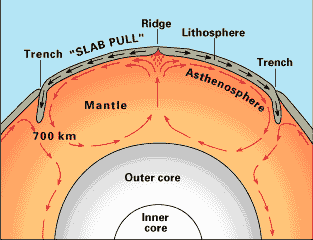
Theory of Sea-floor Spreading - the mid-ocean ridge was a huge crack in the crust where the hot mantle pushed upward.
Pieces of the crust on each side of the crack move away from each other. Molten rock from the mantle wells up, forming new crust.
Old crust is being swallowed
up in ocean trenches at the same time so the ocean bottom is recycled every
300 million years.

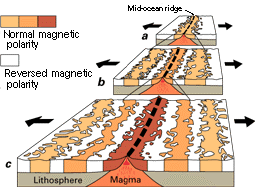
There are parallel magnetic
stripes on either side of the mid-ocean ridge. They show that the earth's
magnetic field reversed itself many times in the past.
New theory - Plate
Tectonics: The lithosphere of the earth
is divided into plates which are constantly moving.
 |
Each plate is made up
of crust and mantle.
There are two kinds of crust - oceanic and continental. |
Oceanic crust is dense,
made of gabbro and basalt.
Continental crust is
less dense, made of granite and rhyolite.
Continental plates - 6 continental plates - mostly continental crust - have one continent and some oceanic crust.
Oceanic plates - 1 major oceanic plate - made of entirely oceanic crust.
Plate boundary - where
plates meet
Divergent - plates move away from each other
Convergent - where plates come together
Transform - plates slide beside each other
Types of convergent boundaries:
Oceanic-oceanic:
one oceanic plate is pushed down under another. This is called subduction.
The melting plate causes volcanoes to form and creates a deep trench.
Oceanic-continental: the oceanic plate is denser and subducts (dives) under the continental plate. Mountain ranges with volcanoes form.
Continental - continental:
both plates have the same density so they fold, forming tall
mountains.
Home
