
First go to https://www.angelfire.com/nj/PflommScience/earthlayers.htm (which is the earth layers lesson) and read that if you haven't already.
As
you go deeper into the earth the materials that the earth is made of change.
As
you go deeper the density increases.
As
you go deeper temperature and pressure increase, but at different rates.
| The above factors interact, causing the earth to form layers: | 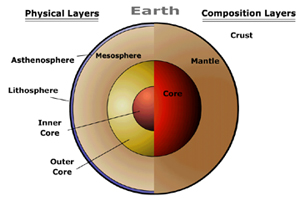 |
Chemical
makeup of the layers (what the earth is made of):
Crust - outermost layer - its rocky silicate material contains much
aluminum. Thickness varies from 5 to 40 km.
Mantle - is about 2,900 km thick. Its dense rocky silicates contain
much
iron and magnesium. It makes up 82 % of the earth's volume and
68 % of its mass.
Core - is about 3,500 km thick. The metals iron and nickel make up
most
of the core. It is very dense. It makes up 32 % of the earth's
mass,
but only 16 % of its volume.
Physical
Properties of the layers (how the layers behave because of temperature
and
pressure differences):
Lithosphere - outer zone. It is cool and rigid. It "floats"
on top of the
asthenosphere. The lithosphere includes the crust and the
uppermost part of the mantle (from the chemical layers above.)
Asthenosphere - is soft and flowing, but not completely liquid.
This condition is known as plasticity. It is in the mantle
of the
chemical layers above. (Temperature - 1,300° C - 1,600° C)
Convection (a circular flow of matter from a warmer to a cooler
place) is happening in the asthenosphere.
Mantle - is solid and rigid compared to the asthenosphere. The
temperature
is not high enough to overcome the high pressure.
Temperature (1,600° C - 3,200° C)
Outer Core - The temperature is very high and the outer core is liquid.
Circulation of molten iron here is thought to be the source of
earth's magnetic field. Temperature (3,200 ° C - 4,000° C)
Inner Core - Even though the temperature is extremely high, the very high
pressure keeps the inner core solid. Temperature (4000°
C - 4,500° C)
The
Lithosphere
The
lithosphere includes the crust and the upper mantle is layered.
The
two layers are continental crust and oceanic crust.
Continental
crust lies under continents. It varies in thickness.
Is less dense than oceanic crust. Has a high percentage of silicon
and oxygen, and is contains more aluminum. Rocks of this crust
are granite and rhyolite.
Oceanic
crust lies underneath oceans. Is more dense than continental
crust. Has denser, darker rocks called basalt and gabbro.
Some islands are made of oceanic crust (Hawaiian Islands, parts
of Alaska, Iceland.)
Soils
formed from the different rocks of oceanic and continental crust can
be
very different. Oceanic crust soil is less fertile.
Granite 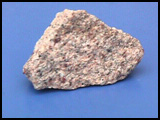 |
Rhyolite 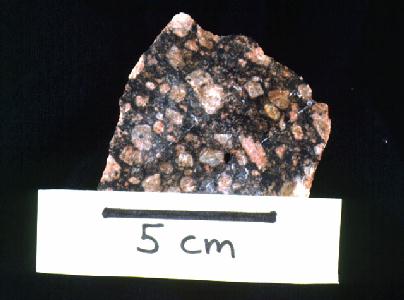 |
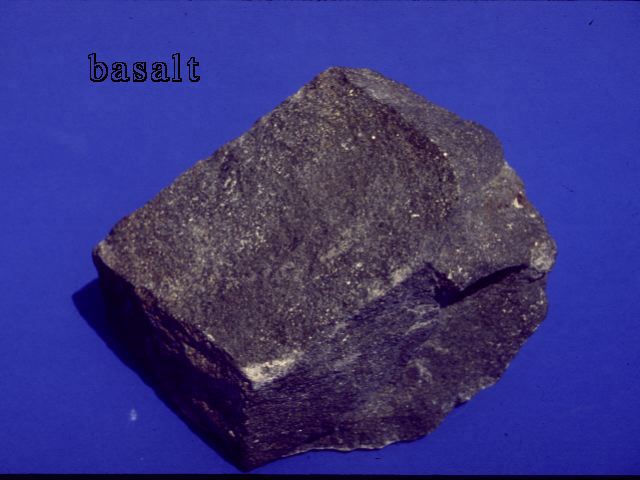 |
Gabbro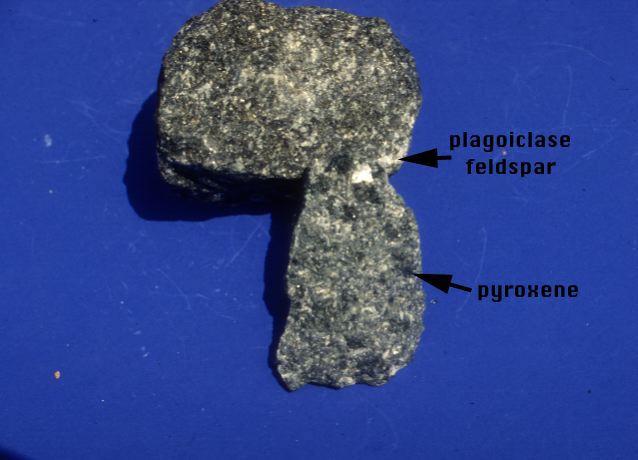 |
This
is a link to some interesting maps of earth layers.
http://hum.amu.edu.pl/~zbzw/glob/glob34e.htm
