Site hosted by Angelfire.com: Build your free website today!
 

Our Solar System


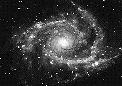
Our solar system is part of  large group of stars called a galaxy.  Our galaxy is the Milky Way.
The universe is made up of billions and billions of galaxies.

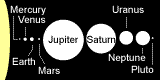
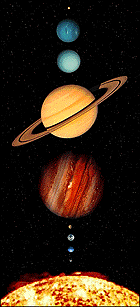
Planets' relative distance from the sun Relative size of the planets
All the planets of of solar system rotate and revolve.
They revolve around the sun in elliptical orbits.
           Inner Planets               Have a core of nickel and iron with a rocky crust and mantle

Mercury
The rocky surface of Mercury is heavily cratered, and looks much like the earth's moon. This planet lacks an atmosphere.  The surface facing the sun gets hot enough to melt lead.

Venus
Venus could be Earth's twin in size, mass, and density. But in other ways, Venus is very different from Earth.  Its dense atmosphere of carbon dioxide keeps the surface temperature around 480°C  both day and night.

Earth
As far as we know, Earth is the only planet that supports life.  It is a living planet because it has liquid water, oxygen in the atmosphere, and moderate temperatures and pressure. Earth has one satellite, the moon, which orbits the Earth.

Mars
Mars, the fourth planet from the sun is much colder than Earth.  But at the Martian equator in summer, the temperature can reach 20°C.  At one time Mars probably had water on its surface. The planet has two moons.
 Outer Planets
The first four outer planets are also known as Jovian planets because they share so many characteristics with Jupiter. They are mostly gas, have numerous moons and rings.

Jupiter
Jupiter is a giant, with 300 times more mass than Earth.  It is mostly a ball of hydrogen and helium gas. Clouds in Jupiter's atmosphere form colored bands around the planet. Jupiter has at least 16    moons

Saturn
Saturn is nearly as large as Jupiter, but has only one third Jupiter's mass.  Like Jupiter, it is made up of mostly hydrogen and helium gas.  Saturn has a spectacular ring system and 23 or more moons.

Uranus
Beyond Saturn is Uranus, the third largest planet.  It appears greenish because of methane gas in its atmosphere.  Uranus is unusual because its axis of rotation is nearly parallel to the plane of its orbit.  Uranus has 15 moons and a system of rings.

Neptune
The eighth planet is Neptune.  It is a ball of water, ammonia, and molten rock, surrounded by hydrogen, helium, and methane. It has 8 moons and a number of rings.

Pluto
Pluto, the ninth planet is unlike the other outer planets.  It is even smaller than Mercury in size.  Its orbit is very elongated and tilted. Pluto has one moon (Charon)  that is nearly half the size of the planet itself.

Links:
NASA Kids http://kids.msfc.nasa.gov/
   NASA Kids (Space)http://kids.msfc.nasa.gov/Space/
   NASA Kids (Solar System)http://kids.msfc.nasa.gov/SolarSystem/
   NASA Kids (Planets) http://kids.msfc.nasa.gov/SolarSystem/Planets/
   NASA Kids (the Sun) http://kids.msfc.nasa.gov/SolarSystem/Sun/

Welcome to the Planets
Exploring the Planetshttp://www.nasm.edu/ceps/etp/
    Tools of Exploration
The Nine Planets
Classifying Galaxies
Windows to the Universe
Virtual Solar System
Star Child
Astronomy picture of the day
Solar System Simulator
The Meteorite Simulation Game
or here
Space Games
Solar System Shuffle
Planet Tic Tac Toe
Arrange the Planets in Order game
Moon Phase Game
Make Your Own Alien Game
Games from Windows on the Universe