
 WEATHER
The blanket of air around the earth is called the atmosphere. All our weather happens in the bottom layer of the atmosphere called the troposphere, which is six to ten miles thick. Meteorology is the study of the changes in temperature, air pressure, moisture, and wind direction in the troposphere.
All of our weather comes from basically two things: the sun and the moisture in the air. These two work together to form clouds, to make rain and thunderstorms, and to cause winds to blow. Without the sun or moisture, our earth would have no weather.
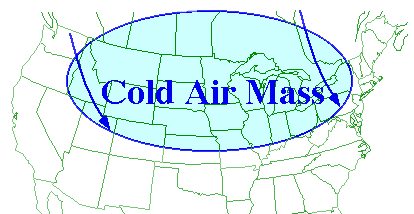
An air mass is a large area of air that may be warm or cold or dry or moist. When two air masses come together, the line between them is called a front. Along a front there are usually clouds and rain and maybe thunderstorms. The movement of air masses helps to cause our weather.
AIR MASSES
When a large amount of air sits over one location an air mass with
certain characteristics forms.
*Polar - Continental or Maritime
* Tropical - Continental or Maritime
*Equatorial
* Arctic
read more about air masses
http://www.usatoday.com/weather/tg/wamsorce/wamsorce.htm
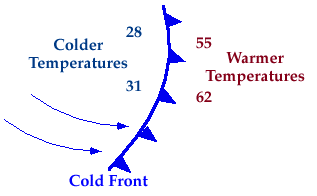
FRONTS - the boundary where two air masses come together
Collisions of the air masses at these boundaries cause WEATHER CHANGES.
(See diagrams of fronts: https://www.angelfire.com/nj/PflommScience/coldfrontwarmfront.html
)
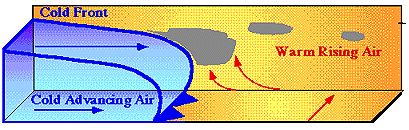
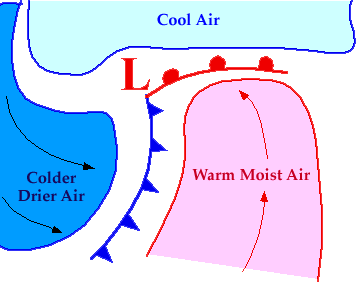
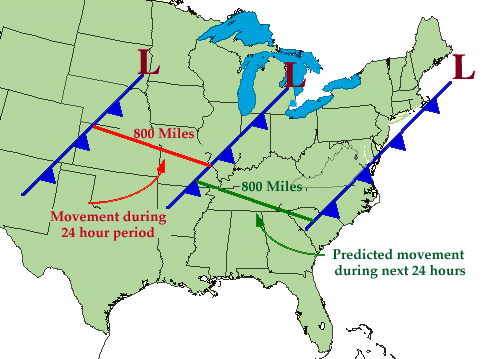
Cold front - a cold air mass pushes away a
warm, moist air mass. These move quickly and produce wind and rain.
Thunderstorms are common.
 |
 |
 |
 |
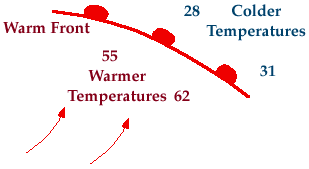
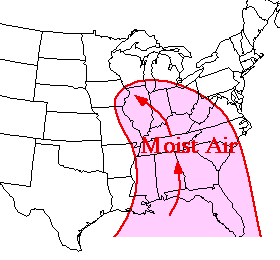
Warm front - a warm air mass creeps over a
cold air mass. Cloudy skies with rain or snow develop.
 |
 |
 |
 |

Air has pressure. Colder air exerts more presssure than warmer air. (remember molecules move apart in warmer air)
Different pressure in different types of air masses cause movement of the air mass. Do you remember "Science in Your Bathroom" from sixth grade? A shower curtain will blow in toward you because warm air in the shower is rising, so cooler air from outside rushes in.
So differences in air pressure can cause winds.
Temperature differences occur because the sun heats the earth's surface
unevenly.
Temperature differences lead to pressure differences.
The wind blows because air has weight. Cold air weighs more than
warm air, so the pressure of cold air is greater. When the sun warms
the air, the air expands, gets lighter, and rises. Cooler, heavier
air blows to where the warmer and lighter air was, or in other words, wind
usually blows from areas of high air pressure to areas of low pressure.
If the high pressure area is very close to the low pressure area, or if
the pressure difference (or temperature difference) is very great, the
wind can blow very fast.
Think back to sixth grade again and remember the spinning cardboard. You spun cardboard on a pencil point and tried to draw a straight line with a ruler. You did not get a straight line, but a curved line. The earth's rotation causes wind to move in circular pattern (due to the Coriolis Force.)
How the Weather Works http://www.usatoday.com/weather/wworks0.htm
