
African American Scientists
 |
Morgan, Garrett A.
Born: 1877 Died: 1963 Occupation: Inventor Source: Altman, Susan. Encyclopedia of African-American Heritage. 2nd ed. New York: Facts On File, Inc., 2000 |
(2)
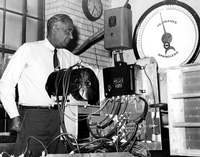 Frederick Jones
 |
Jones, Frederick
|
Orphaned at age nine, Frederick McKinley Jones had little formal education. He taught himself electronics and auto mechanics. After serving in the army during World War I, he moved to Hallock, Minnesota, where he became interested in radio and built the first radio station transmitter in Hallock. He also developed a soundtrack device for motion pictures. Word of his work reached Joseph Numero, the owner of Cinema Supplies, a movie equipment company in Minneapolis, and Numero hired Jones in 1930. Seven years later, Jones received his first patent for a movie-ticket dispenser.
After hearing Numero discuss the problems of developing a workable unit for truck refrigeration that could operate in limited space and withstand the vibrations of road travel, Jones designed a small, shock-proof refrigeration unit that could be mounted on top of trucks. He and Numero then formed the U.S. Thermo Control Company (later called Thermo King Corp.) to manufacture and market his device. Jones' refrigeration unit revolutionized the food industry by making it possible to ship fruit, vegetables, meat, and dairy products across the country without fear of spoilage. It was also critically important in the transport of blood and medicine during World War II. Jones was eventually awarded over 60 patents, of which 40 were for refrigeration equipment.
(3)
| Lewis Howard Latimer
Born: September 4, 1848 Died: December 11, 1928 Birthplace: Chelsea, Massachusetts
Lewis Howard Latimer: Inventor, Engineer (Mechanical and Electrical) |
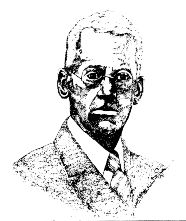 |
Lewis Howard Latimer (1848 - 1928). Born in Chelsea, Massachusetts. As a young man, Lewis Latimer learned mechanical drawing while working for a Boston patent office. In 1880, he was hired by Hiram Maxim of the U.S. Electric Lighting Company to help develop a commercially viable electric lamp. In 1882, Latimer invented a device for efficiently manufacturing the carbon filaments used in electric lamps and shared a patent for the "Maxim electric lamp". He also patented a threaded wooden socket for light bulbs and supervised the installation of electric street lights in New York City, Philadelphia, Montreal, and London. In 1884, Latimer became an engineer at the Edison Electric Light Company where he had the distinction of being the only African American member of "Edison's Pioneers" - Thomas Edison's team of inventors. While working for Edison, Latimer wrote Incandescent Electric Lighting, the first engineering handbook on lighting systems. Although today's incandescent light bulbs use filaments made of tungsten rather than carbon, Latimer's work helped to make possible the widespread use of electric lights.
_________________________________________________________________________________________
(4)
|
Granville T. Woods
Born: April 23, 1856
Granville T. Woods: Inventor |
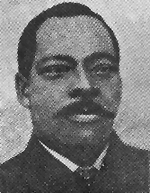
It's hard to believe that a man who was forced to leave school at the age of ten could have patented over thirty-five electrical and mechanical inventions. Yet Granville T. Woods did just that, educating himself outside of school in practical skills for his future.
Born in Columbus, Ohio in April 23, 1856, Woods literally learned his skills on the job. Attending school in Columbus until age 10, he served an apprenticeship in a machine shop and learned the trades of machinist and blacksmith. During his youth he also went to night school and took private lessons. Even though he had to leave formal school at age ten, Granville Woods realized that learning and education were essential for developing critical skills, abilities that would allow him to express his creativity with machinery.
On the railroad: In 1872 he obtained a job as a fireman on the Danville and Southern railroad in Missouri, eventually becoming an engineer. He invested his spare time in studying electronics.
In 1874 Woods moved to Springfield, Illinois worked in a rolling mill.
He moved to the East in 1876 and worked part time in a machine shop. He took a mechanical engineering course in an eastern college.
In 1878, he became an engineer aboard the Ironsides, a British steamer, and, within two years, he became Chief Engineer of the steamer. Even with this background and all his engineering skill he was unable to get anywhere in these jobs. His travels and experiences led him to settle in Cincinnati, Ohio.
But Granville T. Woods was a great electrician and an inventive genius. His talents could not go unnoticed.
By 1880, he had established his own shop in Cincinnati, Ohio. Woods, along with his brother Lyates, went on to organize the Woods Electrical Company in Cincinnati, Ohio.
Woods invented fifteen appliances for electric railways. Granville Woods received his first patent in 1884 on an improved steam boiler furnace.
And, in later years, he succeeded in selling many to his inventions to some of the country's largest corporations.
American Bell Telephone Company bought many of his ideas, as did General Electric and the Westinghouse Air Brake Company.
In 1888 Granville Woods developed and patented a system for overhead electric conducting lines for railroads, which aided in the development of the overhead railroad system found in contemporary metropolitan cities, such as Chicago, St. Louis, and New York City.
In his early thirties, he became interested in thermal power and steam-driven engines. And, in 1889, he filed his first patent for an improved steam-boiler furnace.
In 1892, a complete Electric Railway System was operated at Coney Island, NY. The railway system had no exposed wires, secondary batteries, or slotted causeway -- all previously necessary for electric railways.
In 1887 he patented the Synchronous Multiplex Railway Telegraph , which allowed communications between train stations from moving trains. Train accidents and collisions were causing great concern to both the public and the railways at the time. Woods' invention made it possible for trains to communicate with the station and with other trains so they knew exactly where they were at all times. This invention made train movements quicker and prevented countless accidents and collisions.
Other inventions by Woods
In 1900 - An electric an incubator that was the predecessor to current machines that incubate 50,000 eggs at one time.
In the next three years he patented a series of advances in the development of air brakes.
Granville T. Woods attained great fame. He was a great electrician. A great inventor, Granville Woods was awarded more than 60 patents. A great man. He benefited mankind through inventions of exceptional interest to the world of communications and science. He will be remembered as an ingenious American and a prolific inventor. Granville T. Woods died in New York City on January 30, 1910.
________________________________________________________________________________________
(5)
| Madame C.J. Walker
Born: December 23, 1867
Madame C.J. Walker (Sarah Breedlove McWilliams Walker): Inventor, Businesswoman |
 |
In 1905 Sarah Breedlove developed a conditioning treatment for straightening hair. Starting with door-to-door sales of her cosmetics, Madame C.J. Walker amassed a fortune. In 1910 she built a factory in Indianapolis to manufacture her line of cosmetics. Before her death in 1919 she was a millionaire, one of the most successful business executives in the early half of the twentieth century.
One of the first American women of any race or rank to become a millionaire through her own efforts was Sarah Breedlove Walker. Sarah Breedlove was born in 1867 to Minerva and Owen Breedlove on the shores of the Mississippi River in northeast Louisiana. Sarah's parents, both ex-slaves, were sharecroppers who lived on the Burney plantation in Delta, Louisiana. "Madam Walker always said in her public speeches that she was 'orphaned at seven.' Her mother died first. Her father remarried and apparently died before she turn eight in December, 1875. Because of her impoverished background she had only a limited formal education. She was married to a Mr. McWilliams at fourteen, "to get a home" (as described by Walker herself), and had a daughter, A'Lelia, in 1885. Widowed at twenty in 1887, Sarah and her daughter moved from Vicksburg to St. Louis, Missouri. For eighteen years, from 1887-1905, she supported herself and her daughter by work as a washerwoman.
While in St. Louis in 1905, Walker said she had an idea to begin a cosmetics business. "Madam Walker's treatment did not straighten hair. Her treatment was designed to heal scalp disease through more frequent shampooing, massage and the application of an ointment consisting of petrolatum and a medicinal sulfur. Madam Walker did use a hot comb--which she did NOT invent--in her system, but she was by no means the first person to employ such methods. In fact, Marcel Grateau, a Parisian, was using heated metal hair care implements as early as 1872, and hot combs were available in Sears and Bloomingdale's catalogs in the 1890s, presumably designed for white women."
Before this time, African American women who wanted to de-kink their hair had to place it on a flat surface and press it with a flat iron. She invented her hair softener for use with a straightening comb. Mixing her soaps and ointments in washtubs and kitchen utensils, while adapting the existing hairdressing techniques and modifying curling tools. She added the prefix Madame to her name and took to the road, soon demonstrated her excellent marketing skills to sell her hair products door-to-door.
About The Walker SystemEncouraged by success in St. Louis selling her cosmetic products and method, she moved to Denver, Colorado in July, 1905. Her brother had been dead for some time. She joined her widowed sister-in-law and nieces, who had been in Denver prior to 1900. Six months later she married a newspaperman, Charles J. Walker. She kept the name even after business differences ended the marriage. Proceeding door-to-door, she demonstrated her method to the women of Denver. Sarah developed what was to become known as The Walker Method or The Walker System She attracted not only clients for her products but agent-operators; she called then "hair culturists," "scalp specialists," and "beauty culturists" rather than "hair straighteners" (a term used by others). With the agent-operators conducting sales, Sarah concentrated her efforts on the instruction of her methods and on the manufacture of the products.
The elements of the System were a shampoo, a pomade "hair-grower", vigorous brushing, and the application of heated iron combs to the hair. The "method" transformed stubborn, lusterless hair into shining smoothness. The Madame C. J. Walker manufacturing Company employed principally women who, before the years that preceded the national growth of beauty shops in the United States, carried their treatments to the home.
"Madam Walker established her business in Denver in July, 1905. By September 1906 she had left Denver in care of her daughter, Lelia, and begun to travel throughout the South promoting her products, giving lectures and demonstrations of her products to homes, clubs, and churches. Her success in the increasing business saw her organize a second office in Pittsburgh in 1908, which her daughter A'Lelia managed.
In 1910 transferred operations from the Denver and Pittsburgh offices to a new headquarters in Indianapolis, where a plant was constructed to serve as center of the Walker enterprises. The company was the Walker College of Hair Culture and Walker Manufacturing Company The Madame C.J. Walker Manufacturing Company, headquartered in Indianapolis, Indiana, of which Madame Walker was president and sole owner, provided employment for some three thousand persons. ["The estimates of the number of people employed by Madam Walker varies widely. In her factory and office there were usually somewhere between fifteen and thirty employees. Her sales force, a multi-level sales operation, had, by her claim, in 1919, more than 20,000 agents." Overnight she found herself in business, with assistants, agents, schools, and a manufacturing company. Madame Walker's daughter purchased a townhouse in Harlem in 1913 and Madame Walker moved to New York in 1916.
A generous donor to black charities, Walker encouraged her agents to support black philanthropic work. She made the single largest donation to the successful 1918 effort by the National Association of Colored Women to purchase the home of Frederick Douglass so it could be preserved as a museum. She contributed generously to the National Association of Colored People (NAACP), to homes for the aged in St. Louis and Indianapolis, to needy in Indianapolis (especially during Christmas time), and the Young Men's Christian Association (YMCA) of Indianapolis. She funded scholarships for young women and men at Tuskegee Institute and contributed to Palmer Memorial Institute, a private secondary school for blacks in Sedalia, North Caroline, founded by her close friend Charlotte Hawkins Brown. Walker organized her agents into "Walker Clubs" in 1916, in preparation for her 1917 convention, and gave cash prizes to the clubs that did the largest amount of community philanthropic work. At the annual convention of Walker agents she always gave prizes most to the most generous local affiliate.
Warned by physicians at the Kellogg Clinic at Battle Creek, Michigan, that her hypertension required a reduction of her activities, Madame Walker nevertheless continued her busy schedule. She became ill while in St. Louis and was moved back to New York, where she died on May 25, 1919 of chronic interstitial nephritis, kidney failure and hypertension at the Villa Lewaro estate.
Despite her impoverished beginnings, Madame Walker achieved notable business success.
(6)
 |
Evan B. Forde is an oceanographer.
|
Evan B. Forde is an oceanographer. He was born in Miami, Florida and received his primary education in the local public school system. He received his bachelor's degree in Geology and his Master's Degree in Marine Geology and Geophysics, both from Columbia University in New York City. Evan became a researcher in the Marine Geology and Geophysics laboratory at the National Oceanic and Atmospheric Administration's (NOAA) Atlantic Oceanographic and Meteorological Laboratory (AOML) while an undergraduate at Columbia during the summer of 1973.
Utilizing his background in classical Marine Geology techniques, Evan became a recognized authority on the formation, evolution and sedimentary processes of east coast U.S. submarine canyons. Among his career highlights are successful submersible dive expeditions in several submarine canyons utilizing ALVIN, the JOHNSON SEA LINK and NEKTON GAMMA. Forde's additional significant scientific research efforts have included studies of gravity-induced mass sediment movements on continental slopes, 3-dimensional mapping of hydrothermal plumes, and ocean-atmosphere exchange of anthropogenic carbon dioxide. Evan has recently become a researcher in NOAA/AOML's newly formed Microwave Remote Sensing group. In addition to his scientific duties, Forde is also involved in getting the group established and integrating its work into existing research projects at AOML. The mission of this group is to use satellite radiometry and scatterometry data to verify and improve the quality of oceanographic and meteorological data in open ocean areas. This work has many potentially far reaching applications most notably in the field of improving hurricane intensity and track predictions.
____________________________________________________________________________________
(7)
 |
George Washington Carver, Jr.:
Born: ~Spring 1865
Former Slave, Educator, Scientist, Businessperson, Service Industry Employee, Agriculturist, Medical Worker, Artist, Author, Lecturer, Domestic, Reformer, Performing Artist. |
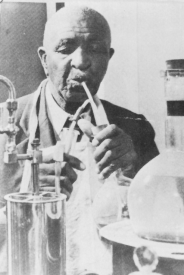
George Washington Carver was born on a Missouri farm near Diamond Grove (now called Diamond), Newton County in Marion Township, Missouri. He received a B.S. from the Iowa Agricultural College in 1894 and a M.S. in 1896. He became a member of the faculty of Iowa State College of Agriculture and Mechanic Arts in charge of the school's bacterial laboratory work in the Systematic Botany department. His work with agricultural products developed industrial applications from farm products, called chemurgy in technical literature in the early 1900s.
His research developed 325 products from peanuts, 108 applications for sweet potatoes, and 75 products derived from pecans.
He moved to Tuskegee, Alabama in 1896 to accept a position as an instructor at the Tuskegee Normal and Industrial Institute and remained on the faculty until his death in 1943.
His work in developing industrial applications from agricultural products derived 118 products, including a rubber substitute and over 500 dyes and pigments, from 28 different plants. He was responsible for the invention in 1927 of a process for producing paints and stains from soybeans, for which three separate patents were issued.
George Washington Carver was honored by U.S. President Franklin Delano Roosevelt in July 14, 1943 dedicating $30,000 for a national monument to be dedicated to his accomplishments. The area of Carver's childhood near Diamond Grove, Missouri has been preserved as a park, with a bust of the agricultural researcher, instructor, and chemical investigator. This park was the first designated national monument to an African American in the United States.
Some of the synthetic products developed by Dr. Carver:
*
| Adhesives Cream
Axle Grease Bleach Buttermilk Cheese Chili Sauce |
Creosote
Dyes Flour Fuel Briquettes Ink Instant Coffee |
Metal Polish
Milk Flakes Mucilage Paper Rubbing Oils Salve |
Insulating Board
Linoleum Mayonnaise Meal Meat Tenderizer |
| Soil Conditioner
Shampoo Shoe Polish Shaving Cream Sugar Synthetic Marble Synthetic Rubber |
Talcum Powder
Vanishing Cream Wood Stains Wood Filler Worcestershire Sauce |
________________________________________________________________________________________
(8)
| Charles Henry Turner
Born: February 3, 1867
|
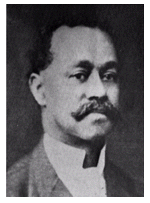
Charles Henry Turner: Zoologist, Entomologist |
Charles Henry Turner was born in Cincinnati, Ohio on February 3, 1867. He received a B.S. from the University of Cincinnati in 1891 and a M.S. in 1892. He received his Ph.D. from the University of Chicago in 1907. He was appointed Professor of Biology at Clark College from 1892 to 1895. He then made a career shift and became a high school biology teacher from 1908 until 1923. This change from academia to secondary education allowed Dr. Turner time to carry out his insect research without the demands of tenure or large teaching loads. He is credited with being the first researcher to prove that insects can hear and can also distinguish pitch. His research determined that roaches can learn by trial and error. This exploration into insect learning systems gave Turner the distinction of being an authority on behavioral patterns of ants and spiders. Charles H. Turner published during his career forty-nine papers on invertebrates.
_______________________________________________________________________________________
(9)
 |
Jewel Plummer Cobb
Born: January 17, 1924
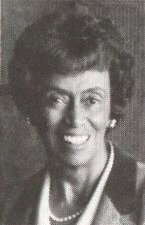
Jewel Plummer Cobb: Biologist (Cell), Physiologist (Cell) |
Jewell Isadora Plummer was born in Chicago, IL on January 17, 1924. She earned a Bachelor of Science from Talladega College in 1944 and a Master of Science from New York University in 1947. Jewell Cobb earned a Ph.D. in Cellular Biology from New York University in 1950. Dr. Cobb served as an Assistant Professor in Research Surgery at New York University, 1956-60. From 1960-69, Dr. Cobb served as Professor of Biology at Sarah Lawrence College. Later, Dr. Cobb was Dean and Professor of Zoology at Connecticut College in New London, CT from 1969 to 1976. From 1976-81, Dr. Cobb was Dean and Professor of Biology, Douglass College -- Rutgers University. From 1981-1990, Dr. Jewell Cobb served as President of California State University at Fullerton. Since 1990 Dr. Jewell Cobb has been President and Professor of Biological Science, Emerita, at California State University at Fullerton, and Trustee Professor at California State University.
__________________________________________________________________________________________
(9)
| Raleigh H. Allen
Born: 1927
Raliegh H. Allen was born in Tampa, Florida in 1927. He became the first African American to pass the three-day certification examination and be licensed as a Veterinarian in the State of Florida. First African American Veterinarian in the State of Florida. Dr. Allen had practiced in Rolla, North Dakota from 1955-1960 before moving to Florida. |
Raleigh H. Allen: Veterinarian |
__________________________________________________________________________________________
