
 |
As the earth revolves around the sun it is spinning or rotating like a top. It spins around an imaginary line called its axis. The earth makes one complete rotation in 23 hours and 56 minutes. |
 |
| Earth's Revolution
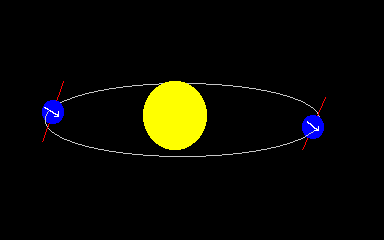
Earth revolves once around the sun in about
365 days (one year.) The path it follows is known as its orbit. During
its elliptical orbit, its distance from the sun changes. The closest
point is earth's perihelion. The farthest point is its aphelion.
|
 |
 |
 |
Seasons
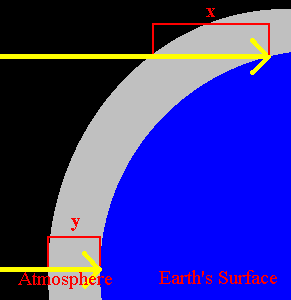
Because of the tilt of the earth's axis (23.5°), the amount of sunlight falling on a region of the earth changes throughout the year. Solstices and Equinoxes zenith - highest point in the sky, directly
overhead
|
The tilt of the Earth’s axis causes seasons.
|
|
http://liftoff.msfc.nasa.gov/News/2001/News-AutumnalEquinox.asp
http://www.enchantedlearning.com/subjects/astronomy/planets/earth/Seasons.shtm
This site is called Here Comes the Sun. It has lots of info about
seasons
http://vortex.plymouth.edu/sun/sun1.html
Other links:
http://windows.arc.nasa.gov/cgi-bin/tour_def/the_universe/uts/seasons1.html
