The Autopsy Guide: IRRESISTIBLE
The Autopsy Guide:
IRRESISTIBLE
"It may be an irony only understood by those of us who conduct these
examinations, who use these pieces to rebuild a narrative, that death, like life itself, is a drama with a beginning, middle and end." -Scully
"You think you find a way to deal with these things. In med school, you develop a clinical detachment to death. In your FBI training, you are confronted with cases, the most terrible and violent
cases. You think you can look into the face of pure evil. And then you find yourself paralysed by it." -Scully
~~~
REVIEW COMING SOON!
~~~
BONUS:
An autopsy excerpt from Autumn's "Irresistible" Review.
Scully proves once again to us ('cause she'd never believe it herself) that she is indeed psychic by:
#2 Suddenly developing an aversion to looking at dead bodies.(Something she usually enjoys. After all she "majored" in it.)
Great Acting Moments:
- The "A body had a story to tell" monologue. Way cool.
These autopsy excerpt courtesy of Autumn
Autumn's Reviews
~~~
TRANSCRIPT
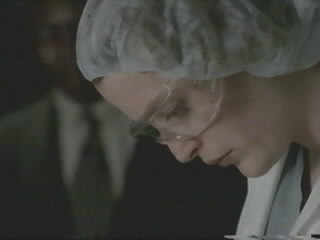
SCULLY'S VOICEOVER: Death is a recorded event. For reasons natural or unnatural, when a body ceases to function, the cause of the effect can be clearly reconstructed. A body has a story to tell.
SCULLY: The time is eleven fourteen AM, Monday, November 14th. The deceased is a female in her twenties...
SCULLY'S VOICEOVER: If the victim was strangled, an examination of the veins in the eyes will reveal this. If the victim was shot, entry
wounds and gunpowder residue can be used to reconstruct the events leading to death and help to establish a possible motive. Body temperature, preferably the temperature of the spleen, is an
accurate indicator of the time of death. As are rigor, livor and levels of sodium in the blood. If the body was moved, sand, small rocks, vegetable debris, even pollen can be removed and analysed to determine the location of the original crime scene and place the position of the body at the time of death. Extracutenous stains and residues can indicate the use of poison or toxins. Hair and fibres, slivers of glass, plastic, even insect casings can serve to recreate the circumstances under which death occurred. It may be an irony only understood by those
of us who conduct these examinations, who use these pieces to rebuild a narrative, that death, like life itself, is a drama with a beginning, middle and end. It is my opinion, having conducted this examination,
that the victim died a wrongful death for the express purpose of extracting her hair and fingernails. The time of death cannot be accurately determined due to what I believe must have been immersion in a cold environment, most likely water. Death came as a result of blood loss and trauma from a deep knife wound which severed the plimonary artery. Of the evidence examined, no one piece or combination gives a clear picture of the killer, other than the motive implied by the bizarre nature if the crime. For the record, it is also my opinion that, outside of child homicide, which may be more tragic and heinous, this is one of the most angry and dehumanizing murders imaginable.
(In the county morgue, a body is lying on an autopsy table covered with a sheet. Scully walks in, wearing her autopsy gear, and moves to the body. She removes the sheet from the body, and with horror sees herself lying on the autopsy table. From the dead Scully's point of view, we see a demonic figure, where the examining Scully stood before. When a phone rings you see Scully bolt upright in bed, in her hotel room and waking from a nightmare.)