
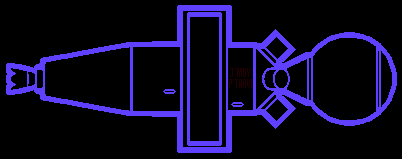
Class I Sensor Probe
Range: 200,000 km
Propulsion: Vectored deuterium micro-fusion engine.
Maximum speed: 0.5 Cochranes
Sensors: Full EM/Subspace and interstellar chemistry pallet for in-space applications.
Telemetry: 12,500 channels at 12 megawatts.
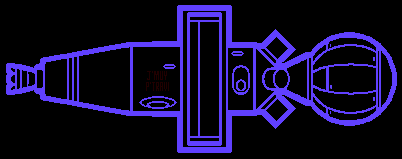
Class II Sensor Probe (Modified Class I)
Range: 400,000 km
Propulsion: Vectored deuterium micro-fusion engine.
Maximum speed: 0.65 Cochranes
Sensors: Same instrumentation as a Class I Probe, with addition of enhanced long-range particle
and field detectors and imaging system.
Telemetry: 15,650 channels at 20 megawatts.
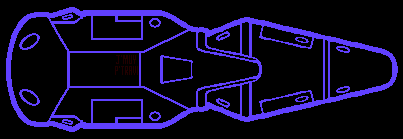
Class III Planetary Probe
Range: 1,200,000 km
Propulsion: Vectored deuterium micro-fusion engine.
Maximum speed: 0.65 Cochranes
Sensors: Terrestrial and gas giant sensor pallet with material smaple and return capability, and an on-board chemical analysis sub-module.
Telemetry: 13,250 channels at approximately 15 megawatts.
Additional data: Limited SIF hull reinforcement. Full range of terrestrial soft landing to sub-surface penetrator missions. Gas giant atmosphere missions survivable to 450 bar pressure. Limited terrestrial loiter time.
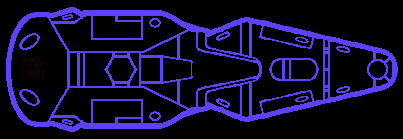
Class IV Stellar Encounter Probe (Modified Class III)
Range: 3,500,000 km
Propulsion: Vectored deuterium micro-fusion engine supplemented with continuum driver coil and an extended maneuvering deuterium supply.
Maximum speed: 0.60 Cochranes
Sensors: Triply redundant stellar fields and particles detectors. A stellar atmosphere analysis
suite.
Telemetry: 9,780 channels at 65 megawatts
Additional data: Six ejectable and survivable radiation flux sub-probes. Deployable for non-stellar
energy phenomena.
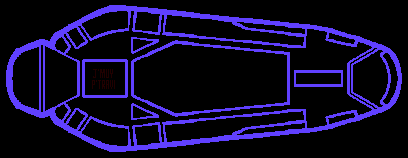
Class V Medium-Range Reconnaissance Probe
Range: 43,000,000,000 km
Propulsion: Dual matter / anti-matter engines. Extended duration at sub-light and limited
duration at warp.
Maximum speed: Warp 2
Sensors: Extended passive data gathering and recording systems with full autonomous mission
execution and return system.
Telemetry: 6,320 channels at 2.5 megawatts.
Additional data: Planetary atmosphere entry and soft landing capability. Low observability
coatings and hull materials. Can be modified for tactical applications with addition of custom sensor
countermeasure package.
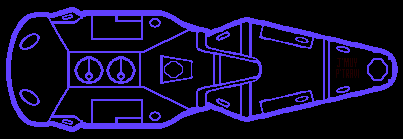
Class VI Communication Relay/Emergency Beacon (Modified Class III)
Range: 43,000,000,000 km
Propulsion: Microfusion engine with high output MHD power tap.
Maximum speed: 0.8 Cochranes
Sensors: Standard pallet.
Telemetry: 9,270 channel RF and subspace transceiver operation at 350 megawatts peak radiated
power, 360 omni antenna coverage. 0.0001 arc-second high-gain antenna pointing resolution.
Additional data: Extended deuterium supply for transceiver power generation and planetary orbit
plane changes.
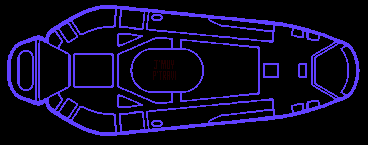
Class VII Remote Culture Study Probe (Modified Class V)
Range: 450,000,000 km
Propulsion: Dual-mode matter / anti-matter engine.
Maximum speed: Warp 1.5
Sensors: Passive data gathering system plus subspace transceiver.
Telemetry: 1,050 channels at 0.5 megawatts
Additional Data: Applicable to civilizations up to technology level III. Low observability coatings
and hull materials. Maximum loiter time: 3.5 months. Low-impact molecular destruct package tied to
anti-tamper detectors.
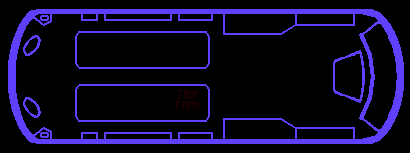
Class VIII Medium-Range Multimission Warp Probe (Modified Photon Torpedo
Casing)
Range: 120 light years
Propulsion: Matter / anti-matter Warp field sustainer engine. Duration 6.5 hours at Warp 9. MHD
power supply tap for sensors and subspace transceiver
Maximum speed: Warp 9
Sensors: Standard pallet plus mission-specific modules
Telemetry: 4,550 channels at 300 megawatts.
Additional Data: Applications vary from galactic particles and fields research to early warning
reconnaissance missions.

Class IX Long-Range Multimission Warp Probe (Modified Photon Torpedo
Casing)
Range: 760 light years
Propulsion: Matter / anti-matter Warp field sustainer engine. Duration 12 hours at Warp 9.
Extended fuel supply for Warp 8 maximum flight duration of fourteen days.
Maximum speed: Warp 9
Sensors: Standard pallet plus mission-specific modules.
Telemetry: 6,500 channels at 230 megawatts.
Additional Data: Limited payload capacity. Isolinear memory storage of 3,400 kiloquads.
Fifty-channel transponder echo. Typical application is emergency log / message capsule on homing trajectory
to nearest starbase or known StarFleet vessel position.
