|
|
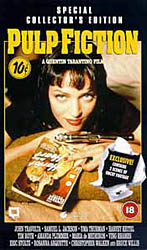
Pulp Fiction (1994) Miramax Directed by: Quentin Tarantino Written by: Quentin Tarantino Starring: John Travolta, Samuel L. Jackson, Uma Thurman, Bruce Willis, Harvey Keitel, Tim Roth, Maria de Madeiros, Amanda Plummer, Eric Stolz, Rosanna Arquette, Christopher Walken, Frank Whaley, Quentin Tarantino Rating: 10/10 |
|
Plot Summary
Crime thriller set as three overlapping stories during a hectic few days in the lives of a collection of Los Angeles criminals.
Review
Since its debut in 1994 Quentin Tarantino's essay on the psychology of "cool" and a society obsessed with pop culture has emerged as one of the most important films of the nineties. Its enormous critical acclaim and unexpected commercial success almost single handedly revolutionised the independent film industry. It was a much-needed blast of fresh air and led the way for other independent American filmmakers to get their work not only made, but noticed and respected. It also inspired a slew of inferior imitators.
|
|
Pulp Fiction has almost everything you could wish for in a movie; drama, hilarity, intensity, action, thrills, fun, intelligence, romance, intimacy, over-the-top bravado, vulgarity, sweetness, suspense, horror, soul-searching and so on and so on. The film is very raw and brutal but has a unique sense of style that keeps the viewer floating along on its sheer energy. The cliché "roller coaster ride" has never been more appropriate. It will build its way up gradually to an incredibly intense scene before dropping down to relative calm only to build back up again a few scenes later. This goes on throughout the entire course of the movie, pummeling the viewer from one scenario to the next.
The stories of Pulp Fiction are a journey through the seedy criminal underbelly of Los Angeles. They don't deal only with the kingpins, but with the hitmen, molls, drug-dealers and petty criminals that populate this sub-culture. The stories are refreshingly unpredictable, you'll think you know what's going to happen just when something totally unexpected occurs. These harsh changes in pace still thrill when you've already seen them many times. The stories may at first seem exploitative, but on close inspection there is real depth there presented through a great cast of characters.
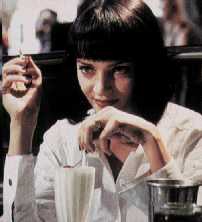
John Travolta reappeared from the wilderness to play Vincent Vega and delivers a remarkably subtle and multi-layered performance. Samuel L. Jackson is at times hilarious at times terrifying as Jules Winfield, the hitman who reaches a moral turning point midway through a job. Uma Thurman is disturbingly charming with her restless mob wife Mia Wallace and Bruce Willis delivers a punchy but also surprisingly tender performance as a prizefighter who lets pride blur his better judgement. The rest of the cast all present interesting and entertaining characters as well but there's simply too many great performances to list them all. Tarantino's attention to detail with his characters is extremely admirable.
The dialog that Tarantino invests these characters with is often priceless. There is a sort of larger-than-life feel throughout Pulp Fiction created by the situations the characters find themselves in, but the conversations the characters have are surprisingly real. Tarantino realizes that when people talk it isn't only to advance the plot of their lives, but mostly about meaningless things to amuse themselves. He manages to capture a tone to the dialogue that is instantly recognisable to his audience.
|
|
There has of course been much debate on what Pulp Fiction is actually about. People often get caught up on meaningless side issues such as what's in the briefcase after all (a flashlight?), others stress rather vague notions that it's all about redemption. I favor that Tarantino had something just a little bit deeper in mind though. The question of what drives human beings to do the things they do has often been credited as our need to keep up what we see as the right image, and in that vein, to avoid embarrassment at all costs. With Pulp Fiction Tarantino puts a fresh spin on this. The question he asks is; how far will you go to be cool?
Tarantino makes no apologies about making gangsters out to be cool because lets face it, they are. At least they are in the pop culture sense presented here. The characters, and Vincent in particular, all take their cues for coolness from these pop culture reference points (Mia's favorite haunt, JackRabbit Slims, is perhaps the greatest symbolism of this). The characters are all chasing their own pulp fiction reality, but at various stages they discover that life doesn't always go along like a movie. Which leads to all sorts of postmodern back flipping, because of course they ARE in a movie. This is where the brilliance of Pulp Fiction truly lies. The lines between where art imitates life and where life imitates art are completely blurred.
While Tarantino clearly relishes in the sordid glamour of the lifestyle presented in Pulp Fiction, he also carefully implies that the lengths you have to go to achieve this kind of cool aren't at all worth it. That it's dehumanizing and that while you may think you're cool, you may not be happy, or even alive. If ever there were two guys who were self-consciously cool and obsessed with self-image then it's Vincent and Jules. From the way they dress, to Jules' over-the-top execution speech, to Vincent arguing with "The Wolf" about saying "please", they're constantly keeping up this act.
We briefly meet Jimmy (probably by no accident played by Quentin) who it is suggested used to run with Jules but who now lives in a very domesticated situation with his wife and is quite happy to dress like a "dork" and worry about bed linen. He's naturally very upset when Jules and Vincent dump all their "gangster shit" on him. When Jules and Vincent leave Jimmy's they've ended up dressed like "dorks" themselves. The implication being, sometimes you have to forget being cool to get on in life. The "freak occurrence" Jules experiences during the hit is enough to convince him to drop the charade because it's not worth it, because it's not right. He's convinced himself he needs to go find something else (the fact that this is also a pop culture inspired lifestyle amusingly suggest he has perhaps missed the bigger picture). Vincent however is stuck in his ways, and because of this he eventually winds up dead. If you create the reality you live in to such an extent, then you must also die by this reality.
Pulp Fiction is an incredibly rich film with many levels of enjoyment. You can watch it over and over again and keep seeing new things, finding new gems. I am sure that some of the great things about the movie were never really intended by Tarantino, they just sort of came out. I've got into all sorts of thematic speculation with this review, but the bottom line is the film is just a complete joy to watch. Every time I revisit Pulp Fiction I enjoy different elements more than others, different segments appeal more on different viewings. But one thing is constant; it keeps me wanting to come back for more.
Tarantino gives a glimpse into the underworld, enough to give us a taste of the excitement that lurks there, but also of the nastiness that keeps most of us away. Leaving us to think that perhaps it is better left in the pages of pulp fiction after all.
|
|
Uma's Performance
Pulp Fiction is without question Uma's most successful film to date, and deservedly so. It's the most commercially successful and received almost universal acclaim. She even got an Academy Award nomination out of it. It's her first (and hopefully not last) bona fide classic. And I don't use the term classic lightly.
I don't think acting wise it's really a standout performance in her career unto itself however, just a typical example of her bringing a character from the page to life in its fullest possibility.
Almost unrecognizable in a black wig, Uma is exceedingly charming and utilizes her imposing presence well. She has always been an actress who pays close attention to the phrasing in dialog and with Tarantino's script she shines. The highlight scene for me was when Vincent finally drops her off and the whole cool facade has been dropped. There's just the vulnerable real Mia there. The sharing of the bad joke is a sweet way to let Vincent know that they do in fact share something deeper now.
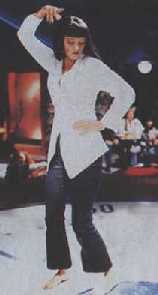
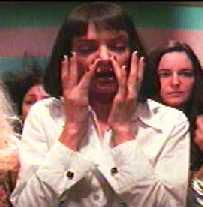
Mia's disturbingly sudden drug overdose and her equally shocking revival are also a moments of greatness for Uma, although most casual viewers will probably find her dance with Travolta at "JackRabbit Slims' the most memorable scene.
Please note: I recommend you buy the special edition of Pulp Fiction because it has an entertaining scene with Uma and Travolta that was cut from the final version of the movie because it didn't quite fit in. Most filmmakers would love to have scenes as good as the ones Tarantino cuts from this film.
Interviews/Articles
Downloads
Short Trailer, 2.5MB, Quicktime