THE COMING PRINCE
BY
SIR ROBERT ANDERSON
1841-1918
Includes All Charts, Tables, and Footnotes Published In "The Coming Prince"
Note: The original Prefaces to the Tenth and Fifth Editions are placed at
the end of the book, for continuity's sake, in the belief that the reader will be
better introduced to "The Coming Prince" by Anderson's initial remarks
in Chapter 1.
To avoid broken links, due to file length, please wait for the page to
load completely
before selecting ANY link below.
Thanks.
Table of Contents
CHAPTER 1: Introductory
CHAPTER 2: Daniel And His Times
CHAPTER 3: The King's Dream And The Prophet's Visions
CHAPTER 4: The Vision By The River Of Ulai
CHAPTER 5: The Angel' s Message
CHAPTER 6: The Prophetic Year
CHAPTER 7: The Mystic Era Of The Weeks
CHAPTER 8: "Messiah The Prince"
CHAPTER 9: The Paschal Supper
CHAPTER 10: Fulfillment Of The Prophecy
CHAPTER 11: Principles Of Interpretation
CHAPTER 12: Fullness Of The Gentiles
CHAPTER 13: Second Sermon On The Mount
CHAPTER 14: The Patmos Visions
CHAPTER 15: The Coming Prince
PREFACES
APPENDICES
1. Chronological Treatise And Tables
2. Miscellaneous: Who And When
Artaxerxes Longimanus & The Chronology Of His Reign / Date Of The Nativity /
Continuous Historical System Of Prophetic Interpretation / The Ten Kingdoms / Chronological
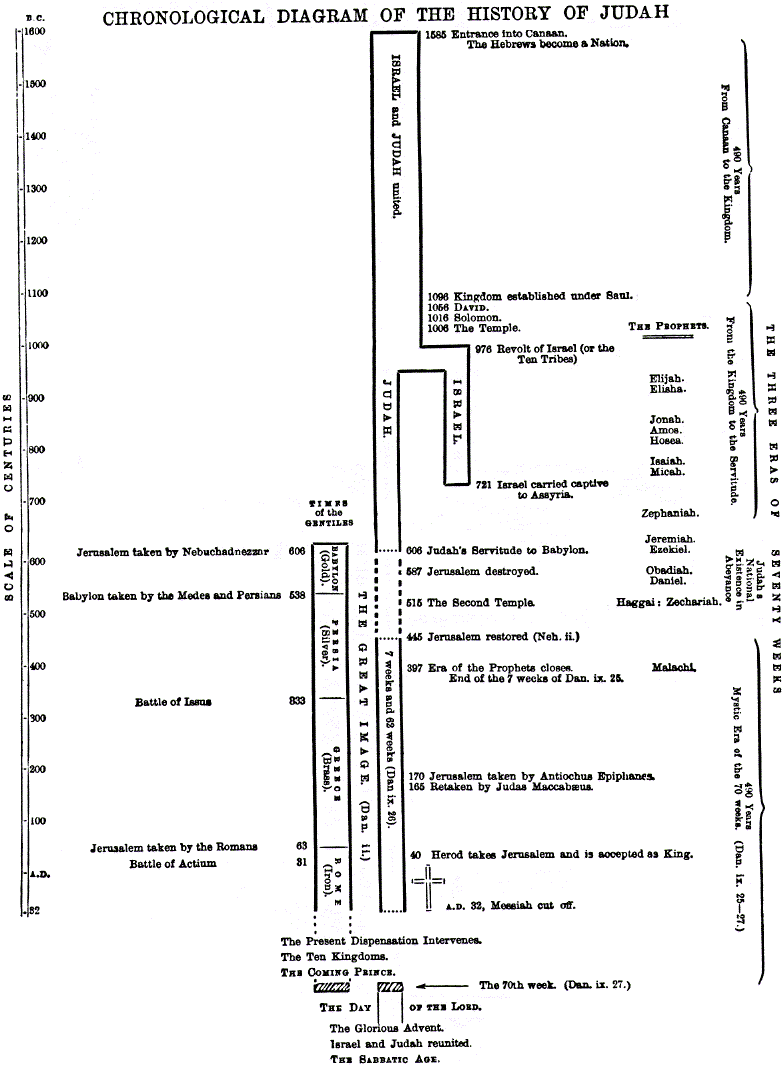
Diagram Of The History Of Judah
3. A Retrospect And A Reply
.
CHAPTER I. Back to Top
INTRODUCTORY
TO living men no time can be so solemn as "the living present," whatever
its characteristics; and that solemnity is immensely deepened in an age of progress
unparalleled in the history of the world. But the question arises whether these days
of ours are momentous beyond comparison, by reason of their being in the strictest
sense the last? Is the world's history about to close? The sands of its destiny,
are they almost run out, and is the crash of all things near at hand?
Earnest thinkers will not allow the wild utterances of alarmists, or the vagaries
of prophecy-mongers, to divert them from an inquiry at once so solemn and so reasonable.
It is only the infidel who doubts that there is a destined limit to the course of
"this present evil world." That God will one day put forth His power to
ensure the triumph of the good, is in some sense a matter of course. The mystery
of revelation is not that He will do this, but that He delays to do
it. Judged by the public facts around us, He is an indifferent spectator of the unequal
struggle between good and evil upon earth.
And how can such things be, if indeed the God who rules above is almighty and
all-good? Vice and godlessness and violence and wrong are rampant upon every side,
and yet the heavens above keep silence. The infidel appeals to the fact in proof
that the Christian's God is but a myth. [1]
The Christian finds in it a further proof that the God he worships is patient
and longsuffering– "patient because He is eternal," longsuffering because
He is almighty, for wrath is a last resource with power. But the day is coming when
This is not a matter of opinion, but of faith. He who questions it has no claim
whatever to the name of Christian, for it is as essentially a truth of Christianity
as is the record of the life and death of the Son of God. The old Scriptures teem
with it, and of all the writers of the New Testament there is not so much as one
who does not expressly speak of it. It was the burden of the first prophetic utterance
which Holy Writ records; (Jude 14) and the closing book of the sacred Canon, from
the first chapter to the last, confirms and amplifies the testimony.
The only inquiry, therefore, which concerns us relates to the nature of the crisis
and the time of its fulfillment. And the key to this inquiry is the Prophet Daniel's
vision of the seventy weeks. Not that a right understanding of the prophecy will
enable us to prophesy. That is not the purpose for which it was given. [2]
But it will prove a sufficient safeguard against error in the study. Notably
it will save us from the follies into which false systems of prophetic chronology
inevitably lead those who follow them. It is not in our time only that the end of
the world has been predicted. It was looked for far more confidently at the beginning
of the sixth century. All Europe rang with it in the days of Pope Gregory the Great.
And at the end of the tenth century the apprehension of it amounted to a general
panic. "It was then frequently preached on, and by breathless crowds listened
to; the subject of every one's thoughts, every one's conversation." "Under
this impression, multitudes innumerable," says Mosheim, "having given their
property to monasteries or churches, traveled to Palestine, where they expected Christ
to descend to judgment. Others bound themselves by solemn oaths to be serfs to churches
or to priests, in hopes of a milder sentence on them as being servants of Christ's
servants. In many places buildings were let go to decay, as that of which there would
be no need in future. And on occasions of eclipses of sun or moon, the people fled
in multitudes for refuge to the caverns and the rocks." [3]
And so in recent years, one date after another has been confidently named
for the supreme crisis; but still the world goes on. A.D. 581 was one of the first
years fixed for the event, [4]
1881 is among the last. These pages are not designed to perpetuate the folly
of such predictions, but to endeavor in a humble way to elucidate the meaning of
a prophecy which ought to deliver us from all such errors and to rescue the study
from the discredit they bring upon it.
No words ought to be necessary to enforce the importance of the subject, and yet
the neglect of the prophetic Scriptures, by those even who profess to believe all
Scripture to be inspired, is proverbial. Putting the matter on the lowest ground,
it might be urged that if a knowledge of the past be important, a knowledge of the
future must be of far higher value still, in enlarging the mind and raising it above
the littlenesses produced by a narrow and unenlightened contemplation of the present.
If God has vouchsafed a revelation to men, the study of it is surely fitted to excite
enthusiastic interest, and to command the exercise of every talent which can be brought
to bear upon it.
And this suggests another ground on which, in our own day especially, prophetic study
claims peculiar prominence; namely, the testimony it affords to the Divine character
and origin of the Scriptures. Though infidelity was as open-mouthed in former times,
it had its own banner and its own camp, and it shocked the mass of mankind, who,
though ignorant of the spiritual power of religion, clung nevertheless with dull
tenacity to its dogmas. But the special feature of the present age – well fitted
to cause anxiety and alarm to all thoughtful men – is the growth of what may be termed
religious skepticism, a Christianity which denies revelation – a form of godliness
which denies that which is the power of godliness. (2 Timothy 3:5)
Faith is not the normal attitude of the human mind towards things Divine, the earnest
doubter, therefore, is entitled to respect and sympathy. But what judgment shall
be meted out to those who delight to proclaim themselves doubters, while claiming
to be ministers of a religion of which FAITH is the essential characteristic?
There are not a few in our day whose belief in the Bible is all the more deep and
unfaltering just because they have shared in the general revolt against priestcraft
and superstition; and such men are scarcely prepared to take sides in the struggle
between free thought and the thraldom of creeds and clerics. But in the conflict
between faith and skepticism within the pale, their sympathies are less divided.
On the one side there may be narrowness, but at least there is honesty; and in such
a case surely the moral element is to be considered before a claim to mental vigor
and independence can be listened to. Moreover any claim of the kind needs looking
into. The man who asserts his freedom to receive and teach what he deems truth, howsoever
reached, and wheresoever found, is not to be lightly accused of vanity or self-will.
His motives may be true, and right, and praiseworthy. But if he has subscribed to
a creed, he ought to be careful in taking any such ground. It is not on the side
of vagueness that the creeds of our British Churches are in fault, and men who boast
of being freethinkers would deserve more respect if they showed their independence
by refusing to subscribe, than by undermining the doctrines they are both pledged
and subsidized to defend and teach.
But what concerns us here is the indisputable fact that rationalism in this its most
subtle phase is leavening society. The universities are its chief seminaries. The
pulpit is its platform. Some of the most popular religious leaders are amongst its
apostles. No class is safe from its influence. And if even the present could be stereotyped,
it were well; but we are entered on a downward path, and they must indeed be blind
who cannot see where it is leading. If the authority of the Scriptures be unshaken,
vital truths may be lost by one generation, and recovered by the next; but if that
be touched, the foundation of all truth is undermined, and all power of recovery
is gone. The Christianized skeptic of today will soon give place to the Christianized
infidel, whose disciples and successors in their turn will be infidels without any
gloss of Christianity about them. Some, doubtless, will escape; but as for the many,
Rome will be the only refuge for those who dread the goal to which society is hastening.
Thus the forces are marshaling for the great predicted struggle of the future between
the apostasy of a false religion and the apostasy of open infidelity. [5]
Is the Bible a revelation from God? This is now become the greatest and most
pressing of all questions. We may at once dismiss the quibble that the Scriptures
admittedly contain a revelation. Is the sacred volume no better than a lottery
bag from which blanks and prizes are to be drawn at random, with no power of distinguishing
between them till the day when the discovery must come too late! And in the present
phase of the question it is no less a quibble to urge that passages, and even books,
may have been added in error to the Canon. We refuse to surrender Holy Writ to the
tender mercies of those who approach it with the ignorance of pagans and the animus
of apostates. But for the purpose of the present controversy we might consent to
strike out everything on which enlightened criticism has cast the shadow of a doubt.
This, however, would only clear the way for the real question at issue, which is
not as to the authenticity of one portion or another, but as to the character and
value of what is admittedly authentic. We are now far beyond discussing rival theories
of inspiration; what concerns us is to consider whether the holy writings are what
they claim to be, "the oracles of God." [6]
In the midst of error and confusion and uncertainty, increasing on every side,
can earnest and devout souls turn to an open Bible, and find there "words of
eternal life"? "The rational attitude of a thinking mind towards the supernatural
is that of skepticism." [7]
Reason may bow before the shibboleths and tricks of priestcraft– "the
voice of the Church," as it is called; but this is sheer credulity. But if GOD
speaks, then skepticism gives place to faith. Nor is this a mere begging of
the question. The proof that the voice is really Divine must be absolute and conclusive.
In such circumstances, skepticism betokens mental or moral degradation, and faith
is not the abnegation of reason, but the highest act of reason. To maintain that
such proof is impossible, is equivalent to asserting that the God who made us cannot
so speak to us that the voice shall carry with it the conviction that it is from
Him; and this is not skepticism at all, but disbelief and atheism. "It pleased
God to reveal His Son in me," was St. Paul's account of his conversion. The
grounds of his faith were subjective, and could not be produced. In proof to others
of their reality he could only appeal to the facts of his life; though these were
entirely the result, and in no sense or degree the basis, of his conviction. Nor
was his case exceptional. St. Peter was one of the favored three who witnessed every
miracle, including the transfiguration, and yet his faith was not the result of these,
but sprang from a revelation to himself. In response to his confession,
"Thou art the Christ, the Son of the living God,"
the Lord declared,
Nor, again, was this a special grace accorded only to apostles.
was St. Peter's address to the faithful generally. He describes them as "born again by the Word of God." So also St. John speaks of such as
is the kindred statement of St. James. (James 1:18).
Whatever be the meaning of such words, they must mean something more than arriving
at a sound conclusion from sufficient premises, or accepting facts upon sufficient
evidence. Nor will it avail to urge that this birth was merely the mental or moral
change naturally caused by the truth thus attained by natural means. The language
of the Scripture is unequivocal that the power of the testimony to produce this change
depended on the presence and. operation of God. Pages might be filled with quotations
to prove this, but two may surface. St. Peter declares they preached the Gospel
and St. Paul's words are still more definite. "Our Gospel came not: unto
you in word only, but also in power and in the Holy Ghost." [8]
And if the new birth and the faith of Christianity were thus produced in the
case of persons who received the Gospel immediately from the Apostles, nothing less
will avail with us who are separated by eighteen centuries from the witnesses and
their testimony. God is with His people still. And He speaks to men's hearts, now,
as really as He did in early times; not indeed through inspired Apostles, and still
less by dreams or visions, but through the Holy Writings which He Himself inspired;
[9] and as the result believers
are "born of God," and obtain the knowledge of forgiveness of sins and
of eternal life. The phenomenon is not a natural one, resulting from the study of
the evidences; it is supernatural altogether. "Thinking minds,"
regarding it objectively, may, if they please, maintain towards it what they deem
"a rational attitude;" but at least let them own the fact that there are
thousands of credible people who can testify to the reality of the experience here
spoken of, and further let them recognize that it is entirely in accordance with
the teaching of the New Testament.
And such persons have transcendental proof of the truth of Christianity. Their faith
rests, not on the phenomena of their own experience, but on the great objective truths
of revelation. Yet their primary conviction that these are Divine truths does
not depend on the "evidences" which skepticism delights to criticize, but
on something which skepticism takes no account of. [10]
"No book can be written in behalf of the Bible like the Bible itself. Man's
defenses are man's word; they may help to beat off attacks, they may draw out some
portion of its meaning. The Bible is God's word, and through it God the Holy Ghost,
who spake it, speaks to the soul which closes not itself against it." [11]
But more than this, the well-instructed believer will find within it inexhaustible
stores of proof that it is from God. The Bible is far more than a textbook of theology
and morals, or even than a guide to heaven. It is the record of the progressive revelation
God has vouchsafed to man, and the Divine history of our race in connection with
that revelation. Ignorance may fail to see in it anything more than the religious
literature of the Hebrew race, and of the Church in Apostolic times; but the intelligent
student who can read between the lines will find there mapped out, sometimes in clear
bold outline, sometimes dimly, but yet always discernible by the patient and devout
inquirer, the great scheme of God's counsels and workings in and for this world of
ours from eternity to eternity.
And the study of prophecy, rightly understood, has a range no narrower than this.
Its chief value is not to bring us a knowledge of "things to come," regarded
as isolated events, important though this may be; but to enable us to link the future
with the past as part of God's great purpose and plan revealed in Holy Writ. The
facts of the life and death of Christ were an overwhelming proof of the inspiration
of the Old Testament. When, after His resurrection, He sought to confirm the disciples'
faith,
But many a promise had been given, and many a prophecy recorded, which seemed to be lost in the darkness of Israel's national extinction and Judah's apostasy. The fulfillment of them all depended on Messiah; but now Messiah was rejected, and His people were about to be cast away, that Gentiles might be taken up for blessing. Are we to conclude then that the past is wiped out for ever, and that God's great purposes for earth have collapsed through human sin? As men now judge of revelation, Christianity dwindles down to be nothing but a "plan of salvation" for individuals, and if St. John's Gospel and a few of the Epistles be left them they are content. How different was the attitude of mind and heart displayed by St. Paul! In the Apostle's view the crisis which seemed the catastrophe of everything the old prophets had foretold of God's purposes for earth, opened up a wider and more glorious purpose still, which should include the fulfillment of them all; and rapt in the contemplation, he exclaimed,
True prophetic study is an inquiry into these unsearchable counsels, these deep
riches of Divine wisdom and knowledge. Beneath the light it gives, the Scriptures
are no longer a heterogeneous compilation of religious books, but one harmonious
whole, from which no part could be omitted without destroying the completeness of
the revelation. And yet the study is disparaged in the Churches as being of no practical
importance. If the Churches are leavened with skepticism at this moment, their neglect
of prophetic study in this its true and broader aspect has done more than all the
rationalism of Germany to promote the evil. Skeptics may boast of learned Professors
and Doctors of Divinity among their ranks, but we may challenge them to name a single
one of the number who has given proof that he knows anything whatever of these deeper
mysteries of revelation. The attempt to put back the rising tide of skepticism is
hopeless. Indeed the movement is but one of many phases of the intense mental activity
which marks the age. The reign of creeds is past. The days are gone for ever when
men will believe what their fathers believed, without a question. Rome, in some phase
of its development, has a strange charm for minds of a certain caste, and rationalism
is fascinating to not a few; but orthodoxy in the old sense is dead, and if any are
to be delivered it must be by a deeper and more thorough knowledge of the Scriptures.
These pages are but a humble effort to this end; but if they avail in any measure
to promote the study of Holy Writ their chief purpose will be fulfilled. The reader
therefore may expect to find the accuracy of the Bible vindicated on points which
may seem of trifling value. When David reached the throne of Israel and came to choose
his generals, he named for the chief commands the men who had made themselves conspicuous
by feats of prowess or of valor. Among the foremost three was one of whom the record
states that he defended a tract of lentiles, and drove away a troop of the Philistines.
(2 Samuel 23:11, 12)? To others it may have seemed little better than a patch of
weeds, and not worth fighting for, but it was precious to the Israelite as a portion
of the divinely-given inheritance, and moreover the enemy might have used it as a
rallying ground from which to capture strongholds. So is it with the Bible. It is
all of intrinsic value if indeed it be from God; and moreover, the statement which
is assailed, and which may seem of no importance, may prove to be a link in the chain
of truth on which we are depending for eternal life.
.
CHAPTER II. Back to Top
DANIEL AND HIS TIMES
"DANIEL the prophet." None can have a higher title to the name,
for it was thus Messiah spoke of him. And yet the great Prince of the Captivity would
himself doubtless have disclaimed it. Isaiah, Jeremiah, Ezekiel, and the rest, "spake
as they were moved by the Holy Ghost;" (2 Peter 1:21) but Daniel uttered no
such "God-breathed" words. [1]
Like the "beloved disciple" in Messianic times, he beheld visions,
and recorded what he saw. The great prediction of the seventy weeks was a message
delivered to him by an angel, who spoke to him as man speaks with man. A stranger
to prophet's fare [2]
and prophet's garb, he lived in the midst of all the luxury and pomp of an
Eastern court. Next to the king, he was the foremost man in the greatest empire of
antiquity; and it was not till the close of a long life spent in statecraft that
he received the visions recorded in the latter chapters of his book.
To understand these prophecies aright, it is essential that the leading events of
the political history of the times should be kept in view.
The summer of Israel's national glory had proved as brief as it was brilliant. The
people never acquiesced in heart in the Divine decree which, in distributing the
tribal dignities, entrusted the scepter to the house of Judah, while it adjudged
the birthright to the favored family of Joseph; [3]
and their mutual jealousies and feuds, though kept in check by the personal
influence of David, and the surpassing splendor of the reign of Solomon, produced
a national disruption upon the accession of Rehoboam. In revolting from Judah, the
Israelites also apostatized from God; and forsaking the worship of Jehovah, they
lapsed into open and flagrant idolatry. After two centuries and a half unillumined
by a single bright passage in their history, they passed into captivity to Assyria;
[4] and on the birth of
Daniel a century had elapsed since the date of their national extinction.
Judah still retained a nominal independence, though, in fact, the nation had already
fallen into a state of utter vassalage. The geographical position of its territory
marked it out for such a fate. Lying half-way between the Nile and the Euphrates,
suzerainty in Judea became inevitably a test by which their old enemy beyond their
southern frontier, and the empire which the genius of Nabopolassar was then rearing
in the north, would test their rival claims to supremacy. The prophet's birth fell
about the very year which was reckoned the epoch of the second Babylonian Empire.
[5] He was still a boy at
the date of Pharaoh Necho's unsuccessful invasion of Chaldea. In that struggle his
kinsman and sovereign, the good king Josiah, took sides with Babylon, and not only
lost his life, but compromised still further the fortunes of his house and the freedom
of his country. (2 Kings 23:29; 2 Chronicles 35:20)
The public mourning for Josiah had scarcely ended when Pharaoh, on his homeward march,
appeared before Jerusalem to assert his suzerainty by claiming a heavy tribute from
the land and settling the succession to the throne. Jehoahaz, a younger son of Josiah,
had obtained the crown on his father's death, but was deposed by Pharaoh in favor
of Eliakim, who doubtless recommended himself to the king of Egypt by the very qualities
which perhaps had induced his father to disinherit him. Pharaoh changed his name
to Jehoiakim, and established him in the kingdom as a vassal of Egypt (2 Kings 23:33-35;
2 Chronicles 36:3, 4).
In the third year after these events, Nebuchadnezzar, Prince Royal of Babylon, [6] set out upon an expedition
of conquest, in command of his father's armies; and entering Judea he demanded the
submission of the king of Judah. After a siege of which history gives no particulars,
he captured the city and seized the king as a prisoner of war. But Jehoiakim regained
his liberty and his throne by pledging his allegiance to Babylon; and Nebuchadnezzar
withdrew with no spoil except a part of the holy vessels of the temple, which he
carried to the house of his god, and no captives save a few youths of the seed royal
of Judah, Daniel being of the number, whom he selected to adorn his court as vassal
princes. (2 Kings 24:1; 2 Chronicles 36:6, 7; Daniel 1:1, 2) Three years later Jehoiakim
revolted; but, although during the rest of his reign his territory was frequently
overrun by "bands of the Chaldees," five years elapsed before the armies
of Babylon returned to enforce the conquest of Judea. [7]
Jehoiachin, a youth of eighteen years, who had just succeeded to the throne,
at once surrendered with his family and retinue, (2 Kings 24:12) and once more Jerusalem
lay at the mercy of Nebuchadnezzar. On his first invasion he had proved magnanimous
and lenient, but he had now not merely to assert supremacy but to punish rebellion.
Accordingly he ransacked the city for everything of value, and "carried away
all Jerusalem," leaving none behind "save the poorest sort of the people
of the land." (2 Kings 24:14)
Jehoiachin's uncle Zedekiah was left as king or governor of the despoiled and depopulated
city, having sworn by Jehovah to pay allegiance to his Suzerain. This was "King
Jehoiachin's captivity," according to the era of the prophet Ezekiel, who was
himself among the captives. (Ezekiel 1:2)
The servitude to Babylon had been predicted as early as the days of Hezekiah; (2
Kings 20:17) and after the fulfillment of Isaiah's prophecy respecting it, Jeremiah
was charged with a Divine message of hope to the captivity, that after seventy years
were accomplished they would be restored to their land. (Jeremiah 29:10) But while
the exiles were thus cheered with promises of good, King Zedekiah and "the residue
of Jerusalem that remained in the land" were warned that resistance to the Divine
decree which subjected them to the yoke of Babylon would bring on them judgments
far more terrible than any they had known. Nebuchadnezzar would return to "destroy
them utterly," and make their whole land "a desolation and an astonishment."
(Jeremiah 24:8-10; 25:9; 27:3-8) False prophets rose up, however, to feed the national
vanity by predicting the speedy restoration of their independence, (Jeremiah 28:1-4)
and in spite of the solemn and repeated warnings and entreaties of Jeremiah, the
weak and wicked king was deceived by their testimony, and having obtained a promise
of armed support from Egypt, (Ezekiel 17:15) he openly revolted.
Thereupon the Chaldean armies once more surrounded Jerusalem. Events seemed at first
to justify Zedekiah's conduct, for the Egyptian forces hastened to his assistance,
and the Babylonians were compelled to raise the siege and withdraw from Judea. (Jeremiah
37:1, 5, 11) But this temporary success of the Jews served only to exasperate the
King of Babylon, and to make their fate more terrible when at last it overtook them.
Nebuchadnezzar determined to inflict a signal chastisement on the rebellious city
and people; and placing himself at the head of all the forces of his empire, (2 Kings
25:1; Jeremiah 34:1) he once more invaded Judea and laid siege to the Holy City.
The Jews resisted with the blind fanaticism which a false hope inspires; and it is
a signal proof of the natural strength of ancient Jerusalem, that for eighteen months
(2 Kings 25:1-3) they kept their enemy at bay, and yielded at last to famine and
not to force. The place was then given up to fire and sword. Nebuchadnezzar
"slew their young men with the sword in the house of their sanctuary, and had
no compassion upon young man or maiden, old man, or him that stooped for age; he
gave them all into his hand. And all the vessels of the house of God, great and small,
and the treasures of the house of the Lord, and the treasures of the king and of
his princes, all these he brought to Babylon. And they burnt the house of God, and
brake down the wall of Jerusalem, and burnt all the palaces thereof with fire, and
destroyed all the goodly vessels thereof. And them that had escaped from the sword
carried he away to Babylon, where they were servants to him and his sons, until the
reign of the kingdom of Persia: to fulfill the word of the Lord by the mouth of Jeremiah."
(2 Chronicles 36:17-21)
As He had borne with their fathers for forty years in the wilderness, so for
forty years this last judgment lingered, "because He had
compassion on His people and on His dwelling place." (2 Chronicles 36:15) For
forty years the prophet's voice had not been silent in Jerusalem; "but
they mocked the messengers of God, and despised His words, and misused His prophets,
until the wrath of the Lord arose against His people, till there was no remedy."
[8]
Such is the sacred chronicler's description of the first destruction of Jerusalem,
rivaled in later times by the horrors of that event under the effects of which it
still lies prostrate, and destined to be surpassed in days still to come, when the
predictions of Judah's supreme catastrophe shall be fulfilled. [9]
.
CHAPTER III. Back to Top
THE KING'S DREAM AND THE PROPHET'S VISIONS
THE distinction between the Hebrew and the Chaldee portions of the writings of Daniel
[1] affords a natural division,
the importance of which will appear on a careful consideration of the whole. But
for the purpose of the present inquiry, the book will more conveniently divide itself
between the first six chapters and the last, the former portion being primarily historical
and didactic, and the latter containing the record of the four great visions granted
to the prophet in his closing years. It is with the visions that here we are specially
concerned. The narrative of the third, fourth, fifth, and sixth chapters is beyond
the scope of these pages, as having no immediate bearing upon the prophecy. The second
chapter, however, is of great importance, as giving the foundation of the later visions.
[2]
In a dream, King Nebuchadnezzar saw a great image, of which the head was gold,
the breasts and arms silver, the body brass, the legs iron, and the feet partly iron
and partly potter's ware. Then a stone, hewn without hands, struck the feet of the
image and it fell and crumbled to dust, and the stone became a great mountain and
filled the whole earth. [3]
The interpretation is in these words:
The predicted sovereignty of Judah passed far beyond the limits of mere supremacy among the tribes of Israel. It was an imperial scepter which was entrusted to the Son of David.
Such were the promises which Solomon inherited; and the brief glory of his reign
gave proof how fully they might have been realized, (2 Chronicles 9:22-28) had he
not turned aside to folly, and bartered for present sensual pleasures the most splendid
prospects which ever opened before mortal man. Nebuchadnezzar's dream of the great
image, and Daniel's vision in interpretation of that dream, were a Divine revelation
that the forfeited scepter of the house of David had passed to Gentile hands, to
remain with them until the day when "the God of heaven
shall set up a kingdom which shall never be destroyed." (Daniel 2:44)
It is unnecessary here to discuss in detail the earlier portions of this prophecy.
There is, in fact, no controversy as to its general character and scope; and bearing
in mind the distinction between what is doubted and what is doubtful, there need
be no controversy as to the identity of the empires therein described with Babylonia,
Persia, Greece, and Rome. That the first was Nebuchadnezzar's kingdom is definitely
stated, (Daniel 2:37, 38) and a later vision as expressly names the Medo-Persian
empire and the empire of Alexander as being distinct "kingdoms" within
the range of the prophecy. (Daniel 8:20, 21) The fourth empire, therefore, must of
necessity be Rome. But it is sufficient here to emphasize the fact, revealed in the
plainest terms to Daniel in his exile, and to Jeremiah in the midst of the troubles
at Jerusalem, that thus the sovereignty of the earth, which had been forfeited by
Judah, was solemnly committed to the Gentiles. [4]
The only questions which arise relate, first to the character of the final
catastrophe symbolized by the fall and destruction of the image, and secondly to
the time of its fulfillment; and any difficulties which have been raised depend in
no way upon the language of the prophecy, but solely upon the preconceived views
of interpreters. No Christian doubts that the "stone cut out without hands"
was typical either of Christ Himself or of His kingdom. It is equally clear that
the catastrophe was to occur when the fourth empire should have become divided, and
be "partly strong and partly brittle." Therefore its fulfillment could
not belong to the time of the first advent. No less clear is it that its fulfillment
was to be a sudden crisis, to be followed by the establishment of "a kingdom
which shall never be destroyed." Therefore it relates to events still to come.
We are dealing here, not with prophetic theories, but with the meaning of plain words;
and what the prophecy foretells is not the rise and spread of a "spiritual
kingdom" in the midst of earthly kingdoms, but the establishment of a kingdom
which "shall break in pieces and consume all these kingdoms." [5]
The interpretation of the royal dream raised the captive exile at a single
bound to the Grand-Vizier-ship of Babylon, (Daniel 2:48) a position of trust and
honor which probably he held until he was either dismissed or withdrew from office
under one or other of the two last kings who succeeded to Nebuchadnezzar's throne.
The scene on the fatal night of Belshazzar's feast suggests that he had been then
so long in retirement, that the young king-regent knew nothing of his fame. [6] But yet his fame was still so great with older men, that
notwithstanding his failing years, he was once more called to the highest office
by Darius, when the Median king became master of the broad-walled city. [7]
But whether in prosperity or in retirement, he was true to the God of his
fathers. The years in which his childhood in Jerusalem was spent, though politically
dark and troubled, were a period of the brightest spiritual revival by which his
nation had ever been blessed, and he had carried with him to the court of Nebuchadnezzar
a faith and piety that withstood all the adverse influences which abounded in such
a scene. [8]
The Daniel of the second chapter was a young man just entering on a career
of extraordinary dignity and power, such as few have ever known, The Daniel of the
seventh chapter was an aged saint, who, having passed through the ordeal scathless,
still possessed a heart as true to God and to His people as when, some threescore
years before, he had entered the gates of the broad-walled city a captive and friendless
stranger. The date of the earlier vision was about the time of Jehoiakim's revolt,
when their ungovernable pride of race and creed still led the Jews to dream of independence.
At the time of the later vision more than forty years had passed since Jerusalem
had been laid in ruins, and the last king of the house of David had entered the brazen
gates of Babylon in chains.
Here again the main outlines of the prophecy seem clear. As the four empires which
were destined successively to wield sovereign power during "the times of the
Gentiles" are represented in Nebuchadnezzar's dream by the four divisions of
the great image, they are here typified by four wild beasts. [9] The ten toes of the image in the second chapter have their
correlatives in the ten horns of the fourth beast in the seventh chapter. The character
and course of the fourth empire are the prominent subject of the later vision, but
both prophecies are equally explicit that that empire in its ultimate phase will
be brought to a signal and sudden end by a manifestation of Divine power on earth.
The details of the vision, though interesting and important, may here be passed unnoticed,
for the interpretation given of them is so simple and so definite that the words
can leave no room for doubt in any unprejudiced mind. "These
great beasts, which are four, are four kings" (i.e., kingdoms; compare
verse 23), "which shall arise out of the earth; but the saints of the Most High
shall take the kingdom and possess the kingdom for ever." (Verses 17, 18)
The prophet then proceeds to recapitulate the vision, and his language affords an
explicit answer to the only question which can reasonably be raised upon the words
just quoted, namely, whether the "kingdom of the saints" shall follow immediately
upon the close of the fourth Gentile empire. [10]
"Then," he adds, "I would know the truth of the fourth beast,
which was diverse from all the others, exceeding dreadful, whose teeth were of iron,
and his nails of brass; which devoured, brake in pieces, and stamped the residue
with his feet; and of the ten horns that were in his head, and of the other which
came up, and before whom three fell, even of that horn that had eyes, and a mouth
that spake very great things, whose look was more stout than his fellows. I beheld,
and the same horn made war with the saints, and prevailed against them; until the
Ancient of days came, and judgment was given to the saints of the Most High; and
the time came that the saints possessed the kingdom."
Such was the prophet's inquiry. Here is the interpretation accorded to him in reply.
Whether history records any event which may be within the range of this prophecy is a matter of opinion. That it has not been fulfilled is a plain matter of fact. [12] The Roman earth shall one day be parceled out in ten separate kingdoms, and out of one of these shall arise that terrible enemy of God and His people, whose destruction is to be one of the events of the second advent of Christ.
.
CHAPTER IV. Back to Top
THE VISION BY THE RIVER OF ULAI
"THE times of the Gentiles;" thus it was that Christ Himself described
the era of Gentile supremacy. Men have come to regard the earth as their own domain,
and to resent the thought of Divine interference in their affairs. But though monarchs
seem to owe their thrones to dynastic claims, the sword or the ballot-box, – and
in their individual capacity their title may rest solely upon these, – the power
they wield is divinely delegated, for "the Most High ruleth
in the kingdom of men, and giveth it to whomsoever He will." (Daniel 4:25)
In the exercise of this high prerogative He took back the scepter He had entrusted
to the house of David, and transferred it to Gentile hands; and the history of that
scepter during the entire period, from the epoch to the close of the times of the
Gentiles, is the subject of the prophet's earlier visions.
The vision of the eighth chapter of Daniel has a narrower range. It deals only with
the two kingdoms which were represented by the middle portion, or arms and body,
of the image of the second chapter. The Medo-Persian Empire, and the relative superiority
of the younger nation, are represented by a ram with two horns, one of which was
higher than the other, though the last to grow. And the rise of the Grecian Empire
under Alexander, followed by its division among his four successors, is typified
by a goat with a single horn between its eyes, which horn was broken and gave place
to four horns that came up instead of it. Out of one of these horns came forth a
little horn, representing a king who should become infamous as a blasphemer of God
and a persecutor of His people.
That the career of Antiochus Epiphanes was in a special way within the scope and
meaning of this prophecy is unquestioned. That its ultimate fulfillment belongs to
a future time, though not so generally admitted, is nevertheless sufficiently clear.
The proof of it is twofold. First, it cannot but be recognized that its most striking
details remain wholly unfulfilled. [1]
And secondly, the events described are expressly stated to be "in the
last end of the indignation," (Daniel 8:19) which is "the great tribulation"
of the last days, (Matthew 24:21) "the time of trouble" which is immediately
to precede the complete deliverance of Judah. [2]
It is unnecessary, however, further to embarrass the special subject of these
pages by any such discussion. So far as the present inquiry is immediately concerned,
this vision of the ram and the he-goat is important mainly as explanatory of the
visions which precede it. [3]
One point of contrast with the prophecy of the fourth Gentile kingdom demands
a very emphatic notice. The vision of Alexander's reign, followed by the fourfold
division of his empire, suggests a rapid sequence of events, and the history of the
three-and-thirty years that intervened between the battles of Issus and of Ipsus
[4] comprises the full realization
of the
prophecy. But the rise of the ten horns upon the fourth beast in the vision of the
seventh chapter, appears to lie within as brief a period as was the rise of the four
horns upon the goat in the eighth chapter; whereas it is plain upon the pages of
history that this tenfold division of the Roman empire has never yet taken place.
A definite date may be assigned to the advent of the first three kingdoms of prophecy;
and if the date of the battle of Actium be taken as the epoch of the hybrid monster
which filled the closing scenes of the prophet's vision – and no later date
will be assigned to it – it follows that in interpreting the prophecy, we may eliminate
the history of the world from the time of Augustus to the present hour, without losing
the sequence of the vision. [5]
Or in other words, the prophet's glance into the future entirely overlooked
these nineteen centuries of our era. As when mountain peaks stand out together on
the horizon, seeming almost to touch, albeit a wide expanse of river and field and
hill may lie between, so there loomed upon the prophet's vision these events of times
now long gone by, and times still future.
And with the New Testament in our hands, it would betray strange and willful ignorance
if we doubted the deliberate design which has left this long interval of our Christian
era a blank in Daniel's prophecies. The more explicit revelation of the ninth chapter,
measures out the years before the first advent of Messiah. But if these nineteen
centuries had been added to the chronology of the period to intervene before the
promised kingdom could be ushered in, how could the Lord have taken up the testimony
to the near fulfillment of these very prophecies, and have proclaimed that the kingdom
was at hand? [6] He who knows all hearts,
knew well the issue; but the thought is impious that the proclamation was not genuine
and true in the strictest sense; and it would have been deceptive and untrue had
prophecy foretold a long interval of Israel's rejection before the promise could
be realized.
Therefore it is that the two advents of Christ are brought seemingly together in
Old Testament Scriptures. The surface currents of human responsibility and human
guilt are unaffected by the changeless and deep-lying tide of the fore-knowledge
and sovereignty of God. Their responsibility was real, and their guilt was without
excuse, who rejected their long-promised King and Savior. They were not the victims
of an inexorable fate which dragged them to their doom, but free agents who used
their freedom to crucify the Lord of Glory. "His blood be on us and on our children,"
was their terrible, impious cry before the judgment-seat of Pilate, and for eighteen
centuries their judgment has been meted out to them, to reach its appalling climax
on the advent of the "time of trouble such as never was since there was a nation."
[7]
These visions were full of mystery to Daniel, and filled the old prophet's
mind with troubled thoughts. (Daniel 7:28; 8:27) A long vista of events seemed thus
to intervene before the realization of the promised blessings to his nation, and
yet these very revelations made those blessings still more sure. Ere long he witnessed
the crash of the Babylonian power, and saw a stranger enthroned within the broad-walled
city. But the change brought no hope to Judah. Daniel was restored, indeed, to the
place of power and dignity which he had held so long under Nebuchadnezzar, (Daniel
2:48; 6:2) but he was none the less an exile; his people were in captivity, their
city lay in ruins, and their land was a wilderness. And the mystery was only deepened
when he turned to Jeremiah's prophecy, which fixed at seventy years the destined
era of "the desolations of Jerusalem" (Daniel 9:2) So "by prayer and
supplications, with fastings, and sackcloth and ashes," he cast himself on God;
as a prince among his people, confessing their national apostasy, and pleading for
their restoration and forgiveness. And who can read that prayer unmoved?
While Daniel was thus "speaking in prayer' Gabriel once more appeared to him, (Daniel 9:21, See chap. 8:16.) that same angel messenger who heralded in after times the Savior's birth in Bethlehem, – and in answer to his supplication, delivered to the prophet the great prediction of the seventy weeks.
.
CHAPTER V. Back to Top
THE ANGEL' S MESSAGE
SUCH was the message entrusted to the angel in response to the prophet's prayer
for mercies upon Judah and Jerusalem.
To whom shall appeal be made for an interpretation of the utterance? Not to the Jew,
surely, for though himself the subject of the prophecy, and of all men the most deeply
interested in its meaning, he is bound, in rejecting Christianity, to falsify not
only history, but his own Scriptures. Nor yet to the theologian who has prophetic
theories to vindicate, and who on discovering, perhaps, some era of seven times seventy
in Israel's history, concludes that he has solved the problem, ignoring the fact
that the strange history of that wonderful people is marked through all its course
by chronological cycles of seventy and multiples of seventy. But any man of unprejudiced
mind who will read the words with no commentary save that afforded by Scripture itself
and the history of the time, will readily admit that on certain leading points their
meaning is unequivocal and clear.
The first question, therefore, which arises is whether history records any event
which unmistakably marks the beginning of the era.
Certain writers, both Christian and Jewish, have assumed that the seventy weeks began
in the first year of Darius, the date of the prophecy itself; and thus falling into
hopeless error at the very threshold of the inquiry, all their conclusions are necessarily
erroneous. The words of the angel are unequivocal: "From the issuing of the
decree to restore and build Jerusalem unto the Messiah the Prince, shall be seven
weeks and sixty-two weeks." That Jerusalem was in fact rebuilt as a fortified
city, is absolutely certain and undoubted; and the only question in the matter is
whether history records the edict for its restoration.
When we turn to the book of Ezra, three several decrees of Persian kings claim notice.
The opening verses speak of that strange edict by which Cyrus authorized the building
of the temple. But here "the house of the Lord God of Israel" is specified
with such an exclusive definiteness that it can in no way satisfy the words of Daniel.
Indeed the date of that decree affords conclusive proof that it was not the beginning
of the seventy weeks. Seventy years was the appointed duration of the servitude to
Babylon. (Jeremiah 27:6-17; 28:10; 29:10) But another judgment of seventy years'
"desolations" was decreed in Zedekiah's reign, [8] because of continued disobedience and rebellion. As an interval
of seventeen years elapsed between the date of the servitude and the epoch of the
"desolations," so by seventeen years the second period overlapped the first.
The servitude ended with the decree of Cyrus. The desolations continued till the
second year of Darius Hystaspes. [9]
And it was the era of the desolations, and not of the servitude which
Daniel had in view. [10]
The decree of Cyrus was the Divine fulfillment of the promise made to the
captivity in the twenty-ninth chapter of Jeremiah, and in accordance with that promise
the fullest liberty was granted to the exiles to return to Palestine. But till the
era of the desolations had run its course, not one stone was to be set upon another
on Mount Moriah. And this explains the seemingly inexplicable fact that the firman
to build the temple, granted to eager agents by Cyrus in the zenith of his power,
remained in abeyance till his death; for a few refractory Samaritans were allowed
to thwart the execution of this the most solemn edict ever issued by an Eastern despot,
an edict in respect of which a Divine sanction seemed to confirm the unalterable
will of a Medo-Persian king. [11]
When the years of the desolations were expired, a Divine command was promulgated
for the building of the sanctuary, and in obedience to that command, without waiting
for permission from the capital, the Jews returned to the work in which they had
so long been hindered. (Ezra 5:1, 2, 5) The
wave of political excitement which had carried Darius
to the throne of Persia, was swelled by religious fervor against the Magian idolatry.
[12] The moment therefore
was auspicious for the Israelites, whose worship of Jehovah commanded the sympathy
of the Zoroastrian faith; and when the tidings reached the palace of their seemingly
seditious action at Jerusalem, Darius made search among the Babylonian archives of
Cyrus, and finding the decree of his predecessor, he issued on his own behalf a firman
to give effect to it. (Ezra 6)
And this is the second event which affords a possible beginning for the seventy weeks.
[13] But though plausible
arguments may be urged to prove that, either regarded as an independent edict, or
as giving practical effect to the decree of Cyrus, the act of Darius was the epoch
of the prophetic period, the answer is clear and full, that it fails to satisfy the
angel's words. However it be accounted for, the fact remains, that though the "desolations"
were accomplished, yet neither the scope of the royal edict, nor the action of the
Jews in pursuance of that edict, went beyond the building of the Holy Temple, whereas
the prophecy foretold a decree for the building of the city; not the street
alone, but the fortifications of Jerusalem.
Five years sufficed for the erection of the building which served as a shrine for
Judah during the five centuries which followed. [14]
But, in striking contrast with the temple they had reared in days when the
magnificence of Solomon made gold as cheap as brass in Jerusalem, no costly furniture
adorned the second house, until the seventh year of Artaxerxes Longimanus, when the
Jews obtained a firman "to beautify the house of the Lord." (Ezra 7:19,
27.) This letter further authorized Ezra to return to Jerusalem with such of the
Jews as desired to accompany him, and there to restore fully the worship of the temple
and the ordinances of their religion. But this third decree makes no reference whatever
to building, and it might be passed unnoticed were it not that many writers have
fixed on it as the epoch of the prophecy. The temple had been already built long
years before, and the city was still in ruins thirteen years afterwards. The book
of Ezra therefore will be searched in vain for any mention of a "commandment
to restore and build Jerusalem." But we only need to turn to the book which
follows it in the canon of Scripture to find the record which we seek.
The book of Nehemiah opens by relating that while at Susa, [15] where he was cup-bearer to the great king, "an honor
of no small account in Persia," [16]
certain of his brethren arrived from Judea, and he "asked them concerning
the Jews that had escaped, which were left of the captivity, and concerning Jerusalem."
The emigrants declared that all were "in great affliction and reproach,"
"the wall of Jerusalem also was broken down, and the gates thereof were burned
with fire." (Nehemiah 1:2) The first chapter closes with the record of Nehemiah's
supplication to "the God of heaven." The second chapter narrates how "in
the month Nisan, in the twentieth year of Artaxerxes," he was discharging the
duties of his office, and as he stood before the king his countenance betrayed his
grief, and Artaxerxes called on him to tell his trouble. "Let the king live
for ever," Nehemiah answered, "why should not my countenance be sad, when
the city, the place of my fathers' sepulchers, lieth waste, and the gates thereof
are burned with fire!" "For what dost thou make request?" the
king demanded in reply. Thereupon Nehemiah answered thus: "If it please the
king, and if thy servant have found favor in thy sight, that thou wouldest send
me unto Judah, unto THE CITY of my fathers' sepulchers, THAT I
MAY BUILD IT." (Nehemiah 2:5) Artaxerxes fiated the petition, and forthwith
issued the necessary orders to give effect to it. Four months later, eager hands
were busy upon the ruined walls of Jerusalem, and before the Feast of Tabernacles
the city was once more enclosed by gates and a rampart. (Nehemiah 6:15)
But, it has been urged, "The decree of the twentieth year of Artaxerxes is but
an enlargement and renewal of his first decree, as the decree of Darius confirmed
that of Cyrus." [17]
If this assertion had not the sanction of a great name, it would not deserve
even a passing notice. If it were maintained that the decree of the seventh year
of Artaxerxes was but "an enlargement and renewal" of his predecessors'
edicts, the statement would be strictly accurate. That decree was mainly an authority
to the Jews "to beautify the House of the Lord. which is in Jerusalem,"
(Ezra 7:27) in extension of the decrees by which Cyrus and Darius permitted them
to build it. The result was to produce a gorgeous shrine in the midst of a
ruined city. The movement of the seventh of Artaxerxes was chiefly a religious revival,
(Ezra 7:10) sanctioned and subsidized by royal favor; but the event of his twentieth
year was nothing less than the restoration of the autonomy of Judah. The execution
of the work which Cyrus authorized was stopped on the false charge which the enemies
of the Jews carried to the palace, that their object was to build not merely the
Temple, but the city. "A rebellious city" it had ever proved to
each successive suzerain, "for which cause" – they declared with truth,
– its destruction was decreed. "We certify the king" (they added) "that
if this city be builded again, and the walls thereof set up, thou shalt
have no portion on this side the river." [18]
To allow the building of the temple was merely to accord to a conquered race
the right to worship according to the law of their God, for the religion of the Jew
knows no worship apart from the hill of Zion. It was a vastly different event when
that people were permitted to set up again the far-famed fortifications of their
city, and entrenched behind those walls, to restore under Nehemiah the old polity
of the Judges. [19]
This was a revival of the national existence of Judah, and therefore it is
fitly chosen as the epoch of the prophetic period of the seventy weeks.
The doubt which has been raised upon the point may serve as an illustration of the
extraordinary bias which seems to govern the interpretation of Scripture, in consequence
of which the plain meaning of words is made to give place to the remote and the less
probable. And to the same cause must be attributed the doubt which some have suggested
as to the identity of the king here spoken of with Artaxerxes Longimanus. [20]
The question remains, whether the date of this edict can be accurately ascertained.
And here a most striking fact claims notice. In the sacred narrative the date of
the event which marked the beginning of the seventy weeks is fixed only by reference
to the regnal era of a Persian king. Therefore we must needs turn to secular history
to ascertain the epoch, and history dates from this very period. Herodotus,
"the father of history," was the contemporary of Artaxerxes, and visited
the Persian court. [21]
Thucydides, "the prince of historians," also was his contemporary.
In the great battles of Marathon and Salamis, the history of Persia had become interwoven
with events in Greece, by which its chronology can be ascertained and tested; and
the chief chronological eras of antiquity were current at the time. [22] No element is wanting, therefore, to enable us with accuracy
and certainty to fix the date of Nehemiah's edict.
True it is that in ordinary history the mention of "the twentieth year of Artaxerxes"
would leave in doubt whether the era of his reign were reckoned from his actual accession,
or from his father's death; [23]
but the narrative of Nehemiah removes all ambiguity upon this score. The murder
of Xerxes and the beginning of the usurper Artabanus's seven months' reign was in
July B.C. 465; the accession of Artaxerxes was in February B.C. 464; [24] One or other of these dates, therefore, must be the epoch
of Artaxerxes' reign. But as Nehemiah mentions the Chisleu (November) of one year,
and the following Nisan (March) as being both in the same year of his master's reign,
it is obvious that, as might be expected from an official of the court, he reckons
from the time of the king's accession de jure, that is from July B.C. 465.
The twentieth year of Artaxerxes therefore
began in July B.C. 446, and the commandment to rebuild
Jerusalem was given in the Nisan following. The epoch of the prophetic cycle
is thus definitely fixed as in the Jewish month Nisan of the year B.C. 445. [25]
.
CHAPTER VI. Back to Top
THE PROPHETIC YEAR
IN English ears it must sound pedantic to speak of "weeks" in any other
than the familiar acceptation of the term. But with the Jew it was far otherwise.
The effect of his laws was fitted "to render the word week capable of
meaning a seven of years almost as naturally as a seven of days. Indeed the generality
of the word would have this effect at any rate. Hence its use to denote the latter
in prophecy is not mere arbitrary symbolism, but the employment of a not unfamiliar
and easily understood language." [1]
Daniel's prayer referred to seventy years fulfilled: the prophecy which came
in answer to that prayer foretold a period of seven times seventy still to come.
But here a question arises which never has received sufficient notice in the consideration
of this subject. None will doubt that the era is a period of years; but of what kind
of year is it composed? That the Jewish year was lunisolar appears to be reasonably
certain. If tradition may be trusted, Abraham preserved in his family the year of
360 days, which he had known in his Chaldean home. [2] The month dates of the flood (150 days being specified as
the interval between the seventeenth day of the second month, and the same day of
the seventh month) appear to show that this form of year was the earliest known to
our race. Sir Isaac Newton states, that "all nations, before the just length
of the solar year was known, reckoned months by the course of the moon, and years
by the return of winter and summer, spring and autumn; and in making calendars for
their festivals, they reckoned thirty days to a lunar month, and twelve lunar months
to a year, taking the nearest round numbers, whence came the division of the ecliptic
into 360 degrees." And in adopting this statement, Sir G. C. Lewis avers that
"all credible testimony and all antecedent probability lead to the result that
a solar year containing twelve lunar months, determined within certain limits of
error, has been generally recognized by the nations adjoining the Mediterranean,
from a remote antiquity." [3]
But considerations of this kind go no further than to prove how legitimate and important
is the question here proposed. The inquiry remains whether any grounds exist for
reversing the presumption which obtains in favor of the common civil year. Now the
prophetic era is clearly seven times the seventy years of the "desolations"
which were before the mind of Daniel when the prophecy was given. Is it possible
then to ascertain the character of the years of this lesser era?
One of the characteristic ordinances of the Jewish law was, that every seventh year
the land was to lie fallow, and it was in relation to the neglect of this ordinance
that the era of the desolations was decreed. It was to last "until the land
had enjoyed her Sabbaths; for so long as she lay desolate, she kept Sabbath, to fulfill
threescore and ten years." (2 Chronicles 36:21; cf. Leviticus 26:34,
35) The essential element in the judgment was, not a ruined city, but a land laid
desolate by the terrible scourge of a hostile invasion, (Compare Jeremiah 27:13;
Haggai 2:17) the effects of which were perpetuated by famine and pestilence, the
continuing proofs of the Divine displeasure. It is obvious therefore,
that the true epoch of the judgment is not, as has been
generally assumed, the capture of Jerusalem, but the invasion of Judea. From the
time the Babylonian armies entered the land, all agricultural pursuits were suspended,
and therefore the desolations may be reckoned from the day the capital was invested,
namely, the tenth day of the tenth month in the ninth year of Zedekiah. This was
the epoch as revealed to Ezekiel the prophet in his exile on the banks of the Euphrates,
(Ezekiel 24:1, 2) and for twenty-four centuries the day has been observed as a fast
by the Jews in every land.
The close of
the era is indicated in Scripture with equal definiteness, as "the four-and-twentieth
day of the ninth month in the second year of Darius. [4] "Consider now" (the prophetic word declared) "from
this day and upward – from the four-and- twentieth day of the ninth month, even from
the day that the foundation of the Lord's temple was laid – consider it: from
this day I will bless you." Now from the tenth day of Tebeth B.C. 589, [5] to the twenty-fourth
day of Chisleu B.C. 520, [6]
was a period of 25, 202 days; and seventy years of 360 days contain exactly
25, 200 days. We may conclude, therefore, that the era of the "desolations"
was a period of seventy years of 360 days, beginning the day after the Babylonian
army invested Jerusalem, and ending the day before the foundation of the second temple
was laid. [7]
But this inquiry may be pressed still further. As the era of the "desolations"
was fixed at seventy years, because of the neglect of the Sabbatic years, (2 Chronicles
36:21; Leviticus 26:34, 35) we might expect to find that a period of seven times
seventy years measured back from the close of the seventy years of "indignation
against Judah," would bring us to the time when Israel entered into their full
national privileges, and thus incurred their full responsibilities. And such in fact
will be found upon inquiry to be the case. From the year succeeding the dedication
of Solomon's temple, to the year before the foundation of the second temple was laid,
was a period of 490 years of 360 days. [8]
It must be admitted, however, that no argument based on calculations of this
kind is final. [9] The only data which
would warrant our deciding unreservedly that the prophetic year consists of 360 days,
would be to find some portion of the era subdivided into the days of which it is
composed. No other proof can be wholly satisfactory, but if this be forthcoming,
it must be absolute and conclusive. And this is precisely what the book of the Revelation
gives us.
As already noticed, the prophetic era is divided into two periods, the one of 7+
62 heptades, the other of a single heptade. [10]
Connected with these eras, two "princes" are prominently mentioned;
first, the Messiah, and secondly, a prince of that people by whom Jerusalem was to
be destroyed, – a personage of such pre-eminence, that on his advent his identity
is to be as certain as that of Christ Himself. The first era closes with the "cutting
off" of Messiah; the beginning of the second era dates from the signature of
a "covenant," or treaty, by this second "prince," with or perhaps
in favor of "the many," [11]
that is the Jewish nation, as distinguished probably from a section of pious
persons among them who will stand aloof. In the middle of the heptade the treaty
is to be violated by the suppression of the Jews' religion, and a time of persecution
is to follow.
Daniel's vision of the four beasts affords a striking commentary upon this. The identity
of the fourth beast with the Roman empire is not doubtful, and we read that a "king"
is to arise, territorially connected with that empire, but historically belonging
to a later time; he will be a persecutor of "the saints of the Most High,"
and his fall is to be immediately followed by the fulfillment of Divine blessings
upon the favored people – the precise event which marks the close of the "seventy
weeks." The duration of that persecution, moreover, is stated to be "a
time and times, and the dividing of time," – a mystical expression, of which
the meaning might be doubtful, were it not that it is used again in Scripture as
synonymous with three and a half years, or half a prophetic week. (Revelation 12:6,
14) Now there can be no reasonable doubt of the identity of the king of Daniel 7:25
with the first "beast" of the thirteenth chapter of Revelation. In the
Revelation he is likened to a leopard, a bear, and a lion,– the figures used for
Daniel's three first beasts. In Daniel there are ten kingdoms, represented by ten
horns. So also in Revelation. According to Daniel, "he shall speak great words
against the Most High, and wear out the saints of the Most High:" according
to Revelation, "he opened his mouth in blasphemy against God," "and
it was given unto him to make war with the saints and to overcome them." According
to. Daniel, "they shall be given into his hand until a. time and times and the
dividing of time," or three and a half years: according to Revelation, "power
was given unto him to continue forty and two months."
It is not impossible, of course, that prophecy may foretell the career of two different
men, answering the same description, who will pursue a precisely similar course in
similar circumstances for a similar period of three and a half years; but the more
natural and obvious supposition is that the two are identical. Owing to the very
nature of the subject, their identity cannot be logically demonstrated, but it rests
upon precisely the same kind of proof upon which juries convict men of crimes, and
convicted prisoners are punished.
Now this seventieth week is admittedly a period of seven years, and half of this
period is three times described as "a time, times, and half a time," or
"the dividing of a time;" (Daniel 7:25; 12:7; Revelation 12:14) twice as
forty-two months; (Revelation 11:2; 13:5) and twice as 1, 260 days. (Revelation 11:3;
12:6) But 1, 260 days are exactly equal to forty-two months of thirty days, or three
and a half years of 360 days, whereas three and a half Julian years contain 1, 278
days. It follows therefore that the prophetic year is not the Julian year, but the
ancient year of 360 days. [12]
.
CHAPTER VII. Back to Top
THE MYSTIC ERA OF THE WEEKS
THE conclusions arrived at in the preceding chapter suggest a striking parallel
between Daniel's earlier visions and the prophecy of the seventy weeks. History contains
no record of events to satisfy the predicted course of the seventieth week. The Apocalypse
was not even written when that period ought chronologically to have closed, and though
eighteen centuries have since elapsed, the restoration of the Jews seems still but
a chimera of sanguine fanatics. And be it remembered that the purpose of the prophecy
was not to amuse or interest the curious. Of necessity some mysticism must characterize
prophetic utterances, otherwise they might be "fulfilled to order" by designing
men; but once the prophecy comes side by side with the events of which it speaks,
it fails of one of its chief purposes if its relation to them be doubtful. If any
one will learn the connection between prophecy and its fulfillment, let him read
the fifty-third chapter of Isaiah, and compare it with the story of the Passion:
so vague and figurative that no one could have acted out the drama it foretold; but
yet so definite and clear that, once fulfilled, the simplest child can recognize
its scope and meaning. If then the event which constitutes the epoch of the seventieth
week must be as pronounced and certain as Nehemiah's commission and Messiah's death,
it is of necessity still future.
And this is precisely what the study of the seventh chapter of Daniel will have led
us to expect. All Christian interpreters are agreed that between the rise of the
fourth beast and the growth of the ten horns there is a gap or parenthesis in the
vision; and, as already shown, that gap includes the entire period between the time
of Christ and the division of the Roman earth into the ten kingdoms out of which
the great persecutor of the future is to arise. This period, moreover, is admittedly
unnoticed also in the other visions of the book. There is therefore a strong a
priori probability that it would be overlooked in the vision of the ninth chapter.
More than this, there is not only the same reason for this mystic foreshortening
in the vision of the seventy weeks, as in the other visions, [1] but that reason applies here with special force. The seventy
weeks were meted out as the period during which Judah's blessings were deferred.
In common with all prophecy, the meaning of this prophecy will be unmistakable when
its ultimate fulfillment takes place, but it was necessarily conveyed in a mystical
form in order to shut up the Jews to the responsibility of accepting their Messiah.
St. Peter's inspired proclamation to the nation at Jerusalem, recorded in the third
chapter of Acts, was in accordance with this. The Jews looked merely for a return
of their national supremacy, but God's first purpose was redemption through the death
of the great Sin-bearer. Now, the sacrifice had been accomplished, and St. Peter
pointed to Calvary as the fulfillment of that "which God before had showed by
the mouth of all His prophets;" and he added this testimony, "Repent
ye therefore, and turn again, that your sins may be blotted out, that so there may
come seasons of refreshing from the presence of the Lord; and that He may send the
Christ, who hath been appointed for you, even Jesus." (Acts 3:19, 20, R.V.)
The realization of these blessings would have been the fulfillment of Daniel's
prophecy, and the seventieth week might have run its course without a break. But
Judah proved impenitent and obdurate, and the promised blessings were once again
postponed till the close of this strange era of the Gentile dispensation.
But it may be asked, Was not the Cross of Christ the fulfillment of these blessings?
A careful study of the Angel's words (Daniel 9:24) will show that not so much as
one of them has been thus accomplished. The sixty-ninth week was to end with Messiah's
death; the close of the seventieth week was to bring to Judah the full enjoyment
of the blessings resulting from that death. Judah's transgression has yet to be restrained,
and his sins to be sealed up. The day is yet future when a fountain shall be opened
for the iniquity of Daniel's people, (Zechariah 13:1) and righteousness shall be
ushered in for them. In what sense were vision and prophet sealed up at the death
of Christ, considering that the greatest of all visions was yet to be given, (The
Revelation.) and the days were still to come when the words of the prophets were
to be fulfilled? (Luke 21:22) And whatever meaning is to be put upon "anointing
the most holy," it is clear that Calvary was not the accomplishment of it. [2]
But is it consistent with fair argument or common-sense to urge that an era
thus chronologically defined should be indefinitely interrupted in its course? The
ready answer might be given, that if common-sense and fairness — if human judgment,
is to decide the question, the only doubt must be whether the final period of the
cycle, and the blessings promised at its close, be not for ever abrogated and lost
by reason of the appalling guilt of that people who "killed the Prince of life."
(Acts 3:15) There exists surely no presumption against supposing that the stream
of prophetic time is tided back during all this interval of the apostasy of Judah.
The question remains, whether any precedent for this can be discovered in the mystical
chronology of Israel's history.
According to the book of Kings, Solomon began to build the temple in the 480th year
after the children of Israel were come out of the land of Egypt. (1 Kings 6:1) This
statement, than which none could, seemingly, be more exact, has sorely puzzled chronologers.
By some it has been condemned as a forgery, by others it has been dismissed as a
blunder; but all have agreed in rejecting it. Moreover, Scripture itself appears
to clash with it. In his sermon at Pisidian Antioch (Acts 13:18-21) St. Paul epitomizes
thus the chronology of this period of the history of his nation: forty years in the
wilderness; 450 years under the judges, and forty years of the reign of Saul; making
a total of 530 years. To which must be added the forty years of David's reign and
the first three years of Solomon's; making 573 years for the very period which is
described in Kings as 480 years. Can these conclusions, apparently so inconsistent,
be reconciled? [3]
If we follow the history of Israel as detailed in the book of Judges, we shall
find that for five several periods their national existence as Jehovah's people was
in abeyance. In punishment for their idolatry, God gave them up again and again,
and "sold them into the hands of their enemies." They became slaves to
the king of Mesopotamia for eight years, to the king of Moab for eighteen years,
to the king of Canaan for twenty years, to the Midianites for seven years, and finally
to the Philistines for forty years. [4]
But the sum of 8 +18+ 20+ 7+ 40 years is 93 years, and if 93 years be deducted
from 573 years, the result is 480 years. It is obvious, therefore, that the 480 years
of the book of Kings from the Exodus to the temple is a mystic era formed by eliminating
every period during which the people were cast off by God. [5] If, then, this principle were intelligible to the Jew in
regard to history, it was both natural and legitimate to introduce it in respect
of an essentially mystic era like that of the seventy weeks.
But this conclusion does not depend upon argument however sound, or inference however
just. It is indisputably proved by the testimony of Christ Himself. "What shall
be the sign of Thy coming, and of the end of the world?" the disciples inquired
as they gathered round the Lord on one of the last days of His ministry on earth.
(Matthew 24:3) In reply he spoke of the tribulation foretold by Daniel, [6] and warned them that the signal of that fearful persecution
was to be the precise event which marks the middle of the seventieth week, namely,
the defilement of the holy place by the "abomination of desolation," —
some image of himself probably, which the false prince will set up in the temple
in violation of his treaty obligations to respect and defend the religion of the
Jews [7] That this prophecy was
not fulfilled by Titus is as certain as history can make it; [8] but Scripture itself leaves no doubt whatever on the point.
It appears from the passages already quoted, that the predicted tribulation is to
last three and a half years, and to date from the violation of the treaty in the
middle of the seventieth week. What is to follow is thus described by the Lord Himself
in words of peculiar solemnity: "Immediately after the tribulation of those
days shall the sun be darkened, and the moon shall not give her light, and the stars
shall fall from heaven, and the powers of the heaven shall be shaken: and then shall
appear the sign of the Son of man in heaven, and then shall all the tribes of the
earth mourn, and they shall see the Son of man coming in the clouds of heaven with
power and great glory." (Matthew 24:29) That it is to the closing scenes of
the dispensation this prophecy relates is here assumed. [9] And as these scenes are to follow immediately after
a persecution, of which the era is within the seventieth week, the inference is incontestable
that the events of that week belong to a time still future. [10]
We may conclude, then, that when wicked hands set up the cross on Calvary,
and God pronounced the dread "Lo-ammi" (Romans 9:25, 26; cf.
Hosea 1:9, 10) upon His people, the course of the prophetic era ceased to run. Nor
will it flow on again till the autonomy of Judah is restored; and, with obvious propriety,
that is held to date from the moment their readmission into the family of nations
is recognized by treaty. [11]
It will, therefore, be here assumed that the former portion of the prophetic
era has run its course, but that the events of the last seven years have still to
be accomplished. The last point, therefore, necessary to complete the chain of proof
is to ascertain the date of "Messiah the Prince."
.
CHAPTER VIII. Back to Top
"MESSIAH THE PRINCE"
JUST as we find that in certain circles people who are reputed pious are apt to
be regarded with suspicion, so it would seem that any writings which claim Divine
authority or sanction inevitably awaken distrust. But if the evangelists could gain
the same fair hearing which profane historians command; if their statements were
tested upon the same principles on which records of the past are judged by scholars,
and evidence is weighed in our courts of justice, it would be accepted as a well-established
fact of history that our Savior was born in Bethlehem, at a time when Cyrenius was
Governor of Syria, and Herod was king in Jerusalem. The narrative of the first two
chapters of St. Luke is not like an ordinary page of history which carries with it
no pledge of accuracy save that which the general credit of the writer may afford.
The evangelist is treating of facts of which he had "perfect understanding from
the very first;" (Luke 1:3) in which, moreover, his personal interest was intense,
and in respect of which a single glaring error would have prejudiced not only the
value of his book, but the success of that cause to which his life was devoted, and
with which his hopes of eternal happiness were identified.
The matter has been treated as though this reference to Cyrenius were but an incidental
allusion, in respect of which an error would be of no importance; whereas, in fact,
it would be absolutely vital. That the true Messiah must be born in Bethlehem was
asserted by the Jew and conceded by the Christian: that the Nazarene was born in
Bethlehem the Jew persistently denied. If even today he could disprove that fact,
he would justify his unbelief; for if the Christ we worship was not by right of birth
the heir to David's throne, He is not the Christ of prophecy. Christians soon forgot
this when they had no longer to maintain their faith against the unbroken front of
Judaism, but only to commend it to a heathen world. But it was not forgotten by the
immediate successors of the apostles. Therefore it was that in writing to the Jews,
Justin Martyr asserted with such emphasis that Christ was born during the taxing
of Cyrenius, appealing to the lists of that census as to documents then extant and
available for reference, to prove that though Joseph and Mary lived at Nazareth,
they went up to Bethlehem to be enrolled, and that thus it came to pass the Child
was born in the royal city, and not in the despised Galilean village. [1]
And these facts of the pedigree and birth of the Nazarene afforded almost
the only ground upon which issue could be joined, where one side maintained, and
the other side denied, that His Divine character and mission were established by
transcendental proofs. None could question that His acts were more than human, but
blindness and hate could ascribe them to Satanic power; and the sublime utterances
which in every succeeding age have commanded the admiration of millions, even of
those who have refused to them the deeper homage of their faith, had no charm for
men thus prejudiced. But these statements about the taxing which brought the Virgin
Mother up to Bethlehem, dealt with plain facts which required no moral fitness to
appreciate them. That in such a matter a writer like St. Luke could be in error is
utterly improbable, but that the error would remain unchallenged is absolutely incredible;
and we find Justin Martyr, writing nearly a hundred years after the evangelist, appealing
to the fact as one which was unquestionable. It may, therefore, be accepted as one
of the most certain of the really certain things of history, that the first taxing
of Cyrenius was made before the death of Herod, and that while it was proceeding
Christ was born in Bethlehem.
Not many years ago this statement would have been received either with ridicule or
indignation. The evangelist's mention of Cyrenius appeared to be a hopeless anachronism;
as, according to undoubted history, the period of his governorship and the date of
his "taxing" were nine or ten years later than the nativity. Gloated over
by Strauss and others of his tribe, and dismissed by writers unnumbered either as
an enigma or an error, the passage has in recent years been vindicated and explained
by the labors of Dr. Zumpt of Berlin.
By a strange chance there is a break in the history of this period, for the seven
or eight years beginning B.C. 4. [2]
The list of the governors of Syria, therefore, fails us, and for the same
interval P. Sulpicius Quirinus, the Cyrenius of the Greeks, disappears from history.
But by a series of separate investigations and arguments, all of them independent
of Scripture, Dr. Zumpt has established that Quirinus was twice governor of
the province, and that his first term of office dated from the latter part of B.C.
4, when he succeeded Quinctilius Varus. The unanimity with which this conclusion
has been accepted renders it unnecessary to discuss the matter here. But one remark
respecting it may not be out of place. The grounds of Dr. Zumpt's conclusions may
be aptly described as a chain of circumstantial evidence, and his critics are agreed
that the result is reasonably certain. [3]
To make that certainty absolute, nothing is wanting but the positive testimony
of some historian of repute. If, for example, one of the lost fragments of the history
of Dion Cassius were brought to light, containing the mention of Quirinus as governing
the province during the last months of Herod's reign, the fact would be deemed as
certain as that Augustus was emperor of Rome. A Christian writer may be pardoned
if he attaches equal weight to the testimony of St. Luke. It will, therefore, be
here assumed as absolutely certain that the birth of Christ took place at some date
not earlier than the autumn of B.C. 4. [4]
The dictum of our English chronologer, than whom none more eminent or trustworthy
can be appealed to, is a sufficient guarantee that this conclusion is consistent
with everything that erudition can bring to bear upon the point. Fynes Clinton sums
up his discussion of the matter thus. "The nativity was not more than about
eighteen months before the death of Herod, nor less than five or six. The death of
Herod was either in the spring of B.C. 4, or the spring of B.C. 3. The earliest
possible date then for the nativity is the autumn of B.C. 6 (U. C. 748), eighteen
months before the death of Herod in B.C. 4. The latest will be the of B.C.
4 (U. C. 750), about six months before his death, assumed to be in spring B.C. 3."
[5] This opinion has weight,
not only because of the writer's eminence as a chronologist, but also because his
own view as to the actual date of the birth of Christ would have led him to narrow
still more the limits within which it must have occurred, if his sense of fairness
had permitted him to do so. Moreover, Clinton wrote in ignorance of what Zumpt has
since brought to light respecting the census of Quirinus. The introduction of this
new element into the consideration of the question, enables us with absolute confidence,
adopting Clinton's dictum, to assign the death of Herod to the month Adar of B.C.
3, and the nativity to the autumn of B.C. 4.
That the least uncertainty should prevail respecting the time of an event of such
transcendent interest to mankind is a fact of strange significance. But whatever
doubt there may be as to the birth-date of the Son of God, it is due to no omission
in the sacred page if equal doubt be felt as to the epoch of His ministry on earth.
There is not in the whole of Scripture a more definite chronological statement than
that contained in the opening verses of the third chapter of St. Luke. "In the
fifteenth year of the reign of Tiberius Caesar, Pontius Pilate being governor of
Judaea, and Herod being tetrarch of Galilee, and his brother Philip tetrarch of Ituraea
and of the region of Trachonitis, and Lysanias the tetrarch of Abilene, Annas and
Caiaphas being the high priests, the word of God came unto John the son of Zacharias
in the wilderness."
Now the date of Tiberius Caesar's reign is known with absolute accuracy; and his
fifteenth year, reckoned from his accession, began on the 19th August, A.D. 28. And
further, it is also known that during that year, so reckoned, each of the personages
named in the passage, actually held the position there assigned to him. Here then,
it might be supposed, no difficulty or question could arise. But the evangelist goes
on to speak of the beginning of the ministry of the Lord Himself, and he mentions
that "He was about thirty years of age when He began." [6] This statement, taken in connection with the date commonly
assigned to the nativity, has been supposed to require that "the fifteenth year
of Tiberius" shall be understood as referring, not to the epoch of his reign,
but to an earlier date, when history testifies that certain powers were conferred
on him during the two last years of Augustus. All such hypotheses, however, "are
open to one overwhelming objection, viz., that the reign of Tiberius, as beginning
from 19th August, A.D. 14, was as well known a date in the time of Luke, as the reign
of Queen Victoria is in our own day; and no single case has ever been, or can be,
produced, in which the years of Tiberius were reckoned in any other manner."
[7]
Nor is there any inconsistency whatever between these statements of St. Luke
and the date of the nativity (as fixed by the evangelist himself, under Cyrenius,
in the autumn of B.C. 4; for the Lord's ministry, dating from the autumn of A.D.
28, may in fact have begun before His thirty-first year expired, and cannot have
been later than a few months beyond it. The expression "about thirty
years implies some such margin. [8]
As therefore it is wholly unnecessary, it becomes wholly unjustifiable, to
put a forced and special meaning on the evangelist's words; and by the fifteenth
year of Tiberius Caesar he must have intended what all the world would assume he
meant, namely, the year beginning 19th August, A.D. 28. And thus, passing out of
the region of argument and controversy, we reach at last a well-ascertained date
of vital importance in this inquiry.
The first Passover of the Lord's public ministry on earth is thus definitely fixed
by the Gospel narrative itself, as in Nisan A.D. 29. And we are thus enabled to fix
32 A.D. as the year of the crucifixion. [9]
This is opposed, no doubt, to the traditions embodied in the spurious Acta
Pilati so often quoted in this controversy, and in the writings of certain of
the fathers, by whom the fifteenth year of Tiberius was held to be itself the date
of the death of Christ; "by some, because they confounded the date of the baptism
with the date of the Passion; by others, because they supposed both to have happened
in one year; by others, because they transcribed from their predecessors without
examination." [10]
An imposing array of names can be cited in support of any year from A.D. 29
to A.D. 33; but such testimony is of force only so long as no better can be found.
Just as a seemingly perfect chain of circumstantial evidence crumbles before the
testimony of a single witness of undoubted veracity and worth, and the united voice
of half a county will not support a prescriptive right, if it be opposed to a single
sheet of parchment, so the cumulative traditions of the Church, even if they were
as definite and clear as in fact they are contradictory and vague, would not outweigh
the proofs to which appeal has here been made.
One point more, however, claims attention. Numerous writers, some of them eminent,
have discussed this question as though nothing more were needed in fixing the date
of the Passion than to find a year, within certain limits, in which the paschal moon
was full upon a Friday. But this betrays strange forgetfulness of the intricacies
of the problem. True it is that if the system by which today the Jewish year is settled
had been in force eighteen centuries ago, the whole controversy might turn upon the
week date of the Passover in a given year; but on account of our ignorance of the
embolismal system then in use, no weight whatever can be attached to it. [11] While the Jewish year was the old lunisolar year of 360 days,
it is not improbable they adjusted it, as for centuries they had probably been accustomed
to do in Egypt, by adding annually the "complimentary days" of which Herodotus
speaks. [12] But it is not to be
supposed that when they adopted the present form of year, they continued to correct
the calendar in so primitive a manner. Their use of the metonic cycle for this purpose
is comparatively modern. [13]
And it is probable that with the lunar year they obtained also under the Seleucidae
the old eight years' cycle for its adjustment. The fact that this cycle was in use
among the early Christians for their paschal calculations, [14] raises a presumption that it was borrowed from the Jews;
but we have no certain knowledge upon the subject.
Indeed, the only thing reasonably certain upon the matter is that the Passover did
not fall upon the days assigned to it by writers whose calculations respecting
it are made with strict astronomical accuracy, [15]
for the Mishna affords the clearest proof that the beginning of the
month was not determined by the true new moon, but by the first appearance
of her disc; and though in a climate like that of Palestine this would seldom be
delayed by causes which would operate in murkier latitudes, it doubtless sometimes
happened "that neither sun nor stars for many days appeared." [16] These considerations justify the statement that in any year
whatever the 15th Nisan may have fallen on a Friday. [17]
For example, in A.D. 32, the date of the true new moon, by which the Passover
was regulated, was the night (10h 57m) of the 29th March. The ostensible date
of the 1st Nisan, therefore, according to the phases, was the 31st March. It may
have been delayed, however, till the 1st April; and in that case the 15th Nisan should
apparently have fallen on Tuesday the 15th April. But the calendar may have been
further disturbed by intercalation. According to the scheme of the eight years' cycle,
the embolismal month was inserted in the third, sixth, and eighth years, and an examination
of the calendars from A.D. 22 to A D. 45 will show that A.D. 32 was the third year
of such a cycle. As, therefore, the difference between the solar year and the lunar
is 11 days, it would amount in three years to 33 3/4 days, and the intercalation
of a thirteenth month (Ve-adar) of thirty days would leave an epact still
remaining of 3 3/4 days; and the "ecclesiastical moon" being that much
before the real moon, the feast day would have fallen on the Friday (11th April),
exactly as the narrative of the Gospels requires. [18]
This, moreover, would explain what, notwithstanding all the poetry indulged
in about the groves and grottoes of Gethsemane, remains still a difficulty. Judas
needed neither torch nor lantern to enable him to track his Master through the darkest
shades and recesses of the garden, nor was it, seemingly, until he had fulfilled
his base and guilty mission that the: crowd pressed in to seize their victim. And
no traitor need have been suborned by the Sanhedrin to betray to them at midnight
the object of their hate, were it not that they dared not take Him save by stealth.
[19] Every torch and lamp increased the risk of rousing
the sleeping millions around them, for that night all Judah was gathered to the capital
to keep the Paschal feast. [20]
If, then, the full moon were high above Jerusalem, no other light were needed
to speed them on their guilty errand; but if, on the other hand, the Paschal moon
were only ten or eleven days old upon that Thursday night, she would certainly have
been low on the horizon, if she had not actually set, before they ventured forth.
These suggestions are not made to confirm the proof already offered of the year date
of the death of Christ, but merely to show how easy it is to answer objections which
at first sight might seem fatal.
.
CHAPTER IX. Back to Top
THE PASCHAL SUPPER
THE trustworthiness of witnesses is tested, not by the amount of truth their evidence
contains, but by the absence of mistakes. A single glaring error may serve to discredit
testimony which seemed of the highest worth. This principle applies with peculiar
force in estimating the credibility of the Gospel narratives, and it lends an importance
that can scarcely be exaggerated to the question which arises in this controversy,
Was the betrayal in fact upon the night of the Paschal Supper? If, as is so commonly
maintained, one or all of the Evangelists were in error in a matter of fact so definite
and plain, it is idle to pretend that their writings are in any sense whatever God-breathed.
[1]
The testimony of the first three Gospels is united, that the Last Supper was
eaten at the Jewish Passover. The attempt to prove that it was an anticipatory celebration,
without the paschal sacrifice, though made with the best of motives, is utterly futile.
"Now on the first day of unleavened bread" (St. Matthew declares), [2] "the disciples came to Jesus, saying, Where wilt thou
that we make ready for Thee to eat the Passover?" It was the proposal not of
the Lord, but of the disciples, who, with the knowledge of the day and of the rites
pertaining to it, turned to the Master for instructions. With yet greater definiteness
St. Mark narrates that this took place on the first day of unleavened bread, when
they killed the Passover. (Mark 14:12) And the language of St. Luke is, if possible,
more unequivocal still:
But it is confidently asserted that the testimony of St. John is just as clear
and unambiguous that the: crucifixion took place upon the very day and, it is; sometimes
urged, at the very hour of the paschal sacrifice. Many an eminent writer may be cited
to support this view, and the controversy waged in its defense is endless. But no
plea for deference to great: names can be tolerated for a moment when the point:
at issue is the integrity of Holy Writ; and despite the erudition that has been exhausted
to prove that the Gospels are here at hopeless variance, none who have: learned to
prize them as a Divine revelation will be surprised to find that the main difficulty
depends; entirely on prevailing ignorance respecting Jewish ordinances and the law
of Moses.
These writers one and all. confound the Paschal Supper with the festival which followed
it, and to which it lent its name. The supper was a memorial. of the redemption of
the firstborn of Israel on the. night before the Exodus; the feast was the anniversary
of their actual deliverance from the house of bondage. The supper was not a part
of the: feast; it was morally the basis on which the feast was founded, just as the
Feast of Tabernacles was based on the great sin-offering of the day of expiation
which preceded it. But in the same way that the Feast of Weeks came to be commonly
designated Pentecost, the feast of Unleavened Bread was popularly called the Passover.
[3] That title was common
to the supper and the feast, and included both; but the intelligent Jew would never
confound the two; and if he spoke emphatically of the feast of the Passover,
he would thereby mark the festival to the exclusion of the supper. [4]
No words can possibly express more clearly this distinction than those afforded
by the Pentateuch in the final promulgation of the Law: " In the fourteenth
day of the first month is the Passover of the Lord; and in the fifteenth day of this
month is the feast." [5]
Opening the thirteenth chapter of St. John in the light of this simple explanation,
every difficulty vanishes. The scene is laid at the Paschal Supper, on the eve of
the festival, "before the feast of the Passover;" [6] and after the narration or the washing of the disciples'
feet, the evangelist goes on to tell of the hurried departure of Judas, explaining
that, to some, the Lord's injunction to the traitor was understood to mean, "Buy
what we have need of against the feast." (John 13:29) The feast day was
a Sabbath, when trading was unlawful, and it would seem that the needed supply for
the festival was still procurable far on in the preceding night; for another of the
errors with which this controversy abounds is the assumption that the Jewish day
was invariably reckoned a nukthameron, beginning in
the evening. [7]
Such, doubtless, was the common rule, and notably in respect of the law of
ceremonial cleansing. This very fact, indeed, enables us without a doubt to conclude
that the Passover on account of which the Jews refused to defile themselves by entering
the judgment hall, was not the Paschal Supper, for that supper was not eaten
till after the hour at which such defilement would have lapsed. In the language of
the law, "When the sun is down he shall be clean, and
shall afterwards eat of the holy things." (Leviticus 12:7) Not so was
it with the holy offerings of the feast day, which they must needs eat before the
hour at which their uncleanness would have ceased. [8] The only question, therefore, is whether partaking of the
peace offerings of the festival could properly be designated as "eating the
Passover." The law of Moses itself supplies the answer: "Thou shalt sacrifice
the Passover unto the Lord thy God of the flock and the herd…seven days shalt
thou eat unleavened bread therewith." (Deuteronomy 16:2, 3, and compare
2 Chronicles 35:7, 8.)
If then the words of St. John are intelligible only when thus interpreted, and if
when thus interpreted they are consistent with the testimony of the three first Evangelists,
no element is lacking to give certainty that the events of the eighteenth chapter
occurred upon the feast-day, Or if confirmation still be needed, the closing
verses of this very chapter give it, for according to the custom cited, it was at
the feast that the governor released a prisoner to the people (John 18:39;
Compare Matthew 27:15; Mark 15:6; and Luke 23:17). Fearing because of the populace
to seize the Lord upon the feast-day, (Matthew 26:5; Mark 14:1, 2) the Pharisees
were eager to procure His betrayal on the night of the Paschal Supper. And so it
came to pass that the arraignment before Pilate took place upon the festival,
as all the Evangelists declare.
But does not St. John expressly state that it was "the preparation of
the Passover," and must not this necessarily mean the fourteenth of Nisan? The
plain answer is, that not a single passage has been cited from writings either sacred
or profane in which that day is so described; whereas among the Jews "the preparation"
was the common name for the day before the Sabbath, and it is so used by all the
Evangelists. And bearing this in mind, let the reader compare the fourteenth verse
of the nineteenth chapter of St. John with the thirty-first and forty-second verses
of the same chapter, and he will have no difficulty in rendering the words in question,
"it was Passover Friday." [9]
But yet another statement of St. John is quoted in this controversy. "That Sabbath
day was an high day," he declares, and therefore, it is urged, it must
have been the 15th of Nisan. The force of this "therefore" partly depends
upon overlooking the fact that all the great sacrifices to which the 15th of Nisan
largely owed its distinctive solemnity, were repeated daily throughout the festival.
(Numbers 28:19-24) [10]
On this account alone that Sabbath was "an high day." But besides,
it was specially distinguished as the day on which the firstfruits of the harvest
were offered in the temple; for in respect of this ordinance, as in most other points
of difference between the Karaite Jews, who held to the Scriptures as their only
guide, and the Rabbinical Jews, who followed the traditions of the elders, the latter
were entirely in the wrong.
The law enjoined that the sheaf of the firstfruits should be waved before the Lord
"on the morrow after the (paschal) Sabbath," (Leviticus 23:10, 11) and
from that day the seven weeks were reckoned which ended with the feast of Pentecost.
But as the book of Deuteronomy expressly ordains that the weeks should be counted
from the first day of the harvest, (Deuteronomy 16:9; and compare Leviticus 23:15,
16) it is evident that the morrow after the Sabbath should not be itself a Sabbath,
but a working day. The true day for the ordinance, therefore, was the day of the
resurrection, "the first day of the week" following the Passover, [11] when, according to the intention of the law, the barley harvest
should begin, and the first sheaf gathered should be carried to the Holy Place and
solemnly waved before Jehovah. But with the Jews all this was lost in the empty rite
of offering in the temple a measure of meal prepared from corn which, in violation
of the law, had been garnered days before. This rite was invariably celebrated on
the 16th of Nisan; and thus synchronizing with the solemnities both of the Paschal
festival and of the Sabbath, that day could not fail to be indeed "an high day."
[12]
The argument in proof that the death of Christ was on the very day the paschal
lamb was killed, has gained a fictitious interest and value from the seeming fitness
of the synchronism this involves. But a closer investigation of the subject, combined
with a broader view of the Mosaic types, will dissipate the force of this conclusion.
The distinctive teaching of Calvinism is based on giving an exclusive place to the
great sin-offering of Leviticus, in which substitution, in its most definite and
narrowest sense, is essential. The Passover, on the other hand, has ever been the
most popular of types. But though the other typical sacrifices are almost entirely
ignored in the systems of our leading schools of theology, they have no little prominence
in Scripture. The offerings which are placed first in the book of Leviticus have
a large share in the theology of the Epistle to the Hebrews, — the new Testament
"Leviticus," whereas the Passover is not even once referred to. [13] Now these Leviticus offerings [14] marked the feast-day, (Numbers 28:17-24) on which,
according to the Gospels, "the Messiah was cut off."
And other synchronisms are not wanting, still more striking and significant. During
all His ministry on earth, albeit it was spent in humiliation and reproach, no hand
was ever laid upon the Blessed One, save in importunate supplication or in devout
and loving service. But when at times His enemies would fain have seized Him, a mysterious
hour to come was spoken of, in which their hate should be unhindered. "This
is your hour, and the power of darkness," He exclaimed, as Judas and the impious
companions in his guilt drew round Him in the garden. (Luke 22:53) His hour,
He called it, when He thought of His mission upon earth: their hour, when
in the fulfillment of that mission He found Himself within their grasp.
The agonies inflicted on Him by men have taken hold on the mind of Christendom; but
beyond and above all these the mystery of the Passion is that He was forsaken and
accursed of God. [15]
In some sense, indeed, His sufferings from men were but a consequence of this;
therefore His reply to Pilate, "Thou couldst have no power at all against Me,
except it were given thee from above." If men seized and slew Him, it was because
God had delivered Him up. When that destined hour had struck, the mighty Hand drew
back which till then had shielded Him from outrage. His death was not the
beginning, but the close of His sufferings; in truth, it was the hour of His triumph.
The midnight agony in Gethsemane was thus; the great antitype of that midnight scene
in Egypt: when the destroying angel flashed through the land. And as His death was
the fulfillment of His people's; deliverance, so it took place upon the anniversary
of "that selfsame day that the Lord did bring the children of Israel out of
the land of Egpyt by their armies." [16]
.
CHAPTER X. Back to Top
FULFILLMENT OF THE PROPHECY
"THE secret things belong unto the Lord our God; but
those things which are revealed belong unto us and to our children." (Deuteronomy
29:29) And among the "things which are revealed" fulfilled prophecy
has a foremost place. In presence of the events in which it has been accomplished,
its meaning lies upon the surface. Let the facts of the Passion be admitted, and
their relation to the twenty-second Psalm is indisputable. There are profound depths
of spiritual significance in the Psalmist's words, because of the nature of the facts
which have fulfilled them; but the testimony which the prophecy affords is addressed
to all, and he who runs may read it. Is it possible then, it may be asked, that the
true interpretation of this prophecy of the Seventy Weeks involves so much inquiry
and discussion?
Such an objection is perfectly legitimate; but the answer to it will be found in
distinguishing between the difficulties which appear in the prophecy itself, and
those which depend entirely on the controversy to which it has given rise. The writings
of Daniel have been more the object of hostile criticism than any other portion of
the Scripture, and the closing verses of the ninth chapter have always been a principal
point of attack. And necessarily so, for if that single passage can be proved to
be a prophecy, it establishes the character of the book as a Divine revelation. Daniel's
visions admittedly describe historical events between the days of Nebuchadnezzar
and of Antiochus Epiphanes; therefore skepticism assumes that the writer lived in
Maccabean times. But this assumption, put forward without even a decent pretense
of proof, is utterly refuted by pointing to a portion of the prophecy fulfilled at
a later date; and accordingly it is of vital moment to the skeptic to discredit the
prediction of the Seventy Weeks.
The prophecy has suffered nothing from the attacks of its assailants, but much at
the hands of its friends. No elaborate argument would be necessary to elucidate its
meaning, were it not for the difficulties raised by Christian expositors. If everything
that Christian writers have written on the subject could be wiped out and forgotten,
the fulfillment of the vision, so far as it has been in fact fulfilled, would be
clear upon the open page of history. Out of deference to these writers, and also
in the hope of removing prejudices which are fatal to the right understanding of
the subject, these difficulties have here been discussed. It now remains only to
recapitulate the conclusions which have been recorded in the preceding pages.
The scepter of earthly power which was entrusted to the house of David, was transferred
to the Gentiles in the person of Nebuchadnezzar, to remain in Gentile hands "until
the times of the Gentiles be fulfilled."
The blessings promised to Judah and Jerusalem were postponed till after a period
described as "seventy weeks"; and at the close of the sixty-ninth week
of this era the Messiah should be "cut off."
These seventy weeks represent seventy times seven prophetic years of 360 days, to
be reckoned from the issuing of an edict for the rebuilding of the city – "the
street and rampart," of Jerusalem.
The edict in question was the decree issued by Artaxerxes Longitmanus in the twentieth
year of his reign, authorizing Nehemiah to rebuild the fortifications of Jerusalem.
The date of Artaxerxes's reign can be definitely ascertained – not from elaborate
disquisitions by biblical commentators and prophetic writers, but by the united voice
of secular historians and chronologers.
The statement of St. Luke is explicit and unequivocal, that our Lord's public ministry
began in the fifteenth year of Tiberius Caesar. It is equally clear that it began
shortly before the Passover, The date of it can thus be fixed as between August A.D.
28 and April A.D. 29. The Passover of the crucifixion therefore was in A.D. 32, when
Christ was betrayed on the night of the Paschal Supper, and put to death on the day
of the Paschal Feast.
If then the foregoing conclusions be well founded. we should expect to find that
the period intervening between the edict of Artaxerxes and the Passion was 483 prophetic
years. And accuracy as absolute as the nature of the case permits is no more than
men are here entitled to demand. There can be no loose reckoning in a Divine chronology;
and if God has; deigned to mark on human calendars the fulfillment of His purposes
as foretold in prophecy, the strictest: scrutiny shall fail to detect miscalculation
or mistake.
The Persian edict which restored the autonomy of Judah was issued in the Jewish month
of Nisan. It may in fact have been dated the 1st of Nisan, but: no other day
being named, the prophetic period must be reckoned, according to a practice common
with the Jews, from the Jewish New Year's Day. [1]
The seventy weeks are therefore to be computed from the 1st of Nisan B.C.
445. [2]
Now the great characteristic of the Jewish sacred year has remained unchanged
ever since the memorable night when the equinoctial moon beamed down upon the huts
of Israel in Egypt, bloodstained by the Paschal sacrifice; and there is neither doubt
nor difficulty in fixing within narrow limits the Julian date of the 1st of Nisan
in any year whatever. In B.C.. 445 the new moon by which the Passover was regulated
was on the 13th of March at 7h. 9m. A. M. [3]
And accordingly the 1st Nisan may be assigned to the 14th March.
But the language of the prophecy is clear: "From the going forth of the commandment
to restore and to build Jerusalem unto Messiah the Prince shall be seven weeks
and threescore and two weeks." An era therefore of sixty-nine "weeks,"
or 483 prophetic years reckoned from the 14th March, B.C. 445, should close with
some event to satisfy the words, "unto the Messiah the Prince."
The date of the nativity could not possibly have been the termination of the period,
for then the sixty-nine weeks must have ended thirty-three years before Messiah's
death.
If the beginning of His public ministry be fixed upon, difficulties of another kind
present themselves. When the Lord began to preach, the kingdom was not presented
as a fact accomplished in His advent, but as a hope the realization of which, though
at the very door, was still to be fulfilled. He took up the Baptist's testimony,
"The kingdom of heaven is at hand." His ministry was a preparation
for the kingdom, leading up to the time when in fulfillment of the prophetic Scriptures
He should publicly declare Himself as the Son of David, the King of Israel, and claim
the homage of the nation. It was the nation's guilt that the cross and not the throne
was the climax of His life on earth.
No student of the Gospel narrative can fail to see that the Lord's last visit to
Jerusalem was not only in fact, but in the purpose of it, the crisis of His ministry,
the goal towards which it had been directed. After the first tokens had been given
that the nation would reject His Messianic claims, He had shunned all public recognition
of them. But now the twofold testimony of His words and His works had been fully
rendered, and His entry into the Holy City was to proclaim His Messiahship and to
receive His doom. Again and again His apostles even had been charged that they should
not make Him known. But now He accepted the acclamations of "the whole multitude
of the disciples," and silenced the remonstrance of the Pharisees with the indignant
rebuke, "I tell you if these should hold their peace, the stones would immediately
cry out." (Luke 19:39, 40)
The full significance of the words which follow in the Gospel of St. Luke is concealed
by a slight interpolation in the text. As the shouts broke forth from His disciples,
"Hosanna to the Son of David! blessed is the king of Israel that cometh in the
name of the Lord!" He looked off toward the Holy City and exclaimed, "If
thou also hadst known, even on this day, the things which belong to
thy peace; but now they are hid from thine eyes!" [4] The time of Jerusalem's visitation had come, and she knew
it not. Long ere then the nation had rejected Him, but this was the predestined day
when their choice must be irrevocable, – the day so distinctly signalized in Scripture
as the fulfillment of Zechariah's prophecy, "Rejoice greatly,
O daughter of Zion! shout, O daughter of Jerusalem! behold thy King cometh unto
thee!" (Zechariah 9:9) Of all the days of the ministry of Christ
on earth, no other will satisfy so well the angel's words, unto Messiah the Prince."
And the date of it can be ascertained. In accordance with the Jewish custom, the
Lord went up to Jerusalem upon the 8th Nisan, "six days before the Passover."
[5] But as the 14th, on
which the Paschal Supper was eaten, fell that year upon a Thursday, the 8th was the
preceding Friday. He must have spent the Sabbath, therefore, at Bethany; and on the
evening of the 9th, after the Sabbath had ended, the Supper took place in Martha's
house. Upon the following day, the 10th Nisan, He entered Jerusalem as recorded in
the Gospels. [6]
The Julian date of that 10th Nisan was Sunday the 6th April, A.D. 32. What
then was the length of the period intervening between the issuing of the decree to
rebuild Jerusalem and the public advent of "Messiah the Prince," – between
the 14th March, B.C. 445, and the 6th April, A.D. 32? THE INTERVAL CONTAINED EXACTLY
AND TO THE VERY DAY 173, 880 DAYS, OR SEVEN TIMES SIXTY-NINE PROPHETIC YEARS OF 360
DAYS, the first sixty-nine weeks of Gabriel's prophecy. [7]
Much there is in Holy Writ which unbelief may value and revere, while utterly
refusing to accept it as Divine; but prophecy admits of no half-faith. The prediction
of the "seventy weeks" was either a gross and impious imposture, or else
it was in the fullest and strictest sense God-breathed. [8] It may be that in days to come, when Judah's great home-bringing
shall restore to Jerusalem the rightful owners of its soil, the Jews themselves shall
yet rake up from deep beneath its ruins the records of the great king's decree and
of the Nazarene's rejection, and they for whom the prophecy was given will thus be
confronted with proofs of its fulfillment. Meanwhile what judgment shall be passed
on it by fair and thoughtful men? To believe that the facts and figures here detailed
amount to nothing more than happy coincidences involves a greater exercise of faith
than that of the Christian who accepts the book of Daniel as Divine. There is a point
beyond which unbelief is impossible, and the mind in refusing truth must needs take
refuge in a misbelief which is sheer credulity.
.
CHAPTER XI. Back to Top
PRINCIPLES OF INTERPRETATION
"THIS is a work which I find deficient; but it is to be done with wisdom,
sobriety, and reverence, or not at all." Thus wrote Lord Bacon in treating of
what he describes as "history of prophecy."
"The nature of such a work," he explains, "ought to be that every
prophecy of the Scripture be sorted with the event fulfilling the same, throughout
the ages of the world, both for the better confirmation of faith and for the better
illumination of the Church touching those parts of prophecies which are yet unfulfilled:
allowing, nevertheless, that latitude which is agreeable and familiar unto Divine
prophecies; being of the nature of their Author with whom a thousand years are but
as one day, and therefore are not fulfilled punctually at once, but have springing
and germinant accomplishment throughout many ages, though the height or ruiness of
them may refer to some one age."
If the many writers who have since contributed to supply the want Lord Bacon noticed,
had given due heed to these wise and weighty words, prophetic study might possibly
have escaped the reproach which comes of its followers being divided into hostile
camps. With the Christian the fulfillment of prophecy does not belong to the region
of opinion, nor even of fact, merely; it is a matter of faith. We have a right,
therefore, to expect that it shall be definite and clear. But though the principles
and maxims of interpretation gained by the study of that part of prophecy which was
accomplished within the era of Holy Writ are by no means to be thrown aside when
we pass out into post-apostolic times, surely there is no presumption against our
finding hidden in the history of these eighteen centuries a primary and partial fulfillment
even of prophecies which will unquestionably receive a final and complete accomplishment
in days to come.
Only let us not forget the "wisdom, sobriety, and reverence" which such
an inquiry demands. In our day prophetic students have turned prophets, and with
mingled folly and daring have sought to fix the very year of Christ's return to earth,
– predictions which possibly our children's children will recall when another century
shall have been added to the history of Christendom. If such vagaries brought discredit
only on their authors, it were well. But though broached in direct opposition to
Scripture, they have brought reproach on Scripture itself, and have given a stimulus
to the jaunty skepticism of the day. We might have hoped that whatever else might
be forgotten, the last words which the Lord Jesus spoke on earth would not be thus
thrust aside:
But what was denied to inspired apostles in days of pristine faith and power,
the prophecy-mongers of these last days have dared to claim; and the result has been
that the solemn and blessed hope of the Lord's return has been degraded to the level
of the predictions of astrologers, to the confusion and grief of faithful hearts,
and the amusement of the world.
Any man who, avoiding extravagant or fanciful views, both of history and of Scripture,
points to events in the present or the past as the correlatives of a prophecy, deserves
a calm and unprejudiced hearing from thoughtful men. But let him not forget that
though the Scriptures he appeals to may thus receive "germinant accomplishment,"
"the height or fullness of them may refer" to an age still future. What
is true of all Scripture is specially true of prophecy. It is ours to assign to it
a meaning; but he who really believes it to be Divine, will hesitate to limit its
meaning to the measure of his own apprehension of it.
The prophecies of Antichrist afford a signal and most apt illustration of this. Were
it not for the prejudice created by extreme statements, prophetic students would
probably agree that the great apostasy of Christendom displays in outline many of
the main lineaments of the Man of Sin. There is, indeed, in our day a spurious liberality
that would teach us to forego the indictment which history affords against the Church
of Rome; but while no generous mind will refuse to own the moral worth of those who,
in England at least, now guide the counsels of that Church, the real question at
issue relates to the character, not of individuals, but of a system.
It is the part, therefore, not of intolerant bigotry, but of true wisdom, to search
the records of the past – terrible records, truly – for the means of judging of that
system. The inquiry which concerns us is not whether good men are found within the
pale of Rome – as though all the moral excellence of earth could avail to cover the
annals of her hideous guilt! Our true inquiry is whether she has suffered any real
change in these enlightened days. Is the Church of Rome reformed? With what
vehemence the answer would be shrieked from every altar within her pale! And if not,
let but dark days come again, and some of the foulest scenes and blackest crimes
in the history of Christendom may be re-enacted in Europe. "The true test of
a man is not what he does, but what, with the principles he holds, he would do;"
and if this be true of individuals, it is still more intensely true of communities.
They do good service, therefore, who keep before the public mind the real character
of Rome as the present day development of the apostasy.
But when these writers go on to assert that the predictions of the Antichrist have
their full and final realization in the Papacy, their position becomes a positive
danger to the truth. It is maintained at the cost of rejecting some of the most definite
of the prophecies, and of putting a lax or fanciful interpretation upon those very
Scriptures to which they appeal.
Indeed, the chief practical evil of this system of interpretation is that it creates
and fosters a habit of reading the Scriptures in a loose and superficial manner.
General impressions, derived from a cursory perusal of the prophecies, are seized
upon and systematized, and upon this foundation a pretentious superstructure is built
up. As already noticed, the Church of Rome displays the chief moral lineaments of
the Man of Sin. Therefore it is an axiom of interpretation with this school that
the ten-horned beast is the Papacy. But of the beast it is written that
"power was given to him over all kindreds and tongues and nations, and all that
dwell upon the earth shall worship him, whose names are not written in the book of
life." (Revelation 13:7, 8) Are these commentators aware that one-half
of Christendom is outside the pale of Rome, and in antagonism to the claims of the
Papacy? Or do they suppose that all who belong to the Greek and Protestant Churches
are enrolled in the book of life? By no means. But they would tell us the verse does
not mean exactly what it says. [1]
Again, the ten-horned beast is the Papacy; the second beast, the false prophet,
is the Papal clergy; Babylon is Papal Rome. And yet when we turn to the vision of
the judgment of Babylon, we find that it is by the agency of the beast that
her doom is accomplished! "And the ten horns which thou sawest, and the beast,
these shall hate the whore (Babylon), and shall make her desolate, and naked,
and shall eat her flesh and burn her with fire; for God hath put in their hearts
to fulfill His will, and to agree, and give their kingdom unto the beast, until
the words of God shall be fulfilled." "These have one mind, and shall
give their power and strength unto the beast." [2] The governments of Christendom, therefore, are to lend their
power to the Roman Pontiff and priesthood in order to the destruction of Papal Rome!
[3] Can absurdity be more
transparent and complete?
The question here at issue must not be prejudiced by misrepresentations, or shirked
by turning away to collateral points of secondary moment. It is not whether great
crises in the history of Christendom, such as the fall of Paganism, the rise of the
Papacy and of the Moslem power, and the Protestant reformation of the sixteenth century,
be within the, scope of the visions of St. John. This may readily be conceded. Neither
is it whether the fact that the chronology of some of these events is marked by cycles
of years composed of the precise multiples; of seventy specified in the book of Daniel
and the Apocalypse, be not a further proof that all forms; part of one great plan.
Every fresh discovery of the kind ought to be welcomed by all lovers of the truth.
Instead of weakening confidence in the accuracy and definiteness of the prophecies,
it ought to strengthen the faith which looks for their absolute and literal fulfillment.
The question is not whether the history of Christendom was within the view of the
Divine Author of the prophecies, but whether those prophecies have been fulfilled;
not whether those Scriptures have the scope and meaning which historical interpreters
assign to them, but whether their scope and meaning be exhausted and satisfied by
the events to which they appeal as the fulfillment of them. It is unnecessary, therefore,
to enter here upon an elaborate review of the historical system of interpretation,
for if it fails when tested at some one vital point, it breaks down altogether.
Does the Apocalypse, then, belong to the sphere of prophecy accomplished? Or, to
reduce the controversy to a still narrower issue, have the visions of the seals and
trumpets and vials been fulfilled? No one will dispute the fairness of this mode
of stating the question, and the fairest possible method of dealing with it will
be to set forth some one of the leading visions, and then quote fully and verbatim
what the historical interpreters put forward as the meaning of it.
The opening of the sixth seal is thus recorded by St. John:" And I beheld when
he had opened the sixth seal, and, lo, there was a great earthquake; and the sun
became black as sackcloth of hair, and the moon became as blood; and the stars of
heaven fell unto the earth, even as a fig-tree casteth her untimely figs, when she
is shaken of a mighty wind. And the heaven departed as a scroll when it is rolled
together; and every mountain and island were moved out of their places. And the kings
of the earth, and the great men, and the rich men, and the chief captains, and the
mighty men, and every bondman, and every freeman, hid themselves in the dens and
in the rocks of the mountains; and said to the mountains and the rocks, Fall on us,
and hide us from the face of Him that sitteth on the throne, and from the wrath of
the Lamb; for the great day of His wrath is come, and who shall be able to stand?"
(Revelation 6:12-17)
The following is Mr. Elliott's commentary upon the vision:
"When we consider," he declares, "the terrors of these Christ-blaspheming
kings of the Roman earth, thus routed with their partisans before the Christian host,
and miserably flying and perishing, there was surely that in the event which, according
to the usual construction of such Scripture figures, might well be deemed to answer
to the symbols of the profigurative vision before us: in which vision kings and generals,
freemen and slaves, appeared flying to and seeking the caves of the rocks to hide
them: to hide them from the face of Him that sat on the throne of power, even from
the wrath of the Lamb.
"Thus under the first shocks of this great earthquake had the Roman earth been
agitated, and the enemies of the Christians destroyed or driven into flight and consternation.
Thus, in the political heavens, had the sun of pagan supremacy been darkened, the
moon become eclipsed and blood-red, and of the stars not a few been shaken violently
to the ground. But the prophecy had not as yet received its entire fulfillment. The
stars of the pagan heaven had not all fallen, nor had the heaven itself been altogether
rolled up like a scroll and vanished away. On Constantine's first triumph, and after
the first terrors of the opposing emperors and their hosts, though their imperial
edict gave to Christianity its full rights and freedom, yet it allowed to the heathen
worship a free toleration also. But very soon there followed measures of marked preference
in the imperial appointments to the Christians and their faith. And at length, as
Constantine advanced in life, in spite of the indignation and resentment of the pagans,
he issued edicts for the suppression of their sacrifices, the destruction of their
temples, and the toleration of no other form of public worship but the Christian.
His successors on the throne followed up the same object by attaching penalties of
the severest character to the public profession of paganism. And the result was that,
before the century, had ended, its stars had all fallen to the ground, its very heaven,
or political and religious system, vanished, and on the earth the old pagan institutions,
laws, rites, and worship been all but annihilated." [4]
"A more notable instance of inadequate interpretation cannot be imagined."
[5] What wonder if men scoff
at the awful warnings of coming wrath, when they are told that THE GREAT DAY OF HIS
WRATH [6] is past, and that it
amounted to nothing more than the rout of the pagan armies before the hosts of Constantine,
– an event which has been paralleled a thousand times in the history of the world?
[7]
For, let the point at issue be clearly kept in view. If the reign of Constantine
or some other era in the history of Christendom were appealed to as affording an
intermediate fulfillment of the vision, it might pass as a feeble but harmless exposition;
but these expositors daringly assert that the prophecy has no other scope or meaning.
[8] They are bound to prove
that
the vision of the sixth seal has been fulfilled; else it is obvious that all
which follows it claims fulfillment likewise. If, therefore, their system failed
at this point alone, its failure would be absolute and complete; but in fact the
instance quoted is no more than a fair example of the manner in which they fritter
away the meaning of the words they profess to explain.
We are now, they tell us, in the era of the Vials. At this very hour the wrath of
God is being poured out upon the earth. [9]
Surely men may well exclaim, – comparing the present with the past, and judging
this age to be more favored, more desirable to live in than any age which has preceded
it, – Is this all the wrath of God amounts to! The vials are the seven last plagues,
"for in them is filled up the wrath of God," and we are told that
the sixth is even at this moment being fulfilled in the disruption of the Turkish
Empire! Can any man be so lost in the dreamland of his own lucubrations as to imagine
that the collapse of the Turkish power is a Divine judgment on an unrepentant world!
[10] Such it may appear to
be to the clique of Pachas, who, ghoul-like, fatten on the misery around them; but
untold millions would hail it as a blessing to suffering humanity, and ask with wonder,
If this be a crowning token of the wrath of God, how are simple souls to distinguish
between the proofs of His favor and of His direst anger!
If the event were cited as a primary fulfillment, within this day of grace,
of a prophecy which strictly belongs to the coming day of wrath, it would merit respectful
attention; but to appeal to the dismemberment of Turkey as the full realization of
the vision, is the merest trifling with the solemn language of Scripture, and an
outrage on common sense.
But there are principles involved in this system of interpretation far deeper and
more momentous than any which appear upon the surface. It is in direct antagonism
with the great foundation truth of Christianity.
St. Luke narrates (Luke 4:19, 20) how, after the temptation, the Lord "returned
in the power of the Spirit into Galilee," and entering the synagogue of Nazareth
on the Sabbath day, as His custom was, He stood up to read. There was handed Him
the book of Isaiah's prophecy, and all eyes being fastened on Him, He opened it and
read these words, "The Spirit of the Lord is upon me, because He hath anointed
me to preach the gospel to the poor; He hath sent me to heal the broken-hearted,
to preach deliverance to the captives, and the recovering of sight to the blind,
to set at liberty them that are bruised, to preach the acceptable year of the Lord."
"And the day of vengeance of our God" are the words which followed, without
a break, upon the open page before Him; but, the record adds, "He closed the
book, and He gave it again to the minister, and sat down." In an age to come,
when the prophecy shall have its ultimate fulfillment, the day of vengeance shall
mingle with blessing to His people. [11]
But the burden of His ministry on earth was only peace. [12] And it is the burden of the gospel still. God's attitude
toward men is grace. "GRACE REIGNS." It is not that there is grace for
the penitent or the elect, but that grace is the principle on which Christ now sits
upon the throne of God. "Upon His head are many crowns, but His pierced hand
now holds the only scepter," for the Father has given Him the kingdom; all power
is His in heaven and on earth. "The Father judgeth no man, but hath committed
all judgment to the Son;" (John 5:22; Compare 3:17; 12:47) but His mission to
earth was not to judge, but only to save. And He who is thus the only Judge is now
exalted to be a Savior, and the throne on which He sits is a throne of grace. Grace
is reigning, through righteousness, unto eternal life. (Romans 5:21)
"The light of this glorious gospel now shines unhindered upon earth. Blind eyes
may shut it out, but they cannot quench or lessen it. Impenitent hearts may heap
up wrath against the day of wrath, but they cannot darken this day of mercy or mar
the glory of the reign of grace." [13]
It will be in "the day of wrath" that the "seven last plagues,"
wherein is "filled up the wrath of God," shall run their course; and it
is merely trifling with solemn and awful truths to talk of their being now fulfilled.
Whatever intermediate fulfillment the vision may be now receiving, the full and final
realization of it belongs to a future time.
And these pages are not designed to deal with the primary and historical fulfillment
of the prophecies, or, as Lord Bacon terms it, their "springing and germinant
accomplishment throughout many ages." My subject is exclusively the absolute
and final fulfillment of the visions in that "one age" to which, in their
"height and fullness," they belong.
The Scripture itself affords many striking instances of such intermediate or primary
fulfillment; and in these the main outlines of the prophecy are realized, but not
the details. The prediction of Elijah's advent is an instance. [14] In the plainest terms the Lord declared the Baptist's ministry
to be within the scope of that prophecy. In terms as clear He announced that it would
be fulfilled in days to come, by the reappearance upon earth of the greatest
of the prophets. (Matthew 11:14; 17:11, 12) St. Peter's words at Pentecost afford
another illustration. Joel's prophecy shall yet be realized to the letter, but yet
the baptism of the Holy Ghost was referred to it by the inspired Apostle. (Joel 2:28-32;
Acts 2:16-21.)
To speak of the fulfillment of these prophecies as already past, is to use
language at once unscriptural and false. Far more unwarrantable still is the assertion
of finality, so confidently made, of the prophecies relating to the apostasy. There
is not a single prophecy, of which the fulfillment is recorded in Scripture,
that was not realized with absolute accuracy, and in every detail; and it is wholly
unjustifiable to assume that a new system of fulfillment was inaugurated after the
sacred canon closed.
Two thousand years ago who would have ventured to believe that the prophecies of
Messiah would receive a literal accomplishment!
To the prophets themselves, even, the meaning of such words was a mystery. (1 Peter 1:10-12) For the most part, doubtless, men regarded them as no more than poetry or legend. And yet these prophecies of the advent and death of Christ received their fulfillment in every jot and tittle of them. Literalness of fulfillment may therefore be accepted as an axiom to guide us in the study of prophecy.
.
CHAPTER XII. Back to Top
FULLNESS OF THE GENTILES
THE main stream of prophecy runs in the channel of Hebrew history. This indeed
is true of all revelation. Eleven chapters of the Bible suffice to cover the two
thousand years before the call of Abraham, and the rest of the old Testament relates
to the Abrahamic race. If for a while the light of revelation rested on Babylon or
Susa, it was because Jerusalem was desolate, and Judah was in exile. For a time the
Gentile has now gained the foremost place in blessing upon earth; but this is entirely
anomalous, and the normal order of God's dealings with men is again to be restored.
"Blindness in part is happened to Israel until the fullness of the Gentiles
be come in. And so all Israel shall be saved, as it is written." [1]
The Scriptures teem with promises and prophecies in favor of that nation,
not a tithe of which have yet been realized. And while the impassioned poetry in
which so many of the old prophecies are couched is made a pretext for treating them
as hyperbolical descriptions of the blessings of the Gospel, no such plea can be
urged respecting the Epistle to the Romans. Writing to Gentiles, the Apostle of the
Gentiles there reasons the matter out in presence of the facts of the Gentile dispensation.
The natural branches of the race of Israel have been broken off from the olive tree
of earthly privilege and blessing, and, "contrary to nature," the wild
olive branches of Gentile blood have been substituted for them. But in spite of the
warning of the Apostle, we Gentiles have become "wise in our own conceits,"
forgetting that the olive tree whose "root and fatness" we partake of,
is essentially Hebrew, for "the gifts and calling of God are without repentance."
The minds of most men are in bondage to the commonplace facts of their experience.
The prophecies of a restored Israel seem to many as incredible as predictions of
the present triumphs of electricity and steam would have appeared to our ancestors
a century ago. While affecting independence in judging thus, the mind is only giving
proof of its own impotence or ignorance. Moreover, the position which the Jews have
held for eighteen centuries is a phenomenon which itself disposes of every seeming
presumption against the fulfillment of these prophecies.
It is not a question of how a false religion like that of Mahomet can maintain an
unbroken front in presence of a true faith; the problem is very different. Not only
in a former age, but in the early days of the present dispensation, the Jews enjoyed
a preference in blessing, which practically amounted almost to a monopoly of Divine
favor. In its infancy the Christian Church was essentially Jewish. The Jews within
its pale were reckoned by thousands, the Gentiles by tens. And yet that same people
afterwards became, and for eighteen centuries have continued to be, more dead to
the influence of the Gospel than any other class of people upon earth. How can "this
mystery," as the Apostle terms it, be accounted for, save as Scripture explains
it, namely, that the era of special grace to Israel closed with the period historically
within the Acts of the Apostles, and that since that crisis of their history "blindness
in part is happened" to them?
But this very word, the truth of which is so clearly proved by public facts, goes
on to declare that this judicial hardening is to continue only "until the fullness
of the Gentiles be come in;" and the inspired Apostle adds, "And so all
Israel shall be saved; as it is written, There shall come out of Sion the Deliverer,
and shall turn away ungodliness from Jacob; for this is My covenant unto them."
[2]
But, it may with reason be demanded, does not this imply merely that Israel
shall be brought within the blessings of the Gospel, not that the Jews shall be blessed
on a principle which is entirely inconsistent with the Gospel? Christianity, as a
system, assumes the fact that in a former age the Jews enjoyed a peculiar place in
blessing:
But the Jews have lost their vantage-ground through sin, and they now stand upon
the common level of ruined humanity. The Cross has broken down "the middle wall"
which separated them from Gentiles. It has leveled all distinctions. As to guilt
"there is no difference, for all have sinned;" as to mercy "there
is no difference, for the same Lord over all is rich unto all that call on
Him." How then, if there be no difference, can God give blessing on a principle
which implies that there is a difference? In a word, the fulfillment of the promises
to Judah is absolutely inconsistent with the distinctive truths of the present dispensation.
This question is one of immense importance, and claims the most earnest consideration.
Nor is it enough to urge that the eleventh chapter of Romans itself supposes that
in this age the Gentile has an advantage, though not a priority, and, therefore,
Israel may enjoy the like privilege hereafter. It is part of the same revelation,
that although grace stoops to the Gentile just where he is, it does not confirm him
in his position as a Gentile, but lifts him out of it and denationalizes
him; for in the Church of this dispensation "there is neither Jew nor Gentile."
[3] Judah's promises, on
the contrary, imply that blessing will reach the Jew as a Jew, not only recognizing
his national position, but confirming him therein.
The conclusion, therefore, is inevitable, that before God can act thus, the special
proclamation of grace in the present dispensation must have ceased, and a new principle
of dealing with mankind must have been inaugurated.
But here the difficulties only seem to multiply and grow. For, it may be asked, does
not the dispensation run its course until the return of Christ to earth? How then
can Jews be found at His coming in a place of blessing nationally, akin to
that which they held in a bygone age? All will admit that Scripture seems to teach
that such will be the case. [4]
The question still remains whether this be really intended. Does Scripture
speak of any crisis in relation to the earth, to intervene before "the day when
the Son of man shall be revealed "?
No one who diligently seeks the answer to this inquiry can fail to be impressed by
the fact that at first sight some confusion seems to mark the statements of Scripture
with respect to it. Certain passages testify that Christ will return to earth, and
stand once more on that same Olivet on which His feet last rested ere He ascended
to His Father; (Zechariah 14:4; Acts 1:11, 12) and others tell us as plainly that
He will come, not to earth, but to the air above us, and call His people up to meet
Him and be with Him. (1 Thessalonians 4:16, 17) These Scriptures again most clearly
prove that it is His believing people who shall be "caught up," (1 Thessalonians
4:16, 17; 1 Corinthians 15:51, 52) leaving the world to run its course to its destined
doom; while other Scriptures as unequivocally teach that it is not His people but
the wicked who are to be weeded out, leaving the righteous "to shine forth in
the kingdom of their Father." (Matthew 13:40-43) And the confusion apparently
increases when we notice that Holy Writ seems sometimes to represent the righteous
who are to be thus blessed as Jews, sometimes as Christians of a dispensation in
which the Jew is cast off by God.
These difficulties admit of only one solution, a solution as satisfactory as it is
simple; namely, that what we term the second advent of Christ is not a single event,
but includes several distinct manifestations. At the first of these He will call
up to Himself the righteous dead, together with His own people then living upon earth.
With this event this special "day of grace" will cease, and God will again
revert to "the covenants" and "the promises," and that people
to whom the covenants and promises belong (Romans 9:4) will once more become the
center of Divine action toward mankind.
Everything that God has promised is within the range of the believer's hope; [5] but this is its near horizon. All things wait on its accomplishment.
Before the return of Christ to earth, many a page of prophecy has yet to be fulfilled,
but not a line of Scripture bars the realization of this the Church's special hope
of His coming to take His people to Himself. Here, then, is the great crisis which
will put a term to the reign of grace, and usher in the destined woes of earth's
fiercest trial – "the days of vengeance, that all things
which are written may be fulfilled." (Luke 21:22)
To object that a truth of this magnitude would have been stated with more
dogmatic clearness is to forget the distinction between doctrinal teaching and prophetic
utterance. The truth of the second advent belongs to prophecy, and the statements
of Scripture respecting it are marked by precisely the same characteristics as marked
the Old Testament prophecies of Messiah. [6]
"The sufferings of Christ and the glories which should follow" were
foretold in such a way that a superficial reader of the old Scriptures would have
failed to discover that there were to be two advents of Messiah. And even the careful
student, if unversed in the general scheme of prophecy, might have supposed that
the two advents, though morally distinct, should be intimately connected in time.
So is it with the future. Some regard the second advent as a single event; by others
its true character is recognized, but they fail to mark the interval which must separate
its first from its final stage. An intelligent apprehension of the truth respecting
it is essential to the right understanding of unfulfilled prophecy.
But having thus clearly fixed these principal landmarks to guide us in the study,
we cannot too strongly deprecate the attempt to fill up the interval with greater
precision than Scripture warrants. There are definite events to be fulfilled, but
no one may dogmatize respecting the time or manner of their fulfillment. No Christian
who estimates aright the appalling weight of suffering and sin which each day that
passes adds to the awful sum of this world's sorrow and guilt, can fail to long that
the end may indeed be near; but let him not forget the great principle that
"the longsuffering of our Lord is salvation," (2 Peter 3:15) nor yet the
language of the Psalm, "A thousand years in Thy sight are but as yesterday when
it is past, and as a watch in the night." (Psalm 90:4) There is much
in Scripture which seems to justify the hope that the consummation will not be long
delayed; but, on the other hand, there is not a little to suggest the thought that
before these final scenes shall be enacted, civilization will have returned to its
old home in the east, and, perchance, a restored Babylon shall have become the center
of human progress and of apostate religion. [7]
To maintain that long ages have yet to run their course would be as unwarrantable
as are the predictions so confidently made that all things shall be fulfilled within
the current century. It is only in so far as prophecy is within the seventy weeks;
of Daniel that it comes within the range of chronology at all, and Daniel's vision
primarily relates to Judah and Jerusalem. [8]
.
CHAPTER XIII. Back to Top
SECOND SERMON ON THE MOUNT
THE connecting link between the past and the future, between the fulfilled and
the unfulfilled in prophecy, will be found in the Gospel of St. Matthew.
The chief Messianic promises are grouped in two great classes, connected respectively
with the names of David and of Abraham, and the New Testament opens with the record
of the birth and ministry of Messiah as "the Son of David, the son of Abraham;"
(Matthew 1:1) for in one aspect of His work He was "a
minister of the circumcision for the truth of God, to confirm the promises made unto
the fathers." (Romans 15:8) The question of the Magi, "Where is
He that is born king of the Jews?" aroused a hope which was part of the national
politics of Judah; and even the base Idumean who then usurped the throne was sensible
of its significance: "Herod was troubled, and all Jerusalem with him. [1]
And when the proclamation afterwards was made, first by John the Baptist,
and finally by the Lord and His apostles, "The kingdom of heaven is at hand,"
the Jews knew well its import. It was not "the Gospel," as we understand
it now, but the announcement of the near fulfillment of Daniel's prophecy. [2] And the testimony had a twofold accompaniment. "The
Sermon on the Mount" is recorded as embodying the great truths and principles
which were associated with the Kingdom Gospel; and the attendant miracles gave proof
that all was Divine. And in the earlier stages of the ministry of Christ, His miracles
were not reserved for those whose faith responded to His words; the only qualification
for the benefit was that the recipient should belong to the favored race. "Go
not into the way of the Gentiles, and into any city of the Samaritans enter ye not:
but go rather to the lost sheep of the house of Israel. And as ye go, preach, saying,
The kingdom of heaven is at hand. Heal the sick, cleanse the lepers, raise the dead,
cast out devils: freely ye have received, freely give." [3] Such was the commission under which the twelve went forth
through that little land, to0 every corner of which their Master's fame had gone
before them. (Matthew 4:24, 25)
But the verdict of the nation, through its accredited and responsible leaders, was
a rejection of His Messianic claims. [4]
The acts and words of Christ recorded in the twelfth chapter of Matthew were
an open and deliberate condemnation and defiance of the Pharisees, and their answer
was to meet in solemn council and decree His death. (Matthew 12:1- 14) From that
hour His ministry entered upon a new phase. The miracles continued, for He could
not meet with suffering and refuse to relieve it; but those whom thus He blessed
were charged "that they should not make Him known." (Matthew 12:16) The
Gospel of the Kingdom ceased; His teaching became veiled in parables, [5] and the disciples were forbidden any
longer to testify to His Messiahship. (Matthew 16:20)
The thirteenth chapter is prophetic of the state of things which was to intervene
between the time of His rejection and His return in glory to claim the place which
in His humiliation was denied Him. Instead of the proclamation of the Kingdom, He
taught them "the mysteries of the Kingdom." (Matthew 13:11) His
mission changed its character, and instead of a King come to reign, He described
Himself as a Sower sowing seed. Of the parables which follow, the first three, spoken
to the multitude, described the outward results of the testimony in the world; the
last three, addressed to the disciples, [6]
speak of the hidden realities revealed to spiritual minds.
But these very parables, while they taught the disciples in the plainest terms that
everything was postponed which the prophets had led them to look for in connection
with the Kingdom, taught them no less clearly that the day would surely come when
all should be fulfilled; when evil should be rooted out, and the Kingdom established
in righteousness and peace. (Matthew 13:41-43) They thus learned that there was to
be an "age" of which prophecy took no account, and another "Advent"
at its close; and "the second Sermon on the Mount" was the Lord's reply
to the inquiry, "What shall be the sign of Thy coming, and of the end of the
age?" [7]
The twenty-fourth chapter of Matthew has been well described as "the
anchor of apocalyptic interpretation," and "the touchstone of apocalyptic
systems." [8]
The fifteenth verse specifies an event and fixes an epoch, by which we are
enabled to connect the words of the Lord with the visions of St. John, and both with
the prophecies of Daniel. The entire passage is obviously prophetic, and its fulfillment
clearly pertains to the time of the end. The fullest and most definite application
of the words must therefore be to those who are to witness their accomplishment.
To them it is that the warning is specially addressed, against being deceived through
a false hope of the immediate return of Christ. [9]
A series of terrible events are yet to come; but "these are the beginning
of sorrows;" "the end is not yet." How long these "sorrows"
shall continue is not revealed. The first sure sign that the end is near will be
the advent of the fiercest trial that the redeemed on earth have ever known. The
fulfillment of Daniel's vision of the defilement of the Holy Place is to be the signal
for immediate flight; "for then shall be the great tribulation,"
(Vers. 15-21. Compare Daniel 11:1.) unparalleled even in Judah's history. But, as
already noticed, this last great persecution belongs to the latter half of Daniel's
seventieth week, and therefore it affords a landmark by which we can determine the
character and fix the order of the chief events which mark the closing scenes foretold
in prophecy.
With the clew thus obtained from the Gospel of St. Matthew, we can turn with confidence
to study the Apocalyptic visions of St. John. But first it must be clearly recognized
that in the twenty-fourth of Matthew, as in the book of Daniel, Jerusalem is the
center of the scene to which the prophecy relates; and this of necessity implies
that the Jews shall have been restored to Palestine before the time of its fulfillment.
[10]
Objections based on the supposed improbability of such an event are sufficiently
answered by marking the connection between prophecy and miracle. The history of the
Abrahamic race, to which prophecy is so closely related, is little else than a record
of miraculous interpositions. "Their passage out of Egypt was miraculous. Their
entrance into the promised land was miraculous. Their prosperous and their adverse
fortunes in that land, their servitudes and their deliverances, their conquests and
their captivities, were all miraculous. The entire history from the call of Abraham
to the building of the sacred temple was a series of miracles. It is so much the
object of the sacred historians to describe these that little else is recorded… There
are no historians in the sacred volume of the period in which miraculous intervention
was withdrawn. After the declaration by the mouth of Malachi that a messenger should
be sent to prepare the way, the next event recorded by any inspired writer is the
birth of that messenger. But of the interval of 400 years between the promise and
the completion no account is given." [11]
The seventy years from Messiah's birth to the dispersion of the nation were
fruitful in miracle and prophetic fulfillment. But the national existence of Israel
is as it were the stage on which alone the drama of prophecy can, in its fullness,
be displayed; and from the Apostolic age to the present hour, not a single public
event can be appealed to as affording indisputable proof of immediate Divine
intervention upon earth. [12]
A silent heaven is a leading characteristic of the dispensation in which our
lot is cast. But Israel's history has yet to be completed; and when that nation comes
again upon the scene, the element of miraculous interpositions will mark once more
the course of events on earth.
On the other hand, the analogy of the past would lead us to expect a merging of the
one dispensation in the other, rather than an abrupt transition; and the question
is one of peculiar interest on general grounds, whether passing events are not tending
towards this very consummation, the restoration of the Jews to Palestine.
The decline of the Moslem power is one of the most patent of public facts; and if
the dismemberment of the Turkish Empire be still delayed, it is due entirely to the
jealousies of European nations, whose rival interests seem to render an amicable
distribution of its territories impossible. But the crisis cannot be deferred indefinitely;
and when it arrives, the question of greatest moment, next to the fate of Constantinople,
will be, What is to become of Palestine? Its annexation by any one European state
is in the highest degree improbable. The interests of several of the first-rate Powers
forbid it. The way will thus be kept open to the Jews, whenever their inclinations
or their destinies lead them back to the land of their fathers.
Not only would no hostile influence hinder their return, but the probabilities of
the case (and it is with probabilities that we are here concerned) are in
favor of the colonization of Palestine by that people to whom historically it belongs.
There is some reason to believe that a movement of this kind has already begun; and
if, whether by the Levant becoming a highway to India, or from some other cause,
any measure of prosperity should return to those shores that were once the commercial
center of the world, the Jews would migrate thither in thousands from every land.
True it is that to colonize a country is one thing, while to create a nation is another.
But the testimony of Scripture is explicit that Judah's national independence is
not to be regained by diplomacy or the sword. Jerusalem is to remain under Gentile
supremacy until the day when Daniel's visions shall be realized. In the language
of Scripture, "Jerusalem shall be trodden down of the Gentiles until the times
of the Gentiles be fulfilled." [13]
But long ere then the Cross must supplant the Crescent in Judea, else it is
incredible that the Mosque of Omar should give place to the Jewish Temple on the
Hill of Zion.
If the operation of causes such as those above indicated, conjointly with the decay
of the Moslem power, should lead to the formation of a protected Jewish state in
Palestine, possibly with a military occupation of Jerusalem by or on behalf of some
European Power or Powers, nothing more need be supposed than a religious revival
among the Jews, to prepare the way for the fulfillment of the prophecies. [14]
"God has not cast away His people;" and when the present dispensation
closes, and the great purpose has been satisfied for which it was ordained, the dropped
threads of prophecy and promise will again be taken up, and the dispensation historically
broken off in the Acts of the Apostles, when Jerusalem was the appointed center for
God's people on earth, [15]
will be resumed. Judah shall again become a nation, Jerusalem shall be restored,
and that temple shall be built in which the "abomination of desolation"
is to stand. [16]
.
CHAPTER XIV. Back to Top
THE PATMOS VISIONS
NARROWNESS of interpretation is the bane of apocalyptic study. "The words
of this prophecy," "Things which must shortly come to pass'" such
is the Divine description of the Book of the Revelation and of its contents. No one,
therefore, is justified in denying to any portion of it a future application. The
Book in its entirety is prophetic. Even the seven epistles, though they were undoubtedly
addressed to Churches then existing, and though their intermediate reference to the
history of Christendom is also clear, may well have a special voice in days to come
for those who are to enter the fierce trials that shall precede the end. [1]
In the fourth chapter the throne is set in heaven. Judgment now waits on grace;
but when the day of grace is past, judgment must intervene ere the promises and covenants,
with all their rich store of blessings, can be fulfilled. But who can unfold that
scroll that lies on the open hand of Him who sits upon the throne? (Revelation 5:2)
No creature in the universe [2]
may dare to look on it, and God Himself will not break a single seal of it,
for the Father has ceded the prerogative of judgment. The ministry of grace may be
shared by all whom grace has blessed, but the Son of man is the only Being in the
universe who can take the initiative in judgment; (John 5:22-27) and amid the anthems
of the heavenly beings round the throne, and the swelling chorus of myriads of myriads
of angels, echoed back by the whole creation of God, the Crucified of Calvary, "a
Lamb, as it had been slain," takes up the book and prepares to break the seals.
(Revelation 5:5-14)
It is at the fifth seal that the vision crosses the lines of the chronology of
prophecy. [3] Of the earlier seals,
therefore, it is unnecessary to speak in detail. They are evidently descriptive of
the events to which the Lord referred in the twenty-fourth chapter of Matthew, as
preceding the great final persecution; – wars and unceasing threats of war, kingdoms
in arms rushing on one another to destruction; and then famine, to be followed again
by pestilence, hunger and the sword still claiming their victims, and others being
seized by strange and nameless deaths in the ever-gathering horrors of these cumulative
woes. (Revelation 6:2-8)
According to the twenty-fourth chapter of Matthew, the tribulation is to be followed
immediately by the signs and portents which the old prophets have declared will herald
"the great and terrible day of the Lord." So in the Apocalypse the martyrs
of the tribulation are seen in the fifth seal, (Revelation 9) and in the sixth, the
advent of the great day of wrath is proclaimed, the precise events being named which
the Lord had spoken of on the Mount of Olives, and Joel and Isaiah had foretold long
centuries before. [4]
Like the dull, oppressive calm which precedes the fiercest storms, there is
silence in heaven when the last seal is broken, (Revelation 8:1) for the day of vengeance
has dawned. The events of the earlier seals were Divine judgments, doubtless, but
of a providential character, and such as men can account for by secondary causes.
But God has at length declared Himself, and as it has been in the past, so now, the
occasion is an outrage committed on His people. The cry of martyrs is come up in
remembrance before God, (Revelation 3) and it is the signal for the trumpet blasts
which herald the outpouring of the long-pent-up wrath. (Revelation 6)
To write a commentary on the Apocalypse within the limits of a chapter would be impossible,
and the attempt would involve a departure from the special purpose and subject of
these pages. But it is essential to notice and keep in view the character and method
of the Apocalyptic visions. The seer, be it remembered, was not privileged to read
a single line of what was written "within and on the back side" of the
sealed scroll of the fifth chapter; but as each seal was broken, some prominent characteristic
of a portion of its contents was communicated to him in a vision. The main series
of the visions, therefore, represent events in their chronological sequence. But
their course is occasionally interrupted by parenthetical or episodical visions;
sometimes, as between the sixth and seventh seals, reaching on to the time of the
end, and more frequently, as between the sixth and seventh trumpets, representing
details chronologically within the earlier visions. The first and most important
step, therefore, towards a right understanding of the Apocalypse is to distinguish
between the serial and the episodical visions of the Book, and the following analysis
is offered to promote and assist inquiry upon the subject. [5] –
First, because the seventh trumpet and the seventh vial both relate to the final
catastrophe. Under the seventh trumpet, the mystery of God is finished (10:7), and
the temple of God is opened, and there are lightnings, voices, thunders, and an earthquake
(11:19). Under the seventh vial, "It is done!" is heard from the temple,
and there are voices, thunders, lightnings, and an earthquake (16:17, 18).
Second, because the sphere of the judgments is the same in the correlative visions
of both series:
As the last trumpet and the last vial embrace the final judgments of the day of
vengeance, which precede the advent of the glorious kingdom, they necessarily include
the doom of the two great antichristian powers of the last days, – the imperial represented
by the ten-horned beast, and the ecclesiastical typified by the scarlet woman. The
visions of the thirteenth and seventeenth chapters, therefore, are interposed, descriptive
of the rise and development of these powers. These accordingly give us details which
relate to events within the earlier seals, for the martyrs of the fifth seal are
the victims of the great persecutor of the thirteenth chapter.
If the foregoing scheme be correct in the main, the eras included in the Revelation
may be divided thus:
It is manifestly within the period of the seals that the prophecies of Daniel
have their fulfillment, and the next inquiry should be directed to ascertain the
points of contact between the visions of St. John and the earlier prophecies.
As already noticed, it is only in so far as prophecy falls within the seventy weeks
that it comes within the range of human chronology. And further, the seventieth week
will be a definite period, of which the epoch of the middle and the end are definitely
marked. The epoch of the first week, that is, of the prophetic period as a whole,
was not the return of the Jews from Babylon, nor yet the rebuilding of their temple,
but the signing of the Persian decree which restored their national position. So
also the beginning of the last week will date, not from their restoration to Judea,
nor yet from the future rebuilding of their shrine, but from the signing of the treaty
by "the coming Prince," which probably will once more recognize them as
a nation. [8]
But it is obvious that this personage must have attained to power before the
date of that event; and it is expressly stated (Daniel 7:24) that his rise is to
be after that of the ten kingdoms which are hereafter to divide the Roman
earth. It follows, therefore, that the development of these kingdoms, and the rise
of the great Kaiser who is to wield the imperial scepter in the last days, must be
prior to the beginning of the seventieth week. [9]
And within certain limits, we can also fix the order of the subsequent events. The
violation of the treaty by the defilement of the Holy Place is to occur "in
the midst of the week." (Daniel 9:27) That event, again, is to be the epoch
of the great persecution by Antichrist, (Matthew 24:15- 21) which is to last precisely
three and a half years; for his power to persecute the Jews is to be limited to that
definite period. (Daniel 7:25; Revelation 13:5) "Immediately
after the tribulation of those days shall the sun be darkened, and the moon shall
not give her light." (Matthew 24:29) Such is the statement of the twenty-fourth
of Matthew; and the sixth of Revelation exactly coincides with it, for the vision
of the fifth seal embraced the period of "the tribulation"; and when the
sixth seal was opened, "the sun became black as sackcloth of hair, and the moon
became as blood," and the cry went forth, "The great day of His wrath is
come." (Revelation 6:12, 17) In keeping with this, again, is the prophecy of
Joel. "The sun shall be turned into darkness, and the
moon into blood, before the great and the terrible day of the Lord come." (Joel
2:31) The events of this day of vengeance are the burden of the vision of
the seventh seal, including the judgment of Babylon, the scarlet woman – or the religious
apostasy – by the agency of the imperial power (Revelation 17:16, 17) the beast,
whose fearful end is to bring the awful drama to a close. (Revelation 19:20) We have
definite grounds, therefore, for assigning the following order to the events of the
last days:
That the seventieth week will be the last seven years of the dispensation, and
the term of the reign of Antichrist, is a belief as old as the writings of the Ante-Nicene
Fathers. But a careful examination of the statements of Scripture will lead to some
modification of this view. The fulfillment to Judah of the blessings specified in
Daniel 9:24 is all that Scripture expressly states will mark the close of the seventieth
week. Antichrist will then be driven out of Judea; but there is no reason whatever
to suppose he will otherwise lose his power. As already shown, the seventieth week
ends with the period of the fifth seal, whereas the fall of Babylon is within the
era of the seventh seal. No one may assert that that era will be of long duration,
and it will probably be brief; but the only certain indication of its length is that
it will be within a single lifetime, for at its close the Antichrist is to be seized
alive, and hurled to his awful doom (Revelation 19:20).
The analogy of the past might lead us to expect that the events foretold to occur
at the end of the seventieth week would follow immediately at its close. But the
Book of Daniel expressly teaches that there will be an interval. Whatever view be
taken of the earlier portion of the eleventh of Daniel, it is clear that "the
king" of the thirty-sixth and following verses is the great enemy of the last
days. His wars and conquests are predicted, [10]
and the twelfth chapter opens with the mention of the predicted time of trouble,
"the great tribulation" of Matthew and Revelation. The seventh verse specifies
the duration of the "time of trouble" as "a time, times, and a half,"
which, as already shown, is the half week, or 1, 260 days. But the eleventh verse
expressly declares that from the date of the event which is to divide the week, and
which, according to Matthew 24., is to be the signal of persecution, there shall
be 1, 290 days; and the twelfth verse postpones the blessing to 1, 335 days, or seventy-five
days beyond the close of the prophetic weeks.
If therefore "the day of the Lord" follows immediately upon the close of
the seventieth week, it seems that Judah's complete deliverance is not to take place
until after that final period has begun. And this is expressly confirmed by the fourteenth
chapter of Zechariah. It is a prophecy than which none is more definite, and the
difficulties which beset the interpretation of it are in no degree overcome by refusing
to read it literally. It seems to teach that at that time Jerusalem is to be taken
by the allied armies of the nations, and that at the moment when a host of prisoners
are being led away, God will intervene in some miraculous way, as when He destroyed
the army of Pharaoh at the Exodus [11]
Comparison with the prophecy of the twenty-fourth chapter of St. Matthew is
the surest and strictest test which can be applied to these conclusions. After fixing
the epoch and describing the character of the great persecution of the last days,
the Lord thus enumerates the events which are to follow at its close:– First the
great natural phenomena predicted; then the appearance of the sign of the Son of
man in heaven; then the mourning of the tribes of the land; [12] and finally the glorious advent.
That there will be no interval between the persecution and the "great
signs from heaven" (Luke 21:11) which are to follow it, is expressly stated;
they are to occur "immediately after the tribulation." That an interval
shall separate the other events of the series is equally clear. From the defilement
of the Holy Place, to the day when the tribulation shall end, and the "fearful
sights" and "great signs" from heaven shall strike terror into men's
hearts, shall be a definite period of 1,260 days; [13] and yet when He goes on to speak of the Advent, the Lord
declares that that day is known to the Father only: it should be His people's part
to watch and wait. He had already warned them against being deceived by expecting
His Advent before the fulfillment of all that must come to pass (Matthew 24:4-28).
Now He warns them against apostasy after the accomplishment of all things, because
of the delay which even then shall still mark His coming. [14]
The words of Christ are unequivocally true, and He never enjoins upon His
people to live in expectation of His coming, save at a time when nothing intervenes
to bar the fulfillment of the hope. Fatalism is as popular among Christians as with
the worshippers of Mahomet; and it is forgotten that though the dispensation has
run its course these eighteen centuries, it might have been brought to a close at
any moment. Hence the Christian is taught to live, "looking for that blessed
hope." (Titus 2:12, 13) It will be otherwise in days to come, when the present
dispensation shall have closed with the first stage of the Advent. Then the word
will be, not "Watch, for ye know not what hour your Lord doth come," (Matthew
24:42) – that belongs to the time when all shall have been fulfilled, – but "Take
heed that no man deceive you, all these things must come to pass, but the end is
not yet." (Matthew 4:6)
.
CHAPTER XV. Back to Top
THE COMING PRINCE
"WHAT is it that all Europe is looking for?" – the words are quoted
from a leading article in the Times newspaper, on the recent finding of Agamemnon's
tomb. [1] "What is it that
all Europe is looking for? It is the KING OF MEN, the great head of the Hellenic
race, the man whom a thousand galleys and a hundred thousand men submitted to on
a simple recognition of his personal qualities, and obeyed for ten long years…The
man who can challenge for his own the shield of Agamemnon, now waiting for the challenge,
is the true Emperor of the East, and the easiest escape from our present difficulties."
The realization of this dream will be the fulfillment of prophecy.
True it is that popular movements characterize the age, rather than the power of
individual minds. It is an age of mobs. Democracy, not despotism, is the goal towards
which civilization is tending. But democracy in its full development is one of the
surest roads to despotism. First, the revolution; then, the plebiscites; then,
the despot. The Caesar often owes his scepter to the mob. A man of transcendent greatness,
moreover, never fails to leave his mark upon his times. And the true King of Men
must have an extraordinary combination of great qualities. He must be "a scholar,
a statesman, a man of unflinching courage and irrepressible enterprise, full of resources,
and ready to look in the face a rival or a foe." [2] The opportunity too must synchronize with his advent. But
the voice of prophecy is clear, that the HOUR is coming, and the MAN.
In connection with this dream or legend of the reappearance of Agamemnon, it is remarkable
that the language of Daniel's second vision has led some to fix on Greece as the
very place in which the Man of prophecy shall have his rise; [3] and it leaves no doubt whatever that he will appear within
the territorial limits of the old Grecian empire.
Having predicted the formation of the four kingdoms into which Alexander's conquests
became divided at his death, the angel Gabriel – the divinely-appointed interpreter
of the vision – proceeded thus to speak of events which must take place in days to
come. "In the latter time of their kingdom, when the transgressors are come
to the full, a king of fierce countenance, and understanding dark sentences, shall
stand up. And his power shall be mighty, but not by his own power; and he shall destroy
wonderfully, and shall prosper, and practice, and shall destroy the mighty and the
holy people. And through his policy also, he shall cause craft to prosper in his
hand; and he shall magnify himself in his heart, and by peace shall destroy many.
He shall also stand up against the Prince of princes; but he shall be broken without
hand." [4]
In the vision of the seventh chapter, the last great monarch of the Gentiles
was represented only as a blasphemer and a persecutor: "He shall speak great
words against the Most High, and shall wear out the saints of the Most High;"
but here he is described as being also a general and a diplomatist. Having thus obtained
a recognized place in prophecy, he is alluded to in the vision which follows as "the
Prince who is coming," (Daniel 9:26) – a well-known personage, whose advent
had already been foretold; and the mention of him in Daniel's fourth and final vision
is so explicit, that having regard to the vital importance of establishing the personality
of this "King," the passage is here set forth at length.
"And the king shall do according to his will; and he shall exalt himself, and
magnify himself above every god, and shall speak marvelous things against the God
of gods, and shall prosper till the indignation be accomplished. for that that is
determined shall be done. Neither shall he regard the God of his fathers, nor the
desire of women, nor regard any god: for he shall magnify himself above all. But
in his estate he shall honor the God of forces; and a god whom his fathers knew not
shall he honor with gold, and silver, and with precious stones, and pleasant things.
Thus shall he do in the most strong holds with a strange god, whom he shall acknowledge
and increase with glory: and he shall cause them to rule over many, and shall divide
the land for gain. And at the time of the end shall the king of the south push at
him: and the king of the north shall come against him like a whirlwind, with chariots,
and with horsemen, and with many ships; and he shall enter into the countries, and
shall overflow and pass over. He shall enter also into the glorious land, and many
countries shall be overthrown; but these shall escape out of his hand, even Edom,
and Moab, and the chief of the children of Ammon. He shall stretch forth his hand
also upon the countries: and the land of Egypt shall not escape. But he shall have
power over the treasures of gold and of silver, and over all the precious things
of Egypt; and the Libyans and the Ethiopians shall be at his steps. But tidings out
of the east and out of the north shall trouble him: therefore he shall go forth with
great fury to destroy, and utterly to make away many. And he shall plant the tabernacles
of his palace between the seas in the glorious holy mountain; yet he shall come to
his end, and none shall help him. And at that time shall Michael stand up, the great
prince which standeth for the children of thy people; and there shall be a time of
trouble, such as never was since there was a nation even to that same time. and at
that time thy people shall be delivered, every one that shall be found written in
the book." [5]
The burden of Daniel's prophecies is Judah and Jerusalem, but the Apocalyptic
visions of the beloved disciple have a wider scope. The same scenes are sometimes
presented, but they are displayed upon a grander scale. The same actors appear, but
in relation to larger interests and events of greater magnitude. In Daniel, the Messiah
is mentioned only in relation to the earthly people, and it is in the same connection
also that the false Messiah comes upon the stage. In the Apocalypse the Lamb appears
as the Savior of an innumerable multitude "out of all nations, and kindreds,
and peoples, and tongues," (Revelation 7:9) and the Beast is seen as the persecutor
of all who name the name of Christ on earth. The visions of St. John, moreover, include
an opened heaven, while the glimpses Daniel was vouchsafed of "things to come"
are limited to earth.
The attempt to fix the meaning of every detail of these visions is to ignore the
lessons to be derived from the Messianic prophecies fulfilled at the first advent.
[6] The old Scriptures taught
the pious Jew to look for a personal Christ – not a system or a dynasty, but a person.
They enabled him, moreover, to anticipate the leading facts of His appearing.
Herod's question, for example, "Where should Christ be born?" admitted
of a definite and unhesitating answer, "In Bethlehem of Judea." (Matthew
2:4; Cf. Micah 5:2) But to assign its place and meaning to every part of the
mingled vision of suffering and glory was beyond the power even of the inspired prophets
themselves." (1 Peter 1:10-12) So also is it with the prophecies of Antichrist.
The case indeed is stronger still, for while they "who waited for redemption
in Israel" had to glean the Messianic prophecies from Scriptures which seemed
to the careless reader to refer to the sufferings of the old Hebrew prophets or the
glories of their kings, the predictions of Antichrist are as distinct and definite
as though the statements were historical and not prophetic. [7]
And yet the task of the expositor is beset with real difficulties. If the
book of Daniel might be read by itself no question whatever could arise. "The
Coming Prince" is there presented as the head of the revived Roman empire of
the future, and a persecutor of the saints. There is not a single statement respecting
him that presents the smallest difficulty. But some of the statements of St. John
seem inconsistent with the earlier prophecies. According to Daniel's visions the
sovereignty of Antichrist appears confined to the ten kingdoms, and his career seems
limited to the duration of the seventieth week. How then can this be reconciled with
the statement of St. John that "power was given him over all kindreds and tongues
and nations, and all that dwell upon the earth shall worship him "? [8] Is it credible, moreover, that a man endowed with such vast
supernatural powers, and filling so marvelous a place in prophecy, will be restrained
within the narrow limits of the Roman earth?
If these points be urged as objections to the truth of Scripture it is enough to
mark that the prophecies of Christ were beset with kindred difficulties. Such prophecies
are like the disjointed pieces of an elaborate and intricate mosaic. To fit each
into its place would baffle our utmost ingenuity. To discover the main design is
all we can expect; or if more be demanded of us, it is enough to show that no part
is inconsistent with the rest. And these results will reward the student of the Apocalyptic
visions of Daniel and St. John, if only he approach them untrammeled by the crude
views which prevail respecting the career of Antichrist.
These visions are not a history, but a drama. In the twelfth chapter of Revelation
we see the woman in her travail. In the twenty-first chapter she is manifested in
her final glory. The intervening chapters afford brief glimpses of events which fill
up the interval. It is with the thirteenth and seventeenth chapters that we have
specially to do in connection with the present subject, and it is clear that the
later vision unfolds events which come first in the order of time.
The false church and the true are typified under kindred emblems. Jerusalem, the
Bride, has its counterpart in Babylon, the Harlot. In the same sense in which the
New Jerusalem is the Jewish church, so likewise Babylon is the apostasy of Rome.
The heavenly city is mother of the redeemed for ages past (Galatians 4:26) the earthly
city is mother of the harlots and abominations of the earth. (Revelation 17:5) The
victims who have perished in the persecutions of Antichristian Papal Rome are estimated
at fifty millions of human beings; but even this appalling record will not
be the measure of her doom. The blood of "holy apostles and prophets,"
– the martyred dead of ages before the Papacy arose, and even of pre-Messianic times,
will be required of her when the day of vengeance comes. [9]
As it is only in its Jewish aspect that the Church is expressly symbolized
as the Bride, [10]
so also it is at a time when this, their normal relationship, has been regained
by the covenant people, that the apostate church of Christendom, in the full development
of its iniquity, appears as the Harlot [11]
The vision clearly indicates moreover a marked revival of her influence. She
is seen enthroned upon the ten-horned Beast, herself arrayed in royal hues and decked
with gold and costliest gems. The infamous greatness of Papal Rome in times gone
by shall yet be surpassed by the splendor of her glories in dark days to come, when,
having drawn within her pale it may be all that usurps the name of Christ on earth,
[12] she will claim as her
willing vassal the last great monarch of the Gentile world.
As regards the duration of this period of Rome's final triumphs, Scripture is silent;
but the crisis which brings it to a close is definitely marked.
"The ten horns and the Beast shall hate the whore, and shall make her desolate
and naked, and shall eat her flesh and burn her with fire." (Revelation 17:16)
One point in the angel's description of the Beast in relation to the harlot
claims special notice. The seven heads have a twofold symbolism. When viewed in connection
with the harlot, they are "seven mountains on which the woman sits;" but
in their special relation to the Beast they have a different significance. The angel
adds, "and they are seven kings;" that is "kingdoms,"
the word being used "according to its strict prophetic import, and to the analogy
of that portion of the prophecy which is here especially in view." [13]
In the seventh chapter of Daniel the Beast is identified with the Roman Empire.
In the thirteenth of Revelation he is identified also with the lion, the bear, and
the panther, the three first "kingdoms'" of Daniel's vision. But here he
is seen as the heir' and representative, not of these alone, but of all the great
world-powers which have set themselves; in opposition to God and to His people. The
seven heads typify these powers. "Five are fallen, and one is." Egypt,
Nineveh, Babylon, Persia, Greece, had fallen; and Rome then held the scepter of earthly
sovereignty, the sixth in succession to the empires already named. [14] "And the other is not yet come, and when he cometh he
must continue a short space," Here the prophecy is marked by the same strange
"foreshortening" already noticed in each of Daniel's visions. While Rome
was the sixth kingdom, the seventh is the confederacy of the latter days, heading
up in "the Coming Prince." The Coming Prince himself, in the full and final
development of his power, is called the eighth, though belonging to the seven, [15] The importance of these
conclusions will appear in the sequel.
The subject of the twelfth chapter is the dragon, the woman in her travail, the birth
of the man-child and his rapture to heaven; the conflict in heaven between the archangel
and the dragon; (Verse 7; Compare Daniel 12:1.) the dragon's banishment to earth;
his persecution of the woman, and her flight to the wilderness, where she is sustained
for "a time, and times, and half a time," or 1, 260 days (Verses 6, 14.)
(the second half of Daniel's seventieth week). The chapter ends by the statement
that, baffled in attempting to destroy the woman, the dragon "went to make war
with the remnant of her seed, which keep the commandments of God, and have the testimony
of Jesus Christ." The thirteenth chapter, crossing the lines of Daniel's visions,
represents the fulfillment of the dragon's purpose through the agency of the man
of prophecy, whom he energizes to this end. Whatever meaning be attached to the birth
and rapture of the woman's child, there can be no reasonable doubt that the obedient,
faithful "remnant of her seed" is the Jewish Church of the latter days,
the persecuted "saints of the Most High" of Daniel's prophecy.
The serpent, the woman, and the man, appear together on the earliest page of Scripture,
and they reappear upon the latest. But how significant and terrible the change! No
longer the subtle tempter, Satan is now displayed in all his awfulness as the great
fiery dragon, [16]
who seeks to destroy the woman's promised seed. And instead of the humbled
penitent of Eden, the man appears as a wild beast, [17] a monster, both in power and wickedness. The serpent's victim
has become his willing slave and ally.
God has found a man to fulfill all His will, and to Him He has given up His throne,
with all power in heaven and "on earth." This will hereafter be travestied
by Satan, and the coming man shall have the dragon's "power, and his throne,
and great authority." (Revelation 8:2) Both the Dragon and the Beast are seen
crowned with royal diadems. (Revelation 12:3; 13:1.) Once, and only once, again in
Scripture the diadem is mentioned, and then it is as worn by Him whose name is "King
of kings and Lord of lords." (Revelation 19:12-16) It must be as pretenders
to His power that the Beast and the Dragon claim it.
The personality of Satan and his interest in and close connection with our race throughout
its history, are among the most certain though most mysterious facts of revelation.
The popular classification of angels, men, and devils, as including intelligent creation,
is misleading. The angels [18]
that fell are "reserved in everlasting chains,
under darkness, unto the judgment of the Great Day." (Jude 6) Demons
are frequently mentioned in the narrative of the Gospels, and they have also
a place in the doctrine of the Epistles. But THE DEVIL is a being who, like the Archangel,
seems, in his own domain, to have no peer [19]
.
Another fact which claims notice here is the hold which serpent worship has had upon
mankind. Among the nations of the ancient world there was scarcely one in whose religious
system it had not a place. In heathen mythology there is scarcely a hero or a god
whose history is not connected in some way with the sacred serpent. "Wherever
the devil reigned the serpent was held in some peculiar veneration." [20]
The true significance of this depends on a just appreciation of the nature
of idol worship. It may be questioned whether idolatry as popularly understood has
ever prevailed except among the most debased and ignorant of races. It is not the
emblem that is worshipped, but a power or being which the emblem represents. When
the Apostle warned the Corinthian Church against participating in anything devoted
to an idol, he was careful to explain that the idol in itself was nothing.
"But" (he declared) "the things which the Gentiles sacrifice, they
sacrifice to demons, not to God, and I would not that ye should have fellowship
with demons." (1 Corinthians 10:20.)
This will afford an insight into the character of the predicted serpent worship
of the last days. [21]
Satan's master lie will be a travesty of the incarnation: he will energize
a man who will claim universal worship as being the manifestation of the Deity in
human form. And not only will there be a false Messiah, but another being, his equal
in miraculous power, yet having for his only mission to obtain for him the homage
of mankind. The mystery of the Godhead will thus be parodied by the mystery of iniquity,
and the Father, the Son, and the Spirit will have their counterpart in the Dragon,
the Beast, and the False Prophet. [22]
A silent heaven marks this age of grace. Whirlwind and earthquake and fire
may awe, yet, as in the days of the old Hebrew prophet, [23] God is not in these, but in the "still small voice"
which tells of mercy and seeks to win lost men from the power of darkness to Himself.
But the very silence which betokens that the throne of God is now a throne of grace
is appealed to as the crowning proof that God is but a myth; and the coarse blasphemer's
favorite trick is to challenge the Almighty to declare Himself by some signal act
of judgment. In days to come, the impious challenge will be taken up by Satan, and
death shall seize on men who refuse to bow before the image of the Beast. [24]
The Antichrist will be more than a profane and brutal persecutor like Antiochus
Epiphanes and some of the Emperors of Pagan Rome; more than a vulgar impostor like
Barcochab. [25] Miracles alone can silence
the
skepticism of apostates, and in the exercise of all the Dragon's delegated power,
the Beast will command the homage of a world that has rejected grace.
"All that dwell upon the earth shall worship him, whose names are not written
in the book of life." (Revelation 8:8) If it were possible, the very
elect would be deceived by his mighty "signs and wonders"; (Matthew 24:24)
but faith, divinely given, is a sure, as it is the only, safeguard against credulity
and superstition.
But this is what he will become in the zenith of his career. In his origin he is
described as a "little horn," (Daniel 7:8) – like Alexander of Macedon,
the king of a petty kingdom. Possibly he will be the head of some new Principality
to arise in the final dismemberment of Turkey; it may be on the banks of the Euphrates,
or perhaps upon the Asian shore of the Aegean Sea. The name of Babylon is strangely
connected with events to come, and Pergamus, so long the home of serpent worship
in its vilest forms, is the only place on earth which Scripture has identified with
Satan's throne (Revelation 2:13).
Of the great political changes which must precede his advent, the most conspicuous
are the restoration of the Jews to Palestine, and the predicted division of the Roman
earth. The former of these events has already been considered in a previous chapter,
and as regards the latter there is but little to be said. The attempt to enumerate
the ten kingdoms of the future would involve a profitless inquiry. [26] History repeats itself; and if there be any element of periodicity
in the political diseases by which nations are afflicted, Europe will inevitably
pass through another crisis such as that which darkened the last decade of the eighteenth
century. And should another revolution produce another Napoleon, it is impossible
to foretell how far kingdoms may become consolidated, and boundaries may be changed.
Moreover in forecasting the fulfillment of these prophecies, we are dealing with
events which, while they may occur within the lifetime of living men, may yet be
delayed for centuries. Our part is not to prophecy, but only to interpret; and we
may well rest content with the certainty that when the Apocalyptic visions are in
fact fulfilled, their fulfillment will be clear, not merely to minds educated in
mysticism, but to all who are capable of observing public facts.
Through the gradual unfolding, it may be, of influences even now in operation; or
far more probably as the outcome of some great European crisis in the future, this
confederation of nations [27]
shall be developed, and thus the stage will be prepared on which shall appear
that awful Being, the great leader of men in the eventful days which are to close
the era of Gentile supremacy.
If we are to understand aright the predicted course of the Antichrist's career, certain
points connected with it must be clearly kept in view. The first is that up to a
certain epoch he will be, notwithstanding his pre-eminence, no more than human. And
here we must judge of the future by the past. At two-and-twenty years of age, Alexander
crossed the Hellespont, the prince of a petty Grecian state. Four years later he
had founded an Empire and given a new direction to the history of the world.
In the career of Napoleon Bonaparte, modern history affords a parallel still more
striking and complete. When, now just a hundred years ago, he entered the French
military school at Brienne, he was an unknown lad, without even the advantages which
rank and wealth afford. So utterly obscure was his position that, not only did he
owe his admission to the school to the influence of the Governor of Corsica, but
calumny has found it possible to use that trifling act of friendly patronage to the
disparagement of his mother's name. If then such a man, by the gigantic force of
his personal qualities, combined with the accident of favoring circumstances, could
attain the place which history has assigned to him, the fact affords the fullest
answer to every objection which can be urged against the credibility of the predicted
career of the man of prophecy.
Nor will it avail to urge that the last fifty years have so developed the mental
activity of civilized races, and have produced such a spirit of independence, that
the suggestion of a career like Napoleon's being repeated in days to come involves
an anachronism. "In proportion as the general standard of mental cultivation
is raised, and man made equal with man, the ordinary power of genius is diminished,
but its extraordinary power is increased, its reach deepened, its hold rendered more
firm. As men become familiar with the achievements and the exercise of talent, they
learn to despise and disregard its daily examples, and to be more independent of
mere men of ability; but they only become more completely in the power of gigantic
intellect, and the slaves of pre-eminent and unapproachable talent." [28]
By the sheer force of transcendent genius the man of prophecy will gain a
place of undisputed pre-eminence in the world; but if the facts of his after career
are to be understood, considerations of a wholly different kind must be taken into
account. A strange crisis marks his course. At first the patron of religion, a true
"eldest son of the church," he becomes a relentless and profane persecutor.
At first no more than a king of men, commanding the allegiance of the Roman earth,
he afterwards claims to be divine, and demands the worship of Christendom.
And we have seen how this extraordinary change in his career takes place at that
epoch of tremendous import in the history of the future, the beginning of the 1,
260 days of the latter half of Daniel's seventieth week. Then it is that that mysterious
event takes place, described as "war in heaven" between the Archangel and
the Dragon. As the result of that amazing struggle, Satan and his angels are "cast
out into the earth," and the Seer bewails mankind because the devil is come
down into their midst, "having great wrath because he
knoweth that he hath but a short time" (Revelation 12:7, 12).
The next feature in the vision is the rise of the ten-horned Beast. (Revelation 13:1)
This is not the event described in the seventh of Daniel. The Beast, doubtless, is
the same both in Daniel and the Apocalypse, representing the last great empire upon
earth; but in the Apocalypse it appears at a later stage of its development. Three
periods of its history are marked in Daniel. In the first it has ten horns.
In the second it has eleven, for the little horn comes up among the
ten. In the third, it has but eight, for the eleventh has grown in power,
and three of the ten have been torn away by it. Up to this point Daniel's vision
represents the Beast merely as "the fourth kingdom upon earth," the Roman
empire as revived in future times, and here the vision turns away from the history
of the Beast to describe the action of the little horn as a blasphemer and
persecutor. [29]
It is at this epoch that the thirteenth chapter of Revelation opens. The three
first stages of the history of the empire are past, and a fourth has been developed.
It is no longer a confederacy of nations bound together by treaty, with a Napoleon
rising up in the midst of them and struggling for supremacy; but a confederacy of
kings who are the lieutenants of one great Kaiser, a man whose transcendent greatness
has secured to him an undisputed pre-eminence. And this is the man whom the Dragon
will single out to administer his awful power on earth in days to come. And from
the hour in which he sells himself to Satan he will be so energized by Satan, that
"ALL power and signs and lying wonders" shall characterize his after course.
[30]
There is a danger lest in dwelling on these visions as though they were enigmas
to be solved, we should forget how appalling are the events of which they speak,
and how tremendous the forces which will be in exercise at the time of their accomplishment.
During this age of grace Satan's power on earth is so restrained that men forget
his very existence. This, indeed, will be the secret of his future triumphs. And
yet how unspeakably terrible must be the dragon's power, witness the temptation of
our Lord! It is written, "The devil, taking Him up into an high mountain, showed
unto Him all the kingdoms of the world in a moment of time; and the devil said unto
Him, All this power will I give Thee, and the glory of them, for that is delivered
unto me, and to whomsoever I will I give it. If Thou, therefore, wilt worship me,
all shall be Thine." (Luke 4:5-7)
It is this same awful being who shall give to the Beast his throne, his power, and
great authority, (Revelation 8:2) – all that Christ refused in the days of His humiliation.
The mind that has realized this stupendous fact will not be slow to accept what follows:
Of the events which afterwards must follow upon earth, it behooves us to speak
with deep solemnity and studied reserve. The phenomenon of sudden and absolute darkness
is inconceivably terrible, even when eagerly looked for with full intelligence of
the causes which produce it. [31]
How unspeakable then would be its awfulness, if unexpected, unaccounted for,
and prolonged, it may be for days together. And such shall be the sign which Holy
Writ declares shall mark the advent of earth's last great woe. [32] The signs and wonders of Satanic power shall still command
the homage of mankind, while the thunders of a heaven no longer silent will break
forth upon the apostate race. Then will be the time of "the seven last plagues,"
wherein "is filled up the wrath of God," – the time when "the
vials of the wrath of God" shall be poured out upon the earth. (Revelation 15:1;
16:1.) And if in this day of grace the heights and depths of God's longsuffering
mercy transcend all human thoughts, His WRATH will be no less Divine. "The day
of vengeance of our God," "the great and the terrible day of the Lord,"
– such are the names divinely given to describe that time of unexampled horror.
And yet when in the midnight darkness of the last apostasy, Divine longsuffering
will only serve to blind and harden, mercy itself shall welcome the awful breaking
of the day of vengeance, for blessing lies beyond it. Another day is still to follow.
Earth's history, as unfolded in the Scriptures, reaches; on to a Sabbatic age of
blessedness and peace; an age when heaven shall rule upon the earth, when, "the
Lord shall rejoice in all His works," (Psalm 104:31) and prove Himself to be
the God of every creature He has made (Psalm 145:9-16).
Further still, the veil is raised, and a brief glimpse afforded us of a glorious
eternity beyond, when every trace of sin shall have been wiped out for ever, when
heaven will join with earth, and "the tabernacle of God" – the dwelling
place of the Almighty – shall be with men, "and He will dwell with them,
and they shall be His people, and God Himself shall be with them, and be their
God" [33]
It was a calamity for the Church of God when the light of prophecy became dimmed
in fruitless controversy, and the study of these visions, vouchsafed by God to warn,
and guide, and cheer His saints in evil days, was dismissed as utterly unprofitable.
They abound in promises which God designed to feed His people's faith and fire their
zeal, and a special blessing rests on those who read, and hear, and cherish them.
(Revelation 1:3) One of the most hopeful features of the present hour is the increasing
interest they everywhere excite; and if these pages should avail to deepen or direct
the enthusiasm even of a few in the study of a theme which is inexhaustible, the
labor they have cost will be abundantly rewarded.
.
PREFACES. Back to Top
WStS Note: These Prefaces to the Tenth and Fifth Editions are
placed at the end of the book, for continuity's sake, in the belief that the reader
will be better introduced to "The Coming Prince" by Anderson's initial
remarks in Chapter 1.
PREFACE TO THE TENTH EDITION
THE COMING PRINCE has been out of print for more than a year; for
it seemed inadvisable to reissue it during the War. But the War has apparently created
an increased interest in the prophecies of Daniel; and as this book is therefore
in demand, it has been decided to publish a new edition without further delay. Not
that these pages contain any sensational "Armageddon" theories. For "a
place called in the Hebrew tongue Armageddon" is situated neither in France
nor in Flanders, but in Palestine; and the future of the land and people of the covenant
will be a main issue in the great battle which is yet to be fought on that historic
plain.
Prophetic students are apt to become adherents of one or other of two rival schools
of interpretation. The teaching of the "futurists" suggests that this Christian
dispensation is altogether a blank in the Divine scheme of prophecy. And the "historicists"
discredit Scripture by frittering away the meaning of plain words in order to find
the fulfillment of them in history. Avoiding the errors of both these schools, this
volume is written in the spirit of Lord Bacon's dictum, that "Divine prophecies
have springing and germinant accomplishment throughout many ages, though the height
or fullness of them may belong to some one age." And this world war is no doubt
within the scope of prophecy, though it be not the fulfillment of any special Scripture.
Very many years ago my attention was directed to a volume of sermons by a devout
Jewish Rabbi of the London Synagogue, in which he sought to discredit the Christian
interpretation of certain Messianic prophecies. And in dealing with Daniel 9., he
accused Christian expositors of tampering, not only with chronology, but with Scripture,
in their efforts to apply the prophecy of the Seventy Weeks to the Nazarene. My indignation
at such a charge gave place to distress when the course of study to which it led
me brought proof that it was by no means a baseless libel. My faith in the Book of
Daniel, already disturbed by the German infidel crusade of "the Higher Criticism,"
was thus further undermined. And I decided to take up the study of the subject with
a fixed determination to accept without reserve not only the language of Scripture,
but the standard dates of history as settled by our best modern chronologists. [1]
The following is a brief summary of the results of my inquiry as regards the
great prophecy of the "Seventy Weeks." I began with the assumption, based
on the perusal of many standard works, that the era in question had reference to
the seventy years of the Captivity of Judah, and that it was to end with the Coming
of Messiah. But I soon made the startling discovery that this was quite erroneous.
For the Captivity lasted only sixty-two years; and the seventy weeks related to the
wholly different judgment of the Desolations of Jerusalem. And further, the period
"unto Messiah the Prince," as Daniel 9:25 so plainly states, was not seventy
weeks, but 7+62 weeks.
The failure to distinguish between the several judgments of the Servitude, the Captivity
and the Desolations, is a fruitful source of error in the study of Daniel and the
historical books of Scripture. And it is strange that the distinction should be ignored
not only by the Critics, but by Christians. Because of national sin, Judah was brought
under servitude to Babylon for seventy years, this was in the third year of King
Jehoiakim (B.C. 606). But the people continued obdurate; and in B.C. 598 the far
severer judgment of the Captivity fell on them. On the former capture of Jerusalem,
Nebuchadnezzar left the city and people undisturbed, his only prisoners being Daniel
and other cadets of the royal house. But on this second occasion he deported the
mass of the inhabitants to Chaldea. The Jews still remained impenitent, however,
in spite of Divine warnings by the mouth of Jeremiah in Jerusalem and Ezekiel among
the exiles; and after the lapse of another nine years, God brought upon them the
terrible judgment of "The Desolations," which was decreed to last for seventy
years. Accordingly in B.C. 589, the Babylonian armies again invaded Judea, and the
city was devastated and burned.
Now both the "Servitude" and the "Captivity," ended with the
decree of Cyrus in B.C. 536, permitting the return of the exiles. But as the language
of Daniel 9:2 so plainly states, it was the seventy years of "The Desolations"
that were the basis of the prophecy of the seventy weeks. And the epoch of that seventy
years was the day on which Jerusalem was invested – the tenth Tebeth in the ninth
year of Zedekiah – a day that has ever since been observed as a fast by the Jews
in every land. (2 Kings 25:1.) Daniel and Revelation definitely indicate that the
prophetic year is one of 360 days. Such moreover was the sacred year of the Jewish
calendar; and, as is well known, such was the ancient year of Eastern nations. Now
seventy years of 360 days contains exactly 25, 200 days; and as the Jewish New Year's
day depended on the equinoctial moon, we can assign the 13th December as "the
Julian date" of tenth Tebeth 589. And 25, 200 days measured from that date ended
on the 17th December 520, which was the twenty-fourth day of the ninth month in the
second year of Darius of Persia – -the very day on which the foundation of the second
Temple was laid. (Haggai 2:18, 19.)
Here is something to set both critics and Christians thinking. A decree of a Persian
king was deemed to be divine, and any attempt to thwart it was usually met by prompt
and drastic punishment; and yet the decree directing the rebuilding of the Temple,
issued by King Cyrus in the zenith of his power, was thwarted for seventeen years
by petty local governors. How was this? The explanation is that until the very last
day of the seventy years of "the Desolations" had expired, God would not
permit one stone to be laid upon another on Mount Moriah.
Dismissing from our minds, therefore, all mere theories on this subject, we
arrive at the following definitely ascertained facts:
And here again we must keep to Scripture. Though God has nowhere recorded the
Bethlehem birth-date of Christ, no date in history, sacred or profane, is fixed with
greater definiteness than that of the year in which the Lord began His public ministry.
I refer of course to Luke 3:1, 2. I say this emphatically, because Christian expositors
have persistently sought to set up a fictitious date for the reign of Tiberias. The
first Passover of the Lord's ministry, therefore, was in Nisan A.D. 29; and we can
fix the date of the Passion with absolute certainty as Nisan A.D. 32. If Jewish or
infidel writers set themselves to confuse and corrupt the chronology of these periods,
we would not be surprised. But it is to Christian expositors that we owe this evil
work. Happily, however, we can appeal to the labors of secular historians and chronologists
for proofs of the divine accuracy of Holy Scripture.
The general attack upon the Book of Daniel, briefly discussed in the "Preface
to the Fifth Edition," is dealt with more fully in the 1902 reissue of Daniel
in the Critics' Den. The reader will there find an answer to the attack of the
Higher Criticism on Daniel based on philology and history; and he will find also
that the Critics are refuted by their own admissions respecting the Canon of the
Old Testament.
Most of the "historical errors" in Daniel, which Professor Driver copied
from Bertholdt's work of a century ago, have been disposed of by the erudition and
research of our own day. But, when writing on the subject, I recognized that the
identity of Darius the Mede was still a difficulty. Since then, however, I have found
a solution of that difficulty in a verse in Ezra, hitherto used only by Voltaire
and others to discredit Scripture. Ezra 5 tells us that in the reign of Darius Hystaspis
the Jews petitioned the throne, appealing to the decree by which Cyrus had authorized
the rebuilding of the Temple. The wording of the petition clearly indicates that,
to the knowledge of the Jewish leaders, that decree had been filed in the house of
the archives in Babylon. But the search there made for it proved fruitless, and it
was ultimately found at Ecbatana (or Achmetha: Ezra 6:2). How then could such a State
paper have been transferred to the Median capital?
The only reasonable explanation of this extraordinary fact completes the circle of
proof that the vassal king whom Daniel calls Darius the Mede was Gobryas (or Gubaru),
who led the army of Cyrus to Babylon. As various writers have noticed, the testimony
of the inscriptions points to that conclusion. For example, the Annalistic tablet
of Cyrus records that, after the taking of the city, it was Gobryas who appointed
the governors or prefects; which appointments Daniel states were made by Darius.
The fact that he was a prince of the royal house of Media, and presumably well known
to Cyrus, who had resided at the Median Court, would account for his being held in
such high honor. He it was who governed Media as Viceroy when that country was reduced
to the status of a province; and to any one accustomed to deal with evidence, the
inference will seem natural that, for some reason or other, he was sent back to his
provincial throne, and that, in returning to Ecbatana he carried with him the archives
of his brief reign in Babylon. In the interval between the accession of Cyrus and
that of Darius Hystaspis, the Temple decree may well have been forgotten by all but
the Jews themselves. And although it was a serious matter to thwart the execution
of an order issued by the king of Persia (Ezra 6:11), yet in this instance, as already
noticed, a Divine decree overruled the decree of Cyrus, and vetoed their taking action
upon it.
The elucidation of the vision of the Seventy Weeks, as unfolded in the following
pages, is my personal contribution to the Daniel controversy. And as the searching
criticism to which it has been subjected has failed to detect in it an error or a
flaw, [2] it may now be accepted
without hesitation or reserve. The only disparaging comment which Professor Driver
could offer upon it in his Book of Daniel was that it is a revival in a slightly
modified form" of the scheme of Julius Africanus, and that it leaves the seventieth
week "unexplained." But surely the fact that my scheme is on the same lines
as that of "the father of Christian Chronologists" creates a very strong
presumption in its favor. And so far from leaving the seventieth week unexplained,
I have dealt with it in accordance with the beliefs of the early Fathers. For they
regarded that week as future, seeing that they looked for the Antichrist of Scripture–
"an individual person, the incarnation and concentration of sin." [3]
– R. A.
PREFACE TO THE FIFTH EDITION
A DEFENSE OF THE BOOK OF DANIEL AGAINST THE "HIGHER CRITICISM."
This volume has been disparaged in some quarters because, it is alleged, it
ignores the destructive criticism which is supposed to have led "all people
of discernment" to abandon belief in the visions of Daniel.
The charge is not altogether just. Not only are some of the chief objections of the
critics answered in these pages, but in proving the genuineness of the great central
prophecy of the book, the authenticity of the whole is established, And the absence
of a special chapter upon the subject may be explained. The practice, too common
in religious controversy, of giving an ex parte representation of the views
of opponents, instead of accepting their own statement of them, is never satisfactory,
and seldom fair. And no treatise was available on the critics' side, concise enough
to afford the basis of a brief excursus, and yet sufficiently full and authoritative
to warrant its being accepted as adequate.
This want, however, has since been supplied by Professor Driver's Introduction
to the Literature of the Old Testament, [1]
a work which embodies the results of the so-called "Higher Criticism,"
as accepted by the sober judgment of the author. While avoiding the malignant extravagance
of the German rationalists and their English imitators, he omits nothing which erudition
can with fairness urge against the authenticity of the Book of Daniel. And if the
hostile arguments he adduces can be shown to be faulty and inconclusive, the reader
may fearlessly accept the result as an "end of controversy" upon the subject.
[2]
Here is the thesis which the author sets himself to establish:
"In face of the facts presented by the Book of Daniel, the opinion that it is
the work of Daniel himself cannot be sustained. Internal evidence shows, with a cogency
that cannot be resisted, that it must have been written not earlier than c. 300 B.C.,
and in Palestine; and it is at least probable that it was composed under the persecution
of Antiochus Epiphanes, B.C. 168 or 167."
Professor Driver marshals his proofs under three heads:
(1) facts of a historical nature;
(2) the evidence of the language of Daniel; and
(3) the theology of the Book.
Under (1) he enumerates the following points:
I dismiss (f) and (h) at once, for the author himself, with his usual fairness,
declines to press them. "They should," he admits, "be used with reserve."
The mention of "Darius the Mede" is perhaps the greatest difficulty which
confronts the student of Daniel, and the problem it involves still awaits solution.
The unqualified rejection of the narrative by many eminent writers only proves the
incapacity even of scholars of repute to suspend their judgment upon questions of
the kind. The history of that age is too uncertain and confused to justify dogmatism,
and, as Professor Driver justly remarks, "a cautious criticism will not build
too much on the silence of the inscriptions, where many certainly remain to be brought
to light". In Mr. Sayce's recent work [3]
this caution is neglected. He accepts, moreover, with a faith which is unduly
simple, all that Cyrus says about himself. It was obviously his interest to represent
the acquisition of Babylonia as a peaceful revolution, and not a military conquest.
But the Book of Daniel does not conflict with either hypothesis. Mr. Sayce here "reads
into it," as is so constantly done, what it in no way states or even implies.
There is not a word about a siege or a capture. Belshazzar was "slain,"
and Darius "received" the kingdom; but how these events came about we must
learn from other sources. Professor Driver here admits in express terms "that
'Darius the Mede' may prove, after all, to have been a historical character";
[4] and this is enough for
our present purpose.
The remaining points I proceed to discuss seriatim.
(a) This is rightly placed first, as being the most
important. But its apparent importance grows less and less the more closely it is
examined. Our English Bible, following the Vulgate, divides the Old Testament into
thirty-nine books. The Jewish Canon reckoned only twenty-four. These were classified
under three heads – the Torah, the Neveeim, and the Kethuvim (the
Law, the Prophets, and the Other Writings). The first contained the Pentateuch. The
second contained eight books, which were again classified in two groups. The first
four – viz., Joshua, Judges, Samuel, and Kings – were called the "Former Prophets";
and the second four – viz., Isaiah, Jeremiah, Ezekiel, and "the Twelve"
(i.e. the minor prophets reckoned as one book) – were called the "Latter
Prophets." The third division contained eleven books – viz., Psalms, Proverbs,
Job, Song of Songs, Ruth, Lamentations, Ecclesiastes, Esther, Daniel, Ezra and Nehemiah
(reckoned as one), and Chronicles. Now, an examination of this list makes either
of two conclusions irresistible. Either the Canon was arranged under Divine guidance,
or else the classification of the books between the second and third divisions was
an arbitrary one. If any one adopts the former alternative, the inclusion of Daniel
in the Canon is decisive of the whole question. If, on the other hand, it be assumed
that the arrangement was human and arbitrary, the fact that Daniel is in the third
group proves – not that the book was regarded as of doubtful repute, for in that
case it would have been excluded from the Canon, but that the great exile of the
Captivity was not regarded as a "prophet."
To the superficial this may seem to be giving up the whole case. But using the word
"prophet" in its ordinary acceptation, Daniel has no claim whatever to
the title, and but for Matthew 24:15 it would probably never have been applied to
him. His visions have their New Testament counterpart, but yet no one speaks of "the
prophet John." According to 2 Peter 1:21 the prophets "spake as they were
moved by the Holy Ghost." This characterized the utterances of Isaiah, Jeremiah,
Ezekiel, and "the Twelve." They were the words of Jehovah by the mouth
of the men who uttered them. The prophets stood apart from the people as witnesses
for God; but Daniel's position and ministry were wholly different. "Neither
have we hearkened unto Thy servants the prophets which spake in Thy name": such
was his humble attitude. Higher criticism may slight the distinction here insisted
on; but the question is how it was regarded by the men who settled the Canon; and
in their judgment its importance was immense. Daniel contains the record, not of
God-breathed words uttered by the seer, but of the words spoken to him,
and of dreams and visions accorded him. And the visions of the latter half of his
book were granted him after more than sixty years spent in statecraft – years the
record of which would fix his fame in the popular mind as statesman and ruler.
The reader will thus recognize that the position of Daniel in the Canon is precisely
where we should expect to find it. The critic speaks of it as being "in the
miscellaneous collection of writings called the Hagiographa, and among the
latest of these, in proximity to Esther." But, in adopting this from earlier
writers, the author is guilty of what may be described as unintentional dishonesty.
Daniel comes before Ezra, Nehemiah, and Chronicles in a group of books which includes
the Psalms – those Psalms than which no part of their Canon was prized more highly
by the Jews – those Psalms, many of which they rightly regarded as prophetic in the
highest and strictest sense. [5]
But Daniel, we are told, was placed "in proximity to Esther." What
does the critic mean by this? He cannot wish to suggest that Esther is held in low
repute by the Jews, for he himself declares that it came to be "ranked by them
as superior both to the writings of the prophets and to all other parts of the Hagiographa."
As to Esther coming before Daniel, he cannot have overlooked that it is bracketed
in the Canon with the four books which precede it – the Megilloth. He cannot
mean to imply that the books of the Kethuvim are arranged chronologically;
and he certainly cannot wish to create an ignorant prejudice. The statement therefore
is an enigma, and the discussion under this head may be dosed by the general remark
that (a) implies that the Jews esteemed the books in
the third division of their Canon as less sacred than "the prophets." But
this is wholly baseless. In common with the rest, they were, as Josephus tells us,
"justly believed to be Divine, so that, rather than speak against them, they
were ready to suffer torture, or even death." [6]
(b) But little need be said in answer to this. Canon
Driver admits that the argument is one "which, standing alone, it would be hazardous
to press," and this is precisely its position if (a) be refuted. If it were
a question of the omission of Daniel's name from a formal list of the prophets everything
above urged would apply here with equal force; but the reader must not suppose that
the son of Sirach gives any list of the kind. The facts are these. The Apocryphal
Book of Ecclesiasticus, which is here referred to, ends with a rhapsody in praise
of "famous men." This panegyric, it is true, omits the name of Daniel.
But in what connection would his name be included? Daniel was exiled to Babylon in
early youth, and never spent a single day of his long life among his people, never
was openly associated with them in their struggles or their sorrows. The critic,
moreover, fails to notice that the Son of Sirach ignores also not only such worthies
as Abel, and Melchisedec, and Job, and Gideon, and Samson, but also Ezra, who, unlike
Daniel, played a most prominent part in the national life, and who also gave his
name to one of the books of the Canon. Let the reader decide this matter for himself
after reading the passage in which the names of Daniel and Ezra ought to appear.
[7] If any one is so mentally
constituted that the omission leads him to decide against the authenticity of these
two books, no words of mine would influence him.
(c) The historical statement with which the Book of
Daniel opens is declared to be improbable on two grounds: first, because "the
Book of Kings is silent" on the subject; and, secondly, because Jeremiah 25
appears inconsistent with it. The first point is made apparently in error, for 2
Kings 24:1 states explicitly that in Jehoiakim's days Nebuchadnezzar came up against
Jerusalem, and that the Jewish king became his vassal. [8]
And the second point is overstated. Jeremiah 25 is silent on the subject,
and that is all that can be said. Now the weight to be given to the silence of a
particular witness or document on any matter is a familiar problem in dealing with
evidence. It entirely depends on circumstances whether it counts for much, or little,
or nothing. Kings being a historical record, its silence here would count for something.
But why should a warning and a prophecy like Jeremiah 25 contain the recital of an
event of a few months before, an event which no one in Jerusalem could ever possibly
forget? [9]
But further discussion on these lines is needless, for the accuracy of Daniel's statement
can be established on grounds which the critic ignores altogether. I refer to the
chronology of the eras of the "servitude" and the "desolations."
Both are commonly confounded with the "captivity," which was only in part
concurrent with them. These several eras represented three successive judgments upon
Judah. The chronology of these is fully explained in the sequel, and a reference
to the excursus (within this work), or indeed a glance at the tables which follow,
will supply proof absolute and complete that the servitude began in the third year
of Jehoiakim, precisely as the Book of Daniel avers.
(d) I will refer under the second head of the inquiry to the
philological question here involved. It is not in any sense a historical difficulty.
(e) The reader will find this point dealt with. Canon Driver remarks: "It
may be admitted as probable that Belsharuzur held command for his father in Babylon;
…but it is difficult to think that this could entitle him to be spoken of by a contemporary
as king." If Belshazzar was regent, as the narrative indicates, it is difficult
to think that a courtier would speak of him otherwise than as king. To have done
so might have cost him his head! Daniel 5:7, 16, 29 affords corroboration here in
a manner all the more striking because it is wholly undesigned. Nebuchadnezzar had
made Daniel second ruler in the kingdom: why does Belshazzar make him third ruler?
Presumably because he himself held but the second place. To avoid this the critics,
trading upon a possible alternative rendering of the Aramaic {as given in the margin
of the Revised Version}, conjecture a "Board of three." But assuming that
the words used may mean a triumvirate in the sense of chap. 6:2, the question
whether this is their actual meaning must be settled by an appeal to history. And
history affords not the slightest hint that such a system of government prevailed
in the Babylonian Empire. A true exegesis, therefore, must decide in favor of the
alternative and more natural view, that Daniel was to rule as third, the absent king
being first, and the king-regent second.
But Belshazzar is called the son of Nebuchadnezzar. The reader will find this
objection fully answered by Dr. Pusey (Daniel, pp. 406-408). He justly remarks
that "intermarriage with the family of a conquered monarch, or with a displaced
line, is so obviously a way of strengthening the newly acquired throne, that it is
a priori probable that Nabunahit would so fortify his claim," and Professor
Driver himself allows (p. 468) that possibly the King may have married a daughter
of Nebuchadnezzar, "in which case the latter might be spoken of as Belshazzar's
father (= grandfather, by Hebrew usage)." I will only add two remarks: first,
the critics forget that even on their own view of Daniel the existence of a tradition
is prima facie proof of its truth; and, secondly, if the usurper chose to
be called the son of Nebuchadnezzar, though with no sort of claim to the title, no
one in Babylon would dare to thwart him.
(g) Here are the words of Daniel 9:2 (R.V.): "I
Daniel understood by the books the number of the years, whereof the word of the Lord
came to Jeremiah the prophet, for the accomplishing of the desolations of Jerusalem,
even seventy years." The prophecy here referred to is admittedly Jeremiah 25:11,
12. Now the word sepher, rendered "book" in Daniel 9:2, means simply
a scroll. It may denote a book, as it often does in Scripture, or merely a
letter. See ex. gr. Jeremiah 29:1 (the letter which Jeremiah
wrote to the exiles in Babylon), or Isaiah 37:14 (Sennacherib's letter to
King Hezekiah). Then, again, Jeremiah 36:1, 2 records that in the fourth year of
Jehoiakim, the very year in which the prophecy of Jeremiah 25: was given, all the
prophecies delivered up to that time were recorded in "a book." And in
Jeremiah 51:60, 61 we find that some ten years later a further "book" was
written and sent to Babylon. Where, then, is the difficulty? Professor Driver, moreover,
himself supplies a complete answer in his own criticism by adopting "the supposition
that in some cases Jeremiah's writings were in circulation for a while as single
prophecies, or small groups of prophecies" These may have been the scrolls or
"books" of Daniel 9.
But suppose, for the sake of argument, we admit that "the books" must mean
the sacred writings up to that period, what warrant is there for affirming that no
such "collection" existed in 536 B.C.? A more arbitrary assertion was never
made, even in the range of controversy. Is it not absolutely incredible that the
scrolls of the Law were not kept together? And considering Daniel's intense piety,
and the extraordinary resources and means he must have had at his disposal under
Nebuchadnezzar, may it not "safely be affirmed" that there was not another
man upon earth so likely as himself to have had copies of all the holy writings?
[10]
I now turn to the critic's second argument, which is based on the language of
the Book of Daniel. He appeals, first, to the number of Persian words it contains;
secondly, to the presence of Greek words; thirdly, to the character of the
Aramaic in which part of the book is written; and, lastly, to the character
of the Hebrew.
Underlying the argument founded on the presence of foreign words is the unexpressed
assumption that the Jews were an uncultured tribe who had lived till then in boorish
isolation. And yet four centuries before Daniel's time the wisdom and wealth of Solomon
were spoken of throughout the then known world. He was a naturalist, a botanist,
a philosopher, and a poet. And why not a linguist also? Were all his communications
with his many foreign wives carried on through interpreters? He traded with near
and distant nations, and every one knows how language is influenced by commerce.
And can we doubt that the fame of Nebuchadnezzar attracted foreigners to Babylon?
What his relations were with foreign courts we know not. Why may not Daniel have
been a Persian scholar? The position assigned to him under the Persian rule renders
this extremely probable. The number of Persian words in the book, according to Professor
Driver, is "probably at least fifteen"; and here is his comment upon them:
But it was precisely in these circumstances that the Book of Daniel was written.
The vision of chap. 10 was given five years after the Persian rule had been established,
and these visions were the basis of the book. Notes and records the writer doubtless
had of the earlier and historical portions of it; but it is a reasonable assumption
that the whole was written after the visions were accorded him.
As regards the Aramaic and the Hebrew of Daniel, I can of course express no opinion
of my own. But my position will be in no way prejudiced by my incompetency in this
respect. In the first place, there is nothing new here. The critic merely gives in
a condensed form what the Germans have urged; and the whole ground has been covered
by Dr. Pusey and others, who, having examined it with equal erudition and care, have
arrived at wholly different conclusions. But, in the second place, it is unnecessary;
for the signal fairness with which Professor Driver states the results of his argument
enables me to concede all he says in this regard and to dismiss the discussion of
it to the sequel. Here axe his words:
May I restate this in other words? The Persian terms raise a presumption that
Daniel was written after a certain date. The Hebrew strengthens this presumption,
the Aramaic is consistent with it, and the Greek words used establish the truth of
it. Problems precisely similar to this claim decision every day in our courts of
justice. The whole strength of the case depends on the last point stated. Any number
of argumentative presumptions may be rebutted; but here, it is alleged, we have proof
which. admits of no answer: the Greek words demand a date which destroys the
authenticity of Daniel.
Will the reader believe it that the only foundation on which this superstructure
rests is the allegation that two Greek words are found in the list of musical,
instruments given in the third chapter? At a, bazaar held some time ago in one of
our cathedral, towns, under the patronage of the bishop of the: diocese, the alarm
was given that a thief was at work: among the company, and two ladies present had
lost their purses. In the excitement which followed, the stolen purses, emptied of
course of their contents, were found in the bishop's pocket! The "Higher Criticism"
would have handed him over to the police! Perhaps an apology is due for this digression;
but, in sober earnestness, surely the inquiry is opportune whether these critics
understand the very rudiments of the science of weighing evidence. The presence of
the two stolen purses did not "demand" the conviction of the bishop. Neither
should the presence of two Greek words decide the fate of Daniel. [11] The question would still remain, How did they come to be
there? According to Professor Sayce, himself a hostile authority, the evidence of
the monuments has entirely refuted this argument of the critics [12] It now appears that there were Greek colonies in Palestine
as early as the days of Hezekiah, and that there was intercourse between Greece and
Canaan at a still earlier period.
But let us admit, for the sake of argument, that the words are really Greek, and
that no such words were known in Babylon in the days of the exile. Is the inference
based on their presence in the book a legitimate one? While some apologists of Daniel
have pressed unduly the hypothesis of a revision, such a hypothesis affords a most
reasonable explanation of difficulties of this particular kind. Why should we doubt
the truth of the Jewish tradition that "the men of the great synagogue wrote"
(that is, edited) the Book of Daniel? And if true, these Greek words may be
easily accounted for. If in the list of musical instruments, and in the title of
the "wise men," the editors found terms which were foreign and strange
to them, how natural for them to substitute words which would be familiar to the
Jews of Palestine. [13]
How natural, too, to spell such names as Nebuchadnezzar and Abednego in the
manner then become usual. These are precisely the sort of changes which they would
adopt; changes of no vital moment, but fitted to make the book more suitable for
those on whose behalf they were revising it.
The critic's last ground of attack is the theology of the Book of Daniel. This, he
declares, "points to a later age than that of the exile." No charge of
error is suggested, for Professor Driver is careful at the outset to repudiate
what he calls the" exaggerations" of the German rationalists and their
English imitators. But his alliance with such men warps his judgment, and betrays
him into adopting statements begotten of their mingled ignorance and malice. Let
one instance suffice. "It is remarkable also," he says, "that Daniel
– so unlike the prophets generally – should display no interest in the welfare or
prospects of his contemporaries." Not even in theological controversy could
another statement be found more flagrantly baseless and false. In the entire history
of the prophets, in the whole range of Scripture, the ninth chapter of Daniel has
no parallel for touching, earnest, passionate "interest in the welfare and prospects"
of contemporaries.
Now the question here is, not whether the doctrine of the Book be true, for that
is not disputed, but whether truth of such an advanced and definite character could
have been revealed at so early a period in the scheme of revelation. It is not easy
to fix the principles on which such a question should be discussed. And the discussion
may be avoided by raising another question, the answer to which will decide the whole
matter in dispute. We know the "orthodox view" of the Book of Daniel. What
alternative does the critic propose for our acceptance? Here he shall speak for himself,
and the two quotations following will suffice:
The first of these quotations refers to Daniel himself, the second to the supposed
author of the Book which bears his name. In the first we pass for a moment out of
the mist and cloud of mere theory and argument into the plain, clear light of fact.
"It cannot be doubted," or, in other words it is absolutely certain, that
Daniel was not only "a historical person," but "a seer"– that
is to say, a prophet. But plunging back again at once into the gloom, we go
on to conjecture the existence of another prophet in the days of Antiochus – a real
prophet, for "he utters genuine predictions" for the encouragement
of "the godly Jews in the season of their trial."
Now the position of the skeptic is in a sense unassailable. He is like the
obstinate juror who puts his back against the wall and refuses to believe the evidence.
But mark what this suggested compromise involves. As already noticed, Daniel had
no pretensions to the prophet's mantle in the sense in which Jeremiah and Ezekiel
wore it. He himself laid no claim to it (see chap. 9:10). He, moreover, passed his
life in the splendid isolation of the Court of Babylon, while they were central figures
among their people – one in the midst of the troubles in Jerusalem, the other among
the exiles. It would not be strange therefore if Daniel's name and fame had no such
place as theirs in the popular memory. But here we are asked to believe that another
prophet, raised up within historic times, whose "message of encouragement"
must have been on every man's lips throughout the noble Maccabean struggle, passed
clean out of the memory of the nation. The historian of this struggle cannot have
been removed from him by more than a single generation, yet he ignores his existence,
though he refers in the plainest terms to the Daniel of the Captivity. [14] The prophet's voice had been silent for centuries; with what
wild and passionate enthusiasm the nation would have hailed the rise of a new seer
at such a time! And when the issue of that fierce struggle set the seal of truth
upon his words, his fame would have eclipsed that of the old prophets of earlier
days. But in fact not a vestige of his fame or name survived. No writer, sacred or
secular, seems to have heard of him. No tradition of him remained. Was there ever
a figment more untenable than this?
No such compromise between faith and unbelief is; possible. From either of two alternatives
there is no escape. Either the Book of Daniel is what it claims. to be, or else it
is wholly worthless. "All must be true or all imposture." It is idle to
talk of it as; being the work of some prophet of a later epoch. It dates from Babylon
in the days of the Exile, or else it is a literary fraud, concocted after the time
of Antiochus Epiphanes. But how then could it come to be quoted in the Maccabees
– quoted, not incidentally, but in one of the most solemn and striking passages in
the entire book, the dying words of old Mattathias? And how could it come to be included
in the Canon? The critics make much of its position in the Canon: how do they
account for its having a place in it at all?
It is reasonably certain that the first two divisions of the Canon were settled by
the Great Synagogue long before the days of the Maccabees, and that its completion
was the work of the Great Sanhedrin, not later than the second century B.C. And we
are asked to suppose that this great College, composed of the most learned men of
the nation, would have accepted a literary fraud of modern date, or could have been
duped by it. This is one of the wildest and most reckless hypotheses imaginable.
Nor would this argument be sensibly weakened if the critics should insist that the
Canon may still have been open for a hundred years after the death of Antiochus.
[15] If it was thus kept
open, the fact would be a further pledge and proof that the most jealous and vigilant
care must have been unceasingly exercised. The presence of the Book of Daniel in
the Jewish Canon is a fact more weighty than all the criticisms of the critics.
Thousands there are who cling to the Book of Daniel, and yet dread to face this destructive
criticism lest faith should give way under the influence. And yet this is all it
has to urge, as formulated by one of its best exponents. Of all these hostile arguments
there is not so much as one which may not be refuted at any moment by the discovery
of further inscriptions. In presence of some newly found cylinder from the as yet
unexplored ruins of Babylon, [16]
all this theorizing about improbabilities and peddling over words might be
silenced in a day. And this being so, it is obvious to any one in whom the judicial
faculty is not wanting that the critics exaggerate the importance of their criticisms.
Even if all they urge were true and weighty, it should lead us only to suspend our
judgment. But the critics are specialists, and it is proverbial that specialists
are bad judges. And here it is possible for one who cannot pose as a theologian or
a scholar to meet them on more than equal terms. With them it is enough that evidence
of a certain kind points in one direction. But they in whom the judicial faculty
is developed will pause and ask, "What is to be said upon the other side?"
and "Will the proposed decision harmonize with all the facts?" Questions
of this kind, however, have no existence for the critics. If they ever presented
themselves to Professor Driver's mind, it is to be regretted that he failed to take
account of them when stating the general results of his inquiry. And if ignored by
an author so willing to reach the truth, they need not be looked for in the writings
of the skeptics and apostates.
I have hitherto been dealing with presumptions and inferences and arguments. To deny
that these have weight would be both dishonest and futile. It may be conceded that
if the Book of Daniel had been brought to light within the Christian era, they would
suffice to bar its admission to the Canon. But to the Christian the Book is accredited
by the Lord Jesus Christ Himself; and in presence of this one fact the force of these
criticisms is dispelled like mist before the sun. The very prediction which the rationalists
most cavil at, He has adopted in that discourse which is the key to all unfulfilled
prophecy (Matthew 24); and if Daniel be proved a fraud, He whom we own as Lord is
discredited thereby.
Such an argument as this the rationalists of the German school despise. And with
them the mention of Daniel in the Book of Ezekiel counts for nothing, though according
to their own canons it ought to outweigh much of the negative evidence they adduce.
Daniel is not mentioned by other prophets; therefore, they argue, Daniel is a myth.
Three times the prophecies of Ezekiel speak of him; therefore, they infer, some other
Daniel is intended. Their argument is based on the silence of the sacred and other
books of the Jews. A man so eminent as the Daniel of the exile would not, they urge,
have been thus ignored. And yet they conjecture the career of another Daniel of equal,
or even greater eminence, whose very existence has been forgotten! It is not easy
to deal with such casuists. But there is one argument, at least, which they cannot
rob us of.
They have got rid of the second chapter and the seventh, and the closing vision of
the Book, but the great central prophecy of the Seventy Weeks remains; and this affords
proof of the Divine authority of Daniel, which cannot be destroyed. Let them fix
the date of the Book where they will, they fail to account for this. From one definitely
recorded historical event – the edict to rebuild Jerusalem, to another definitely
recorded historical event – the public manifestation of the Messiah, the length of
the intervening period was predicted; and with accuracy absolute and to the very
day the prediction has been fulfilled.
To elucidate that prophecy this volume has been written, and as the result constitutes
my personal contribution to the controversy, I may be pardoned for explaining the
steps by which it has been reached. The vision refers to 70 sevens of years, but
I deal here only with the 69 "weeks" of the twenty-fifth verse. Here are
the words:
Now it is an undisputed fact that Jerusalem was rebuilt by Nehemiah, under an
edict issued by Arta-xerxes (Longimanus), in the twentieth year of his reign. Therefore,
notwithstanding the doubts which controversy throws upon everything, the conclusion
is obvious and irresistible that this was the epoch of the prophetic period. But
the month date was Nisan, and the sacred year of the Jews began with the phases of
the Paschal moon. I appealed, therefore, to the Astronomer Royal, the late Sir George
Airy, to calculate for me the moon's place for March in the year in question, and
I thus ascertained the date required– March 14th, B.C. 445.
This being settled, one question only remained, Of what kind of year does the era
consist? And the answer to this is definite and clear. That it is the ancient year
of 360 days is plainly proved in two ways. First, because, according to Daniel and
the Apocalypse, 31/2 prophetic years are equal to 1, 260 days; and, secondly, because
it can be proved that the 70 years of the "Desolations" were of this character;
and the connection between the period of the "Desolations" and the era
of the "weeks" is one of the few universally admitted facts in this controversy.
The "Desolations" began on the 10th Tebeth, B.C. 589 (a day which for four-and-twenty
centuries has been commemorated by the Jews as a fast), and ended on the 24th Chisleu,
B.C. 520.
Having thus settled the terminus a quo of the "weeks," and the form
of year of which they are composed, nothing remains but to calculate the duration
of the era. Its terminus ad quem can thus with certainty be ascertained. Now
483 years (69 x 7) of 360 days contain 173, 880 days. And a period of 173, 880 days,
beginning March 14th, B.C. 445, ended upon that Sunday in the week of the crucifixion,
when, for the first and only time in His ministry, the Lord Jesus Christ, in fulfillment
of Zechariah's prophecy, made a public entry into Jerusalem, and caused His Messiahship
to be openly proclaimed by "the whole multitude of the disciples." (Luke
19)
I need not discuss the matter further here. In the following chapters every incidental
question involved is fully dealt with, and every objection answered. [18] Suffice it to repeat that in presence of the facts and figures
thus detailed no mere negation of belief is possible. These must be accounted for
in some way. "There is a point beyond which unbelief is impossible, and the
mind, in refusing truth, must take refuge in a misbelief which is sheer credulity."
---------------------------------------------------------------
It was not till after the preceding pages were in print that Archdeacon Farrar's
Daniel reached my hands. Some apology is due, perhaps, to Professor Driver
for bracketing such a work with his, but The Expositor's Bible will be read
by many to whom The Introduction is an unknown book. Both writers agree in
impugning the authenticity of the Book of Daniel; but their relative positions are
widely different, and no less so are their arguments and methods. The Christian scholar
writes for scholars, desirous only to elucidate the truth. The popular theologian
retails the extravagances of German skepticism for the enlightenment of an easily
deluded public. As we turn from the one book to the other, we are reminded of the
difference between a criminal trial when in charge of a responsible law officer of
the Crown, and when promoted by a vindictive private prosecutor. In the one case
the lawyer's aim is solely to assist the Court in arriving at a just verdict, In
the other, we may be prepared for statements which are reckless, if not unscrupulous.
And here we must distinguish between the Higher Criticism as legitimately used by
Christian scholars in the interests of truth, and the rationalistic movement which
bears that name. If that movement leads to unbelief, it is in obedience to the law
that like begets like. It is itself the offspring of skepticism. Its reputed founder
set out with the deliberate design of eliminating God from the Bible. From the skeptic's
point of view Eichhorn's theories were inadequate, and De Wette and others have improved
upon them. But their aim and object are the same. The Bible must be accounted for,
and Christianity explained, on natural principles. The miracles therefore had to
be got rid of, and prophecy is the greatest miracle of all. In the case of most of
the Messianic Scriptures the skepticism which had settled like a night mist upon
Germany made the task an easy one; but Daniel was a difficulty. Such passages as
the fifty-third chapter of Isaiah could be jauntily disposed of, but the infidel
could make nothing of these visions of Daniel. The Book stands out as a witness for
God, and by fair means or foul it must be silenced. And one method only of accomplishing
this is possible. The conspirators set themselves to prove that it was written after
the events it purports to predict. The evidence they have scraped together is of
a kind which would not avail to convict a known thief of petty larceny – much of
it indeed has already been discarded; but any sort of evidence will suffice with
a prejudiced tribunal, and from the very first the Book of Daniel was doomed.
Dr. Farrar's book reproduces every shred of this evidence in its baldest and crudest
form. His original contributions to the controversy are limited to the rhetoric which
conceals the weakness of fallacious arguments, and the dogmatism with which he sometimes
disposes of results accredited by the judgment of authorities of the highest eminence.
Two typical instances will suffice. The first relates to a question of pure scholarship.
Referring to the fifth chapter of Daniel he writes:
"Entirely untenable!" In view of the decision of the Old Testament Company
of the Revisers on this point, the statement denotes extraordinary carelessness or
intolerable arrogance. And I have authority for stating that the Revisers gave the
question full consideration, and that it was only at the last revision that the alternative
rendering, "rule as one of three," was admitted into the margin. On no
occasion was it contemplated to accept it in the text. [19]
The right rendering of ch. 5:29 is admittedly "the third ruler"
in the kingdom; but the authorities differ as to verses 7 and 16. Professor Driver
tells me that, in his opinion, the absolutely literal rendering there is "rule
as a third part in the kingdom," or, slightly paraphrasing the words, "rule
as one of three" (as in R.V. margin). Professor Kirkpatrick, of Cambridge,
has been good enough to refer me to Kautzsch's Die Heilige schrift des alten Testaments,
as representing the latest and best German scholarship, and his rendering of verse
7 is "third ruler in the kingdom," with the note, "i.e., either
as one of three over the whole kingdom (compare 6:3), or as third by the side of
the king and the king's mother." And the Chief Rabbi (whose courtesy to me here
I wish to acknowledge) writes:
It is perfectly clear, therefore, that Dr. Farrar's statement is utterly unjustifiable.
Is it to be attributed to want of scholarship, or to want of candor?
Again, referring to the prophet's third vision, Archdeacon Farrar writes:
It is not easy to deal with such a statement with even conventional respect. No
honest man will deny that, whether the ninth chapter of Daniel be a prophecy or a
fraud, the blessings specified in the twenty-fourth verse are Messianic. Here all
Christian expositors are agreed. And though the views of some of them are marked
by startling eccentricities even the wildest of them will contrast favorably with
Kuenen's exegesis, which, in all its crude absurdity, Archdeacon Farrar adopts. [20]
Professor Driver's opinions are entitled to the greatest weight within the
sphere in which he is so high an authority. [21]
But I have ventured to suggest that his eminence as a scholar lends undue
weight to his dicta on the general topics involved, and that he shares in
the proverbial disability of experts in dealing with a mass of apparently conflicting
evidence. The tone and manner in which his inquiry is conducted shows a readiness
to reconsider his position in the light of any new discoveries hereafter. In contrast
with this there are no reserves in Dr. Farrar's denunciations. For him retreat is
impossible, no matter what the future may disclose. But to review his book is not
my purpose. The only serious counts in the indictment of Daniel have been already
noticed. His treatise, however, raises a general question of transcendent importance,
and to this I desire in conclusion to refer.
With him the Book of Daniel is the merest fiction, differing from other fiction of
the same kind by reason of the multiplicity of its inaccuracies and errors. Its history
is but idle legend. Its miracles are but baseless fables. It is, in every part of
it, a work of the imagination. "Avowed fiction" (p. 43), he calls
it, for it is so obviously a romance that the charge of fraud is due solely to the
stupidity of the Christian Church in mistaking the aim and purpose of "the holy
and gifted Jew" (p. 119) who wrote it.
Such are the results of his criticisms. What action shall we take upon them? Shall
we not sadly, but with deliberate purpose, tear the Book of Daniel from its place
in the Sacred Canon? By no means.
"These results," Dr. Farrar exclaims, "are in no way derogatory to
the preciousness of this Old Testament Apocalypse. No words of mine can exaggerate
the value which I attach to this part of our Canonical Scriptures.. .. Its right
to a place in the Canon is undisputed and indisputable, and there is scarcely a single
book of the Old Testament which can be made more richly profitable for teaching,
for reproof, for correction, for instruction in righteousness, that the man of God
may be complete, completely furnished unto every good work" (p. 4).
This is not an isolated statement such as charity might attribute to thoughtlessness.
Like words are used again and again in praise of the book [22] Daniel is nothing more than a religious novel, and yet "there
is scarcely a single book of the Old Testament" of greater worth!
The question here is not the authenticity of Daniel but the character and value of
the Holy Scriptures. Christian scholars whose researches lead them to reject any
portion of the Canon are wont to urge that, in doing so, they increase the authority,
and enhance the value, of the rest. But the Archdeacon of Westminster, in impugning
the Book of Daniel, takes occasion to degrade and throw contempt upon the Bible as
a whole.
Bishop Westcott declares that no writing in the Old Testament had so great a share
in the development of Christianity as the Book of Daniel. [23] Or, to quote a hostile witness, Professor Bevan writes:
Just as mist and storm may hide the solid rock from sight, so this truth may be
obscured by casuistry and rhetoric; but when these have spent themselves it stands
out plain and clear. In all this controversy one result of the rejection of the Book
of Daniel is entirely overlooked or studiously concealed. If "the Apocalypse
of the Old Testament" be banished from the Canon, the Apocalypse of the New
Testament must share in its exclusion. The visions of St. John are so inseparably
interwoven with the visions of the great prophet of the exile, that they stand or
fall together. This result the critic is entitled to disregard. But the homilist
may by no means ignore it. And it brings into prominence the fact so habitually forgotten,
that the Higher Criticism claims a position which can by no means be accorded to
it. Its true place is not on the judgment seat, but in the witness chair. The Christian
theologian must take account of much which criticism cannot notice without entirely
abandoning its legitimate sphere and function.
No one falls back upon this position more freely when it suits his purpose, than
Archdeacon Farrar. He evades the testimony of the twenty-fourth chapter of St. Matthew
by refusing to believe that our Lord ever spoke the words attributed to Him. But
this undermines Christianity; for, I repeat, Christianity rests upon the Incarnation,
and if the Gospels be not inspired, the Incarnation is a myth. What is his answer
to this? I quote his words:
This deserves the closest attention, not merely because of its bearing on the question at issue, but as a fair specimen of the writer's reasoning in this extraordinary contribution to our theological literature. Here is the Christian argument:
On what then do we base our belief of the great central fact of the Christian system? Here the dilemma is inexorable: to disparage the Gospels, as this writer does, is to admit that the foundation of our faith is but a Galilaean legend. By no means, Dr. Farrar tells us; we have not only "personal verification, and the Inward Witness of the Spirit, but we have also myriads of external and independent witnesses." No Christian will ignore the Witness of the Spirit. But the question here, remember, is one of fact. The whole Christian system depends upon the truth of the last verse of the first chapter of St. Matthew – I will not quote it. How then can the Holy Spirit impart to me the knowledge of the fact there stated, save by the written Word? I believe the fact because I accept the record as God-breathed Scripture, an authoritative revelation from heaven. But to talk of personal verification, or to appeal to some transcendental instinct, or to tens of thousands of external witnesses, is to divorce words from thoughts, and to pass out of the sphere of intelligent statement and common sense. [26]
.
APPENDICES. Back to Top
APPENDIX 1.
CHRONOLOGICAL TREATISE AND TABLES
THE point of contact between sacred and profane chronology, and therefore the
first certain date, in biblical history, is the accession of Nebuchadnezzar to the
throne of Babylon (cf. Daniel 1:1 and Jeremiah 25:1). From this date we reckon
on to Christ and back to Adam. The agreement of leading chronologers is a sufficient
guarantee that David began to reign in B.C. l056-5, and therefore that all dates
subsequent to that event can be definitely fixed. But beyond this epoch, certainty
vanishes.. The marginal dates of our English Bible represent: in the main Archbishop
Ussher's chronology, [*]
and notwithstanding his eminence as a chronologer some of these dates are
doubtful, and others entirely wrong.
Of the doubtful dates in Ussher's scheme the reigns of Belshazzar and "Ahasuerus"
may serve as examples. Belshazzar's case is specially interesting. Scripture plainly
states that he was King of Babylon at its conquest by the Medo-Persians, and that
he was slain the night Darius entered the city. On the other hand, not only does
no ancient historian mention Belshazzar, but all agree that the last king of Babylon
was Nabonidus, who was absent from the city when the Persians captured it, and who
afterwards submitted to the conquerors at Borsippa. Thus the contradiction between
history and Scripture appeared to be absolute. Skeptics appealed to history to discredit
the book of Daniel; and commentators solved or shirked the difficulty by rejecting
history. The cuneiform inscriptions, however, have now settled the controversy in
a manner as satisfactory as it was unexpected. On clay cylinders discovered by Sir
H. Rawlinson at Mughier and other Chaldean sites, Belshazzar (Belsaruzur) is named
by Nabonidus as his eldest son. The inference is obvious, that during the latter
years of his father's reign, Belshazzar was King-Regent in Babylon. According to
Ptolemy's canon Nabonidus reigned seventeen years (from s. c. 555 to B.C. 538), and
Ussher gives these years to Belshazzar.
In common with many other writers, Ussher has assumed that the King of the book of
Esther was Darius Hystaspes, but it is now generally agreed that it is the son and
successor of Darius who is there mentioned as Ahasuerus – "a name which orthographically
corresponds with the Greek Xerxes." [1]
The great durbar of the first chapter of Esther, held in his third
year (ver. 3), was presumably with a view to his expedition against Greece (B.C.
483); and the marriage of Esther was in his seventh year (2:16), having been delayed
till then on account of his absence during the campaign. The marginal dates of the
book of Esther should therefore begin with B.C. 486, instead of B.C. 521, as given
in our English Bibles.
But these are comparatively trivial points, whereas the principal error of Ussher's
chronology is of real importance. According to 1 Kings 6:1, Solomon began to build
the Temple "in the 480th year after the children of Israel were come out of
the land of Egypt." The mystic character of this era of 480 years has been noticed
in an earlier chapter. Ussher assumed that it represented a strictly chronological
period, and reckoning back from the third year of Solomon, he fixed the date of the
Exodus as B.C. 1491, – an error which vitiates his entire system.
Acts 13:18-21, St. Paul, in treating of the interval between the Exodus and the end
of Saul's reign, specifies three several periods; viz., 40 years, about 450
years, and 40 years = 530 years. From the accession of David to the third year of
Solomon, when the temple was founded, was forty-three years. According to this enumeration
therefore, the period between the Exodus and the temple was 530 + 43 years = 573
years. Clinton, however, whose chronology has been very generally adopted, conjectures
that there was an interval of twenty-seven years between the death of Moses and the
first servitude, and an interval of twelve years between "Samuel the prophet"
(1 Samuel 7) and the election of Saul. Accordingly he estimates the period between
the Exodus and the temple as 573 + 27 + 12 years = 612 years. [2]
Clinton's leading dates, therefore, are as follows:--
In this chronology Browne proposes three corrections (Ordo Sec., Ch. 10,
13); viz., he rejects the two conjectural terms of twenty-seven years and twelve
years above noticed; and he adds two years to the period between the Deluge and the
Exodus. If this last correction be adopted (and it is perfectly legitimate, considering
that approximate accuracy is all that the ablest chronologer can claim to
have attained for this era), let three years be added to the period between
the Deluge and the Covenant with Abraham, and the latter event becomes exactly, as
it is in any case approximately, the central epoch between the Creation and the Crucifixion.
The date of the Deluge will thus be put back to B.C. 2485, and therefore the Creation
will be B.C. 4141.
The following most striking features appear in the chronology as thus settled:--
The Covenant here mentioned is that recorded in Genesis 12 in connection with
the call of Abraham. The statements of Scripture relating to this part of the chronology
may seem to need explanation in two respects.
Stephen declares in Acts 7:4 that Abraham's removal from Haran (or Charran) took
place after the death of his father. But Abraham was only seventy-five years
of age when he entered Canaan; whereas if we assume from Genesis 11:26 that Abraham
was born when Terah was but seventy, he must have been one hundred and thirty at
the call, for Terah died at two hundred and five. (Compare Genesis 11:26, 31, 32;
12:4.) The fact however is obvious from these statement that though named first among
the sons of Terah, Abraham was not the firstborn, but the youngest: Terah was seventy
when his eldest son was born, and he had three sons, Haran, Nahor, and Abraham. To
ascertain his age at Abraham's birth we must needs turn to the history, and there
we learn it was one hundred and thirty years. [4]
And this will account for the deference Abraham paid to Lot, who, though his
nephew, was nevertheless his equal in years, possibly his senior; and moreover, as
the son of Abraham's eldest brother, the nominal head of the family. (Genesis 13:8,
9.)
Again. According to Exodus 12:40 "the sojourning of the children of Israel,
who dwelt in Egypt, was 430 years." If this be taken to mean (as the statement
in Genesis 15:13, quoted by Stephen in Acts 7:6, might also seem to imply) that the
Israelites were four centuries in Egypt, the entire chronology must be changed. But,
as St. Paul explains in Galatians 3:17, these 430 years are to be computed from the
call of Abraham, and not from the going down of Israel into Egypt. The statement
in Genesis 15:13 is explained and qualified by the words which follow in ver. 16.
The entire period of Israel's wanderings was to be four centuries, but when the passage
speaks definitely of their sojourn in Egypt it says' "In the fourth generation
they shall come hither again" – a word which was accurately fulfilled, for Moses
was the fourth in descent from Jacob. [5]
It was not till 470 years after the covenant with Abraham that his descendants
took their place as one of the nations of the earth. They were slaves in Egypt, and
in the wilderness they were wanderers; but under Joshua they entered the land of
promise and became a nation. And with this last event begins a series of cycles of
"seventy weeks" of years.
Again the period Between the dedication of the first temple in the eleventh year
of Solomon (B.C. 1066-5) and the dedication of the second temple in the sixth year
of Darius Hystaspes of Persia (B.C. 515), was 490 years. [6]
Are we to conclude that these results are purely accidental? No thoughtful
person will hesitate to accept the more reasonable alternative that the chronology
of the world is part of a Divine plan or "economy of times and seasons."
The chronological inquiry suggested by the data afforded by the books of 2 Kings,
2 Chronicles, Jeremiah, Ezekiel, and Daniel, is of principal importance, not only
as establishing the absolute accuracy of Scripture, but also because it throws light
upon the main question of the several eras of the captivity, which again are closely
allied with the era of the seventy weeks.
The student of the book of Daniel finds every step beset with difficulties, raised
either by avowed enemies, or quasi expositors of Holy Writ. Even the opening
statement of the book has been assailed on all sides. That Daniel was made captive
in the third year of Jehoiakim "is simply an invention of late Christian days,"
declares the author of Messiah the Prince (p. 42), in keeping with the style
in which this writer disposes of history sacred and profane, in order to support
his own theories.
In Dean Milman's History of the Jews, the page which treats of this epoch is full
of inaccuracies. First he confounds the seventy years of the desolations, predicted
in Jeremiah 25., with the seventy years of the servitude, which had already begun.
Then as the prophecy of Jeremiah 25: was given in the fourth year of Jehoiakim, he
fixes the first capture of Jerusalem in that year, whereas Scripture expressly states
it took place in Jehoiakim's third year (Daniel 1:1). He proceeds to specify B.C.
601 as the year of Nebuchadnezzar's invasion; and here the confusion is hopeless,
as he mentions two periods of three years each between that date and the king's death,
which nevertheless he rightly assigns to the year B.C. 598.
Again, Dr. F. W. Newman's article on the Captivities, in Kitto's Cyclopaedia,
well deserves notice as a specimen of the kind of criticism to be found in standard
books ostensibly designed to aid the study of Scripture.
This writer's conclusions are adopted by Dean Stanley in his Jewish Church
(vol. 2., p. 459), wherein he enumerates among the captives taken with Jehoiachin
in the eighth year of Nebuchadnezzar, the prophet Daniel, who had gained a position
at the court of Babylon six years before Jehoiachin came to the throne! (Compare
2 Kings 24:12 with Daniel 2:1.)
A reference to the Five Great Monarchies (vol. 3., pp. 488-494), and the Fasti
Hellenici, will show how thoroughly consistent the sacred history of this period
appears to the mind of a historian or a chronologer; and moreover how completely
it harmonizes with the extant fragments of the history of Berosus.
Jehoiakim did in fact reign eleven years. In his third year he became the vassal
of the King of Babylon. For three years he paid tribute, and in his sixth year he
revolted. There is not a shadow of reason for believing that the first verse of Daniel
is spurious; and apart from all claim to Divine sanction for the book, the idea that
such a writer – a man of princely rank and of the highest culture, (Daniel 1:3, 4.)
and raised to the foremost place among the wise and noble of Babylonia – was ignorant
of the date and circumstances of his own exile, is simply preposterous. But according
to Dr. Newman, he needed to refer to the book of Chronicles for the information,
and was deceived thereby! A comparison of the statements in Kings, Chronicles, and
Daniel clearly establishes that the narratives are independent, each giving details
omitted in the other books. The second verse of Daniel appears inconsistent with
the rest only to a mind capable of supposing that the living king of Judah was placed
as an ornament in the temple of Belus along with the holy vessels; for so Dr. Newman
has read it. And the apparent inconsistency in 2 Chronicles 36:6 disappears when
read with the context, for the eighth verse shows the writer's knowledge that Jehoiakim
completed his reign in Jerusalem. Moreover the correctness of the entire history
is signally established by fixing the chronology of the events, a crucial test of
accuracy.
Jerusalem was first taken by the Chaldeans in the third year of Jehoiakim (Daniel
1:1). His fourth year was current with the first of Nebuchadnezzar (Jeremiah 25:1).
This accords with the deft, the statement of Berosus that Nebuchadnezzar's first
expedition took place before his actual accession (Jos., Apion, 1. 19). According
to the canon of Ptolemy, the accuracy of which has been fully established, the reign
of Nebuchadnezzar dates from B.C. 604, i.e., his accession was in the year
beginning the first Thoth (which fell in January) B.C. 604, and the history leaves
no doubt it was early in that year. But the captivity, according to the era of Ezekiel,
began in Nebuchadnezzar's eighth year (comp. Ezekiel 1:2 and 2 Kings 24:12); and
in the thirty-seventh year of the captivity, Nebuchadnezzar's successor was on the
throne (2 Kings 25:27). This would give Nebuchadnezzar a reign of at least: forty-four
years, whereas according to the Canon (and Berosus confirms it) he reigned only forty-three
years, and was succeeded by Evil-Merodach
(the Iluoradam of the Canon), in B.C. 561.
It follows therefore that Scripture antedates the years of Nebuchadnezzar, computing
his reign from B.C. 605. [7]
This would be sufficiently accounted for by the fact that, from the conquest
of Jerusalem in the third year of Jehoiakim, the Jews acknowledged Nebuchadnezzar
as their suzerain. It has been overlooked, however, that it is in accordance with
the ordinary principle on which they reckoned regnal years, computing them from Nisan
to Nisan. In B.C. 604 the 1st Nisan fell on or about the 1st April, [8] and according to Jewish reckoning, the King's second year
would begin on that day, no matter how recently he had ascended the throne. Therefore
"the fourth year of Jehoiakim that was the first year of Nebuchadnezzar"
(Jeremiah 25:1), was the year beginning Nisan B.C. 605; and the third of Jehoiakim,
in which Jerusalem was taken and the servitude began, was the year beginning Nisan
B.C. 606.
This result is most remarkably confirmed by Clinton, who fixes the summer of B.C.
606 as the date of Nebuchadnezzar's first expedition. [9]
It is further confirmed by, and affords the explanation of a statement of
Daniel, which has been triumphantly appealed to in depreciation of the value of his
book. If, it is urged, the King of Babylon kept Daniel three years in training before
admitting him to his presence, how could the prophet have interpreted the King's
dream in his second year? (Daniel 1:5, 18; 2:1). Daniel, a citizen of Babylon, and
a courtier withal, naturally and of course computed his sovereign's reign according
to the common era in use around him (as Nehemiah afterwards did in like circumstances.)
But as the prophet was exiled in B.C. 606, his three years' probation terminated
at the close of B.C. 603, whereas the second year of Nebuchadnezzar, computed from
his actual accession, extended to some date in the early months of B.C. 602.
Again. The epoch of Jehoiachin's
captivity was in the eighth year of Nebuchadnezzar (2 Kings 24:12), i.e.,
his eighth year as reckoned from Nisan.
But the ninth year of the captivity was still current on the tenth Tebeth in the
ninth year of Zedekiah and seventeenth of Nebuchadnezzar (comp. Ezekiel 24:1, 2,
with 2 Kings 25:1-8).
And the nineteenth year of Nebuchadnezzar and
eleventh of Zedekiah, in which Jerusalem was destroyed,
was in part concurrent with the twelfth year of the captivity (comp. 2 Kings 25:2-8
with Ezekiel 33:21).
It follows therefore that Jehoiachin (Jeconiah) must have been taken at the
close of the Jewish year ("when the year was expired," 2 Chronicles
36:10), that is the year preceding 1st Nisan, B.C. 597; and Zedekiah was made king
(after a brief interregnum) early in the year beginning on that day. [10] And it also follows that whether computed according to the
era of Nebuchadnezzar, of Zedekiah, or of the captivity, B.C. 587 was the year in
which "the city was smitten." [11]
The first link in this chain of dates is the third year of Jehoiakim, and
every new link confirms the proof of the correctness and importance of that date.
It has been justly termed the point of contact between sacred and profane history;
and its importance in the sacred chronology is immense on account of its being the
epoch of the servitude of Judah to the King of Babylon.
The servitude must not be confounded with the captivity, as it generally is. It was
rebellion against the Divine decree which entrusted the imperial scepter to Nebuchadnezzar,
that brought on the Jews the further judgment of a national deportation, and the
still more terrible chastisement of the "desolations." The language of
Jeremiah is most definite in this respect. "I have given all these lands into
the hand of Nebuchadnezzar, the king of Babylon, my servant." "The nation
which will not serve the same Nebuchadnezzar, the king of Babylon, that nation will
I punish, saith the Lord, with the sword, and with the famine, and with the pestilence,
until I have consumed them by his hand." But the nations that bring their neck
under the yoke of the king of Babylon, and serve him, those will I let remain
still in their own land, saith the Lord, and they shall till it and dwell therein"
(Jeremiah 27:6, 8 11; and comp. chap.38:17-21).
The appointed era of this servitude was seventy years, and the twenty-ninth chapter
of Jeremiah was a message of hope to the captivity, that at the expiration of that
period they should return to Jerusalem (ver. 10). The twenty-fifth chapter, oil the
oilier hand, was a prediction for the rebellious Jews who remained in Jerusalem after
the servitude had commenced, warning them that their stubborn disobedience would
bring on them utter destruction, and that for seventy years the whole land should
be "a desolation."
To recapitulate. The thirty-seventh year of the captivity was current on the accession
of Evil-Merodach (2 Kings 25:27), and the epoch of that king's reign was B.C. 561.
Therefore the captivity dated from the year beginning Nisan 598 and ending Adar 597.
But this was the eighth year of Nebuchadnezzar according to Scripture reckoning.
Therefore his first year was Nisan 605 to Nisan 604. The first capture of Jerusalem
and the beginning of the servitude was during the preceding year, 606-605. The final
destruction of the city was in Nebuchadnezzar's nineteenth year, i.e., 587,
and the siege began 10th Tebeth (or about 25th December), 589, which was the epoch
of the desolations. The burning of Jerusalem cannot have been B.C. 588, as given
by Ussher, Prideaux, etc., for in that case [12]
the captivity would have begun B.C. 599, and the thirty-seventh year would
have ended before the accession of Evil-Merodach. Nor can it have been B.C. 586,
as given by Jackson, Hales, etc., for then the thirty-seventh year would not have
begun during Evil-Merodach's first year. [13]
This scheme is practically the same as Clinton's, [14] and the sanction of his name may be claimed for it, for it
differs from his only in that he dates Jehoiakim's reign from August B.C.
609, and Zedekiah's from June B.C. 598, his attention not having been called
to the Jewish practice of computing reigns from Nisan; whereas I have fixed
Nisan B.C. 608 as the epoch of Jehoiakim's reign, and Nisan B.C. 597 for Zedekiah's.
Not of course that Nisan was in fact the month-date of the accession, but that, according
to the rule of the Mishna and the practice of the nation, the reign was so
reckoned. Jehoiakim's date could not be Nisan B.C. 609, because his fourth
year was also the first of Nebuchadnezzar, and the thirty-seventh year, reckoned
from the eighth of Nebuchadnezzar, was the first of Evil-Merodach, i.e., B.C.
561, which date fixes the whole chronology as Clinton himself conclusively argues.
[15] It follows from this
also that: Zedekiah's date must be B.C. 597, and not 598.
The chronology adopted by Dr. Pusey [16]
is essentially the same as Clinton's. The scheme here proposed differs from
it only to the extent and on the grounds above indicated. His suggestion: that the
fast proclaimed in the fifth year of Jehoiakim (Jeremiah 36:9.) referred to the capture
of Jerusalem in his third year, is not improbable, and points to Chisleu (Nov.) B.C.
606 as the date of that event. For the reasons above stated, it could not have been
B.C. 607, as Dr. Pusey supposes, and the same argument proves that Canon Rawlinson's
date for Nebuchadnezzar's expedition (B.C. 605) is a year too late. [17]
The correctness of this scheme will, I presume, be admitted, as regards the
cardinal point of difference between it and Clinton's chronology, namely, that the
reigns of the Jewish kings are reckoned from Nisan. It remains to notice the points
of difference between the results here offered and Browne's hypotheses (Orda Saec.,
Ch. 162-169). He arbitrarily assumes that Jehoiachin's captivity and Zedekiah's reign
began on the same day. This leads him to assume further (1) that they were
reckoned from the same day, viz., the 1st Nisan, and (2) that Nebuchadnezzar's
royal years dated from some date between 1st Nisan and 10 Ab 606 (Ch. 166).
Both these positions are untenable. (1) The Jews certainly reckoned the reigns of
their kings from 1st Nisan, but there is no proof that they so reckoned the years
of ordinary periods or eras such as the captivity. (2) The presumption is strong,
confirmed by all the synchronisms of the chronology, that they computed Nebuchadnezzar's
royal era either according to the Chaldean reckoning, as in Daniel, or according
to their own system, as in the other books.
TABLE #1-- CHRONOLOGICAL TABLE
The following table will show at a glance the several eras of the servitude to
Babylon, king Jehoiachin's captivity, and the desolations of Jerusalem.
In using the table it is essential to bear in mind two points already stated.
If these points be kept in view the chronology of the table will be found to harmonize
every chronological statement relating to the period embraced in it, contained
in the Books of Kings, Chronicles, Jeremiah, Ezekiel, and Daniel.
|
|
||||||
|
Jewish Year* |
Kings of Babylon |
Kings of Judah |
Era of the Servitude |
Era of the Captivity |
|
Events and Remarks |
|
B.C. |
20th year of Nabopolassar |
3rd year of Jehoiakim (Eliakim) |
1 |
- |
- |
The 3rd year of Jehoiakim, from 1st Nisan, 606, to 1st Nisan, 605. Jerusalemtaken by Nebuchadnezzar (Dan. i. 1, 2), see p. 231, ante. With this event the servitude to Babylon began, 490 years (or 70 weeks of years) after the establishment of the Kingdom under Saul. "The 4th year of Jehoiakim, that was the 1st year of Nebuchadnezzar," i.e., the year beginning 1st Nisan, 605 (Jer. xxv. 1). |
|
605 |
Nebuchad |
4 |
2 |
- |
- |
|
|
604 |
2 |
5 |
3 |
- |
- |
Vision of the great image (Dan. ii). |
|
603 |
3 |
6 |
4 |
- |
- |
- |
|
602 |
4 |
7 |
5 |
- |
- |
- |
|
601 |
5 |
8 |
6 |
- |
- |
- |
|
600 |
6 |
9 |
7 |
- |
- |
- |
|
599 |
7 |
10 |
8 |
- |
- |
- |
|
598 |
8 |
11 |
9 |
1 |
- |
This year included the 3 months' reign of Jehoiachin (Jeconiah), whose captivity began in the 8th year of Nebuchadnezzar (2 Kings xxiv. 12, see pp. 234, 236, ante). |
|
3 months of Jehoiachin |
||||||
|
597 |
9 |
Zedekiah |
10 |
2 |
- |
Reigned 11 years (2 Kings xxiv. 18). |
|
596 |
10 |
2 |
11 |
3 |
- |
- |
|
595 |
11 |
3 |
12 |
4 |
- |
- |
|
594 |
12 |
4 |
13 |
5 |
- |
Ezekiel began to prophesy in the 30th year from Josiah's Passover (2 Kings xxiii. 23), and the 5th year of the captivity (Ezek. i. 1,2.) |
|
593 |
13 |
5 |
14 |
6 |
- |
- |
|
592 |
14 |
6 |
15 |
7 |
- |
- |
|
591 |
15 |
7 |
16 |
8 |
- |
- |
|
590 |
16 |
8 |
17 |
9 |
- |
- |
|
589 |
17 |
9 |
18 |
10 |
1 |
Jerusalem invested for the third time by Nebuchadnezzar, on the 10th day of Tebeth-- "the fast of Tebeth,"-- the epoch of the "Desolations" (see pp. 69, 70, ante). |
|
588 |
18 |
10 |
19 |
11 |
2 |
"The 10th year of Zedekiah, which was the 18th year of Nebuchadnezzar" (Jer. xxxii. 1). |
|
587 |
19 |
11 |
20 |
12 |
3 |
Jerusalem taken on the 9th day of the 4th month, and burnt on the 7th day of the 5th month in the 11th year of Zedekiah, and the 19th year of Nebuchadnezzar (2 Kings xxv. 2,3,8,9, see p. 234, ante), called "The 12th year of our Captivity" in Ezek. xxxiii. 21, the news having reached the exiles on the 5th day of the 10th month. |
|
586 |
20 |
- |
21 |
13 |
4 |
- |
|
585 |
21 |
- |
22 |
14 |
5 |
- |
|
584 |
22 |
- |
23 |
15 |
6 |
- |
|
583 |
23 |
- |
24 |
16 |
7 |
- |
|
582 |
24 |
- |
25 |
17 |
8 |
- |
|
581 |
25 |
- |
26 |
18 |
9 |
- |
|
580 |
26 |
- |
27 |
19 |
10 |
- |
|
579 |
27 |
28 |
20 |
11 |
- |
- |
|
578 |
28 |
29 |
21 |
12 |
- |
- |
|
577 |
29 |
30 |
22 |
13 |
- |
- |
|
576 |
30 |
31 |
23 |
14 |
- |
- |
|
575 |
31 |
32 |
24 |
15 |
- |
- |
|
574 |
32 |
33 |
25 |
16 |
- |
The 25th year of the Captivity was the 14th (inclusive, as the Jews usually reckoned) from the destruction of Jerusalem (Ezek. xl. 1). |
|
573 |
33 |
34 |
26 |
17 |
- |
- |
|
572 |
34 |
35 |
27 |
18 |
- |
- |
|
571 |
35 |
36 |
28 |
19 |
- |
- |
|
570 |
36 |
37 |
29 |
20 |
- |
- |
|
569 |
37 |
38 |
30 |
21 |
- |
- |
|
568 |
38 |
39 |
31 |
22 |
- |
- |
|
567 |
39 |
40 |
32 |
23 |
- |
- |
|
566 |
40 |
41 |
33 |
24 |
- |
- |
|
565 |
41 |
42 |
34 |
25 |
- |
- |
|
564 |
42 |
43 |
35 |
26 |
- |
- |
|
563 |
43 |
44 |
36 |
27 |
- |
- |
|
562 |
44 |
45 |
37 |
28 |
- |
According to the Canon, the accession of Iluoradam (Evil-Merodach) was in the year beginning 1st Thoth (11th Jan.) B.C. 561, (see p. 232, ante). But the year 562 in this table is the Jewish year, i.e., the year preceding 1st Nisan (or about 5th April 561, and the 37th year of Jehoiachin's captivity was current till towards the close of that year. In this year Jehoiachin was "brought forth out of prison." (Jer. lii. 31). |
|
561 |
Evil-Merodach |
46 |
38 |
29 |
- |
- |
|
560 |
2 |
47 |
39 |
30 |
- |
- |
|
559 |
Neriglissar or Nergalsherezer |
48 |
40 |
31 |
- |
- |
|
558 |
2 |
- |
49 |
41 |
32 |
- |
|
557 |
3 |
- |
50 |
42 |
33 |
- |
|
556 |
4 |
- |
51 |
43 |
34 |
- |
|
555 |
Nabonidus |
- |
52 |
44 |
35 |
The Nabonadius of the Canon is called Nabunnahit in the Inscriptions, and Labynetus by Herodotus. |
|
554 |
2 |
- |
53 |
45 |
36 |
- |
|
553 |
3 |
- |
54 |
46 |
37 |
- |
|
552 |
4 |
- |
55 |
47 |
38 |
- |
|
551 |
5 |
- |
56 |
48 |
39 |
- |
|
550 |
6 |
- |
57 |
49 |
40 |
- |
|
549 |
7 |
- |
58 |
50 |
41 |
- |
|
548 |
8 |
- |
59 |
51 |
42 |
- |
|
547 |
9 |
- |
60 |
52 |
43 |
- |
|
546 |
10 |
- |
61 |
53 |
44 |
- |
|
545 |
11 |
- |
62 |
54 |
45 |
- |
|
544 |
12 |
- |
63 |
55 |
46 |
- |
|
543 |
13 |
- |
64 |
56 |
47 |
- |
|
542 |
14 |
- |
65 |
57 |
48 |
- |
|
541 |
15 |
- |
66 |
58 |
49 |
In or before this year, Belshazzar (the Belsaruzur of the Inscriptions) became regent in the lifetime of his father, Nabonadius. Daniel's vision of the Four Beasts was in the 1st year, and his vision of the Ram and the Goat was in the 3rd year of Belshazzar (Dan. vii., viii.). |
|
540 |
16 |
- |
67 |
59 |
50 |
- |
|
539 |
17 |
- |
68 |
60 |
51 |
- |
|
538 |
Darius (the Mede) |
- |
69 |
61 |
52 |
Babylon taken by Cyrus. Daniel's vision of the 70 weeks was in this year. |
|
537 |
2 |
- |
70 |
62 |
53 |
- |
|
536 |
Cyrus |
- |
- |
- |
54 |
Decree of Cyrus authorizing the Jews to return to Jerusalem: end of the Servitude. (N.B. The 70th year of the Servitude was current till the 1st Nisan, 536.) |
|
535 |
2 |
- |
- |
- |
55 |
- |
|
534 |
3 |
- |
- |
- |
56 |
Year of Daniel's last vision (Dan. x.-xii.). |
|
533 |
4 |
- |
- |
- |
57 |
- |
|
532 |
5 |
- |
- |
- |
58 |
- |
|
531 |
6 |
- |
- |
- |
59 |
- |
|
530 |
7 |
- |
- |
- |
60 |
- |
|
529 |
Cambyses |
- |
- |
- |
61 |
- |
|
528 |
2 |
- |
- |
- |
62 |
- |
|
527 |
3 |
- |
- |
- |
63 |
- |
|
526 |
4 |
- |
- |
- |
64 |
- |
|
525 |
5 |
- |
- |
- |
65 |
- |
|
524 |
6 |
- |
- |
- |
66 |
- |
|
523 |
7 |
- |
- |
- |
67 |
- |
|
522 |
8 |
- |
- |
- |
68 |
- |
|
521 |
Darius I |
- |
- |
- |
69 |
Darius Hystaspes (p. 57, ante). |
|
520 |
2 |
- |
- |
- |
70 |
End of the Desolations. The foundation of the Second Temple was laid on the 24th day of the 9th month in the 2nd year of Darius (Hag. ii. 18, see p. 70, ante). |
|
519 |
3 |
- |
- |
- |
- |
- |
|
518 |
4 |
- |
- |
- |
- |
- |
|
517 |
5 |
- |
- |
- |
- |
- |
|
516 |
6 |
- |
- |
- |
- |
The Temple was finished on the 3rd day of Adar in the 6th year of Darius (Ezra vi. 15). |
|
515 |
7 |
- |
- |
- |
- |
The Temple was dedicated at the Passover in Nisan 515 (Ezra vi. 15-22), 490 years after the dedication of Solomon's temple (B.C. 1005), and 70 years before the date of the edict to build the city (see p. 66, ante). |
| BC | ||
| 4141* Adam – The Creation | ||
| to | = 1656 yrs | |
| 2485* Noah – The Flood |
+ |
= 2086 yrs |
| to | = 430 yrs | |
| 2055 Abraham – The Covenant** | ||
| to | = 430 yrs | |
| 1625 Moses – The Law |
+ |
= 2086 yrs |
| to | = 1656 yrs | |
| AD 32*** Christ – The Crucifixion |
TABLE #3-- CERTAIN LEADING DATES
IN HISTORY, SACRED AND PROFANE [19]
.
.
TABLE #4-- THE JEWISH MONTHS
Nisan, or Abib ... March – April.
Zif, or Iyar ... April – May.
Sivan ... May – June.
Tammuz ... June – July.
Ab ... July – August.
Elul ... August – September.
Tisri, or Ethanim ... September – October.
Bul, or Marchesvan ... October – November.
Chisleu ... November – December
Tebeth ... December – January
Sebat ... January – February
Adar ... February – March
Ve-Adar (the intercalary month).
Full information on the subject of the present "Hebrew Calendar" will be
found in an article so entitled in Encyc. Brit. (9th ed.), and also in Lindo's
Jewish Calendar, a Jewish work. The Mishna is the earliest work relating
to it.
.
APPENDIX I1. Back to Top
MISCELLANEOUS: WHO AND WHEN
NOTE A
ARTAXERXES LONGIMANUS AND THE CHRONOLOGY OF HIS REIGN
So thorough is the unanimity with which the Artaxerxes of Nehemiah is now admitted
to be Longimanus, that it is no longer necessary to offer proof of it. Josephus indeed
attributes these events to Xerxes, but his history of the reigns of Xerxes and Artaxerxes
is so hopelessly in error as to be utterly worthless. In fact he transposes the events
of these respective reigns (see, Ant. 11., caps 5: and 7.) Nehemiah's master
reigned not less than thirty-two years (Nehemiah 13:6); and his reign was subsequent
to that of Darius Hystaspes (comp. Ezra 6:1 and 7:1), and prior to that of Darius
Nothus (Nehemiah 12:22). He must, therefore, be either Longimanus or Mnemon, for
no other king after Darius Hystaspes reigned thirty-two years, and it is certain
Nehemiah's mission was not so late as the twentieth of Artaxerxes Mnemon, viz., B.C.
385.
This appears, first, from the general tenor of the history; second, because this
date is later than that of Malachi, whose prophecy must have been considerably later
than the time of Nehemiah; and third, because Eliashib, who was high priest when
Nehemiah came to Jerusalem, was grandson of Jeshua, who was high priest in the first
year of Cyrus (Nehemiah 3:1; 12:10; Ezra 2:2; 3:2); and from the first year of Cyrus
(B.C. 536), to the twentieth of Artaxerxes Longimanus (B.C. 445), was ninety-one
years, leaving room for precisely three generations. [1]
Moreover, the eleventh chapter of Daniel, if read aright, affords conclusive
proof that the prophetic era dated from the time of Longimanus. The second verse
is generally interpreted as though it were but a disconnected fragment of history,
leaving a gap of over 130 years between it and the third verse, whereas the chapter
is a consecutive prediction of events within the period of the seventy weeks.
There were to be yet (i.e., after the issuing of the decree to build Jerusalem)
"three kings in Persia." These were Darius Nothus (mentioned in Nehemiah
12:22), Artaxerxes Mnemon, and Ochus; the brief reigns of Xerxes II., Sogdianus,
and Arogus being overlooked as being, what in fact they were, utterly unimportant.
and indeed two of them are omitted in the Canon of Ptolemy. "The fourth"
(and last) king was Darius Codomanus, whose fabulous wealth – the accumulated
horde of two centuries – attracted the cupidity of the Greeks. What sums of money
Alexander found in Susa is unknown, but the silver ingots and Hermione purple he
seized after the battle of Arbela were worth over [2] £ 20, 000, 000. Verse 2 thus reaches to the close of
the Persian Empire; verse 3 predicts the rise of Alexander the Great; and verse 4
refers to the division of his kingdom among his four generals.
According to Clinton (F. H., vol. 2., p. 380) the death of Xerxes was in July B.C.
465, and the accession of Artaxerxes was in February B.C. 464. Artaxerxes of course
ignored the usurper's reign, which intervened, and reckoned his own reign from the
day of his father's death. Again, of course, Nehemiah, being an officer of the court,
followed the same reckoning. Had he computed his master's reign from February 464,
Chisleu and Nisan could not have fallen in the same regnal year (Nehemiah 1:1; 2:1).
No more could they, had be, according to the Jewish practice, computed it from Nisan.
Dr. Pusey here remarks, [3]
This is altogether a mistake. As already mentioned, Chisleu and Nisan fell in
the same regnal year; and so also did Nisan and the first day of Ab (Ezra
7:8, 9). But the 1st Ab of B.C. 459 (the seventh year of Artaxerxes) fell on or about
the 16th July, and therefore the passages quoted are perfectly consistent with the
received chronology, and serve merely to enable us to fix the dates more accurately
still, and to decide that the death of Xerxes and the epoch of the reign of Artaxerxes
should be assigned to the latter part of July B.C. 465.
Those who are not versed in what writers on prophecy have written on this subject,
will be surprised to learn that this date is assailed as being nine years too late.
All chronologers are agreed that Xerxes began to reign in B.C. 485, and that the
death of Artaxerxes was in B.C. 423; and so far as I know, no writer of repute, unbiased
by prophetic study, assigns as the epoch of the latter king's reign any other date
than B.C. 465 [4] (or 464; see ante).
This is the date according to the Canon of Ptolemy, which has been followed by all
historians; and it is confirmed by the independent testimony of Julius Africanus,
who, in his Chronagraphy, [5]
describes the twentieth year of Artaxerxes as the 115th year of the Persian
Empire [reckoned from Cyrus, B.C. 559] and the fourth year of the eighty-third Olympiad.
This fixes B.C. 464 as the first year of that king, as it was in fact the year of
his actual accession.
It was Archbishop Ussher who first raised a doubt upon the point. Lecturing on "Daniel's
Seventies" [6]
in Trinity College, Dublin, in the year 1613, difficulties connected with
his subject suggested an inquiry which led him ultimately to put back the reign of
Longimanus to B.C. 474, which is the date given in his Annales Vet. Test.
The same date was afterwards adopted by Vitringa, and a century later by Kruger.
But Hengstenberg is regarded as the champion of this view, and the treatise thereon
in his Chronology [7]
omits nothing that can be urged in its favor.
The objections raised to the received chronology depend mainly on the statement of
Thucydides, that Artaxerxes was on the throne when Themistocles reached the Persian
Court; for it is urged that the flight of Themistocles could not have been so late
as B.C. 464. [8] But, as Dr. Pusey remarks,
t "they have not made any impression on our English writers who have treated
of Grecian history." [9]
In common with the German writers, Dr. Pusey ignores Ussher altogether in
the controversy, though Dr. Tregelles [10]
. rightly claims for him the foremost place for scholarship among those who
have advocated the earlier date. The apparent difficulty of making the prophecy and
the chronology agree has led Dr. Pusey, following Prideaux, in opposition to Scripture,
to fix the seventh year of Artaxerxes as the epoch of the seventy weeks, while it
induced Dr. Tregelles [11]
sheltering behind Ussher's name, to adopt the B.C. 455 date for the twentieth
year of that king's reign. Bishop Lloyd when affixing Ussher's dates to our English
Bible reverted to the received chronology when dealing with the book of Nehemiah.
It is unnecessary to enter here upon a discussion of this question. Nothing short
of a reproduction of the entire argument in favor of the new chronology would satisfy
its advocates; and for my present purpose it is a sufficient answer to that argument,
that although everything has been urged which ingenuity and erudition can suggest
in support of it, it has been rejected by all secular writers. Unfulfilled prophecy
is only for the believer, but prophecy fulfilled has a voice for all. It is fortunate,
therefore, that the proof of the fulfillment of this prophecy of the seventy weeks
does not depend on an elaborate disquisition, like that of Hengstenberg's, to disturb
the received chronologies.
One point only I will notice. It is urged in favor of limiting the reign of Xerxes
to eleven years, that no event is mentioned in connection with his reign after his
eleventh year. The answer is obvious: first, that it is to Greek historians, writing
after his time, that we are mainly indebted for our knowledge of Persian history;
and secondly, the battles of Thermopylae and Salamis may well have induced a king
of the temperament and character of Xerxes to give himself up to a life of indolent
ease and sensual enjoyment.
But further, the twelfth year of Xerxes is expressly mentioned in the book of Esther
(3:7), and the narrative proves that his reign continued to the twelfth (Jewish)
month of his thirteenth year. [12]
Hengstenberg answers this by asserting that it was customary with Hebrew writers
to include in a regnal era the years of a co-regency where it existed, and he appeals
to the case of Nebuchadnezzar as a proof of such a custom. [13] If Nebuchadnezzar's reign was in fact reckoned thus, this
solitary instance would establish no such custom, for it would prove nothing more
than that the Jews in Jerusalem, knowing nothing of the politics or customs of Babylon,
reckoned Nebuchadnezzar's reign upon a system of their own. But I believe this theory
about Nebuchadnezzar's reign is a thorough blunder. If in the sacred history he is
called King of Babylon, in connection with his first invasion of Judea, it is because
the writers were his contemporaries. "Lord Beaconsfield was Chancellor of the
Exchequer in Lord Derby's administrations" is a statement which will be rightly
condemned as an anachronism if made by the historian of the future, but it is precisely
the language which would have been used by a contemporary writer acquainted with
the living statesman. I have shown elsewhere (App. 1., ante) that the Jews
reckoned Nebuchadnezzar's reign according to their own custom, as dating from the
Nisan preceding his accession. Unless, therefore, some entirely new case can be made
in support of the co-regency theory of Xerxes's reign, it remains that the book of
Esther is absolutely conclusive against Ussher's date, and in favor of the received
chronology.
NOTE B
DATE OF THE NATIVITY
IN treating of the date of the birth of our Lord, the arguments in favor of an
earlier date than that which is here adopted are too well known to be left unnoticed.
Dr. Farrar states the question thus in his Life of Christ (Excursus 1.):--
This passage is a typical illustration of the relative value attached to the statements
of sacred and profane historians. In the histories of Josephus an incidental mention
of an eclipse or of the length of a king's reign suffices to give "absolute
certainty," before which the clearest and most definite statements of Holy Writ
must give place, albeit they relate to matters of such transcendent interest to the
writers that even if the Evangelists be dismissed to the category of mere historians,
no mistake was possible.
The following is a more temperate statement of the question, by the Archbishop of
York, in an article (Jesus Christ) contributed to Smith's Bible Dictionary.
–
According to this, the commonly received view, Herod's death took place within
the first six days of a Jewish year, and these days are reckoned as a complete year
in his regnal era. Now it is admitted that in computing time the Jews generally included
both the terminal units of a given period. A signal and well-known instance of this
is afforded by the words of the Lord Himself, when He declared He would lie in death
for three days and nights. What meaning did these words convey to Jews? Four-and-twenty
hours after His burial they came to Pilate and said, "We remember that that
deceiver said, while He was yet alive, 'After three days I will rise again;'
command, therefore, that the sepulcher be made sure until the third day."
[15] Had that Sunday passed
leaving the seal upon the tomb unbroken, the Pharisees would boldly have proclaimed
their triumph; whereas, by our modes of reckoning, the resurrection ought to have
been deferred till Monday night, or Tuesday morning. [16]
Again, it may be assumed that Herod's accession dated in fact from B.C. 40,
and, therefore, that B.C. 4 was the thirty-seventh and last year of his reign. Further
it is probable he died shortly before a Passover. The question remains whether
his death occurred at the beginning or toward the close of the Jewish year.
Josephus relates that when the event took place Archelaus remained in seclusion during
seven days, and then presented himself publicly to the people. His first reception
was not unfavorable, though he had to yield to many a popular demand then pressed
on him; and after the ceremonial, he "went and offered sacrifice to God, and
then betook himself to feast with his friends." Soon, however, discontent and
disaffection began to smolder and spread, and fresh demands were made upon the king.
To these again he yielded, though with less grace, instructing his general to remonstrate
with the people, and persuade them to defer their petitions till his return from
Rome. These appeals only increased the prevailing dissatisfaction, and a riot ensued.
The king still continued to parley with the seditious, but, "upon the
approach of the feast of unleavened bread," when the capital became thronged
with the Jews from the country, the state of things became so alarming that Archelaus
determined; to suppress the rioters by force of arms. This was "upon the
approach of the feast," and the Jews considered the Passover was "nigh
at hand" upon the eighth day of Nisan, when they repaired to Jerusalem for the
festival. [17]
The Passover began the 14th Nisan. This final riot took place during the preceding
week. The earlier riot occurred before that again, £e., before the date of
the incursion of Jews for the festival, the 8th Nisan. This again was preceded by
some interval, measured from the day following the court mourning for Herod,
which had lasted seven days. The history, therefore, establishes conclusively that
Herod's death was more than fourteen days before the Passover, and therefore at
the close and not at the beginning of a Jewish year.
But which year? His death must have been after the eclipse of 13th March,
B.C. 4 [18] But the eclipse was
only a month before the Passover of that year, and his death was fourteen days at
least before the Passover, could then the events recorded by Josephus as occurring
in the interval between the eclipse and the king's death have taken place in a fortnight?
Let the reader turn to the Antiquities and judge for himself whether it be
possible. The natural inference from the history is that the death was not weeks
but months after the eclipse, and therefore, again, at the close of the year.
The correctness of this conclusion can be established by the application of the strictest
of all tests, that of referring to the historian's chronological statements.
In his Wars (2:7, 3), Josephus assigns the banishment of Archelaus to the
ninth year of his government; in his later work (Ant., 17, 13, 3),
he states it was in his tenth year. And these dates are given with a definiteness
and in a manner which preclude the idea of a blunder. They are connected with the
narration of a dream in which Archelaus saw a number of ears of corn (nine in the
Wars, ten in the Antiquities), devoured by oxen, – presaging that the
years of his rule were about to be brought abruptly to an end. Now whether a ruler
be Christian, Jew, or Turk, his ninth year is the year beginning with the eighth
anniversary of his government, and his tenth year that beginning with the ninth anniversary;
and it is mere casuistry to pretend that there is either mystery or difficulty in
the matter. It is evident that the difference between the two statements of the historian
is intentional, and that in his two histories he computed the Ethnarch's government
from two different epochs. But if Herod died in the first week of the Jewish year,
as these writers maintain, this would be impossible, for Archelaus's actual accession
would have synchronized with his accession according to Jewish reckoning. Whereas
if his government dated from the close of a Jewish year, A.D. 6 [19] would be his ninth year in fact, but his tenth year according
to Mishna rule of computing reigns from Nisan.
In numerous treatises on this subject will be found an argument based on John 2:20,
"Forty and six years was this temple in building." According to Josephus
(it is urged), "Herod's reconstruction of the temple began in the eighteenth
year of his reign," [20]
and forty-six years from that date would fix A.D. 26 as the year in which
these words were spoken, and therefore as the first year of our Lord's ministry.
That writers of repute should have written thus may be described as a literary phenomenon.
Not only does Josephus not say what is thus attributed to him, but his narrative
disproves it. The foundation for the statement is that either in his eighteenth or
nineteenth year [21]
Herod made a speech proposing to rebuild the temple. But the historian adds,
that finding his intentions and promises thoroughly distrusted by the people, "the
king encouraged them, and told them he would not pull down their temple till all
things were gotten ready for building it up entirely again. And as he promised them
this beforehand, so he did not break his word with them, but got ready a thousand
wagons, that were to bring stones for the building, and chose out ten thousand of
the most skillful workmen, and bought a thousand sacerdotal garments for the priests,
and had some of them taught the art of stone-cutters, and others of carpenters,
and then began to build; but this was not till everything was well prepared
for the work." [22]
What length of time these preparations occupied, it is of course impossible
to decide, but if, as Lewin supposes, the work was begun at the Passover of B.C.
18, then forty-six years would bring us exactly to A.D. 29 – the first Passover of
the Lord's ministry.
NOTE C
CONTINUOUS HISTORICAL SYSTEM OF PROPHETIC INTERPRETATION
THE historical interpreters of prophecy have grasped a principle the importance
of which is abundantly proved by the striking parallelisms between the visions of
the Apocalypse and the events of the history of Christendom. But not content with
this, they have on the one hand brought discredit on prophetic study by wild and
arrogant predictions about the end of the world, and on the other, they have reduced
their principle of interpretation to a system, and then degraded it to a hobby.
The result is fortunate in this respect, that the evil cannot fail to cure itself,
and the time cannot be far distant when the "continuous historical interpretation,"
in the form and manner in which its champions have propounded it, will be regarded
as a vagary of the past. The events of the first half of the present century produced
on the minds of Christians such an impression in its favor, that it bid fair to gain
general acceptance. But the late Mr. Elliott's great work has thoroughly exposed
its weaknesses. A perusal of the first five chapters of the Horae Apocalypticae
cannot fail to impress the reader with a sense of the genuineness and importance
of the writer's scheme, nor will he fail to appreciate the erudition displayed, and
the sobriety with which it is used. But when he passes from the commentary upon the
first five seals, to the account of the sixth seal, he must experience a revulsion
of feeling which will be strong just in proportion to his apprehension of the trueness
and solemnity of Holy Writ. Let any one read the last six verses of the sixth
chapter of Revelation, a passage the awful solemnity of which has scarcely a parallel
in Scripture, and with what feelings will he turn to Mr. Elliott's book to find that
the words are nothing more than a prediction of the downfall of paganism in the fourth
century!
The words of the Apocalyptic vision in relation to the great day of Divine wrath
(Revelation 6:17), are the language of Isaiah (13:9, 10) respecting "the day
of the Lord," and again of Joel's prophecy (Joel 2:1, 30, 31, quoted by St.
Peter on the day of Pentecost (Acts 2:16-20). Nor is this all. The twenty-fourth
chapter of St. Matthew is a Divine commentary upon the visions of the sixth chapter
of Revelation, and each of the seals has its counterpart in the Lord's predictions
of events preceding His second advent:, ending with the mention of these same terrible
convulsions of nature here described. Therefore, even if the mind be "educated"
up to the point of accepting such an interpretation of the vision of the sixth seal,
these other Scriptures remain to be accounted for.
Many other points in Mr. Elliott's scheme might be cited as equally faulty. Take
for example the labored essay on the subject of the two witnesses, culminating in
the amazing and-climax that their ascent to heaven (Revelation 11:12) was fulfilled
when Protestants obtained "an advancement to political dignity and power."
(Horae. Ap., 2., 410). Still more wild and reckless is his exposition of Revelation
12:5. "It seems clear" (he says) "that whatever the woman's hope in
her travail, the lesser consummation was the one figured in the man child's birth
and assumption, viz., the elevation of the Christians, first to recognition as
a body politic, then very quickly to the supremacy of the throne in the
Roman Empire" (vol. 3., 12). The reference to Wilberforce in connection with
Revelation 15: is almost grotesque (vol. 3., 430). And finally he drifts upon the
rock on which every man who follows this false system must inevitably be wrecked
– the chronology of prophecy: proving by cumulative evidence that the year
1865 would usher in the millennium, or if not 1865, then 1877 or 1882 (vol.
3., 256-266).
"An apocalyptic commentary which explains everything is self-convicted of error."
This dictum of Dan. Alford's (Gr. Test.. Revelation 11:2) applies with full
force to Mr. Elliott's book. Maintaining as he does that these visions have received
their absolute and final fulfillment, he is bound to explain everything;" and
as the result these lucubrations mar a work which if recast by some intelligent student
of prophecy would be of the highest value. In days like these, when we have to contend
for the very words of Scripture, we cannot afford to dismiss them as harmless puerilities.
They have given an impetus to the skepticism of the age, and have encouraged Christian
men to treat the most solemn warnings of coming wrath as mere stage thunder.
Mr. Elliott's mantle appears now to have fallen upon the author of the Approaching
End of t/re Age. Mr. Grattan Guinness's treatise upon lunisolar cycles and epacts
will be deemed by many the most interesting and valuable portion of the work. The
study of it has confirmed an impression I have long entertained, that in some mystic
interpretation of the prophetic periods of Daniel, the chronology of Gentile supremacy
and of the Christian dispensation lies concealed. Professor Birks, however, justly
remarks, that it is "very doubtful whether much of the specialty on which Mr.
Guinness founds this part of his theory is not due to a partial selection unconsciously
made of some epact numbers out of many, and that the special relations of
the epacts to the numbers 6, 7, 8, 13, would probably disappear on a comprehensive
examination of all the epact numbers" (Thoughts on Sacred Prophecy, p.
64).
It might also be remarked that with the latitude obtained by reckoning sometimes
in lunar years, sometimes in lunisolar years, and sometimes in ordinary Julian years,
the list of seeming chronological coincidences and parallelisms might be still further
increased. The period from the Council of Nice (A.D. 325) to the death of Gregory
XIII. (1585) was 1, 260 years. From the edict of Justinian (533) to the French Revolution
was 1, 260 years; and again from A.D. 606, when the Emperor Phocas conferred the
title of Pope on Boniface III., to the overthrow of the temporal power (1866-1870),
was also 1, 260 years. If these facts prove anything, they prove, not that the periods
mentioned are the fulfillment of Daniel's visions, for Daniel's visions relate to
the history of Judah, with which these events have nothing to do, but that the chronology
of such events is marked by cycles composed of multiples of seventy. Therefore, they
greatly strengthen the a priori presumption that this is a general characteristic
of "the tithes and seasons" as divinely planned, and that the visions will,
hereafter, be literally fulfilled. In a word, such proofs prove far too much for
the cause they are intended to support.
I have already noticed the transparent fallacy of sup posing that the ten-horned
beast and the Babylon of the Apocalypse can both be typical of Rome (p. 134,
ante). In the, Approaching End of the Age this fallacy is accepted
apparently without suspicion or misgiving, for the writer neither adopts nor improves
upon the pleasing romance by which Mr. Elliott attempts to conceal the absurdity
of such a view.
As the Harlot comes to her doom by the agency of the Beast, it is absolutely certain
that they are not identical; and every proof these writers urge to establish that
the Church of Rome is Babylon, is equally conclusive to prove that the Papacy is
not the Beast, the Man of Sin. Their whole system is like a house of cards which
falls to pieces the moment it is tried. As such books are read by many who are unversed
in history it may be well to repeat once more, that the division of the Roman earth
into ten kingdoms has never yet taken place. That it has been partitioned is plain
matter of history and of fact' that it has ever been divided into ten is a mere conceit
of writers of this school. [23]
Of Daniel 9:24-27 Mr. Guinness writes, "From the then approaching command
to restore and to build again Jerusalem, to the coming of Messiah the Prince, was
to be seventy weeks" (p. 417). This is a typical instance of the looseness
of the historical school in dealing with Scripture. The words of the prophecy are,
"From the going forth of the commandment to restore and to build Jerusalem unto
the Messiah the Prince shall be seven weeks and threescore and two weeks."
[24] As this error underlies
his entire exposition of the prophecy which forms the special subject of these pages,
it is needless to discuss it. He follows Prideaux in computing the weeks from the
seventh year of Artaxerxes.
Again, in common with almost all commentators he confounds the seventy years of Judah's
servitude with the seventy years of the desolations of Jerusalem. The prophecy he
quotes from Jeremiah 25 (p. 414) was given in the fourth year of Jehoiakim, whereas
the servitude began in his third year; and it foretold a judgment which fell seventeen
years; later It would seem ungracious to notice'. minor inaccuracies, such as that
of confounding Belshazzar with Nabonidus, the last king of Babylon.
Such a book is useful in so far as it deals positively with the historical fulfillment
as a primary and partial realization of the prophecies; and as a full and fearless
indictment of the Church of Rome it is most valuable. But in the dogmatic negation
of a literal fulfillment, in the blind and obstinate determination to establish,
no matter at what cost to Scripture, that the Apocalypse has been "FULFILLED
in the events of the Christian era," such a work cannot fail to be dangerous
and mischievous. The real question at issue here is the character and value of the
Bible. If the views of these writers be just, the language of Holy Writ in such passages
as the close of the sixth chapter of Revelation is the most utter bombast. And if
wild exaggeration characterize one portion of the Scriptures, what confidence can
we have in any part? If the Great Day of Divine wrath, described in terms of unsurpassed
solemnity, were nothing but a brief crisis in the history of a campaign now long
past, the words which tell of the joy of the blessed and the doom of the impenitent
may after all be mere hyperbole, and the Christian's faith may be mere credulity.
NOTE D
THE TEN KINGDOMS
"PROPHECY is not given to enable us to prophesy," and no one who has
worthily pursued the study will fail to feel misgivings at venturing out upon the
tempting field of forecasting "things to come." By patient contemplation
we may clearly discern the main outlines of the landscape of the future; but "until
the day dawn," our apprehension of distances and details must be inadequate,
if not wholly false. The great facts of the future, so plainly revealed in Scripture,
have been touched on in preceding pages. For what follows here no deference is claimed
save what may be accorded to a "pious opinion" based on earnest and careful
inquiry.
Next to the restoration of the Jews, the most prominent political feature of the
future, according to Scripture, is the tenfold partition of the Roman earth. The
emphasis and definiteness with which ten kingdoms are specified, not only
in Daniel, but in the Revelation, forbid our interpreting the words as describing
merely a division of power such as has existed ever since the disruption of the Roman
Empire, though this is undoubtedly a feature of the prophecy. Babylon, Persia, Greece,
and Rome in turn sought to grasp universal dominion. That there should be a commonwealth
of nations living side by side at peace, was a conception that nothing in the history
of the world could have suggested.
The principal clew which Scripture affords upon the subject is the connection between
these kingdoms and the Roman Empire. [25]
But some latitude must probably be allowed as to boundaries, otherwise we
should have to choose between two equally improbable alternatives, namely, either
that our own nation shall have sunk to the position of a province, not even Ireland
remaining under her sway, [26]
or else that the England which is to be numbered among the ten kingdoms will
include the vast empire of which this island is the heart and center. May we not
indulge the hope that however far our nation may lapse in evil days to come from
the high place which, with all her faults, she has held as the champion of freedom
and of truth, she will be saved from the degradation of participating in the vile
confederacy of the latter days?
These considerations as to boundaries apply also to Germany, though in a lower degree;
and Russia is clearly out of the reckoning altogether. The special interest and importance
of these conclusions depend upon the fact that the antichrist is to be at first a
patron and supporter of the religious apostasy of Christendom, and that England,
Germany, and Russia are precisely the three first-rate Powers who are outside the
pale of Rome.
But there is no doubt that Egypt, Turkey, and Greece will be numbered among the ten
kingdoms; [27] and is it not improbable
in the extreme that these nations will ever accept the leadership of a man who is
to appear as the champion and patron of the Latin Church? A striking solution of
this difficulty will probably be found in the definite prediction, that while the
ten kingdoms will ultimately own his suzerainty, three of the ten will be
brought into subjection by force of arms (Daniel 7:24.)
Turning again to the West, the names of France, Austria, Italy, and Spain present
themselves; and seven of the kingdoms are thus accounted for. Can the list be completed?
Belgium, Switzerland, and Portugal remain, and these too would claim a place were
we dealing with the Europe of today; but as it is the future we are treating of,
any attempt to press the matter further seems futile. It has been confidently urged
by some that as the ten kingdoms were symbolized by the ten toes of Nebuchadnezzar's
image, – five on either foot, – five of these kingdoms must be developed in the East,
and five in the West. The argument is plausible, and possibly just; but its chief
force depends upon forgetting that in the prophet's view the Levant and not the Adriatic,
Jerusalem and not Rome, is the center of the world.
To the scheme here indicated the objection may naturally be raised: Is it possible
that the most powerful nations of the world, England, Germany, and Russia, are to
have no part in the great drama of the last days? But it must be remembered, first,
that the relative importance of the great Powers may be different at the time when
these events shall be fulfilled, and secondly, that difficulties of this kind may
depend entirely on the silence of Scripture, or, in other words, on our own
ignorance. I feel bound to notice, however, that doubts which have been raised in
my mind regarding the soundness of the received interpretation of the seventh chapter
of Daniel point to a more satisfactory answer to the difficulties in question.
As the vision of the second chapter specifies the four empires which were successively
to rule the world, and as the seventh chapter also enumerates four "kingdoms,"
and expressly identifies the fourth of these with the fourth - kingdom of the earlier
vision, the inference appears legitimate that the scope of both visions is the same
throughout. And this conclusion is apparently confirmed by some of the details afforded
of the kingdoms typified by the lion, the bear, and the leopard. So strong indeed
is the prima facie case in support of this view, that I have not felt at liberty
to depart from it in the foregoing pages. At the same time I am constrained to own
that this case is less complete than it appears to be, and that grave difficulties
arise in connection with it; and the following observations are put forward tentatively
to promote inquiry in the matter:--
All this – and more might be added [30]
– suggests that the entire vision of the seventh chapter may have a future
reference. We have already seen that sovereign power is to be with a confederacy
of ten nations ultimately heading up in one great Kaiser, and that several of what
are now the first-rate Powers are to be outside that confederacy: it is in the last
degree improbable, therefore, that such a supremacy will be attained save after a
tremendous struggle. At this moment the international politics of the old world center
in the Eastern Question, which is after all merely a question of the balance of power
in the Mediterranean. Now Daniel 7:2 expressly names the Mediterranean ("the
Great Sea") as the scene of the conflict between the four beasts. May not the
opening portion of the vision then refer to the gigantic struggle which must come
some day for supremacy in the Mediterranean, which will doubtless carry with it the
sovereignty of the world? The lion may possibly typify England, whose vast naval
power may be symbolized by the eagle's wings. The plucking of the wings may represent
the loss of her position as mistress of the seas. And if such should be the result
of the impending struggle, we would be eager to believe that her after course shall
be characterized by moral and mental pre-eminence: the beast, we read, was "made
to stand upon the feet as a man, and a man's heart was given to it."
If the British lion have a place in the vision, the Muscovite bear can scarcely be
omitted; and it may confidently be averred that the bear of the prophecy may represent
the Russia of today fully as well as the Persia of Cyrus and Darius. The definiteness
of the symbolism used in respect of the leopard (or panther) of the vision makes
it more difficult to refer this portion of the prophecy to Germany or any oilier
nation in particular. It would be easy to make out an ad captandum case in
support of such a view, but it may suffice to remark that if the prophecy be still
unfulfilled, its meaning will be incontestable when the time arrives.
.
CHRONOLOGICAL DIAGRAM OF THE HISTORY OF JUDAH (784 x 1068 pixels)
---New
Window
.
APPENDIX II1. Back to Top
A RETROSPECT AND A REPLY
"TAKE heed that no man deceive you." Such were the first words of our
Lord's reply to the inquiry, "What shall be the sign of Thy coming, and of the
end of the age?" And the warning is needed still. "It is not for you to
know the times or the seasons," was almost His last utterance on earth, before
He was taken up. And if this knowledge was denied to His holy apostles and prophets,
we may be sure it has not been disclosed to us today. Nor can a secret which, as
the Lord declared, "the Father hath put in His own power,"
(Acts 1:7) be discovered by astronomical research or flights of higher mathematics.
But, on the other hand, no thoughtful Christian can ignore the signs and portents
which mark the days we live in. I little thought as I penned the introductory chapter
of this book that the advance of infidelity would be with such terribly rapid strides.
In the few brief years that have since elapsed the growth of skepticism within the
Churches has exceeded even the gloomiest forecast. And side by side with this, again,
the spread of spiritualism and demon-worship has been appalling. Its rotaries are
reckoned by tens of thousands; and in America it has already been systematized into
a religion, with a recognized creed and cult.
But these dark features of our times, striking and solemn though they be, are not
the most significant. While the warned-against apostasy of the last days thus seems
to be drawing near, we are gladdened by signal triumphs of the Cross. It is not merely
that at home and abroad the Gospel is being preached by such multitudes with a freedom
never known before, but that, in a way unprecedented since the days of the Apostles,
the Jews are coming to the faith of Christ. The fact is but little known that during
the last few years more than a quarter of a million copies of the New Testament in
Hebrew have been circulated among the Jews in Eastern Europe, and the result has
been their conversion to Christianity, not by ones and twos, as in the past, but
in large and increasing numbers. Entire communities in some places have, through
reading the word of God, accepted the despised Nazarene as the true Messiah. This
is wholly without parallel since Pentecostal times.
Then again, the return of the Jews to Palestine is one of the strangest facts of
the day. There is scarcely a country in the world that does not offer more attractions
to the settler, be he agriculturist or trader; and yet, since The Coming Prince
was written, more Jews have migrated to the land of their fathers than returned
with Ezra when the decree of Cyrus brought the servitude to a close. But yesterday
the prophecy that Jerusalem should be inhabited "as towns without walls"
seemed to belong to a future far remote. The houses beyond the gates were few in
number, and no one ventured abroad there after nightfall. Today the existence of
a large and growing Jewish town outside the walls is a fact within the knowledge
of every tourist, and year by year the immigration and the building still go on.
If I venture to touch upon the international politics of Europe, it will be but briefly,
in connection with the prophecy of the seventh chapter of Daniel. I have given in
detail my reasons for suggesting that the "historical" interpretation of
that vision does not exhaust its meaning, [1]
and I own to a deepening conviction that every part of it awaits its fulfillment.
There, as elsewhere in the Scriptures, "the great sea" must surely mean
the Mediterranean; and a terrible struggle for supremacy in the Levant appears to
be the burden of the earlier portion of the vision. The nearness of such a struggle
is now being anxiously discussed in every capital in Europe, and nowhere more anxiously
than here at home. Never indeed since the days of Pitt has there been such cause
for national anxiety; and the question of the balance of power in the Mediterranean
has recently gained a prominence and interest greater and more acute than ever before
attached to it.
I will not notice topics of a more doubtful character, but confine myself to these;
nor will I attempt by word-painting to exaggerate their significance. But here we
are face to face with great public facts. On the one hand, there is this spread of
infidelity and demon-worship, preparing the way for the great infidel and devil-inspired
apostasy of the last days; and, on the other hand, there are these spiritual and
national movements among the Jews, wholly without precedent during all the eighteen
centuries which have elapsed since their dispersion. And, finally, the Cabinets of
Europe are watching anxiously for the beginning of a struggle such as prophecy warns
us will ultimately herald the rise of the last great monarch of Christendom. Is all
this to be ignored? Is there not here enough on which to base, I will not say the
belief, but an earnest hope, that the end may be drawing near? If its nearness be
presented as a hope, I cherish and rejoice in it; if it be urged as a dogma, or an
article of faith, I utterly repudiate and condemn it.
As we dwell on these things a double caution will be opportune. These events and
movements are not in themselves the fulfillment of the prophecies, but merely indications
on which to found the hope that the time for their fulfillment is approaching. Any
who searched their Bibles amidst the strange, and startling, and solemn events of
a century ago must surely have concluded that the crisis; was then at hand; and it
may be that once more the tide: which now seems so rapidly advancing may again recede:.
and generations of Christians now unborn may still be: waiting and watching upon
earth. Who will dare to set a limit to the long-suffering of God? and this is His
own explanation of His seeming "slackness." (2 Peter 3:9.)
We need further to be warned against the error into which the Thessalonian Christians
were betrayed. Their conversion was described as a turning from idols to serve the
true God and "to wait for His Son from heaven." And the coming of the Lord
was presented to them as a practical and present hope, to comfort and gladden them
as they mourned their dead. (1 Thessalonians 1:9, 10, and 4:13-18.) But when the
Apostle passed on to speak of "the times and seasons" and "the day
of Jehovah," (1 Thessalonians 5:1-3.) they misunderstood the teaching; and,
supposing that the coming of the Lord was immediately connected with the day of Jehovah,
they concluded that that awful day was breaking. On both points they were wholly
wrong. In the Second Epistle the Apostle wrote, "Now we beseech you, brethren,
in behalf of the coming of our Lord Jesus Christ and our gathering together unto
Him, to the end that ye be not quickly shaken from your mind, nor yet be troubled,
either by spirit, or by word, or by epistle as from us [referring of course to the
First Epistle], as that the day of the Lord is now present." [2]
"The times and seasons" are connected with Israel's hope and the
events which will precede the realization of it. (Acts 1:6, 7.) The Church's hope
is wholly independent of them. And if the Christians of the early days were taught
to "live looking for that blessed hope," how much more may we! Not a line
of prophecy must first be fulfilled; not a single event need intervene. And any system
of interpretation-or of doctrine which clashes with this, and thus falsities the
teaching of the Apostles of our Lord, stands thereby condemned. [3]
Let us then beware lest we fall into the common error of exaggerating the
importance of contemporary movements and events, great and solemn though they be;
and let the Christian take heed lest the contemplation of these things should lead
him to forget his heavenly citizenship and his heavenly hope. The realization of
that hope will but clear the stage for the display of the last great drama of earth's
history as foretold in prophecy.
If the digression may be pardoned, it may be well to amplify this, and explain' my
meaning more fully. That Israel will again be restored to the place of privilege
and blessing upon earth is not a matter of opinion, but of faith; and no one who
accepts the Scriptures as Divine can question it. Here the language of the Hebrew
prophets is unusually explicit. Still more emphatic, by reason of the time when it
was given, is the testimony of the Epistle to the Romans. The very position of that
Epistle in the sacred Canon gives prominence to the fact that the Jew had then been
set aside. The New Testament opens by chronicling the birth of Him who was Son of
Abraham and Son of David, (Matthew 1:1.) the seed to whom the promises were made
and the rightful Heir to the scepter once entrusted to Judah; and the Gospels record
His death at the hands of the favored people. Following the Gospels comes the narrative
of the renewed offer of mercy to that people, and of their rejection of it. "To
the Jew first" is stamped upon every page of the Acts of the Apostles; and it
characterized the transitional Pentecostal dispensation of which that book is the
record. The Pentecostal Church was essentially Jewish. Not only were the Gentiles
in a minority, but their position was one of comparative tutelage, as the record
of the Council of Jerusalem gives proof. (Acts 15. See also chap. 11:19.)
Even the Apostle of the Gentiles, in the whole course of his ministry, brought the
Gospel first to the Jews. "It was necessary that the word of God should
first have been spoken to you," he said to them at Antioch. (Acts 13:46; cf.
17:2, 18:4.) "The salvation of God is sent unto the Gentiles, and they will
hear it," was his final word to them at Rome when they rejected his testimony
and "departed." (Acts 28:29.)
And the next book of the Canon is addressed to believing Gentiles. But in
that very Epistle the Gentiles are warned that "God has not cast away His people."
Through unbelief the branches are broken off, but the root remains, and "God
is able to graft them in again." "And so all Israel shall be saved, as
it is written, There shall come out of Sion the Deliverer, and He shall turn away
ungodliness from Jacob." [4]
. Judgment will in that day mingle with mercy, for He "whose fan is in
His hand" will then gather His wheat into the garner, but burn up the chaff
with unquenchable fire. The true remnant of the covenant people will become the "all
Israel" of days of future blessedness.
That remnant was typified by the "men of Galilee" who stood around Him
on the Mount of Olives as "He was taken up, and a cloud received Him out of
their sight." And as with straining eyes they watched Him, two angel messengers
appeared to renew the promise which God had given centuries before through Zechariah
the prophet:
A glance at the prophecy will suffice to show that the event it speaks of is wholly
different from the Coming of the First Epistle to the Thessalonians. It is the same
Lord Jesus, truly, who is coming for His Church of this dispensation and coming to
His earthly people gathered in Jerusalem in a dispensation to follow; but otherwise
these "Comings" have absolutely nothing in common. The later manifestation
– His return to the Mount of Olives – is an event as definitely localized as was
His ascension from that same Mount of Olives; and its purpose is declared to be to
bring deliverance to His people on earth in the hour of their supreme peril. Tim
earlier Coming will have no relation to locality at all. All the wide world over,
wherever His dead have been laid to rest, "the trump of God" shall call
them back to life, in "spiritual bodies" like His own; and wherever living
"saints" are found, they "will be changed, in a moment, in the twinkling
of an eye," and all shall be caught up together to meet Him in the air. While
the profane skeptic ridicules all this, and the religious skeptic ignores it, the
believer remembers that his Lord was thus caught up to heaven; and as he ponders
the promise, his wonder leads to worship, not to unbelief.
And this event, which is the Church's proper hope, is as independent of the chronology,
as it is of the geography, of earth. It is with the fulfillment of Irsrael's hope
that the "times and seasons" have to do, and the signs and portents that
belong to them. The Lord's public manifestation to the world is a further event distinct
from both. Our Jehovah-God will come with all His holy ones; (Zechariah 14:5.) the
Lord Jesus will be revealed in flaming fire, taking vengeance. [5] What interval of time will separate these successive stages
of "the Second Advent," we cannot tell. It is a secret not revealed. All
that concerns us is, "rightly dividing the word of truth," to mark that
they are in all respects distinct. [6]
I use the expression "Second Advent" merely as a concession to popular
theology, for it has no Scriptural warrant. It would be better to discard it altogether,
for it is the cause of much confusion of thought and not a little positive error.
It is a purely theological term, and it belongs properly to the great and final Coming
to judge the world. But while many refuse to believe that there will be any revelation
of Christ to His people upon earth until the epoch of that great crisis, the more
careful student of Scripture finds there the clearest proof that there will be a
"Coming" before the era popularly called "the millennium."
Here again there are those who, while clearly recognizing a "pre-millennial
advent," have failed to notice the difference, so plainly marked in Scripture,
between the Coming for the Church of the present dispensation, the Coming to the
earthly people in Jerusalem, and the Coming to destroy the Lawless One and to set
up the kingdom.
But, it may be urged, Is not the expression justified by the closing verse of the
ninth chapter of Hebrews? It is only the superficial reader of the passage, I reply,
who can use it thus. "Unto them that look for Him shall He appear the second
time," our Authorized Version renders it. And the words are taken as though
they were equivalent to "His second appearing," "the Appearing"
being a recognized synonym for "the Coming." But this is merely: trading
on the language of our English version. The word actually employed is wholly different.
It is a general word, and it is the very word used with reference to His manifestation
to His disciples after the Resurrection. [7]
And further, the definite article must be omitted:
The statement is not prophetic, but doctrinal; and the doctrine in question is
not the Advent, but the priesthood. It is not the prediction of an event to be realized
by those who shall be alive on earth at the time of the end, but the declaration
of a truth and a fact to be realized by every believer, no matter in what dispensation
his sojourn upon earth may fall.
The passage therefore cannot be appealed to in support of the dogma that never again
but once will Christ appear to His people upon earth. And as the expression
"Second Advent" is so intimately connected with that dogma, it would be
well that all intelligent students of Scripture should unite in discarding it. The
Coming of Christ is the hope of His people in every age.
------------------------------
The only adverse criticism I have seen of The Coming Prince has appeared in
later editions of The Approaching End of the Age. Feelings of esteem and friendship
for the author influenced my notice of that work, but no considerations of this kind
have restrained his pen in replying to my strictures; and the fact that a writer
so able and so bitterly hostile has not ventured to question in a single point
the main conclusions here established is a signal proof that they are irrefutable.
Dr. Grattan Guinness complains that I have made no attempt to "reply" to
his book. My only reference to it has been made incidentally in an appendix note;
and in so far as it deals with the "primary and partial realization of the prophecies"
I have taken the liberty of praising it. Why then should I "reply "to a
treatise in respect of that in it which I value and adopt? These pages give proof
how thoroughly I accept a historical interpretation of prophecy; [8] and if any one demands why then I have not given it greater
prominence, I recall St. James's answer when the Apostles were accused of neglecting
in their teaching the writings of Moses. "Moses," he declared, "hath
in every city them that teach him. "What was needed, therefore, if the equilibrium
of doctrine was to be maintained, was that they should teach grace. On
similar grounds the task I here set myself was to deal with the fulfillment of
the prophecies. But I have no controversy with those who use their every talent in
unfolding the "historical" interpretation of them. My quarrel is only with
men who practically deny the Divine authorship of the sacred word, by asserting that
their apprehension of it is the limit of its scope, and exhausts its meaning. And
The Coming Prince is a crushing reply to the system which dares to write".
Fulfilled" across the prophetic page. "The real question at issue here,"
I again repeat, "is the character and value of the Bible." Dr. Guinness
asserts that the apocalyptic visions have been fulfilled in the events of
the Christian era. I hold him to that issue, and I test it by a reference to the
vision of the sixth chapter. Has this been fulfilled, as in fact he dares to assert
it has? The question is vital, for if this vision still awaits fulfillment, so also
do all the prophecies which follow it. Let the reader decide this question for himself,
after studying the closing verses of the chapter, ending with the words, "For
THE GREAT DAY OF HIS WRATH IS COME, and who shall be able to stand?"
The old Hebrew prophets were inspired of God to describe the terrors of "the
great day of His wrath," and the Holy Spirit has here reproduced their very
words. (Cf. Isaiah 13:9, 10, and Joel 2:31, 3:15; see also Zephaniah
1:14, 15.) The Bible contains no warnings more awful in their solemnity and definiteness.
But just as the lawyer writes "Spent" across a statute of which the purpose
has been satisfied, so these men would teach us to write "Fulfilled" across
the sacred page. They tell us, forsooth, that the vision meant nothing more than
to predict the rout of pagan hordes by Constantine [9] To speak thus is to come perilously near the warned-against
sin of those who "take away from the words of the book of this prophecy."
But when our thoughts turn to these teachers themselves we are restrained by remembering
their piety and zeal, for "their praise is in all the Churches." Let us
then banish from our minds all thoughts of the men, and seize upon the system
which they advocate and support. No appeal to honored names should here be listened
to. Names as honorable, and a hundred times more numerous, can be cited in defense
of some of the crassest errors which corrupt the faith of Christendom. What then,
I ask, shall be our judgment on a system of interpretation which thus blasphemes
the God of truth by representing the most awful warnings of Scripture as wild exaggeration
of a sort but little removed from falsehood?
If it be urged that the events of fifteen centuries ago, or of some other epoch in
the Christian dispensation, were within the scope of the prophecy, we can consider
the suggestion on its merits; but when we are told that the prophecy was thus fulfilled,
we can hold no parley with the teaching. It is the merest trifling with Scripture.
And more than this, it clashes with the great charter truth of Christianity. If the
day of wrath has come, the day of grace is past, and the Gospel of grace is no longer
a Divine message to mankind. To suppose that the day of wrath can be an episode in
the dispensation of grace is to betray ignorance of grace and to bring Divine wrath
into contempt. The grace of God in this day of grace surpasses human thought; His
wrath in the day of wrath will be no less Divine. The, breaking of the sixth seal
heralds the dawning of that awful day; the visions of the seventh seal unfold its
unutterable terrors. But, we are told, the pouring out of the vials, the "seven
plagues which are the last, for in them is finished the wrath of God,"
(Revelation 15:1, R.V.) is being now accomplished. The sinner, therefore, may comfort
himself with the knowledge that Divine wrath is but stage thunder, which, in a practical
and busy world, may safely be ignored! [10]
I called attention to Dr. Guinness's statement that "from the then approaching
command to restore and to build again Jerusalem to the coming of Messiah the Prince
was to be seventy weeks"; and I added," This is a typical instance
of the looseness of the historical school in dealing with Scripture." Of this,
and of some other errors which I noticed, the only defense he offers is that "expressions
not strictly correct, yet perfectly legitimate, because evidently elliptical, are
for brevity's sake employed." How brevity is attained by writing "seventy"
instead of "sixty-nine" I cannot conceive. The statement is a sheer perversion
of Scripture, unconsciously made, no doubt, to suit the exigencies of a false system
of interpretation. The prophecy plainly declares the period "unto Messiah the
Prince" to be sixty-nine weeks, leaving the seventieth week to be accounted
for after the specified epoch; but Dr. Guinness's system can give no reasonable
account of the seventieth week, and so, unconsciously, I repeat, he shirks the difficulty
by misreading the passage. Insist on his reading it aright and accounting for the
last seven years of the prophetic period, and his interpretation of the vision at
once stands refuted and exposed.
When the language of Scripture is treated so loosely by this writer, no one need
be surprised if my words fare badly at his hands. He is wholly incapable of
deliberate misrepresentation, and yet his inveterate habit of inaccuracy has led
him to misread The Coming Prince on almost every point on which he refers
to it. [11]
The fact is, he only knows two schools of prophetic interpretation, the Futurist
and his own; and therefore he seems unable even to understand a book which is throughout
a protest against the narrowness of the one and the mingled narrowness and wildness
of the other. But his personal references are unworthy of the writer and of the subject.
I pass on to deal with the only points on which his criticisms are of any general
interest or importance; I mean the predicted division of the Roman earth, and the
relations between Antichrist and the apostate Church.
My statement was: "The division of the Roman earth into ten kingdoms has never
yet taken place. That it has been partitioned is plain matter of history and of fact;
that it has ever been divided into ten is a mere conceit of writers of this school."
"An astonishingly reckless assertion" Dr. Guinness declares this to be;
and yet we have but to turn the page to obtain from his own pen the plainest admission
of its truth. It must be borne in mind, he says, that the ten kingdoms are to be
sought "only in the territory west of Greece." And if we are prepared
to accept this theory, we shall find, after making large allowances as to boundaries,
that in this, which is prophetically the least important moiety of the Roman earth,
"the number of the kingdoms of the European commonwealth has, as a rule,
averaged ten." Mr. Guinness gives a dozen lists – and he tells us he has a hundred
more in reserve – to prove that, with kaleidoscopic instability and vagueness, or,
to quote his words, "amidst increasing and almost countless fluctuations, the
kingdoms of modern Europe have from their birth to the present day always averaged
about ten in number." "Averaged about ten," mark, though the
prophecy specifies ten with a definiteness which becomes absolute by its mention
of an eleventh rising up and subduing three of them. And "modern Europe,"
too! Zeal for the Protestant cause seems to blind these men to the plainest teaching
of Scripture. Jerusalem, and not Rome, is the center of the Divine prophecies and
of God's dealings with His people; and the attempt to explain Daniel's visions upon
a system which ignores Daniel's city and people does violence to the very rudiments
of prophetic teaching. This vaunted canon of interpretation, which reads "modern
Europe" instead of the prophetic earth, is, I repeat, "a mere conceit of
writers of this school." First they minimize and tamper with the language of
prophecy, and then they exaggerate and distort the facts of history to suit their
garbled reading of it. "Can they," Dr. Guinness demands of us, "alter
or add to this tenfold list of the great kingdoms now occupying the sphere of old
Rome? – Italy, Austria, Switzerland, France, Germany, England, Holland, Belgium,
Spain, and Portugal. Ten, and no more! ten, and no less!" I answer, Yes, we
can both alter it and add to it. The list includes territory which was never within
"the sphere of old Rome" at all, and it omits altogether nearly half of
the Roman earth.
This is bad enough, but it is not all. For if we accept his statements, and seek
to interpret the thirteenth chapter of Revelation by them, he at once changes his
ground and protests against our numbering "Protestant nations "among the
ten horns at all. They are "chronologically out of the question," he tells
us. Here is the language of this vision about Antichrist. "And
there was given to him authority over every tribe, and people, and tongue, and nation.
And all that dwell on the earth shall worship him, every one whose name hath not
been written in the book of life." (Revelation 13:7, 8, R.V.) What mean
these most definite and solemn words? Nothing, he tells us, but that "throughout
the Dark Ages," and "prior to the rise of Protestantism," the Roman
Catholic religion should prevail in the western moiety of the Roman earth. This,
he declares, is "the fulfillment of the prediction." He calls this
"explaining" Scripture. Most people would call it explaining it away!
I now come to the last point. "Our critics maintain," Dr. Guinness writes,
"that Babylon runs her career, and is destroyed by the ten horns, who then agree
and give their power to Antichrist, or the Beast. That is, they hold that the reign
of Antichrist follows the destruction of Babylon by the ten horns."
The foundation of this statement must be sought in the author's own lucubrations,
for nothing to account for it will be found in the pages he criticizes; and a similar
remark applies to his references to The Coming Prince in the paragraphs which
follow. I will not allude to them in detail, but in a few sentences dispose of the
position he is seeking to defend.
We have now got to the seventeenth chapter of Revelation. His argument is this. The
eighth head of the Beast must be a dynasty; the Beast carries the Woman; the Woman
is the Church of Rome. Therefore the dynasty symbolized by the eighth head must have
lasted as long as the Church of Rome; and thus the Protestant interpretation is settled
"on a foundation not to be removed."
It is not really worth while pausing to show how gratuitous are some of the assumptions
here implied. Let us, for the sake of argument, accept them all, and what comes of
it? In the first place, Dr. Guinness is hopelessly involved in the transparent fallacy
I warned him against in this volume. The Woman is destroyed by the agency of the
Beast. How then is he going to separate the Pope from the apostate Church of which
he is the head, and which, according to the "Protestant interpretation,"
would cease to be the apostate Church if he were no longer owned as head?
The historicist must here make choice between the Woman and the Beast. They are distinct
throughout the vision, and in direct antagonism at the close. If the Harlot represents
the Church of Rome, his system gives no account whatever of the Beast; it ignores
altogether the foremost figure in the prophecy, and the vaunted "foundation"
of the so-called "Protestant interpretation" vanishes into air. Or if he
takes refuge upon the other horn of the dilemma, and maintains that the Beast symbolizes
the apostate.. Church, the Harlot remains to be accounted for. He, forgets, moreover,
that the Beast appears in Daniel's visions; in relation to Jerusalem and Judah. Suppose,
therefore,. we should admit everything he says, what would it amount to? Merely a
contention that "the springing and germinant accomplishment" of these prophecies
"throughout many' ages" (I quote Lord Bacon's words once more) is fuller,
and clearer than his critics can admit, or the facts of history' will warrant. The
truth still stands out plainly that "the height or fullness of them" belongs
to an age to come:, when Judah shall once more be gathered in the Promised Land,
and the light of prophecy which now rests dimly' upon Rome shall again be focused
on Jerusalem.
The popularity of the historical system lies no doubt in the appeal it makes to the
"Protestant spirit." But surely we can afford to be sensible and fair in
our denunciation of the Church of Rome. Who can fail to perceive the growth of an
antichristian movement that may soon lead [ us to hail the devout Romanist as an
ally? With such, the Bible, neglected though it be, is still held sacred as the inspired
word of God; and our Divine Lord is reverenced and worshipped, albeit the truth of
His Divinity is obscured by error and superstition. I appeal here to the Pope's Encyclical
Letter of the 18th November, 1893, on the study of the Holy Scriptures. The following
is an extract from it:--
"We fervently desire that a greater number of the faithful should undertake
the defense of the holy writings, and attach themselves to it with constancy; and,
above all, we desire that those who have been admitted to Holy Orders by the grace
of God should daily apply themselves more strictly and zealously to read, meditate
upon, and explain the Scriptures. Nothing can be better suited to their state. In
addition to the excellence of such knowledge and the obedience due to the word of
God, another motive impels us to believe that the study of the Scriptures should
be counseled. That motive is the abundance of advantages which follow from it, and
of which we have the guarantee in the words of Holy Writ: 'All Scripture is given
by inspiration of God, and is profitable for doctrine, for reproof, for correction,
for instruction in righteousness, that the man of God may be perfect, thoroughly
furnished unto all good works. It is with this design that God gave man the Scriptures;
the examples of our Lord Jesus Christ and His apostles show it. Jesus Himself was
accustomed to appeal to the holy writings in testimony of His Divine mission."
There is here surely, in some sense at least, the ground for a common faith, which
might, as regards individual Christians, be owned as a bond of brotherhood; but an
impassable gulf divides us from the ever-increasing host of so-called Protestants
who deny the Divinity of Christ and the inspiration of the Scriptures. These have
their true place in the great army of infidelity which will muster at last around
the banner of the Antichrist.
My protest is made, not in defense of the Papacy, but of the Bible. If any one can
point to a single passage of Scripture relating to Antichrist, whether in
the Old Testament or in the New, which can, without whittling it down, and frittering
away the meaning of the words, find its fulfillment in Popery, I will publicly
retract, and confess my error. Take 2 Thessalonians 2:4 as a sample of the rest.
The "man of sin" "opposeth and exalteth himself against all that is
called God or that is worshipped [Greek, that is an object of worship], so that he
sitteth in the temple of God, setting himself forth as God." This means merely,
forsooth, that on certain occasions the Pope's seat in St. Peter's is raised above
the level of the altar on which the "consecrated wafer" lies! Such statements
– I care not what names may be cited in support of them – are an insult to our intelligence
and an outrage upon the word of God. [12]
Then, again, in the ninth verse, the coming of the "Lawless One"
is said to be "according to the working of Satan, with all power and signs and
lying wonders." These words are explained by the vision of the Beast in the
thirteenth chapter of the Revelation, which declares that "the Dragon gave him
his power, and his throne, and great authority." And we have from the lips of
our blessed Lord Himself the warning, that the "great signs and wonders,"
thus to be wrought by Satanic power, shall be such that, "if it were possible,
they shall deceive the very elect." (Matthew 24:24.) In a word, the awful and
mysterious power of Satan will be brought to bear upon Christendom with such terrible
effect, that human intellect will be utterly confounded. Agnosticism and infidelity
will capitulate in presence of overwhelming proof that supernatural agencies are
at work. And if faith itself, divinely given, shall stand the test, it is only because
it is impossible for God to allow His own elect to perish.
When we demand the meaning of all this, we get answer "Popery." But where,
we ask, are the "great signs and wonders" of the Popish system? And, in
reply, we are told of its millinery, and its mummery, and all the well-known artifices
of priestcraft, which constitute its special stock-in-trade. As though there were
anything in these to deceive the elect of God! To take the low ground of mere
Protestantism, it is notorious that here in England none become entangled in the
toils of Rome save such as have already become enervated and corrupted by sacerdotalism
and superstition within the communion they abandon. And it is no less notorious that,
in Roman Catholic countries, the majority of men maintain towards it an attitude
of either benevolent or contemptuous indifference. Remembering, moreover, that the
followers of the Beast are doomed to endless and hopeless destruction, we go on to
inquire whether this is to be the fate of every Roman Catholic. By no means, we are
assured; for, in spite of the evils and errors of the Romish Church, some within
its pale are reckoned among the number of "God's elect."
What conclusion, then, are we to come to? Are we to accept it as a canon of interpretation
that Scripture never means what it says? Are we to hold that its language is so loose
and unreliable as to be practically false? We repudiate the profane suggestion; and,
adopting the only possible alternative, we boldly assert that all these solemn words
still await their fulfillment. In a word, we are shut up to the conclusion that THE
ANTICHRIST IS YET TO COME.
.
END OF "THE COMING PRINCE".