Site hosted by Angelfire.com: Build your free website today!
Main Desktop Lessons Desktop Review Desktop Lab Desktop Chart Desktop

      
Characteristics of Sound

Table of Contents

Introduction
Problems
Answers

      
Introduction

Sound requires a medium that vibrates.  Sound cannot travel through a vacuum.

Sound travels different speeds through different materials.  An approximate equation for the speed of sound through air is 

v = (331 + 0.60T) m/s     T is in Celsius because it is a comparison to the speed of air at 0oC.

It is an approximation because it also varies due to air pressure.  The air pressure varies with altitude.

As a quick rule of thumb, there is a five second interval between when you see lightning and hear thunder for every mile the lightning missed you.

Speed of Sound in Various Materials at 20oC and 1 atm
  

Material Speed (m/s)
Air 343
Air (0oC) 331
Helium 1005
Hydrogen 1300  
Water 1440
Sea Water 1560
Iron and Steel approx 5000
Glass approx 4500
Aluminum approx 5100
Hardwood approx 4000


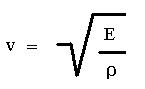
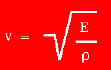
The velocity can also be calculated using   for solids and  for liquids and gases.
   

Loudness Related to the energy in the sound wave.  Measured in decibels and watts/m2.
    
Pitch The higher the frequency of sound, the higher the pitch.
   
Audible Range      Varies with individuals but generally between 20 Hz to 20,000 Hz.  As people age, the upper limit drops to 10,000 Hz or less.
   
Ultrasonic Sound waves with frequencies above the audible range.
   
Infrasonic Sound waves with frequencies below the audible range.


Table of Contents


Problems

1.      How long does it take sound to travel 500. m in Death Valley when the temperature is 40.oC?
    
2. It takes 3.26 seconds for sound to travel 1.00 km at the South Pole.  What is the temperature?
   
3. Tamarie sees a heavy stone hit a concrete sidewalk.  She hears two sounds 1.5 seconds apart.  One sound traveled through air at 25oC and the other traveled through the concrete.  By how far did the heavy stone miss Tamarie?    Modulus Charts     Density Charts
    
4. The sound of a very high burst of fireworks takes 4.5 seconds for you to hear.  The burst occurred 1.50 km above you and traveled vertically through two stratified layers of air.  The top layer of air is at 0.oC and the bottom layer of air is 20.oC.  How thick is each layer of air?

Table of Contents


Answers

1.      How long does it take sound to travel 500. m in Death Valley when the temperature is 40.oC?
    
   
 v = (331 + 0.60T)

 v = (331 + 0.60 x 40.)m/s = 355 m/s

   
                          d          500. m
 d = vt  =>  t = ----  =  ----------------- = 1.41 s
                          v         355 m s -1 


First calculate the speed of sound at 40.oC


Sound does not accelerate.  Solve for time.


2. It takes 3.26 seconds for sound to travel 1.00 km at the South Pole.  What is the temperature?
   
    
                       d           1.00 x 10³ m
 d = vt => v = -----  =  -------------------- = 307 m s -1 
                        t                3.26 s

   
 v = (331 + 0.60T)  

           v  -  331           307  -  331
 T  =  --------------  =  -----------------  =  -40.oC
             0.60                      0.60


Sound does not accelerate.  Solve for the velocity of sound.


Solve the equation for the speed of sound in air for T and substitute.


3. Tamarie sees a heavy stone hit a concrete sidewalk.  She hears two sounds 1.5 seconds apart.  One sound traveled through air at 25oC and the other traveled through the concrete.  By how far did the heavy stone miss Tamarie?    Modulus Charts     Density Charts
    
    
 vair  = (331 + 0.60T) m/s = (331 + 0.60 x 25) = 346 m/s 

 vconcrete  = 

                         20 x 10 9 N/m2  
 vconcrete  =  ( ------------------------- ) 1/2  =  2900 m/s
                        2.3 x 10 3 kg/m3 
   

 d concrete  =  d air  

 v concrete x t concrete  =  v air  x (t concrete + 1.5 s)

  
 v concrete x t concrete  = v air  x t concrete + 1.5 v air 

   
 v concrete x t concrete  - v air  x t concrete  =  1.5 v air 
  

 t concrete (v concrete - v air )  = 1.5 v air 
   

                             1.5 v air 
 t concrete =  -----------------------------
                       (v concrete - v air
   

                          1.5 s x 346 m s -1  
 t concrete  =  -----------------------------  =  0.20 s
                       ( 2900 - 346 ) m s -1  
   

 d concrete  =  2900 m s -1 x 0.20 s  =  580 m


First calculate the velocity of sound in air at 25oC.


Calculate the velocity sound in concrete.


Sound must travel the same medium in both mediums.

Sound takes 1.5 seconds longer to travel through air than concrete.  It takes the longer time through the slower medium.


Solve for t concrete .


Solve for the distance the sound traveled through concrete.


4. The sound of a very high burst of fireworks takes 4.5 seconds for you to hear.  The burst occurred 1.50 km above you and traveled vertically through two stratified layers of air.  The top layer of air is at 0.oC and the bottom layer of air is 20.oC.  How thick is each layer of air?
   
   
 v 0  =  331 m/s

 v 20 = (331 + 0.60T) = (331 + 0.60 x 20) = 343 m/s
   

 4.5 s = t 0  +  t 20   =>  t 0  =  4.5 - t 20  

 1.50 x 10 3 m = v 0 t0  +  v 20 t 20 

   
 1.50 x 10 3  = v 0 (4.5 - t 20)  +  v 20 t 20 

 1.50 x 10 3  = 4.5v 0  - v0 t 20  +  v 20 t 20 

  v 20 t 20   - v0 t 20  = 1.50 x 10 3  - 4.5v 0 

    
             1.50 x 10 3  - 4.5v 0 
 t 20  =  --------------------------
              ( v 20  -  v0 )
   

              1.50 x 10 3 m  - 4.5 s x 331 m s -1 
 t 20  =  --------------------------------------------- = 0.88 s
                ( 343 m s -1  -  331 m s -1)

   
 d 20 = v 20 t 20  =  343 m s -1 x 0.88 s = 3.0 x 10 2
m

 d 0  =  1.50 x 10 3 m  - 3.0 x 10 2 m  =  1.20 x 10 3 m


Find the velocity of sound in air at 0oC and 20oC.


Total time of 4.5 s is the sum of the time to travel through the 0oC air and the 20.oC air.

Total distance traveled is the sum of the distance traveled through 0oC air and 20.oC air.

Simulataneously solve the two equations.


Calculate the distance traveled through 20.oC air after calculating time through air at 20.oC.

Calculate distance through 0.oC air since d 0 + d20 must equal total distance.


Table of Contents