|
Center of Mass
Introduction
| Center of Mass |
The general motion of an extended body (or
system of bodies) can be considered as the sum of translational motion of
the center of mass, plus rotational, vibrational, or other types of motion
about the center of mass. |

As shown in the diagram above, twisting and tumbling does not
change the path taken by the center of mass.
| Center of Mass if all in one line. |
 (mnxn) (mnxn)
xcm = -------------
mn
|
| Center of Mass if all in one plane. |
(mnxn)
xcm = -------------
mn |
(mnyn)
ycm = -------------
mn
|
| Center of Mass for 3 D object. |
(mnxn)
xcm = -------------
mn |
(mnyn)
ycm = -------------
mn |
(mnzn)
zcm = -------------
mn
|
As shown in the equations above, you must do a separate
center of mass calculation for each dimension present for the system. It
is important that none of the points are at the origin of your reference frame.
 As
shown in the diagram to the left, the Center of Mass can be outside the
object. Pole vaulters and high jumpers use this to clear the rod at the
maximum height. As
shown in the diagram to the left, the Center of Mass can be outside the
object. Pole vaulters and high jumpers use this to clear the rod at the
maximum height.
| Center of Gravity |
 The
point in a body at which the force of gravity s considered to act.
Gravity is actually acting on all points in the body, but it can be used
for calculation purposes. The
point in a body at which the force of gravity s considered to act.
Gravity is actually acting on all points in the body, but it can be used
for calculation purposes.
|
The Center of Gravity can be found by suspending the object
from a pivot point and letting it swing. The object will swing until the
Center of Gravity is immediately below the Pivot Point. Draw a line
straight down from the Pivot Point.
Now use a second Pivot Point and repeat the procedure.
The Center of Gravity will be the point where the two lines intersect.

Table of Contents
Problems
| 1. |
The distance between a carbon atom, 12 amu,
and an oxygen atom, 16 amu, in the carbon monoxide molecule is
1.13 x 10 -10 m. How far from the
carbon atom is the center of mass of the molecule?
|
| 2. |
An empty 1050 kg car has its CM 2.50 m
behind the front of the car. How far from the front of the car will
the CM be when two people sit in the front seat 2.80 m from the front
of the car, and three people sit in the back seat 3.90 m from the
front? Assume that each person has a mass of 75.0 kg.
|
| 3. |
Three cubes with sides of l, 2l,
and 3l are placed in contact with their centers along a
straight line starting from the smallest cube to the largest cube.
What is the position, along this line of the CM of the system.
Assume the cubes are made of the same uniform material.
|
| 4. |
A square uniform raft, 28.0 m by 28.0 m, of
mass 7500. kg, is used as a ferryboat carrying cars northward across the
river. If three cars, each of mass 1500. kg occupy the NE, SE, and
SW corners with their centers of mass 1.50 m from the side of the car
and 2.50 m from the front of the car, where is the center of mass of
the loaded ferryboat? |
Table of Contents
Answers
| 1. |
The distance between a carbon atom, 12 amu,
and an oxygen atom, 16 amu, in the carbon monoxide molecule is
1.13 x 10 -10 m. How far from the
carbon atom is the center of mass of the molecule?
|
|
Use the center of the molecule as the
origin. The carbon atom is in the positive direction.
 (mnxn)
12 amu x 5.65 x 10 -11 m - 16 am x 5.65 x 10
-11 m (mnxn)
12 amu x 5.65 x 10 -11 m - 16 am x 5.65 x 10
-11 m
xcm = ------------- =
--------------------------------------------------------------------- = -
8.1 x 10 -12 m
mn
( 12 amu + 16 amu )
The center of mass is closer to the oxygen
atom that the carbon atom.
distance from carbon atom = 5.65 x 10 -11
m + 8.1 x 10 -12 m = 6.46 x 10 -11 m
|
|
|
| 2. |
An empty 1050. kg car has its CM 2.50 m
behind the front of the car. How far from the front of the car will
the CM be when two people sit in the front seat 2.80 m from the front
of the car, and three people sit in the back seat 3.90 m from the
front? Assume that each person has a mass of 75.0 kg.
|
|

The origin of the frame of reference is the
front of the car.
(mnxn)
1050. kg x 2.50 m + 2 x 75.0 kg x 2.80 m + 3 x 75.0 kg x 3.90 m
xcm = ------------- =
---------------------------------------------------------------------------------------
= 2.75 m
mn
( 1050. kg + 5 x 75.0 kg )
|
|
|
| 3. |
Three cubes with sides of l, 2l,
and 3l are placed in contact with their centers along a
straight line starting from the smallest cube to the largest cube.
What is the position, along this line of the CM of the system.
Assume the cubes are made of the same uniform material.
|
|
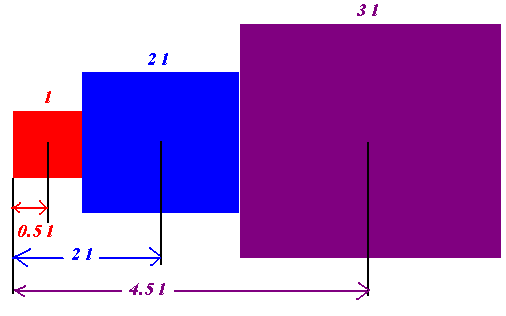
v = l3 and mass = Volume x Density
m1 = l3D
m2 = ( 2l )3D = 8l3D
m3 = ( 3l )3D = 27l3D
The center of mass for each cube is 1/2 the
lenght of a side. The origin of the axis is to the left of the first
cube.
(mnxn)
1/2 l x l3D + 2 l x 8l3D
+ 4.5 l x 27l3D
xcm = ------------- =
----------------------------------------------------- = 3.83 l
( l3 and D cancelled )
mn
l3D + 8l3D + 27l3D
|
|
|
| 4. |
A square uniform raft, 28.0 m by 28.0 m, of
mass 7500. kg, is used as a ferryboat carrying cars northward across the
river. If three cars, each of mass 1500. kg occupy the NE, SE, and
SW corners with their centers of mass 1.50 m from the side of the car
and 2.50 m from the front of the car, where is the center of mass of
the loaded ferryboat?
|
|

Use the North End of the ferryboat as the
origin for the Y axis.
(mnyn)
14.0 m x 7500. kg + 2.50 m x 1500. kg + 2 x 25.5 m x 1500. kg
ycm = ------------- =
---------------------------------------------------------------------------------------
= 15.4 m
mn
( 7500. kg + 3 x 1500. kg )
Use the West End of the ferryboat as the
origin for the X axis.
(mnxn)
14.0 m x 7500. kg + 2 x 1.50 m x 1500. kg +
26.5 m x 1500. kg
xcm = ------------- =
-----------------------------------------------------------------------------------------
= 12.4 m
mn
( 7500. kg + 3 x 1500. kg )
|
Table of Contents
|

