|

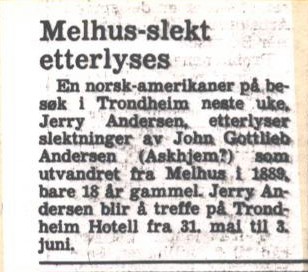
In the late 1980's, I was working as IBM's representative to several committees which worked on standards of interest to the computer industry. Two of those committees were international ones and I eventually became the chairman of one of them. One of my responsibilities was to find venues for the meetings and to arrange for a member who lived in the host country to make the various arrangements. We held meetings in the U.S. as well as Europe, Asia and the Middle East, and I really enjoyed the opportunity to travel to such interesting areas of the world. When our Danish member offered to host a meeting in Copenhagen, my interest really perked up. Copenhagen is not that far from Norway, and a little checking showed that it would be relatively easy to get from Copenhagen to Oslo, and then fly to Trondheim. I had vacation time available, so scheduled a week's vacation following the Copenhagen meeting. Here was my chance to find out more about my Norwegian heritage! My Danish IBM friend recommended I travel by ship to Oslo, as he claimed it was a beautiful and memorable voyage. I agreed, and he made the travel arrangements for me to get to Oslo and then on by air to Trondheim. Our Norwegian member then helped me book a hotel room in Trondheim for four days. I also asked if he would place a small notice for me in the Trondheim newspaper. It was to say that I would be in the Trondheim Hotel from May 31 to June 3 and was looking for information about my grandfather, John Gottlieb Andersen (Askhjem?), who emigrated from Melhus to the United States in 1889 at the age of 18. The afternoon our meeting adjourned, I spent a couple of hours waiting for a cab to take to the part of Copenhagen (a lovely city, by the way) where the ship was waiting. It was to leave at 4:00 pm, so I had time to relax. Or did I? Better check that ticket one more time! There it was, plain as day...1400. Yikes!!! 1400 is 2 pm, not 4 pm and it was then ten minutes to 2!! I dashed to the counter in the lobby and frantically related my problem to the young woman there. She called the steamship company and was told that the ship would be leaving in three minutes but that I could cancel the reservation and get my money refunded since it had not yet set sail! It took until the following morning, but I eventually got my money back, which was enough for me to afford an airline ticket to Oslo, with just enough time to make the connection to my Trondheim flight. A short time later I was in Norway, an even 100 years after my grandfather had left!
Perhaps ten minutes later, the phone rang. The woman on the other end introduced herself as Serianna Blekesaune, and told me she was my second cousin! Could she come meet me? And bring another cousin? You bet! A half hour later Serianna and Per ("Pare") Storhaugen arrived and offered to take me to meet other cousins who lived in Melhus ("Mel-hoos") and nearby.
That day, and the following, I was taken to farmhouse after farmhouse, where I met cousin after cousin, and was offered coffee and refreshments at every home. And every house had been added onto, two, three, four or more times. Soon I was having a difficult time keeping track of the names and relationships of the various husbands, wives, children, grandchildren, cousins, aunts, uncles and grandparents, but the hospitality was always warm and genuine. Over the next few days, I learned that making the connection with my cousins had been something of a lucky break. More than one had seen the notice and they had discussed it with each other by phone, but concluded that we were not related because their ancestors did not live in Melhus in 1889!! Ole Andersen, their grandfather (and John Andersen's brother) had lived with his parents and siblings on a farm across the fjord from Trondheim, and had emigrated to the United States well before 1889. He eventually returned to Norway and bought a farm in Melhus. So while many of Ole's children and grandchildren grew up in Melhus, his brother John had probably never been there and certainly had not emigrated from there in 1899. Also, it turned out that none of the family had any idea about what had happened to their family members in America or even if there were any surviving relatives in in the U.S.! They knew as little of their American cousins as we knew of them, which was precisely nothing. As one generation gave way to the next, letters dried up and family relationships across the ocean dwindled. The last letter from the U.S. to Norway seems to have been sent in 1949, so it had been 50 years since there had been any communication between the two countries. Fortunately, a distant relative had seen the notice as well, however, and had recognized that our John Andersen was indeed Ole's brother. The reference to John emigrating from Melhus was incorrect. He had called one of the Melhus cousins and clarified the situation, resulting in my reception by Serianna and Per. The biggest surprise of my trip was the realization that they were as excited to meet me as I was to meet them!
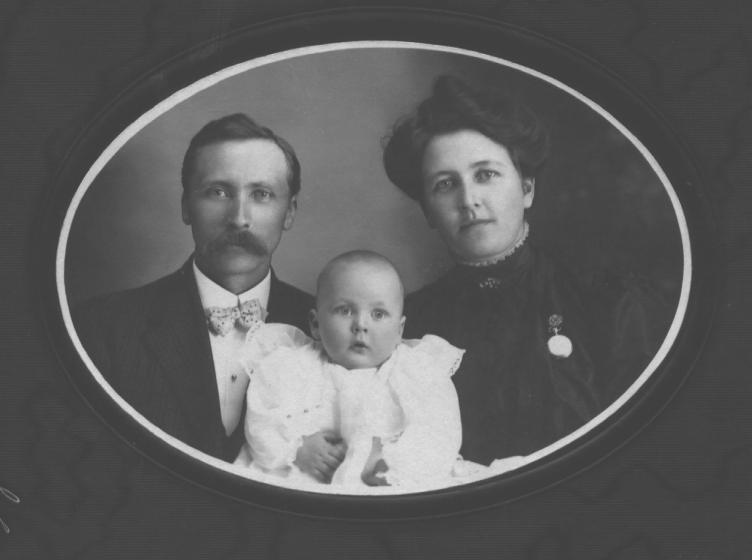
Whisked from one second cousin to another over the course of four days, I could not have been treated better had I been royalty. Everyone spoke English, at least well enough to get by, and I was shown numerous family artifacts, photos and old letters, and learned a tremendous amount about the family. Ola Eggen proudly showed me a worn leather "poke" which his grandfather Ole had carried with him to hold any gold he found when prospecting in the Yukon. On a visit with cousin Per Storhaugen, I actually had a shiver go down my spine when he showed me an old photo of a boy about one year old, in a white christening gown. He had no idea who the child was but I recognized him immediately because I have the same photo at home. The faint pencil writing on the dull black cardboard frame read simply "Alton Andersen". Somehow it seemed surreal to see a picture of my father when I was thousands of miles from home.
So Dad had been mistaken when he said that his father was from Melhus, because it was Dad's Uncle Ole who lived there. But without knowing of Melhus I doubt I would ever have made the connection with the family. He was right about the name, however. Askhjem, of course, was the name of the second farm where my grandfather had lived and from where the family had emigrated. It was the custom in Norway at the time to use the name of the farm in addition to one's surname, so that in Norway my grandfather would first have been known as Johan Gottleib Andersen Tørstad. When the family moved, he became Johan Gottlieb Andersen Askhjem. Johan, Ole, and the other brothers and sisters were Andersens and Andersdatters because they were sons and daughters of Anders Olsen. Anders and his wife Marta (who is buried in Poulsbo, Washington) were the great-grandparents that I shared in common with my Norwegian second cousins. (I also found out, much later, that the family had not come through Ellis Island, which did not open as an immigration center until 1892, but instead had come to the U.S. via Quebec city, having arrived in Canada on a Canadian liner.) On leaving Melhus, I returned to Oslo ("Ooh-shloo") by air and was met there by Berit Welle, another second cousin. Berit is a spry and delightful woman with an unsettling penchant for stopping her little car in the middle of an intersection while she decides whether to turn left, turn right, or continue straight ahead. Be that as it may, she graciously drove me around Oslo, taking me to the Viking Ship Museum, the Norwegian Folk Museum (an open-air museum which features homes and other buildings that are well over a hundred years old), the Kon-Tiki Museum and the Fram Polar Ship Museum. We also wandered around Frogner Park, which contains hundreds of statues by Gustav Vigeland, a well-known Norwegian sculptor. It was a fitting climax to my trip to Norway. Making the Norwegian connection has meant a tremendous amount to me. I choked up (and teared up) at the reunion they hosted for me, as it truly was a defining moment in my life. I not only learned a tremendous amount about Norway and my Norwegian ancestors and relatives during the trip, but about Norwegian hospitality and character. Several of the cousins that I met are avid 'crafters' who love to carve, knit, sew or weave. Two have had books published. They are all warm, intelligent and caring people who would, I am sure, welcome any of our family to their homes and hearts. A sad footnote to the trip came in the mail only a month after I returned home. Per Storhaugen, who had come to meet me at the hotel with his cousin Serianna, and who had shown me the picture of the baby boy that I recognized as my father, had died unexpectedly. Had my trip taken place a month later, I never would have known him. Since then, Ola Eggen has also passed away, as well as Johannes, the husband of Gjertrude Saglie, another second cousin. But as the old guard slowly passes away, the children and grandchildren grow and multiply. In Norway, as in the United States, the Andersen Clan fluorishes.
Aftermath
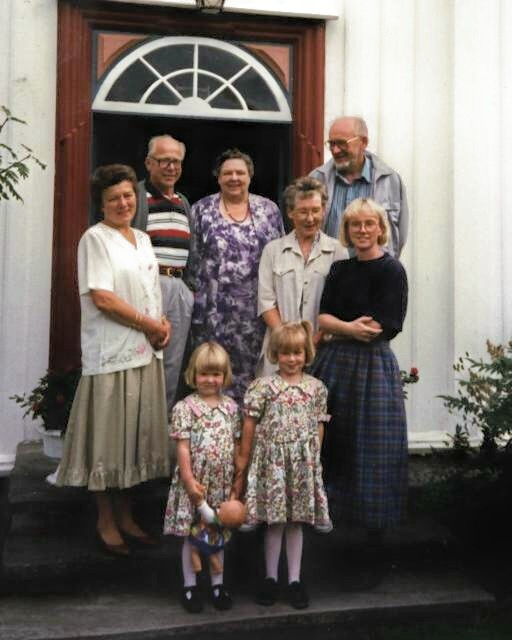
Another reunion gathering had been planned at the Storhaugen farm, so we had ample opportunity to take photos of all the cousins present, along with their families. Several of the pictures shown here, including the one at left, were taken on Anne-Marie's front porch. Anne-Marie is the woman in the flowered dress. Ola Storhaugen, Per's brother, stands in the top row, wearing a suit and tie.
As enjoyable as the visits were, the emotional highlight of the trip was the reunion dinner held at Anne-Marie's house. A connecting door to the home next door was opened, allowing space for everyone to flow from one home to the other. The cousins and their families treated us to a lavish and delicious dinner, followed by an evening of conversation capped by an account of the day the Germans left Melhus near the end of the war. That evening the people of Melhus had gathered outside the Melhus church to celebrate. As snow began to lightly fall, the crowd spontaneously began singing the Norwegian anthem. After years of cruel occupation, the Germans were gone.
As Ole Andersen had three children, there are three branches of the family in Melhus. The family wanted to have their pictures taken in family groups and those are the three family photos shown here. Shirley and I (far left in the first and second rows) joined the Andersen branch in the photo at left. Berit Welle, who lives in Oslo and had to leave before the pictures were taken, is at the right in the photo below, along with Shirley and me. The picture was taken on the ferry ride to Stadsbygd and the two Andersen farms.
From Oslo we flew to London where I made a careless mistake and failed to confirm the portion of our travel going back to the U.S. As a result, there were no seats left in coach for our return! Fortunately, the airline had two empty seats in first-class, however, and that is where we sat for the flight back home. (No, I did not do it on purpose.) All in all, a wonderful trip, to a beautiful country, and hosted by warm-hearted folks who have become wonderful friends as well as second cousins. Highly recommended!
A great number of Internet searches were performed over the next several years in an attempt to find out as much as possible about the Andersen emigration from Norway. The results of one of the earliest and most interesting is shown above. The family is listed here in the Digital database maintained by the Norwegian National Archives. (The Andersen name has been abreviated to 'Anders.') Note that the family is heading to Jamestown, Kansas, and traveling (from Trondheim to Hull, England) on the S/S Domino (Wilson Line) and then (by train to Liverpool and then on to Quebec) on the Allan Line. This section of the Archive lists all Norwegians who emigrated from Trondheim between 1867 and 1930. One mystery has yet to be solved, however. Who was Ingeborg Anna, who is listed following my grandfather John? What happened to her? She is not mentioned in the area Bygdebok (local farm history book) as having been a member of the family, and is unknown to our cousins in Norway. We will probably never know. - Jerry Andersen  |