Mackintosh
|
|
Clan Mackintosh Septs |
|

There are various ancestral surnames, better known as Septs, that have connections by heritage to the Clan Mackintosh. The Mackintoshes themselves are a sept of the Clan Chattan, which includes the Farquharsons, Shaws, MacPhersons, MacBeans, and eleven others.
The Clan is basically a family and the name is derived from a gaelic word meaning children. The Clan system emerged from the old tribal ways of the people living in what is now called Scotland. From around the 10th to 13th centuries more and more names became recognised as Clan names with their own varied histories and genealogies. Clan names are now representative of blood lines and all members of a clan share one bloodline.
Here is a list of the many Septs that have a family association with the Clan Mackintosh.
|
ADAMSON |
|
HARDY |
|
MACFALL |
|
MACTAUSE |
History of Clan Mackintosh
Probably the earliest authentic history of Mackintosh is traceable to Shaw or Seach MacDuff, a Cadet son of the third Earl of Fife. The son of MacDuff, for his support of Malcom IV, was awarded the lands of Petty and Breachley in Invernesshire and was appointed Constable of the Castle thereto. Assuming the name "Mac-an-toisch", which means "Son of the Thane or Chief", he began his own Clan. The Clan support of James I in 1429 resulted in large tracts of land being settled on the Mackintoshes. Clan Mackintosh was involved in the "Battle of the Thirty", a mass trial by combat, which was held under the judicial control of the King in 1396 on the North Inch of Perth, in which Clan Macintosh regained all lands taken from the Shaws.
Clan Mackintosh supported the King in the revolt of 1688, but in 1715, Mackintosh gave his support to the Jacobite Rebellion. At the "45 Rising", Angus, who held a commission in the Black Watch, could not in honor raise the Clan for Prince Charles Edward. His wife, Lady Ann (Colonel Anne), raised the Mackintosh Battalions for Clan Chattan in support of "Bonnie Prince Charlie". The Chattan Regiment distinguished itself at the Battle of Culloden under the leadership of the Chief of the MacGillivray's and was one of only two Scottish Regiments which did not lose their colors. Earlier, following "Colonel Anne's" tactics, five Mackintoshes, under the leadership of Frasier, the Blacksmith, had routed 1500 of Lord Louden's Troops who were approaching Moy Hall in an attempt to capture Bonnie Prince Charlie.
Clan Mackintosh is second to none. It's members have demonstrated that they are stalwart, fearless, and adventuresome people. In the United States, Mackintoshes have played an important part in it's history, especially in the Southeast. A group under John Mor Mackintosh helped guard General Oglethorpe's new colony in Savannah, Georgia and aided in extending settlements west to the Tombigbee River between Georgia and Arkansas. The Clan Mackintosh spirit is as strong as ever and binds our clansmen together in all parts of the world.
Probably the earliest authentic history of MacKintosh is traceable to Shaw or Seach MACDUFF, a Cadet son of the third Earl of Fife. The son of MACDUFF, for his support of Malcolm IV, was awarded the lands of Petty and Breachley in Invernesshire and was appointed Constable of the Castle thereto. Assuming the name "Mac-an-Toisch", which means "Son of the Thane or Chief", he began his own Clan. The Clan support of James I in 1429 resulted in large tracts of land being settled on the MacKintoshes. Clan MacKintosh was involved in the "Battle of the Thirty", a mass trial by combat, which was held under the judicial control of the King in 1396 on the North Inch of Perth, in which Clan MacKintosh regained all lands taken from the Shaws.
Clan MacKintosh supported the King in the revolt of 1688, but in 1715, The MacKintosh gave its support to the Jacobite Rebellion. At the "45 Rising", Angus, who held a commission in the Black Watch, could not, in honor, raise the Clan for Prince Charles Edward. His wife, Lady Ann (Colonel Anne), raised the MacKintosh Battalions for Clan Chattan in support of "Bonnie Prince Charlie." The Chattan Regiment distinguised itself at the Battle of Culloden under the leadership of the Chief of the MacGillivray's and was one of only two Scottish Regiments which did not lose their colors. Earlier, following "Colonel Anne's" tactics, five MacKintoshes, under the leadership of Fraser, the Blacksmith, had routed 1500 of Lord Louden's Troops who were approaching Moy Hall in attempt to capture Bonnie Prince Charlie.
The arms consist,Quarterly, 1st, a lion rampant Gules, armed and langued Azure; 2nd, Argent, a dexter hand couped fessways grasping a man's heart paleways Gules; 3rd, Azure, a boar's head couped Or, armed Proper and langued Gules; 4th, Or, a lymphad sails furled Azure, flagged and surmounted of her oars in saltire Gules.
|
|
|
|
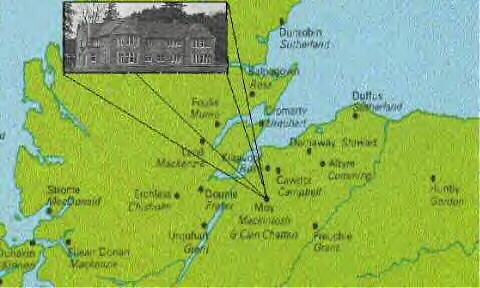
Map of where the MacKintosh are seated
|
|
|
|
War Cry: "Loch Moigh" (Lake of Plain)
Motto: "Touch not the cat bot a glove"
Plant Badge: "Red Whortleberry"
|
|
|
|
|
|
MacKintosh Lament :MacKintosh Tartans: |
|