|
AGE OF FOSSIL
|
NAME
|
DISCOVERED
BY
|
LOCATION
|
FACTS
|
|
5.8 million years
|
Ardipithecus Ramidus
(Fossil: Ardi)
|
Tim White, UC Berkeley Team
|
Africa: Ethiopia
|
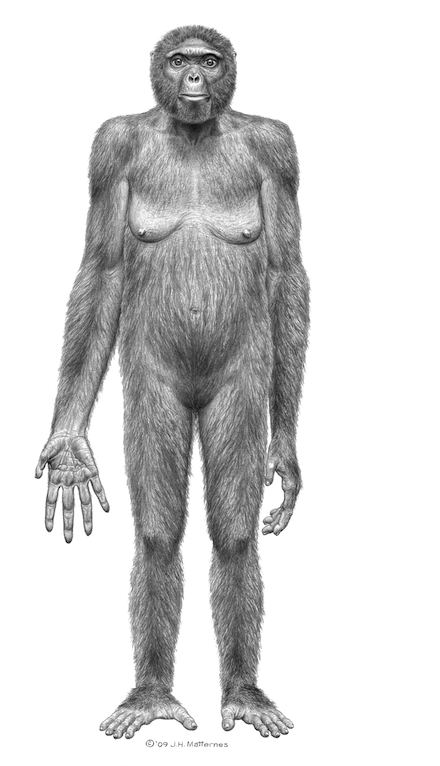
The structures of the upper pelvis as well as the leg and feet bones indicate that this species walked upright, yet it retained the ability to climb trees if he chose to do so.
This was a surprising discovery because previously
archaeologists had believed that our ancestors during that time period would have more chimpanzee or gorilla-like characteristics and would likely spend most of their time in tree branches.
The hand was more maneuverable than a chimpanzee's which made the species more apt at holding and catching things as well as carrying objects while walking on two legs. The hands had a large and well-muscled opposable thumb.
The wrists were flexible like ours, not stiff like those of chimpanzees or apes.
Because of its age, the discovery of Ardipithecus Ramidus brought researchers closer to the last common ancestor that ape and prehistoric-man shared.
|
|
5.2 to 5.8 million years
|
Ardipithecus Kadabba

|
Tim White, UC Berkeley Team
|
Africa: Ethiopia
|
Probable ancestor of A. ramidus. This species is believed to be first species on human branch of evolution tree just after the split between lines leading to modern-day chimpanzees and humans. This creature was placed on the human evolution chart because of his small canine teeth which were more human-like that an ape or chimp which posses large, prominent, tusk-like canines. These were used as weapons, the main use being males fighting with other males for access to females. This species, along with other hominids, did not have that characteristic.
|
|
3.9 and 4.2 million years
|
Australopithecus Anamensis
|
Meave Leakey
|
Africa, Kenya
|
The Australopithecus
(pronunciation)Anamensis
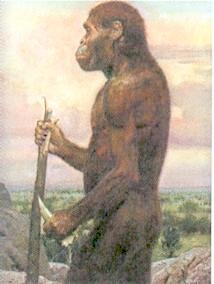
species has somewhat of a mixture of primitive features in the skull, yet advanced features in his body. Teeth and jaws appear quite similar to older ape fossils. The tibia presents strong evidence of bipedality, and the
the upper arm bone is quite humanlike.
|
|
3.2 - 4 million years
|
Australopithecus Afarensis
(Fossils: Lucy)

|
Dr. Donald Johanson
|
Africa: Hadar, Ethiopia
|
Australopithecus
(pronunciation) Afarensis appeared more human-like as far as the cranial characteristics are concerned than previous species. An upright stance was confirmed by the large opening in the occipital bone of the cranium, also a prominent mastoid-process which is necessary for a better balance in walking upright. But the biggest difference between Lucy and today's chimpanzees was shown in the hips and not the craniums. A skeleton of today's chimpanzee shows a femur that comes straight out of the hip socket, however, Lucy and human beings exhibit a bipedal carrying angle. Lucy's pelvic and femur structure, along with her knee joint, are those of a species which walked up-right. An in-depth study of Lucy's bones showed that she was between 25 and 30 years old and showed signs of arthritis.
|
|
2.5 - 3 million years
|
Paranthropus Aethiopicus
Fossil: “Omo"
"Black Skull"
|
Richard Leakey
|
Africa: Ethiopia
Lake Turkana
|
According to tools which have been found and dated,
Paranthropus
(pronunciation) Aethiopicus is believed to be the first hominid species to use stone tools. The species shares many traits with Australopithecus afarensis (above), and studies of the structural designs suggest that A. Afarensis was ancestral to P. Australopithecus.
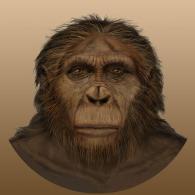
The size of the roots and the palate indicated that the teeth were rather large. The bone that runs lengthwise along the mid-line on top of the skull indicated that the species had exceptionally strong jaw muscles.
This ridge in P. Aethiopicus is pronounced in the back of the skull like A. Afarensis which suggests that both of these species emphasized the back part of the jaw muscle.
Other similarities between P. Aethiopicus and A. Afarensis include a forward jutting face and a rather small cranial capacity, the shape and size of the joint between the cranium and the lower jaw are also quite similar.
The importance of noting the like-features in these two species lies in the fact that these identical features are not found in other species of the Paranthropus group (A. Afarensis, A. Africanus, A. Anamnesis, and P. Aethiopicus, among others).
|
|
2 -3.3 million years
|
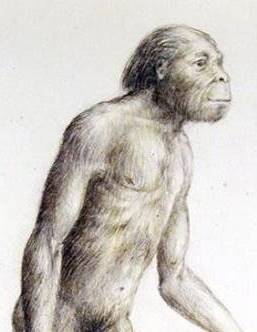
Australopithecus Africanus
Fossil: "Taung Child"
|
Dr. Raymond Dart
|
South Africa: Taung
|
The fossils of the A. africanus species show that it had six lumbar vertebrae. Humans have five, and chimps normally have three. The shape of the jaw was much more like that of humans than the A. Afarensis (Lucy), and the size of the canine teeth were smaller than Lucy's.
The anatomy of the Australopithecus species, especially the pelvis
is much more like a human's than either a chimpanzee or an ape. The blades appear short and wide rather than
elongated like that of a chimpanzee. Also the posterior is positioned directly behind the hip joint. While the pelvis is not completely that of a human,
the features above definitely point to a structure that can be considered remodeled to accommodate bipedalism.
|
|
2.3 - 2.6 million years
|
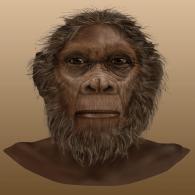
Homo Rudolfensis
Fossil: ER-1470
|
Bernard Ngeneo
(R. Leakey Team)
|
Africa: Lake Turkana
|
Less robust, smaller jaw teeth than earlier species. Larger brain size and intelligence capable of fashioning and employing stone tools. Estimated height of 6’. Teeth slightly smaller than those in the robust australopithecines, this species did not have a heavy jaw or strong jaw muscle attachments as earlier species.
|
1.4 - 2.3 million years
|
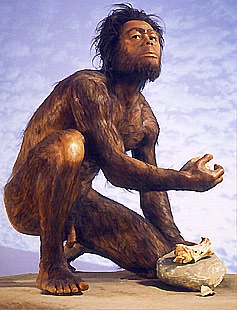
Homo Habilis
Fossil: OH-7
|
Louis Leakey, Phillip Tobias, and John Napier
|
Olduvai Gorge, Tanzania
|
The tools found around the same sites as the Habilis fossils were called Oldowan tools. They were very simple pebble tools made from water worn stone 3" to 4" in diameter. The tools were constructed by chipping off flakes from different sides of the stone, creating a sharper edge. The tools were initially found at the same level as P. boisei and H. habilis, but "zinj" (P. bosiei) was probably too primitive to use this type of tool. H. habilis has a larger brain size therefore, seems to be a much more likely candidate to use this type of tool. The tools were most likely used to make their lifestyle easier by allowing the hominids to remove meat and bones from a carcass in a more efficient manner. Habilis is considered to be the very first member of the genus homo for two reasons. (1) The larger brain size, and (2) the presence of the stone tools definitely indicates that their large brain was more than capable of a complex thought process which had not been seen in previous species. The Habilis started a trend in evolution which pointed toward larger brains and a higher degree of intelligence. In addition, Habilis fossils show that this species also had smaller sized molars and premolars and a clearly bi-pedal foot structure.
NOTE: At this point no fossil has been discovered which would indicate that another species directly branched from H. habilis during its existence. (see chart 1 and chart 2),
|
1.8 to 0.3 million years ago
|
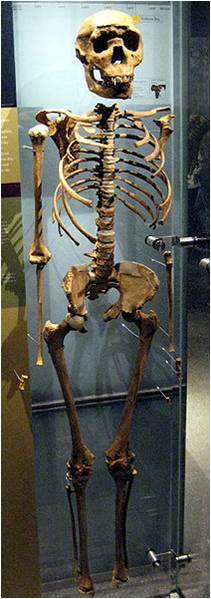
Homo Ergaster/Homo Erectus
Fossil: Turkana Boy
(Classified as either Homo erectus or Homo ergaster)

|
Kamoya Kimeu, Leakey Team
|
Lake Turkana, Kenya, E. Africa
|
The most important differences in features between Homo habilis (preceding speicies) and the species H. Erectus (pronunciation)
and H. Ergaster (pronunciation)
include an increase in brain size, the appearance of brow ridges, a shorter face, and more projecting nasal aperture.
Many archaeologists see Homo erectus as actually being split into three different species depending on the region in which the specimens were discovered, they are: H. Ergaster (Africa), H. Erectus (Asia), and H. Heidelbergensis (Europe). The reason for this split is because of the overlapping in the timeline of the existence of each species.
Homo erectus represents the first hominid's appearance outside of Africa.
Researchers have attempted to discover differences between Homo Ergaster and the species Homo erectus which branched from H. Ergaster. What they found were seven differences of characteristics between erectus and Ergaster.
A few of the differences were the details of the skull, the brow ridges are shaped differently, and Homo erectus had a larger brain size. Some later samples of Homo erectus proved to have a larger brain than many modern humans. As far as height goes, Homo erectus reached an average height of five-feet-ten-inches. Physically, these species were more similar to modern man than earlier hominids, including Homo habilis which immediately preceded Homo erectus.
The pelvic structure of both species is narrower than Homo sapiens, which means that Homo Ergaster as well as Homo erectus in both Africa and Asia had a more advanced ability to run than the modern human. The average abilities in this area for both species could be equivalent to a professional athletic track runner today.
Although H. Erectus, which spawned from Homo Ergaster, was found to have used fire, there's no solid proof that H. Ergaster did. Features of this species support a meat-eating or scavenging diet as opposed to a largely vegetarian diet. Findings in the areas show that stone and wooden tools were used to process their food. The first few centuries of Ergaster populations made and used Oldowan or simple flaked tools, but from about 1.6 to 1.7 million years ago, two-sided hand axes as well as meat cleavers were being made and used.
At an
excavation site in the northern part of Israel, searchers discovered the earliest evidence of a social organization, of genuine communication, and separate working and living quarters all belonging to the Home Erectus. This findings are considered to be milestones in modern human behavior.
|
|
1.2 to 780,000 years
|
Homo Antecessor

|
Eudald Carbonell, J. L. Arsuaga and J. M. Bermúdez de Castro
|
Spain
|
The middle-facial area of H. Antecessor appears quite modern, but the teeth, forehead and brow ridges have a more primitive look. Some researchers have doubt concerning the validity of Antecessor since the fossils were those of a juvenile specimen, and feel there is a possibility that the fossil belongs to a different species, perhaps Homo Heidelbergensis in the early stages of his evolving.
|
800,000 to 100,000 years
|
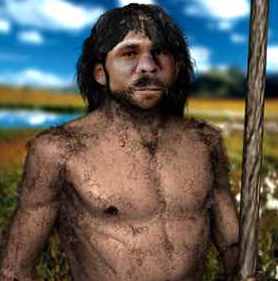
Homo Heidelbergensis
Fossil: Heidelberg Man
|
Workers in Germany discovered the first fossils while digging in a gravel pit.
|
Heidelberg, Germany
Northern Spain
|
The major differences that were found between Homo heidelbergensis (pronunciation) and Homo erectus are:
An increase in brain size
A shift from the widest part of the brain case being the cranial base to the side and top of the skull region.
A reduction in cranial bulkiness.
A change from a shorter, robust stature to a taller leaner body
Evidence was found which showed a more controlled use of fire and in hunting animals for food. The Homo heidelbergensis period is important for several reasons and is considered to be a period when a more modern, human behavior was developing.
In a chamber located inside a cave at an excavation site in Spain, archaeologists have discovered a storage area containing the bones of 30-40 human beings. The site is dated as being approximately 300,000 years old. This behavior would naturally suggest that the people at that time, namely Homo Heidelbergensis or Neanderthals according to the time period, believed that dead humans were not exactly the same as other animals and deserved a certain amount of respect after death. Sites dating to 90,000 years ago have provided reasonable evidence of actual burial of the dead. The skeletons found buried had been placed in a fetal position. In most cases, stone tools and a few other times were found in the graves along with the remains. This might suggest that human beings some 90,000 years ago believed or at least considered the possibility of a person's existence continuing after physical death.
|
|
AGE OF FOSSIL
|
NAME
|
DISCOVERED BY
|
LOCATION OF FIND
|
FACTS
|