
Technical Overview
Daystrom Computing Systems Model Q-79H Starship Mainframe
Central Processing:
|
|
10M node symmetric nanoprocessing system |
|
|
10 integrated holographic processing units (dim. 10 cm^3) |
Central Storage:
|
|
1GQ conventional isolinear |
|
|
200MQ integrated holographic |
Software:
|
|
Microsoft LCARS 2374 OEM |
The central processing facility on Akira class ships consists of three redundant cores (Model Q-79H). The cores are shown in
yellow in the diagram below.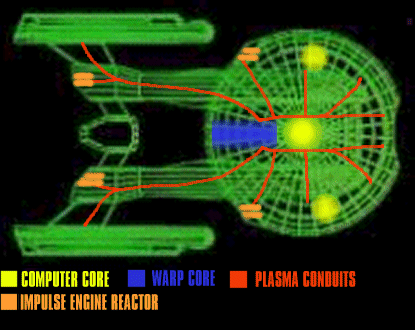
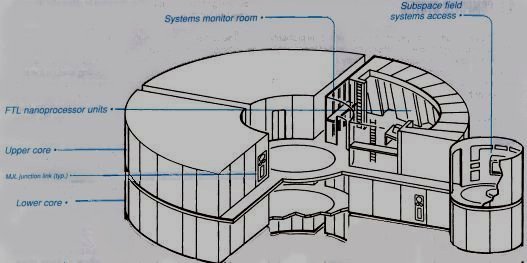
Each core utilizes a hybrid of technologies to provide the highest performance possible. The majority of the 3-level core consists of 10 million interlinked advanced nanoprocessor units. Each core also contains a series of holographic processors. These experimental units occupy only about 8% of core volume, but carry 47% of processing load and23% of memory capacity. Holographic computing, a breakthrough made by researchers while developing bioneural circutry, will eventually replace conventional nanoprocessor units and isolinear storage modules with several small, integrated units.
Diagnostic Level Definitions
Level 1
Most comprehensive test of systems aboard a starship. Extensive automated diagnostics are preformed, however, all results are physically verified by ship's crew. Level 1 diagnostics on major systems can takes several hours and usually require the systems being diagnosed to be offline.
Level 2
This level of diagnostics requires that a battery of automated tests, similar to those performed at level 1, be performed on the systems being tested, however fewer system components are physically examined by the crew. This results in the ability to conduct a level 2 diagnostic in half the time it takes a level 1 diagnostic to be performed and does not require taking the systems off-line.
Level 3
This level of diagnostics requires that a battery of automated tests, similar to those performed at level 1, be performed on the systems being tested, however, in a level 3 diagnostic, only the key mechanisms and readings need be physically verified by the crew. Level 3 diagnostics are designed to be performed in under 10 minutes.
Level 4
This level of diagnostics requires that a battery of automated tests be performed on the systems being tested. This battery of tests is slightly less intensive than the one used in level 3 diagnostics, and can usually be performed in under 30 seconds. No physical verification of test results is required.
Level 5
This level of diagnostics requires that a battery of automated tests of a very low level be used for basic maintenance and verification of system performance. Level 5 diagnostics are performed on all systems a minimum of once daily, and are performed regularly during crisis and alert situations. Level 5 diagnostics take 2.5 seconds on average to execute.
Turbo Lift
Main Page
Back to Ship Specs
Crew Manifest

