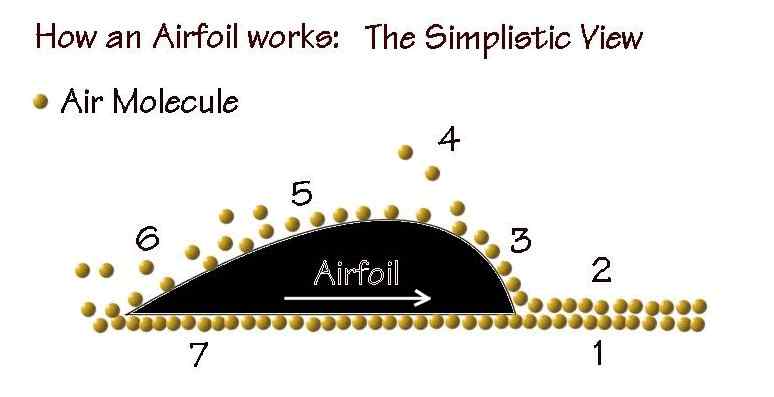
(1.)Air molecules acting as a support for the airfoil traveling over them
(2.) The air molecules in the upper layer move up and over the airfoil when disturbed by the airfoil.
(3.) When the top layer of air molecules are redirected by the air foil, they flow up and along the surface of the air foil with the exception of a few molecules which travel up and away as in (4.), their momentum being too great to be influenced by the laminar forces, those forces which tend to keep the air molecules close to the airfoil surface. This leaves fewer molecules to flow along the airfoil lessening the number of molecules on the top surface.
(5.)As the airfoil begins to slope away, two things are happening. Some molecules tend to travel in a straight line and some tend to follow laminar flow leaving an area with less molecules per square unit as in (6.) than underneath the airfoil as in (7.) the straight line laminar flow beneath the airfoil. More molecules under the airfoil support the structure with more pressure Where the smaller number of molecules on the top surface push down with less pressure therefore the net pressure is pushing the airfoil upwards.
The curved area of an airfoil serves to increase the distance molecules travel, disperse some of those molecules, and to lessen the number of molecules of air per square unit relative to the straight area of the airfoil. This ratio of air molecules on each side of the airfoil is what causes the airfoil to move in the direction of fewer molecules. This is the classic Bernoulli Principle.
If you wish to see an exhaustive study of airfoil go to this reference!
http://www.monmouth.com/~jsd/how/htm/airfoils.html
Back to the Index
Tom Conally, 2001


