 This article was compiled from the
following webpages:
This article was compiled from the
following webpages:
Madison's Introduction Of The
Bill Of Rights
The Bill Of Rights
The First Twelve Amendments
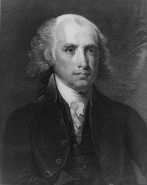
James Madison
(1751 - 1836)
James Madison, is considered by many to be the father of the Constitution, and not without good reason. What is perhaps less well known is his role in the Bill of Rights, too.
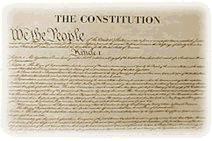
What is interesting to note is that when the Constitutional Convention finished its work, it did not find it necessary to include a bill of rights in the final version. Several members, notably George Mason, were very disappointed by this decision and refused to sign the document over the issue. The argument was that the Constitution did not give the new federal government the ability to restrict inherent rights, so no list of those rights was necessary. Others worried that if the rights were listed, they would invariably forget some and the list would ever be incomplete. Finally, the argument was that the states each had their own constitutions, too, and that rights were best protected at a state level.
Of all the issues that the Anti-Federalists gave for rejecting the new constitution, the lack of a bill of rights was the most compelling for many people. In the ratifying documents of five states, requests or demands for a bill of rights were included in the text, along with suggested lists (see the ratifying documents of Massachusetts, South Carolina, New Hampshire, Virginia, and New York). Rhode Island also included a list, but they ratified the Constitution after the first Congress approved the Bill of Rights.
The Federalists were opposed to adding a bill of rights, expounding on the reasons why in Alexander Hamilton's Federalist 84. Among the reasons listed was a list of the personal protections the new constitution did contain, such as the prohibition of ex post facto laws, the inviolate habeas corpus, and the restrictions on a conviction of treason. Federalist 85 addressed the subject, too, noting that amendment is always a possibility after ratification. It turns out, once the process of ratification was complete, that this was exactly the route taken.
The drive for a bill of rights in the federal Constitution was strong, however.
Madison, himself, in his election campaign against James Monroe for the new U.S. House, vowed to fight for a bill of rights. This may (haved seemed) odd since Madison was one of those who advocated the omission of such a list of rights, but he eventually became convinced of the necessity. Madison in a letter to Thomas Jefferson, wrote "[I have] always been in favor of a bill of rights... At the same time I have never thought the omission a material defect, nor been anxious to supply it even by subsequent amendment."
On June 8, 1789, James Madison rose in the House of Representatives and read his thoughts about amendments to the Constitution. The text can be found in The Annals of Congress, House of Representatives, First Congress, 1st Session, pp 448-460. (To Read This click here )
Not everyone was in support of a Bill of Rights, and much debate ensued. Many of Madison's proposals were accepted, and some were rejected. The legislative process had to take place, with formal bills being introduced in the House, being voted on and approved, then sent to the Senate where they were debated and modified, and with both Houses eventually coming to agreement on twelve articles of amendment.
On September 21, 1789, a House/Senate conference was called, and the differences between the versions of the two houses were worked out. Madison was one of the House managers in the committee. Several points were agreed upon, and the House was informed of the Senate's acceptance of the compromise bill on September 25, 1789, the official date of submission of the Bill of Rights to the states. The Bill included the twelve articles as well as a preamble which, while not a part of the Constitution, is important as a way to place the Bill in historical context. (See Image: Page1, Page 2; See Text.)
Two years later, in 1791, the last ten of these original twelve were ratified by the states and they became a part of the Constitution. By custom, the amendments were added to the end of the original document, rather than inserted in the text, as Madison had envisioned. All ten of the original amendments are referred to as The Bill of Rights, though only the first nine pertain to the people (Amendment 10 pertains to the states, though it mentions the people in parallel).
The Bill of Rights would answer Mason's greatest concern and the concerns of many ratifying states.
Note: The second of these original twelve articles (concerning the compensation of Congressman) was ratified on May 7, 1992.
From The Department of Justice
Federal Bureau of Investigation
Philadelphia, Pennsylvania
(215)- 418 - 4000
For immediate release: March 19, 2003
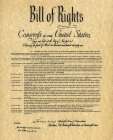 FBI RECOVERS ONE OF THE ORIGINAL COPIES
OF THE BILL OF RIGHTS
Jeffery A. Lampinski, Special Agent in Charge of the Philadelphia Division of the FBI announced the recovery of one of 14 original copies of the Bill of Rights. This document was seized on Tuesday, March 18, 2003 as the result of an undercover operation conducted by the FBI in Philadelphia.
The FBI learned that the National Constitution Center (NCC) reported the document was being offered for sale. During the authentication process, the NCC determined that this copy had been made for the State of North Carolina in 1789 and notified the Honorable Michael F. Easley, Governor of North Carolina.
In 1789, the Continental Congress wrote the Bill of Rights in New York and George Washington, President of the United States, ordered that 14 copies be hand written and sent to each of the 13 original states and one for the federal government. These copies were to be ratified by each state.
Historical records indicate that on April 14, 1865, Union Troops under the command of General William Tecumseh Sherman, entered the State Capitol in Raleigh, North Carolina and took the Bill of Rights. It is believed that a Union soldier took this copy of the Bill of Rights home with him to Tippecanoe, Ohio.
The document has surfaced for sale back to North Carolina a number of times since the Civil War, but the state official said they would not buy back its own property.
When the NCC determined that this was the missing North Carolina copy of the Bill of Rights, the state of North Carolina was notified and the FBI began an investigation into the proposed sale of the document.
This investigation is a result of cooperation on many levels. SAC Lampinski would like to thank The Honorable Edward G. Rendell, Governor of Pennsylvania, The Honorable Michael F. Easley, Governor of North Carolina, and Roy Cooper, Attorney General of North Carolina for their commitment to the return of this historic document. Outstanding assistance from the NCC, the United States Attorney’s Office in the Eastern District of North Carolina, the United States Attorney’s Office in the Eastern District of Pennsylvania, the Charlotte Division of the FBI and Stephen J. Harmelin of the Dillworth and Paxton law firm enabled the FBI to recover the Bill of Rights.
This North Carolina Bill of Rights, although priceless to the heritage of the United States of America, is believed to be worth between 20 to 30 million dollars.
North Carolina Attorney General Roy Cooper stated, “ Our goal was to reclaim a piece of North Carolina history. We now look forward to seeing our copy of the Bill of Rights returned to its rightful owners, the people of North Carolina.”
Joseph Torsella, CEO and President of the NCC stated, "Throughout this process, the NCC's main concern has been always to do the right thing by this document and we're happy, above all, that it is protected and safe. We are proud to have played a role in safeguarding this American treasure and our greatest hope is that all the attention which is being paid to this remarkable document prompts people across the country to reacquaint themselves with the remarkable ideas it embodies. It's those ideas that make us uniquely American."
This press release was located at Bill Of Rights.com