Menes, or Narmer was the
first Egyptian Pharao in conquer upper an d lower Egypt, he unified them in
3100 B.C.
The Step pyramid was the first stone pyramid (Saggara/Djoser) and is different
from the others Egyptian pyramids because isn't flat and had steps
The fisrt Stone Pyramid was the Step Pyramid (Saqqara/Djoser), it was built
at Saggara and was specially built for Pharaoh Djoser. This pyramid is different
from the others later Egyptian pyramids because it had steps and the other
ones were flat (had no steps).
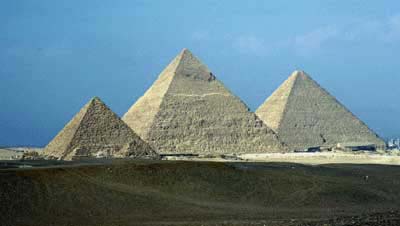
The Pyramids of Giza were built at the 4th dynasty. Tutankhamun was pharaoh near the end of the 18th dynasty. His tomb was discovered in 1922 and the most amazing thing about this discovering was that it was the first tomb found that had not been emptied bye tomb robbers.
The Rosseta Stone was made in 196 B.C. and it was used to record and agreement between a group of Priest and Egyptian Government. That agreement was written in three languages: Hieroglyphic, Demotic and Ancient Greek.
In 1822 Jean Francois Champollion discovered how to read Egyptian Hieroglyphs.
The three pyramids of Giza
are Menkaure, Khafre, and Khufu
The largest of the Giza Pyramids is Khufu. The Sphinx is found in front of
the pyramid Khafre. The Sphinx has the body of a lion and the face of Pharaoh
Khafra. The Sphinx is 57 m long and 20 m high.
Egyptians first cut the body on the left side to remove internal organs. It
was important because they are the first part of the body to descompose.
Then they put natron inside the body. Natron is a salt and it helped to dry the dead bodies.
They didn't take out the heart of the body because they believed that the heart was the center of feelings and intelligence and that man will need it in afterlife.


They take the brain out of the body using a hook through the nose.
After all this, they stuffed the body with natron so that the body will become
dry.
After 40 days they washed the body with water of the Nile and after this they
covered it with oils to keep skin stay elastic.
They used Caponic Jars to hold internal organs. This Caponic Jars were also named the "Four Sons of Horus" and each have a different headed-form.
|
Name
of the god
|
internal
organ
|
type
of head
|
|
imsety
|
liver
|
human
|
|
hapy
|
lungs
|
baboon
|
|
duamutef
|
stomach
|
jackal
|
|
Qebehsenuef
|
Instestines
|
falcos
|