«
Alice Pleasance Liddell
»
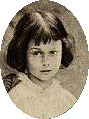
The real-life "Alice"
In 1846, Carroll met Alice Liddell, the 4year old daughter of Dean Henry George Liddell of Christ Church. Carroll had already established himself as a close friend of Alice's elder sister and cousin. But it is Alice who figures most prominently in Carroll's most famous creation, Alice In Wonderland.
On July 4, 1852, Carroll and a friend, Rev. Robinson Duckworth, took the Liddell children, Lorina [13], Alice [10], and Edith [8] on a boat ride [a row boat] up the Isis River [the local name for the Thames River]. As they made their way upstream, Carroll began telling a story about the underground adventures of a little girl named Alice. According to Duckworth, the story "was actually composed and spoken over my shoulder for the benefit of Alice Liddell, who was acting as 'cox' of our gig. I remember turning around and saying, 'Dodgson, is this an extempore romance of yours? And he replied, 'Yes, I'm inventing as we go along.'"
Upon disembarking, Alice asked Carroll to write out Alice's adventures for her, and Carroll promised to do so by the following Christmas, but the work was not completed until February 10, 1863 by which time Alice Liddell was about 11.
From an initial length of 18,000 words, Carroll's manuscript expanded to 35, 000 words, and the famous English illustrator John Tenniel read it and consented to draw illustrations for it. As Carroll searched for a publisher, he gave anxious thoughts to a perfect title. Various ones came to him: Alice's Golden Hour, Alice's Hour in Elf-land, Alice Amoung the Elves, Alice's Doings in Elf-land,and Alice's Adventures Under Ground. Finally, Alice In Wonderland was chosen, and Macmillan, the publishers of Oxford University, agreed to publish the book on a commission basis.
Alice was an immediate critical success when it appeared in 1865. "The Reader" magazine called it "a glorious artistic treasure...a book to put on one's shelf as an antidote to fit on the blues." "The Pall Mall Gazette" wrote that "this delightful little book is a children's feast and atriumph of nonsense." About 180,000 copies of Alice in various editions were sold in England during Carroll's lifetime; by 1911, there were almost 7000,000 copies in print. Since then, with the expiration of the copyright in 1907, the book has been translated into every major language, and now it has become a perennial best-seller, ranking with the works of Shakespeare and the Bible in popular demand. In the words of the critic Derek Hudson; "The most remarkable thing about Alice is that, though it springs from the very heart of the Victorian period, it is timeless in its appeal. This is a characteristic that it shares with other classics - a small band - that have similarly conquered the world."
|
|
|

