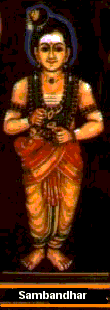
Thirugnana Sambandhar
At
around 700 AD, in the ancient town Chirkazi of the choza kingdom, a boy was
born to
a Shivaite Brahmin couple, Shivapada Hridayar and his wife
Bhagavathiyar. The happy parents brought up the child in the Shivaite
tradition and the child grew up happily in the company of the happiness of the kith and kin.
A glimpse into the society of that time
It was the time when Buddhism propounded by Sri Buddha at around 500 B.C.E., a religion simple enough for the masses to follow, with a view to remove the maladies of the ritualistic Hinduism of that time has taken strong roots and has almost wiped out Hinduism. The kings and over 80 % of the populace has adopted it. Fire worship replaced idol worship, temple building activities began, varna system has collapsed - intermarriage between varnas was the order of the day. Buddhist monks became businessmen and warriors as well. Vaishyas became kings. Kshatriyas became religious leaders and as a result theocratic kingdoms came to being for the first time in India. Hinduism survived only in small pockets in the deep south, and in the holy cities like Kashi.
However, Buddhism started its decline around 400 AD. A lack of balance and an extreme loose social structure propounded by Buddhism and Jainism led to many social evils. Monasteries enjoying Royal patronage, got filled with inept people with more vices than virtues. The common man, who would normally turn to a Brahmin for spiritual guidance, the condition of Buddhist monasteries were no solace, leaving nowhere to turn to and the society collapsed morally.
The period from 400 AD to 700 AD could best be classified as India's Dark Age. During these times, in order to protect themselves from what was going on around them and to retain their identity, Brahmins closeted themselves from the rest of society. Untouchability was born and Brahmins instead of being a moral and spiritual guide to the rest of the populace formed into closed orthodox groups. This gave rise to excessive importance to rituals in those groups. Any Brahmin seeking to deviate from this was condemned to oblivion. This caused the state of the country to fall further down the precipice.
The pious Shivaite couple too was worried about the world forgetting Shaivaism and getting lured by the new found religions.
Hagiography: One day at the age of three years, this child insisted on accompanying his father on his morning ablutions. At the temple pond, while the father took bath, seated the child on its steps and offered salutations to the Lord of Thiruththonipuram. Meanwhile the child got worried on being left alone and cried loudly looking at the tower of the Lord of Chirkazi shouting "amme!! appa!!" (mother!! father!!). God Shiva and Goddess Parvathi the deities of the temple appeared along with the bull (Nandi) and the Goddess fed the child with Her holy breast milk - the essence of knowledge. Being blessed thus, the child became the son of God and an admirable Shivanyana Sampandhar.
 The father after completing the
ablutions, saw his young son
standing with great satisfaction and happiness on his face. Father
who had no way of knowing what has happened questioned the child about the milk and took a stick to punish him for having
accepted food from a stranger. Raising his leg, and with tears of joy poring out, pointing to the almighty Lord and the pretty Parvati, began
to sing the padhikam - "Thodudaiya Cheviyan" (One with
ornate ear - referring to Shiva) stating that, "He is the Lord who did
like this to me".
The father after completing the
ablutions, saw his young son
standing with great satisfaction and happiness on his face. Father
who had no way of knowing what has happened questioned the child about the milk and took a stick to punish him for having
accepted food from a stranger. Raising his leg, and with tears of joy poring out, pointing to the almighty Lord and the pretty Parvati, began
to sing the padhikam - "Thodudaiya Cheviyan" (One with
ornate ear - referring to Shiva) stating that, "He is the Lord who did
like this to me".
The padhikam goes on to propound that even if the people who did mistakes, when they surrender to God they would enjoy His grace.
He showed that the Lord blesses only those who worship Him, by pointing to how Brahma and Vishnu failed to reach the Lord on their own strengths, as a bird and a boar respectively, and how they succeeded after these disgusting failures when they realised the supremacy of Lord and saluted Him.
Sambandhar admonished the world about the religions - Jainism and Buddhism, which he said, without realizing the God take the self-centered philosophies that would lead only to misery. He sang in the last hymn the fruit of praising the glory of God (thiruk kadaik kappu).
 Teachings:
A child prodigy, he mastered Sanskrit
by the age of 3 and by 7 he was writing his own treatise on the Vedas.
He saw what was wrong with the state of the country, and set forth northwards to
reform religion. He realised that Buddhism had to be reformed and absorbed into
Hinduism - but he never tried to undertake this monumental task by himself. He concentrated
on removing the undesirable traits in Hinduism, and he trained many followers in
the true traditions of Vedas, Upanishads and Puranas. Even though Brahmins at
that time looked down upon idol worship as a Buddhist trait, he asked his followers
to adopt it, since he knew that Buddhism could not be defeated without
turning its own methods against itself. He trained his followers in the art of
debate, which the Brahmins had lost over the previous few centuries due to
their self-imposed isolation to save themselves from the new religion
and the
evils of the society.
Teachings:
A child prodigy, he mastered Sanskrit
by the age of 3 and by 7 he was writing his own treatise on the Vedas.
He saw what was wrong with the state of the country, and set forth northwards to
reform religion. He realised that Buddhism had to be reformed and absorbed into
Hinduism - but he never tried to undertake this monumental task by himself. He concentrated
on removing the undesirable traits in Hinduism, and he trained many followers in
the true traditions of Vedas, Upanishads and Puranas. Even though Brahmins at
that time looked down upon idol worship as a Buddhist trait, he asked his followers
to adopt it, since he knew that Buddhism could not be defeated without
turning its own methods against itself. He trained his followers in the art of
debate, which the Brahmins had lost over the previous few centuries due to
their self-imposed isolation to save themselves from the new religion
and the
evils of the society.
When he died at the age of 32 ( was it 18? or 20?), he left behind a legacy of temples, centers of learning and a small army of reformers and philosophers, and a sense of unity of purpose in all of them. marking the revival of Shaivaism.
Saint Sambandhar, a younger contemporary of Saint Appar, converted the Pandya ruler from Jainism to Shaivaism. He defeated the Buddhists in another controversy. As a Brahmin, he was a champion of Vedic religion against the Jains and the Buddhists. There are plenty of polemical (debate) references about the Jains and the Buddhists in his Bhakthi poetries.
Popular compositions: He started composing songs even when he was a toddler of just three years old and is believed to have written 16,000 verses in all, but less than 4,000 survive. His songs spread over 23 Panns (equivalent of Ragas).
His famous songs are Thodudaiya Cheviyan (his first creation, at the age of three in Gambheeranattai), Kadalagi (Bhairavi), and so on.
Ankitha mudra (signature words) - "Gyanasabandhar".