History
of the
First Congregational Parish, Unitarian, Petersham, Massachusetts,
by Rev. John Pastor. c2003.
Additional information provided by
Rev. Fred Wooden from an email to Rev. Michelle LaGrave, dated 4 Sept.
2012 History of the First Congregational Parish, Unitarian,
Petersham, Massachusetts, by Rev. John Pastor. c2003.
Rev. Wooden's information is added in red type.
In 1730 the Great and General Court granted to volunteers who
served with
His Majesty under the command of Capt. Lovell and Captain White 1200
acres of land to be distributed among them. This land, located in
Central Massachusetts, some eighty miles west of Boston came to be
called Volunteer Town. However from the time of its settlement to its incorporation the name also recorded for the town is Nichewaug the name
of the Native American tribe called Nipmucks.
In October of 1733 seventy-two house lots were drawn including the one
set aside for the use of the minister. And a petition was made to the
General Court for incorporation as a township. The courts prepared the
documents for incorporation, but left the name of the town blank until
1754, when the town officially became incorporated, the court officials
selected the name of a good old English town, Petersham for the name of
this new town.
Also in 1733 a vote was also taken to build a house of worship and
instruction and two years later, in 1735, the First Meeting House was
built at the northwest corner of what would become the Village
Cemetery. "This first house of worship was fifty feet long and forty
feet wide. The front door was on the south side, the pulpit on the
northern. It was without spire, unpainted, with windows of small
diamond-shaped glass set in lead" (Coolidge). The first preaching was
done in the month of May 1736 by Mr. Ephriam Keith. Various ministers
where employed until December 1738 when Aaron Whitney was ordained and
settled as minister. He remained minister until May 1775, when he was
forbidden to preach from the pulpit because he was a Tory. The story
goes that he was locked out of the church and a guard was placed at the
door to make sure that he didn't try to come back in. He continued to
preach from his own house to those who "where politically in sympathy
with him". (Coolidge) Years later at the time of the fourth meeting
house which is the current church, there was a marble plaque placed
above the pulpit wall that reads, "Aaron Whitney, First minister of
this church, 1738 - 1775, True to his convictions."
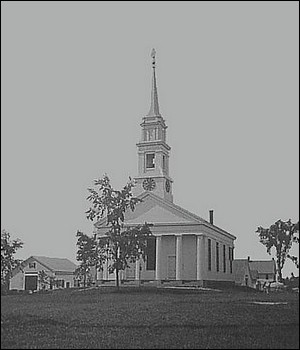 The second minister was Rev.
Solomon Reed who was ordained at the Meeting House on October 28th,
1780 and was dismissed from his ministry on June 25th, 1800 for public
drunkenness. During Rev. Reed's pastorate the Second Meeting House was
built in 1783. This building was located on the south side and middle
of the Town Green (Common). A bell cast by Paul Revere and Sons was
hung in this church steeple. The bell was recast in 1798 and encircled
by the inscription "The living to the church I call and to the grave I
summon all." After the dismissal of Rev. Reed, the town was without a
minister for over a year. Then Rev. Festus Foster was called as the
settled minister and remained to the end of the year 1817.
The second minister was Rev.
Solomon Reed who was ordained at the Meeting House on October 28th,
1780 and was dismissed from his ministry on June 25th, 1800 for public
drunkenness. During Rev. Reed's pastorate the Second Meeting House was
built in 1783. This building was located on the south side and middle
of the Town Green (Common). A bell cast by Paul Revere and Sons was
hung in this church steeple. The bell was recast in 1798 and encircled
by the inscription "The living to the church I call and to the grave I
summon all." After the dismissal of Rev. Reed, the town was without a
minister for over a year. Then Rev. Festus Foster was called as the
settled minister and remained to the end of the year 1817.
On June 23rd 1819, Rev Luther Willson was installed as the forth
minister of the Town Church. Rev. Willson is the most written about
minister of the Petersham church to date.
He began his studies at Yale but withdrew after a year to continue his
studies at Williams College.
He studied theology, as was the custom at the time, with the Rev.
Zephaniah Swift Moore of Leicester, MA. He was ordained "junior pastor" of the First Church of Brooklyn, CT. in 1813. That same year Williams
College, in recognition of his educational work, conferred him the
degree of Master of Arts.
During his time in Brooklyn, Willson's study of the scripture convinced
him that the doctrine of the Trinity and the supreme diety of Jesus
were not essentials or fundamentals of the Christian faith. The church
council at the time found this radical but recommended "mutual charity and the concession to one another of the liberty which each
claims for himself." (Coolidge) There was a faction, however, in the
congregation that wanted to see Willson dismissed. The disagreement
threatened to cause a split in the church, so Willson asked that he be
dismissed rather than be the cause of a rift.
After Brooklyn, Willson was quite upset and considered leaving the
ministry. Coolidge writes, "(He) was disposed to give up a calling
which held such uncertainties for the conscientious seeker and upholder
of truth." He spent a week in Boston as the guest of William Ellery
Channing who evidently convinced him to stay in the ministry. Channing
also presented him with a watch "in recognition of his sturdy manhood."
Shortly after his visit, Willson received a call to the Petersham
Church. The church in Petersham was just what Willson was seeking. "It
did not require acceptance of the debated doctrines that had provoked
widespread dissention of the Congregational fellowship, but left each
member to follow his own conscience and convictions." This was because
there was a large liberal element in the community. However, there were
some that were opposed to having a more liberal minister. Within a few
years of his arrival, some of the less liberal minded asked Rev.
Willson to change his views and manner of preaching. But when he
continued to expound what he regarded as "the pure undogmatic religion
of our Lord Jesus Christ, the son of God but not God the Son,"
dissatisfied members withdrew and organized the North Congregational
Church, which today is called the Orthodox Congregational Church of
Petersham.
Willson served as pastor of the Petersham Church until October 18,
1834, when he resigned at the age of fifty-one. He continued to live in
town until his death in 1848 preaching in various Unitarian pulpits.
Dr. Andrew Peabody, writing of early Unitarians said of Luther Willson,
that he left, "a spotless record of a life passed in simplicity and
godly sincerity, and in close and constant following of his Saviour."
It was during Willson's tenure that a clock was installed in the belfry
of the church.
It was known as the town clock, and still is to this day, even in the
fourth Meeting House- the present church. Every year the town sends a
tax stipend to the church for the maintenance and repair of the clock.
In 1900 the original clock was replaced by a new one presented to the
Parish by the grandchildren of Rev. Willson. This was destroyed in the
fire of 1905 and replaced by the present one.
In 1834 George R. Noyes, a native of Newport, RI was installed as
minister. He remained as minister until 1840 when became a
distinguished professor of Hebrew and lecturer on Biblical literature
at Harvard University.
In 1833 by order of the General Court of Massachusetts church and state
were separated.
In 1842 "The Unitarians built their own church, which became the Third
Meeting House on the west side of the common and the town church, the
Meeting House that was built in 1783 was moved to the east side of the
Town Green beside the Town House and was burned with it on February 5th
1845, during one of the fiercest snow storms the town has ever known."
(Coolidge)
It was in 1843 that the first of what is called Levees was held. The
Levee is an annual fund raising event held in January, originally on
the night of the full moon so that the horses and carriages could find
there way home. There is a dinner at the Unitarian Church and a ball
(nowadays a dance) at the Town Hall. The whole town is invited. The
purpose of this event is to provide some additional support the church
because of its loss of tax revenues. Except for the war years, the
Levee has been happening every year. Part of the tradition for the
Levee is that forsythias are forced to bloom and branches of the
blossoms are used to decorate the church and town hall.
As noted he went to
Harvard to teach Hebrew and biblical
literature. Some of his library, though, remained in storage in
the
parsonage barn as late as the 1980s, along with volumes from other
clergy. Here
is the Wikipedia entry for him, that mentioned Petersham, btw. http://en.wikipedia.org/wiki/George_R._Noyes
1841-1845. Rev. Nathaniel Gage.
In 1845 Ephraim Nute, Jr., became the minister. He remained minister
for two and one-half years, resigned and went to Kansas under the
auspices of the Emigrant Aid Society, where his leadership in that
movement earned him a national reputation.
1848-1851. Rev. Martin W. Willis
1851-1855. Rev. John J. Putnam
1856-1864. Rev. Seth Saltmarsh
Served in Windsor VT, Wilton NH and Hubbardston MA as well as
Petersham. He is named as a founder of the Unitarian Society of
Hartford
CT, apparently before being ordained. By some references, he may
have
been a physician as well, and served in some capacity in Knoxville
after the
war.
1866-1869. Rev. Daniel Goddard
1870-1874. Rev. Thomas D. Howard
1874-1882. Rev. Lyman Clarke
1883-1887. Rev. Issac F. Porter
1888-1889. Rev. Henry Harrison Brown
1889-1897. Rev. Edward Green
1897-1898. Rev. Charles T. Sempers
1898-1902. Rev. Robert Collyer Douthit
Robert
Collyer Douthit, was obviously named for the famed Welsh American
Unitarian
Minister of Chicago and New York, Robert Collyer. According
to one
online genealogy: “Rev. Robert Collyer DOUTHIT was born on 15 Mar 1869
in
Shelbyville, , IL.He was married to Alma Lillian MCGILVRA on 8 Aug 1894
in
Shelbyville, IL. Children were: Alison DOUTHIT , Macleod DOUTHIT.
The
Petersham Brass band really got underway in 1914 being revived by the
late Rev.
Robert Douthit. The Christian Register of 1914 records that Mr.
Douthit
made a visit home to Shelbyville where his father Jasper (also a
Unitarian
minister) was long a presence. He was an 1892 graduate of
Meadville
Theological School (when it was still in Meadville PA).
I
found this entry from the Brooklyn Daily Eagle of March 1914 (spelling
errors
due to computer transcription of old newsprint) The
Rev. Robert Collyer Douthit in . Second, U n i t a r i a n Church. The
Rev.
Robert Collyer Douthit of the First Unitarian Church of Petersham,
Mass.,
occupied the pulpit of the Second Unitarian Church, yesterday morning,
speaking
-from the subject, "Tho Power of tho Divine Sonshlp.' He said, among
other
things: "We are
yet in t he childhood of tho race with Its glorious possibilities
which, as
they unfold and develop and become realizations, cause us to a t t a in
nearer
and nearer to our spiritual majority and to a closer conception of the
truth t
h a t we aro all members of the Divino Sonshlp. Ours is a growing
universe and
tho evil wo encounter Is but and incident to our progress to.a largo
vision and
greater opportunities, if t he consequences of this reasonable belief
nro such
that we lead happier and bettor lives, then it would appear to.
be a
justification
of t he claim that the gospel of love is mora potent than the gospel of
hate,
and t h a t our rational faith is at least as well adapted to tho needs
of
humanity ns the religion of dogmatism." Mr. Douthit Is a son of Jasper
Douthit and the intimate friend of tho late Robert Collyer, for whom the son was named.
1902-1907. Rev. Alfred W. Birks
1907-1912. Rev. George Browning Spurr

In 1908 the Third Meeting House burned during a severe drought which
prevented saving the church; only the pulpit was saved. A week later,
at a parish meeting an enthusiastic congregation pledged to rebuild and
within one hour more than $15,000 dollars was raised. The corner stone
was laid on July 2, 1909. The first church service was held in March of
the following year. The formal dedication was held on June 10th with
the Rev. W.W. Fenn, Dean of Harvard University preaching a sermon.
1912-1929. Rev. Robert C. Douthit (Repeat minister -- see the entry for the years 1898-1902)
1930-1932. Rev. Stephen H. Fritchman
He penned an autobiography, noting only briefly his short service in Petersham. But he went on to some notoriety as editor of the AYAS Christian Register where his leftist sympathies were visible to all. He is most known for his service at the First Unitarian Society in LA, and his continued political utterances during the McCarthy period. You can get more info here: http://www.harvardsquarelibrary.org/unitarians/fritchman.html
1933-1955. Rev. Earl Davis. A long time-minister who everyone in
town, regardless of their faith background, would call friend. Of
course he was the minister during WWII when many of Petersham's young
man were away at war.
Some stuff
gleaned in cursory research: Rev. Earl C.
Davis of
Auburn. Me., has accepted a call to the Unitarian Church of Pittsfield
and will be ordained April 7. Rev. Mr. Davis, after graduating
from
Bowdoin, was appointed principal of the Howe School in Billerica, where
he
taught five years. He was graduated from Harvard Divinity School in
1904, and
was one of the commencement orators. In 1911, while in
Pittsfield,
he is recorded as a member of the Western Massachusetts Committee
for the
YPRU (Youth organization) along with Mr. Spurr of Petersham, btw.
But he
was actie in the YPRU since 1904 when he was in Billerica. Later,
he is
named as a summer student at Harvard Divinity in 1920, a program for
Unitarian
clergy, according to the Christian Register (AUA journal) while serving
in
Lancaster PA. While In Petersham he was very involved in forming
Senexet
Retreat House in CT.
1955-1958. Rev. Leon Hopper -- Who was a student minister in 1953 who
eventually was called to be the settled minister of the church. He went
on to serve other New England Congregations and one in Colorado. He
also served in two administrative positions in the UUA prior to being
Senior Minister of the Shore Unitarian Church in Bellevue, WA. He is
the first president of the Partner Church Council. PCC founded in
1991. The council fosters connections between North American UU
churches and the Unitarian churches in Romania, Hungary, the
Philippines and India. Leon is still active in the PCC. Leon came back
to Petersham in 2003 to celebrate 50 years of ministry.
1958-1962. Rev. Fred Rutledge
BA, Univ. of Texas, 1953, MDiv, Starr King School for the Ministry, 1958, Date of Fellowship 1958, Ordained 1958. 1995-1996 Interim Minister. Southwest UU Church North Royalton OH, 1971-1974 Assistant Minister The First Unitarian Church of Baltimore Baltimore MD, 1970-1971 Assistant Minister. First Unitarian Society of Minneapolis Minneapolis MN, 1966-1970 Assistant Minister Unity Church Unitarian Saint Paul, MN, 1962-1965 Minister Northshore UU Church Danvers MA.
1965. Rev. Gilbert Potter
1965-1966. Rev. R.W. Brownlie
Robert Brownlie eventually served in Canada, I believe. Finding more is
very
difficult.
1967-1972. Rev. Waitstill Sharp. Rev Sharp and his wife
Martha helped hundreds of Jews escape from the Nazis.
The Sharps were honored posthumously as "Righteous
Among the Nations" by Yad Vashem, the Holocaust
Martyrs' and Heroes' Remembrance Authority in Israel.
The Sharps are only the second and third U.S. citizens
to receive this international distinction; Martha
Sharp is the first woman from the United States to be
so honored.
1973-1977. Ron Mazur
Served in Salem MA before coming to Petersham, and developed a
career in
marriage counseling along the way. Here is his Linkedin summary:
Taught
for 18 years at the University of Massachusetts in Amherst; served
Unitarian
and Universalist Churches in Massachusetts and Florida; had private
practice as
Clinical Sex Therapist in Massachusetts and Florida; has written four
books.
Got his BD (now MDiv) from Harvard in 1959.
1977-1980. Rev. Vance Frank
AB, Bluffton College, 1949, BD, Oberlin College, 1965, Date of
Fellowship 1966, Ordained 1953. 1985-1992 Minister First Church Unitarian Inc. Athol, MA, 1972-1992 Minister First Universalist Church Orange, MA, 1967-1972 Minister First Universalist Church West Paris, ME, 1965-1967 Minister First
Universalist Church Lyons, OH.
1980-1985. Rev. Fred Wooden, who wrote music for five of the hymns and also wrote one of the readings in Singing the Living Tradition. Rev. Wooden was ordained at our church in 1980.
Lastly myself, though I could go on about predecessors and successors. I have since served in Groton MA, Austin TX, Brooklyn NY and now Grand Rapids MI. Chuck Gaines preached my ordination sermon, btw, as well serving in Groton, so we are very intertwined. Leon Hopper was also part of my ordination, and Vance Frank, Ron Mazur and Waitstill Sharp. My Brooklyn church is the successor of the one Mr. Douthit preached in back in 1914. I was on the commission that wrote SLT, in addition to contributing to it. I met Mr. Fritchman as a student and have preached in that church lately, and also contributed two cover stories to the successor magazine he edited, the UUWorld. I played trombone in the Brass Band founded by Mr. Douthit, as did Leon and Fred Rutledge, continuing for five years after leaving the Petersham pulpit. For some time I was a guest preacher in Brooklyn CT, because this was Luther Willson’s church. That church was the first to ordain a woman, Celia Burleigh, who coincidentally lived in Brooklyn NY prior to that, being a member of the same Second Society where Douthit preached although a generation or more before. My infant children are buried in the center cemetery, along with Whitney and Willson. Our ashes shall likely join them in the future.
1985-1986. Rev. Judith Deutsch
1987-1990. Rev. Wesley Hromatko
1991-1995. Rev. Bonnie Devlin
1995-1997. Rev. William Baughan
1997. Rev. Alan Shaw. Died suddenly after serving only three
months.
1998-1999. Rev. Larry Smith was Interim Minister while he was still a
student at Harvard.
1999 March-2003. Rev. Adele Smith Penniman who was the first African-American to be minister.
2002-2003. Rev. Charles Gaines (Interim Consulting Minister)
2003-2004. Rev. Andrea Anastos (Interim Minister)
2004-2006 March. Rev. William Baughan (Supply Minister)
2006-2007. Rev. John G. Pastor, Jr. Married and ordained in
the church, Rev. Pastor served the congregation in
many capacities for eight years. During his tenure the
congregation became a UU "Welcoming Congregation." He
was active in the peace movement. He and is spouse,
Bob Hall, particpated in an anti-war rally and march
in Washington, D.C. and participated in the weekly
peace vigils held at the church.
2007-2008. Rev. Ralph T. Clarke and ministry candidate M. Lara Hoke served the congregation together as a ministry team. Rev. Clarke advised the congregation during its time of transition, while Lara Hoke provided pulpit supply twice a month. In March of 2008, Lara Hoke was ordained at her home church (the Unitarian Universalist Church of Worcester) with 25 members of the First Congregational Parish, Unitarian, in Petersham in attendance.
2008-2011. Rev. M. Lara Hoke (Half-time consulting Minister)
2011- Rev. Michelle LaGrave is currently serving as the congregation's three-quarter-time Developmental Minister.
last rev. rcwh 120910.

